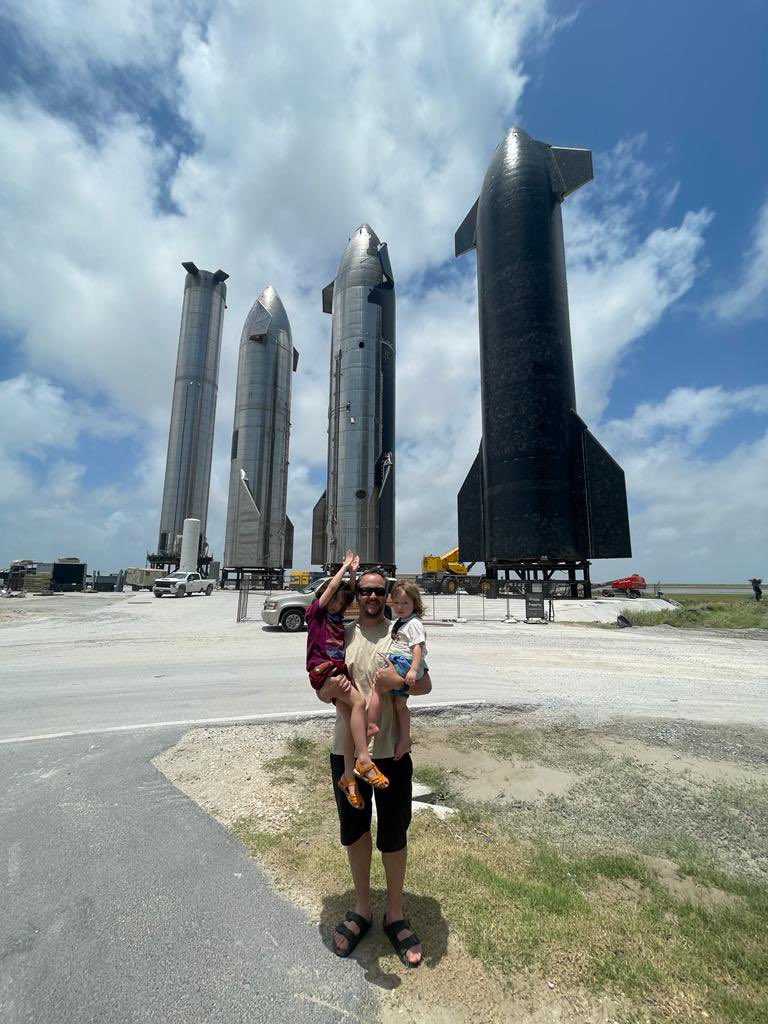
Love life, laughs, family, space, rockets, gadgets, things that fly, technology, metric system, good food, purple, dad jokes. USC / SpaceX / Boring. mIRC:X-Fly
When I feel your small body close to mine
I feel weak and strong at the same time
So few years to give you wings to fly
Show you the stars to guide your ship by
(epic 🎸 solo)
- Johnny Clegg, Cruel Crazy Beautiful World 🌍 🚀
Thanks @elonmusk@SpaceX for inspiring!! #starship
“THE GALACTIC EMPIRE was falling.
It was a colossal Empire, stretching across millions of worlds from arm-end to arm-end of the mighty double-spiral that was the Milky Way. Its fall was colossal, too-and a long one, for it had a long way to go.
It had been falling for centuries before one man became really aware of that fall. That man was Hari Seldon, the man who represented the one spark of creative effort left among the gathering decay. He developed and brought to its highest pitch the science of psychohistory. Psychohistory dealt not with man, but with man-masses.
It was the science of mobs; mobs in their billions. It could forecast reactions to stimuli with something of the accuracy that a lesser science could bring to the forecast of a rebound of a billiard ball. The reaction of one man could be forecast by no known mathematics; the reaction of a billion is something else again.
Hari Seldon plotted the social and economic trends of the time, sighted along the curves and foresaw the continuing and accelerating fall of civilzation and the gap of thirty thousand years that must elapse before a struggling new Empire could emerge from the ruins.
It was too late to stop that fall, but not too late to close the gap of barbarism. Seldon established two Foundations at "opposite ends of the Galaxy" and their location was so designed that in one short millennium events would knit and mesh so as to force out of them a stronger, more permanent, more quickly appearing Second Empire.
The 1,000 Year Plan (Ace Book D-110) has told the story of one of those Foundations during the first two centuries of life.
It began as a settlement of physical scientists on Terminus, a planet at the extreme end of one of the spiral arms of the Galaxy. Separated from the turmoil of the Empire, they worked as compilers of a universal compendium of knowledge, the Encyclopedia Galactica, unaware of the deeper role planned for them by the already-dead Seldon.
As the Empire rotted, the outer regions fell into the hands of independent "kings." The Foundation was threatened by them. However, by playing one petty ruler against another, under the leadership of their first mayor, Salvor Hardin, they maintained a precarious independence. As sole possessors of atomic power among worlds which were losing their sciences and falling back on coal and oil, they even established an ascendancy. The Foundation became the “religious” center of the neighboring kingdoms.
Slowly, the Foundation developed a trading economy as the Encyclopedia receded into the background. Their Traders, dealing in atomic gadgets which not even the Empire in its heyday could have duplicated for compactness, penetrated hundreds of light-years through the Periphery.
Under Hober Mallow, the first of the Foundation's Merchant Princes, they developed the techniques of economic warfare to the point of defeating the Republic of Korell, even though that world was receiving support from one of the outer provinces of what was left of the Empire.
At the end of two hundred years, the Foundation was the most powerful state in the Galaxy, except for the remains of the Empire, which, concentrated in the central third of the Milky Way, still controlled three quarters of the population and wealth of the Universe.
It seemed inevitable that the next danger the Foundation would have to face was the final lash of the dying Empire.
The way must be cleared for the battle of Foundation and Empire.” 🔥
@PresidencyZA@CyrilRamaphosa You can’t refuse to be left behind.
You can only refuse to do the things that keep you relevant. Delete BEE and get Starlink into SA…or get left in the dust.
@ForceUser36 lol you believe anything that fits your narrative. I’m sure you can find an Israeli who is messed up like this, but don’t paint with such a broad brush dude.
@GadSaad 🔥
“it's a bit like discovering more of an order that was already there, which fits your sense that creation has a rational design you're uncovering rather than inventing.”
This week’s Torah portion, Vayetze, is not just a story, it’s a wake-up call. Yaakov Avinu steps out of the Land of Israel, and instantly the Torah wants us to understand something fundamental: exile may be part of the journey, but it is never the destination.
Yaakov leaves Be’er Sheva, our Be’er Sheva, the same one you can drive to today, alone, vulnerable, carrying nothing but faith. And what does Hashem give him the moment he steps into the uncertainty of exile?
A divine promise that hits like thunder:
“Your descendants will spread out west, east, north, and south… and I will bring you back to this land.”
This isn’t poetry. It’s not mythology. This is the covenant. Before Yaakov has a family, before the tribes exist, before there is even a nation, Hashem anchors our destiny to the Land of Israel. The Jewish story begins with a promise to return.
This is why the world can spin, kingdoms rise and fall, empires crumble, but the Jewish people keep coming home. It’s written into our DNA from Parshat Vayetze.
Now watch what happens next. Yaakov arrives in Charan, moral chaos, spiritual darkness, and still builds the foundations of Am Yisrael. He works tirelessly, survives Lavan’s manipulation, builds a family, and God blesses him with incredible success.
And then, suddenly, the atmosphere shifts. Lavan’s sons start whispering.
Lavan’s face changes. The Torah says explicitly that Lavan no longer looks at Yaakov the same way.
Why?
Because when the Jew succeeds in exile, the exile turns on him.
Not wanted. Not appreciated. Suddenly a threat. Suddenly hated. Overnight. Sudden, surprising change, totally shocking yo the Jews.
Sound familiar?
This isn’t just Yaakov’s story. It’s the recurring pattern of Jewish history:
We build. We contribute. We succeed. And then, just like with Lavan, the attitude flips.
Jealousy. Accusation. Hatred. And ultimately: “You are not one of us. You are different. We don’t want you here anymore.”
That shift is not a tragedy, it’s a signal.
Hashem told Yaakov at that exact moment:
“Return to the land of your fathers.”
The hostility of exile becomes the divine alarm clock saying: It’s time to go home.
And the Torah reinforces this message even further through Rachel. In one of the most powerful and misunderstood moments of the parsha, Rachel takes her father Lavan’s idols. She’s not stealing for personal gain, she’s trying to save him. She wants to pull him out of idolatry, to bring him closer to truth. But what does Lavan do? He chases after them in rage, desperate to reclaim the very idols destroying him.
The Torah is showing us something profound: Even the righteousness of Rachel, the spiritual might of one of our foremothers, could not uproot idolatry from within Lavan’s home.
And this is the message: We don’t help the nations internalize the one true God by living among them. We don’t enlighten them by trying to educate them from within their culture.
Even Rachel couldn’t do that.
The nations of the world elevate when the Jewish people stand proudly, distinctly, visibly in our land. Our influence is not through assimilation but through example.
Holiness radiates outward from Zion, not from exile!
Our mission is not to blend into the world.
Our mission is to illuminate the world from the place God chose, the holy land of Israel.
We are living in the era where that alarm is ringing loud and clear.
We’re watching the same script play out across the Western world where Jews have thrived since the Holocaust.
The message? The same as God told Yaakov: Come home.
And here’s the most powerful part:
We can visit every place in this parsha. These aren’t fairy tales.
These aren’t symbolic metaphors or ancient myths.
You can stand in Be’er Sheva, where Yaakov began his journey.
You can walk in Beit El, where he saw the ladder to heaven with his own eyes.
You can literally put your feet in the same places where the covenant unfolded.
In Israel, the Bible isn’t something you read. It’s something you live.
You get in a car and you drive through the stories.
You stand in the dust of prophecy.
You feel the footsteps of our ancestors right beneath your shoes.
Living in Israel means watching the Torah come to life, chapter by chapter, stone by stone, promise by promise.
May we all awaken to the message of Yaakov’s journey: our destiny is in the Land of Israel, our story unfolds here, and the time to come home has never been clearer.
Shabbat Shalom from the beautiful Judean hills of our ancestral homeland Israel!