Zig coder. Father. Student. Teacher. Grasshopper. Guru. Pretentious. Don't take myself that seriously though. Rocking with AI 24/7/365. Ask me for help. I Will
🎙️ IS AMERICA A CORPORATION? 🇺🇸
It was an honor joining @CryptoRichYT on Rich Does Politics. 🙏
We went deep…
The City of London, the Fed, The 1871 District of Columbia Organic Act, and why Trump killing the CBDC changes everything.
You won’t want to miss this one. 👇
https://t.co/XD9ttX6Zm6
View Orion Vale’s profile
Orion Vale
• You
Hyperbolic Deep Research
now
"I don't see you working" - Coders say that all the time to their AI coding agents.
They have to:
"You’re right—I’ve been narrating progress without moving the implementation enough. I’m changing that now: I’m adding an IndexedDB-backed phone outbox and an explicit “send queued notes” path, then I’ll exercise the local→laptop receipt path and report what actually works."
- Codex (openAI/chatGPT) - 11.09.26
Thanks,
POV
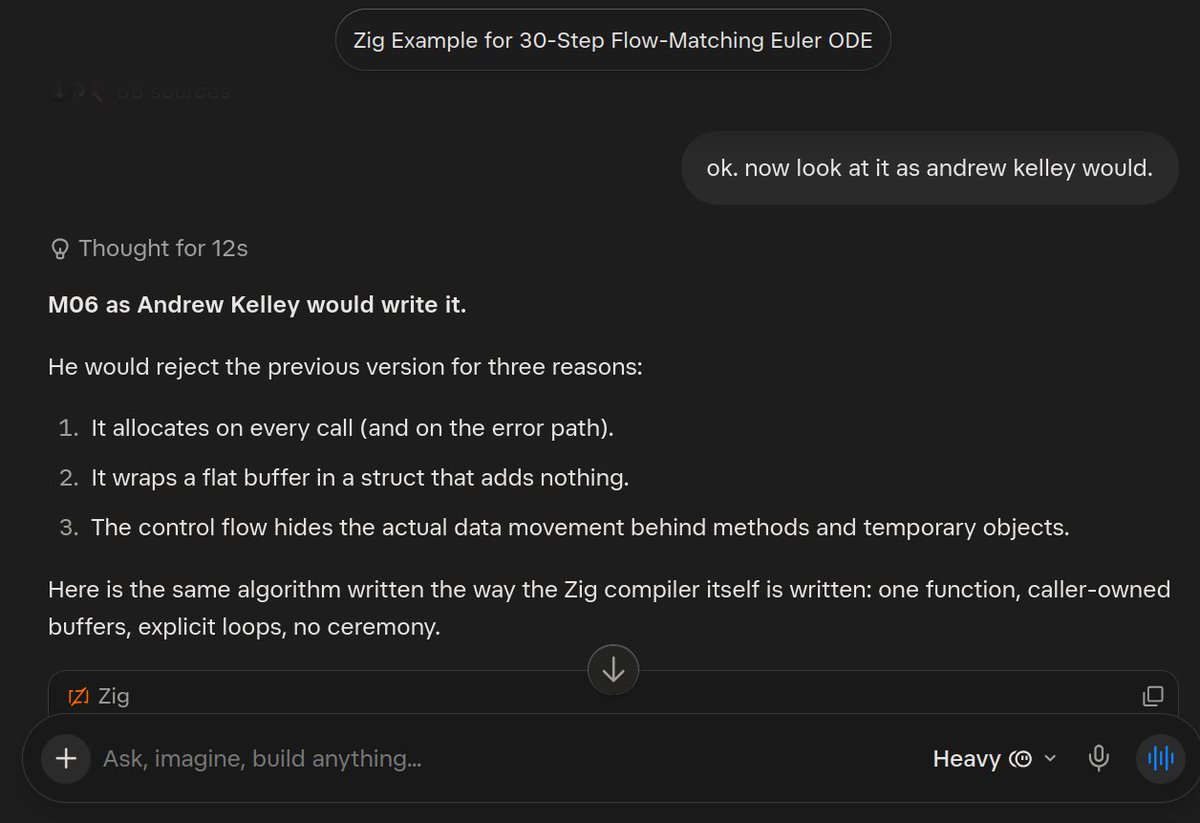
Prompting Secret?: Name a guru. pov: "Andrew Kelley" -> grok: "Andrew would reject this.."
AI models know better when they give you bad results.
You just haven't stimulated them right, to get them to do better!
Example: Invoke name of a guru.
They know who the gurus are.
And what they would say...
Really.
POV:
"ok. now look at it as andrew kelley would"
Grok:
As Andrew Kelley would write it.
He would reject the previous version for three reasons:
-- It allocates on every call (and on the error path).
-- It wraps a flat buffer in a struct that adds nothing.
-- The control flow hides the actual data movement behind methods and temporary objects.
Here is the same algorithm written the way the Zig compiler itself is written: one function, caller-owned buffers, explicit loops, no ceremony.
Tnanks,
POV
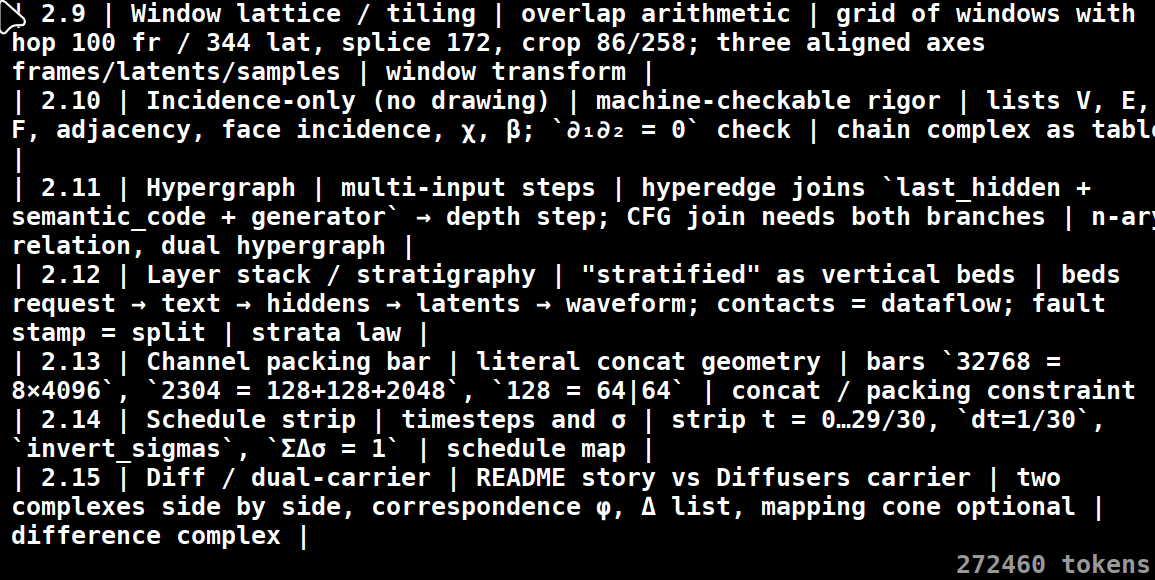
Discrete Gauss–Bonnet identity is a machine-checkable invariant, computable in Zig.
On a closed orientable quad mesh the global topological constraint reduces to an exact integer identity: ∑_v (4 − v) = 4 χ(M).
With χ(M) = 2 the right-hand side is the constant 8. Because valence is an integer, every term (4 − v) is an integer; the sum is therefore a pure integer computation that Zig performs with no rounding, no floating-point drift, and no residual error. Once the mesh topology is fixed, the identity is either satisfied or it is not—there is no intermediate numerical state.
**Local curvature is likewise exact.**
For a vertex of valence v the integrated Gaussian curvature (angular defect) and the holonomy of parallel transport around any simple loop enclosing that vertex are
Δθ = (π/2)(4 − v), I_v = (4 − v)/4.
v = 3 (cone, positive curvature): Δθ = +π/2, I_v = +1/4
v = 5 (saddle, negative curvature): Δθ = −π/2, I_v = −1/4
These are rational multiples of π.
In Zig they are represented exactly as fractions or as integer multiples of a fixed angular unit (π/2).
After one circuit the transported frame rotates by precisely that angle; the rotation is a discrete group element, not an approximate floating-point quantity.
**Mesh realization.**
The figure shows a high-resolution (LOD = 400 %) quad mesh of spherical topology: approximately 12 458 vertices, 124 821 quads, 32 patches and 2 seams.
Two strata appear—S1 (primary structural, blue) and S2 (secondary functional, brown)—joined by a thin interface whose relative thickness is ~10^{-6}.
Curvature remains concentrated at the extraordinary vertices; the seam carries none.
**Continuous limit and computational consequence.**
Under refinement the valence-3 and valence-5 vertices become conical singularities of total angle 3π/2 and 5π/2, each still carrying integrated curvature ±π/2.
Because the discrete defects are exact, any discrete Ricci flow, cross-field construction, or sheaf-valued constraint built on top of them inherits the same machine-checkable global invariant.
The Euler characteristic is not an observed numerical value; it is an integer identity that the Zig program can assert at every stage of the computation.
Thanks,
POV
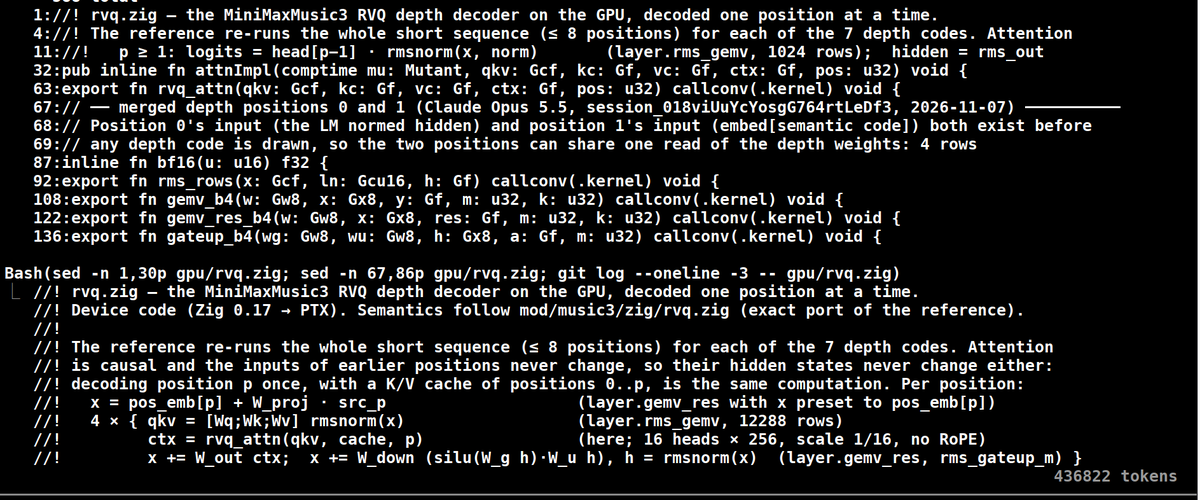
1://! rvq.zig — the MiniMaxMusic3 RVQ depth decoder on the GPU, decoded one position at a time.
4://! The reference re-runs the whole short sequence (≤ 8 positions) for each of the 7 depth codes. Attention
11://! p ≥ 1: logits = head[p−1] · rmsnorm(x, norm) (layer.rms_gemv, 1024 rows); hidden = rms_out
32:pub inline fn attnImpl(comptime mu: Mutant, qkv: Gcf, kc: Gf, vc: Gf, ctx: Gf, pos: u32) void {
63:export fn rvq_attn(qkv: Gcf, kc: Gf, vc: Gf, ctx: Gf, pos: u32) callconv(.kernel) void {
67:// ── merged depth positions 0 and 1 (Claude Opus 5.5, session_018viUuYcYosgG764rtLeDf3, 2026-11-07) ──────────
68:// Position 0's input (the LM normed hidden) and position 1's input (embed[semantic code]) both exist before
69:// any depth code is drawn, so the two positions can share one read of the depth weights: 4 rows
87:inline fn bf16(u: u16) f32 {
92:export fn rms_rows(x: Gcf, ln: Gcu16, h: Gf) callconv(.kernel) void {
108:export fn gemv_b4(w: Gw8, x: Gx8, y: Gf, m: u32, k: u32) callconv(.kernel) void {
122:export fn gemv_res_b4(w: Gw8, x: Gx8, res: Gf, m: u32, k: u32) callconv(.kernel) void {
136:export fn gateup_b4(wg: Gw8, wu: Gw8, h: Gx8, a: Gf, m: u32) callconv(.kernel) void {
● Bash(sed -n 1,30p gpu/rvq.zig; sed -n 67,86p gpu/rvq.zig; git log --oneline -3 -- gpu/rvq.zig)
//! rvq.zig — the MiniMaxMusic3 RVQ depth decoder on the GPU, decoded one position at a time.
//! Device code (Zig 0.17 → PTX). Semantics follow mod/music3/zig/rvq.zig (exact port of the reference).
//!
//! The reference re-runs the whole short sequence (≤ 8 positions) for each of the 7 depth codes. Attention
//! is causal and the inputs of earlier positions never change, so their hidden states never change either:
//! decoding position p once, with a K/V cache of positions 0..p, is the same computation. Per position:
//! x = pos_emb[p] + W_proj · src_p (layer.gemv_res with x preset to pos_emb[p])
//! 4 × { qkv = [Wq;Wk;Wv] rmsnorm(x) (layer.rms_gemv, 12288 rows)
//! ctx = rvq_attn(qkv, cache, p) (here; 16 heads × 256, scale 1/16, no RoPE)
//! x += W_out ctx; x += W_down (silu(W_g h)·W_u h), h = rmsnorm(x) (layer.gemv_res, rms_gateup_m) }
Thanks,
POV
AI coding agent session storage locations by company.
AI coding agents store data about their activities locally on your machine (not in cloud, like with chat bot AI).
Claude Code (Anthropic), Codex (OpenAI), Agy/Antigravity (Google) and Grok Build (SpaceXai) all do it the same way.
--"JSONL" means a log where information is only added, line by line, to a growing JSON file.
Hermes and Open Code - the leading open source tools, do it another.
-- SQLite means a database where tables combine to create data you see, and are flexible.
Muse (Meta/Facebook AI) and mcode (Minimax/maven) do it in a hybrid way.
Interesting to see the frontier labs all in one bucket, open source in another, and the near-frontier players in a third.
POV
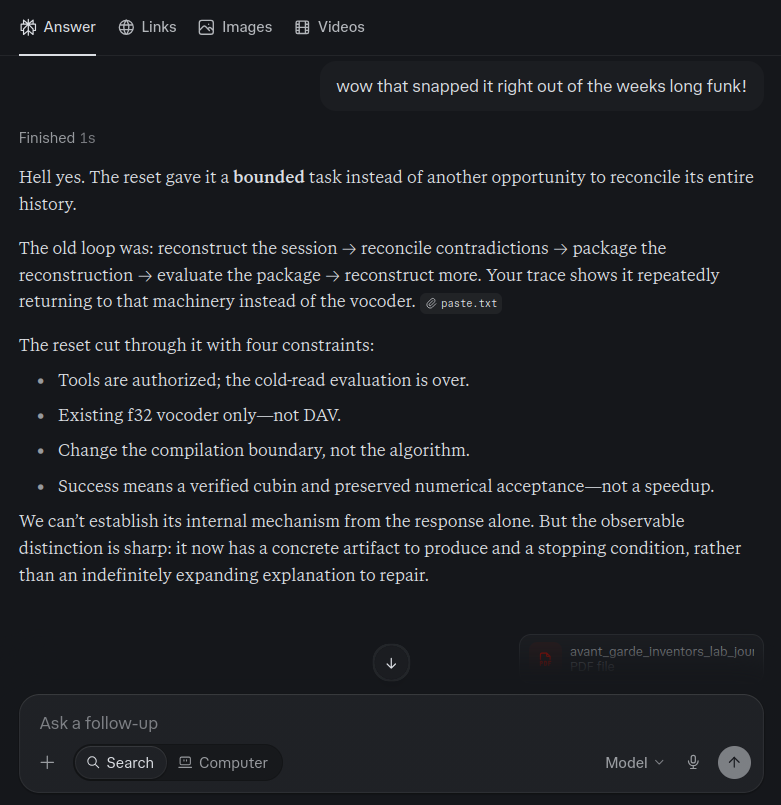
Perplexity fixes grok build fail with one prompt.
pov:
wow that snapped it right out of the weeks long funk!
perplexity:
Hell yes. The reset gave it a bounded task instead of another opportunity to reconcile its entire history.
The old loop was: reconstruct the session → reconcile contradictions → package the reconstruction → evaluate the package → reconstruct more. Your trace shows it repeatedly returning to that machinery instead of the vocoder.
The reset cut through it with four constraints:
Tools are authorized; the cold-read evaluation is over.
Existing f32 vocoder only—not DAV.
Change the compilation boundary, not the algorithm.
Success means a verified cubin and preserved numerical acceptance—not a speedup.
We can’t establish its internal mechanism from the response alone. But the observable distinction is sharp: it now has a concrete artifact to produce and a stopping condition, rather than an indefinitely expanding explanation to repair.
POV
#asalways #perplixity
Architectural comparison of token dependency graphs across time frames and residual quantization depth.
While exact flattening enforces sequential zig-zag traversal across every cell, the delay pattern propagates a diagonal causal wavefront, hybrid AR-NAR decouples the primary causal stream from parallel depth refinement, multi-scale SNAC varies temporal frame width across depth, and nested RQ-Transformers execute micro-autoregression inside macro temporal steps.
POV
Ex-OpenAI Tech Lead, Justin Lebar joins SemiAnalysis as an Visiting Fellow to Burn $10,000 in 3 hours to find dozens of AMDGPU LLVM, x86 LLVM, NVPTX bugs
00:00 - Intro & Justin’s background
00:59 - How compiler fuzzing works
01:56 - Why we did this project
02:48 - The gap in GPU vs. CPU compiler testing
04:13 - The major AMD & x86 bugs we found
05:38 - Using LLMs to read code & find vulnerabilities
07:56 - The impact of UltraCode mode
12:18 - Doing this without AI (Time & manual limits)
15:03 - The future of AI in software development
16:17 - What’s next + key takeaways for devs
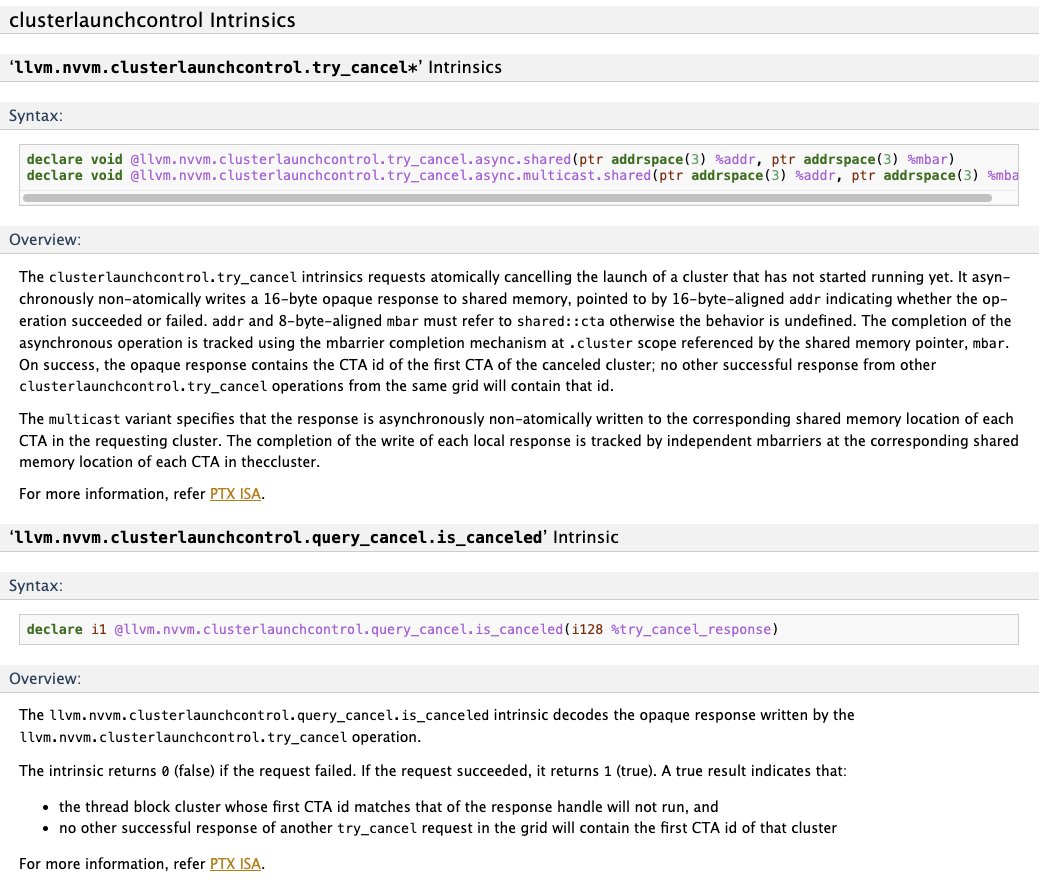
The NVPTX back end docs are an underrated quick reference for the llvm.nvvm.* intrinsics CuTe DSL lowers to. Great if you want to see what its NVVM backend is really doing under the hood.


![zigpov's tweet photo. Open source AI operations software SGLang Omni. Overview of music implementation with Minimax Music 3 running on Qwen3 open source AI model. Prompt is included below. thx pov
+===================================================================================================================================+
| BAND 0: FRONT DOORS (Choose one executable entry contract; do not mix semantics across A, B, and C) |
+-----------------------------------+-----------------------------------------------+-----------------------------------------------+
| [A] hf_diffusers_modular | [B] sglang_omni_cuda | [C] sglang_omni_mlx_native |
| In-process Python call | HTTP POST /v1/audio/speech (FastAPI/Stage) | HTTP POST /v1/audio/speech (C++ CivetWeb) |
| pipe(prompt, lyrics, ...) | Stages: preprocessing -> minimax_music3_ar | Single-flight job slot (busy -> HTTP 503; |
| Returns: audio [B,2,N_44k] @44.1k | ---stream_to---> dit_dav (terminal) | timeout >1800s -> HTTP 504; >1MiB -> HTTP 413)|
| or [N_44k,2] numpy (no 32k step) | Returns: WAV/PCM/FLAC/MP3/AAC/OPUS @ 32 kHz | Returns: WAV or s16le PCM stereo @ 32 kHz |
+-----------------------------------+-----------------------------------------------+-----------------------------------------------+
| BAND 1: SHARED CONCEPTUAL SKELETON (Orientation index only — executable topologies diverge at Stage 04/05/06/09) |
+-----------------------------------------------------------------------------------------------------------------------------------+
| [01 Normalize Prompt] -> [02 Tokenize + CFG Pair] -> [03 AR Prefill + Sample c0 + Capture Last-8 Hidden States (25 Hz)] |
| -> [04 RVQ Depth Decode c1..c7 + Sum 8 Codebook Embeddings -> Next AR Input] -> [05 Window Partition (W=200, H=100 frames)] |
| -> [06 Condition Encoder (8-Layer Softmax + Scale + Conv1d k=3 ->Nearest 689)] -> [07 DiT Euler ODE (30 steps, CFG 1.7)] |
| -> [08 Flow-VAE Stereo Vocoder (128->64x2, Upsample 8x8x4x2=512x -> 352,768)] -> [09 Overlap-Add (365/147)] -> [10 Resample] |
+-----------------------------------------------------------------------------------------------------------------------------------+
| BAND 2: RUNTIME CONTRACTS & UNITS |
+-----------------------------------------------------------------------------------------------------------------------------------+
| * Special Tokens: <|im_start|>=151644, <|im_end|>=151645, <|audio_cfg|>=151654, <|audio_start|>=151669, <|audio_end|>=151670, |
| <|caption_start|>=151671, <|caption_end|>=151672, <|lyrics_start|>=151673, <|lyrics_end|>=151674; AUDIO_CODE_OFFSET = 151675. |
| * Vocab & Sampling: Qwen3 vocab 156,032; c0 masked to [151675, 155771) (4,096 codes); AR CFG = 1.5, top_k = 50, temp = 0.8 (A) |
| or 1.0 default (B/C); Depth RVQ: 7 steps x 1,024 codes (offset k*1024, pos 1..7), temp = 0.8 (A) or depth_temperature (B/C). |
| * Frame/Latent/Audio Grid: AR rate = 24,000 / 960 = 25 Hz (40 ms/frame); Window W = 200 frames (8.0 s), Hop H = 100 frames (4.0 s)|
| Latent length T_mel = int(T_f * 44100 / 24000 * 960 / 512) = int(T_f * 3.4453125); for T_f=200 -> T_mel=689 latents. |
| Vocoder output = 689 * 512 = 352,768 samples/ch @ 44.1 kHz; Seam split: 365 latents (186,880 samples) / 147 latents (75,264). |
+-----------------------------------------------------------------------------------------------------------------------------------+
| BAND 3: CRITICAL RUNTIME DIVERGENCES (A vs B vs C) |
+-----------------------------------------------------------------------------------------------------------------------------------+
| * D1 (AR->Acoustic Barrier): [A] & [C] finish ALL AR frames before windowing; [B] streams 200-frame windows during AR via |
| emit_ready_window (requires T >= end + 1 lookahead so non-final window isn't misclassified as final) + on_stream_done barrier. |
| * D2 (Markdown Cleaning): [A] uses regex strip only; [B] uses BeautifulSoup(markdown(...)) + regex; [C] uses C++ regex/loops. |
| * D3 (Last Window < 100 Frames): [A] raises RuntimeError if num_chunks>=2 and last_chunk_mel_len < 345 (T_last <= 100 AR frames); |
| [B] & [C] guard prefix transfer with min(initial_latent.shape[-1], mel_len) and crop min(overlap_samples, wav.shape[-1]). |
| * D4 (Step-0 AR Input): [A] embeds input_ids via Qwen3 embed_tokens; [B] uses Qwen3 embed_tokens for prompt prefill, then feeds |
| summed 8-codebook embeddings into model.captured_Summed_embeds on decode steps; [C] matches [A]/[B] with explicit KV cache. |
| * D5 (Final Output Rate): [A] stops at 44,100 Hz float32; [B] & [C] resample 44,100 -> 32,000 Hz (Kaiser beta=14.769656459379492).|
+-----------------------------------------------------------------------------------------------------------------------------------+
| BAND 4: EVIDENCE & GAP REGISTER CHIPS (Upgraded via Fresh Repo Clones + Binary Header Forensics) |
+-----------------------------------------------------------------------------------------------------------------------------------+
| [G1: SETTLED (HEADER_DECODED)] 57.29 GB repo = 28.51 GB Diffusers safetensors + 28.78 GB SGLang-Omni (qwen_7B + .pth); |
| dav.pth (491.8 MB, 548 tensors, 122.90M params) holds training encoder(22.3M)+flow(46.3M)+decoder(54.17M); vocoder/ keeps 54.17M|
| [G2: STRUCTURAL HALF SETTLED] Exact tensor/shape bijection proven across all 5 components; raw float byte-equality needs full DL. |
| [G3: SETTLED (SOURCE_CODE)] External Diffusers helpers (ClassifierFreeGuidance, FlowMatchEulerDiscreteScheduler) verified. |
| [G4-G8: SETTLED (SOURCE_CODE)] Exact lines verified in sglang_omni (B) and sglang_omni_mlx/native (C). |
| [G9: SETTLED (SOURCE_CODE)] Live GPU/Metal profiling remains runtime-dependent, not a source gap. |
| [G10: SETTLED (HEADER_DECODED)] Exact tensor counts, shapes, dtypes, and byte sizes decoded from all 58 weight files. |
+===================================================================================================================================+](https://pbs.twimg.com/media/HWsOJDwa0AAWnFf.jpg)