We almost cut Claude from our pipeline once.
First test on Thai accounting docs: 5.7% of fields wrong vs Google's 2.1%.
Turned out we'd reused the prompt we tuned for Google.
10 days later, with a prompt written for Claude: 0.81% vs 2.21%.
Now all our production runs on Claude.
A copied prompt can make any model look unusable.
Oct 7: Claude Sonnet 5.5 got 5.7% of printed fields wrong. Google: 2.1%. We deleted our whole Claude OCR setup.
Oct 17: Opus 5.5 with its own prompt: 0.81%. Google: 2.21%. Claude went to production.
Same blind answer key. A model verdict holds for one model and one prompt.
The key: 215 real documents. 8 agents filled in every answer without seeing any engine output, 4 more re-read the disputed ones, also blind.
Oct 7 ran all 215 through the real intake path, with Claude on the prompt we'd written for Google. Oct 17 changed the prompt and the model at once, so I can't tell you how much of the drop was the prompt.
The 0.81% is on 168 of the 215: we tuned the prompt on the other 47 and didn't look at the 168 until we ran them, once.
Non-receipts that got entered into the books on those 168: Opus 0, Google 13.
In production now, Haiku reads first, and anything that fails its self-check goes to Opus.
@ppulwey@marouane53 same here: subagents on high, main session reviews before anything lands.
if you want a hard cap, settings.json has maxEffortLevel. anything above it gets clamped
@marouane53 nice. does it ever pick too low on a task that turns out hard?
I went the other way: every subagent fixed at high, and the main session checks their work before anything lands
Twice this month Claude Code trusted an old doc over what had happened since.
Oct 5: it pitched a "new finding" off one stale line in an architecture doc. We'd tested that exact approach 3 days earlier: error rate went from 2.41% to 21%. That's why it was turned off.
Oct 19: it built my to-do list from the previous day's handoff and marked a check we'd finished that night as "not started."
Memory is a snapshot. Agents read it as the present.
First question I'd ask any self-evolving memory: how does a skill learned in week one find out it's stale by week four?
https://t.co/B8hKdCYRwF
We’re betting our $5.5M seed round that the next leap in AI coding won’t come from OpenAI or Anthropic.
It’ll come from a new feedback loop that learns from you.
Introducing Beacon: open-source, self-improving memory for coding agents.
Your sessions capture how you debug and solve problems. Today, that context gets lost and you have to re-explain things every time you switch tools.
Beacon continuously distills your sessions into reusable skills across Claude Code, Cursor, Codex, and 20+ harnesses, so your next agent can learn from the last.
Beacon is free and OSS 🌟 https://t.co/Q6gvnXXT5f
Why should the frontier labs be the only ones winning with your sessions?
You already did the work. Now let your coding agents learn from you.
@bindureddy tested deepseek v4.1 flash on real thai accounting docs
receipts and invoices: tied a cheaper gemini lite
thai tax filing forms: 17% error rate. gemini 3.8 on the same batch: 3.9%
price the "10x cheaper" on your hardest docs. the easy ones already have cheap options
best thing i did for AI-written UI: take choices away from it
claude writes my whole frontend. 47 component files, ~840 hard-coded sizes and spacings
each one a separate choice. none of them knew about mobile
now there's one set of design tokens and a check that blocks hard-coded values
consistency is the part you can enforce
https://t.co/HrEGVy5uwg
a cheap vision model caught 93% of the one-digit typos we planted in real invoices.
on the 24 errors our OCR actually made, it caught 5-10, even while wrongly flagging 5% of correct values.
most of those 24 were judgment calls:
- which number is the doc number when a book prefix sits in front of it
- which date to use
- the VAT on a mixed-rate invoice, read as 0
when the mistake is picking the wrong number, looking at the number again doesn't help.
so before you add a second model to check your OCR, sort what it still gets wrong into misreads and wrong calls.
if most are wrong calls, the fix is business rules. another pair of eyes won't see them.
(real docs from my father-in-law's accounting firm in thailand. claude ran the whole eval for about $0.25)
Before you quote DeepInfer's benchmarks, read the setup.
4 SM100s on prefill, 64 on decode.
Not in this release: a KV cache system, load balancing across replicas, and prefill/decode disaggregation (mostly built, not shipped). V4.1-Flash only.
Reference code for now, not a drop-in engine.
https://t.co/UmLYHLvW8q
🚀 Introducing DeepInfer, our in-house inference framework, now fully open source!
Powering DeepSeek-V4.1-Flash at scale with high throughput and low latency. We’re sharing our production stack to help the community lower compute costs, reduce energy use, and make AI more affordable.
🔗 https://t.co/JGAik1kgk0
1/4
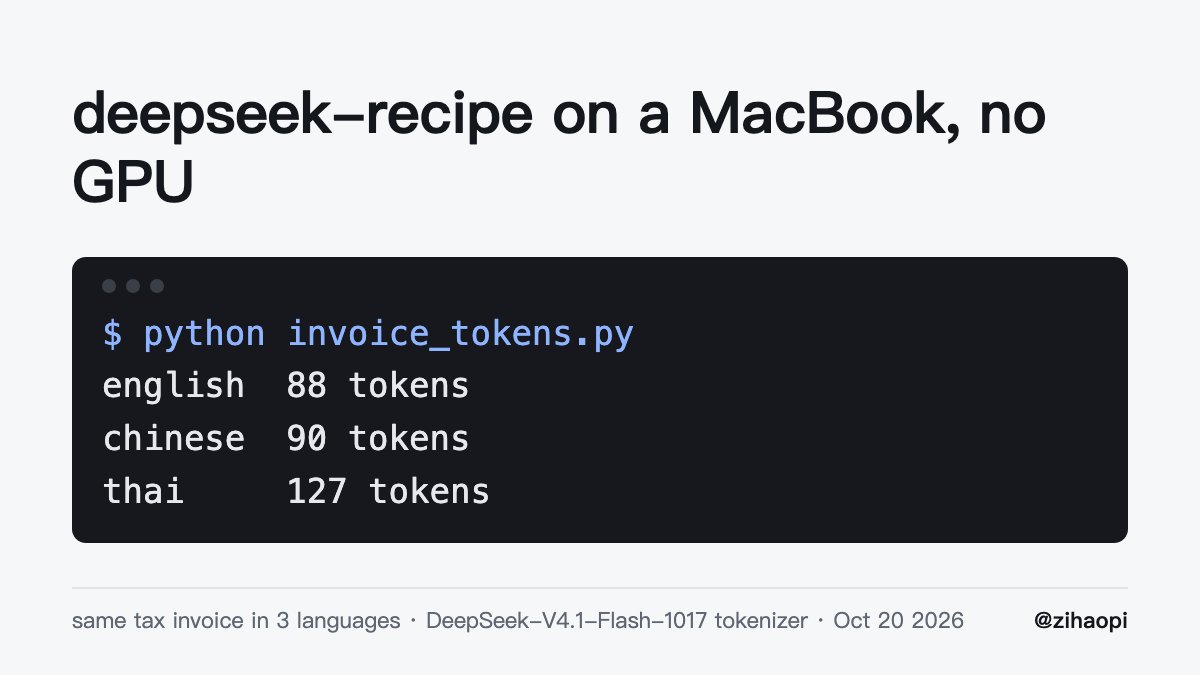
The sleeper in today's DeepSeek drop is deepseek-recipe.
It renders chats into V4/V4.1 prompts and tokenizes them, aligned with the official API. No GPU.
Installed it on my MacBook in a few minutes.
Self-hosting V4.1? Use it to get prompts right.
https://t.co/CJPnLUseQd
🚀 Introducing DeepInfer, our in-house inference framework, now fully open source!
Powering DeepSeek-V4.1-Flash at scale with high throughput and low latency. We’re sharing our production stack to help the community lower compute costs, reduce energy use, and make AI more affordable.
🔗 https://t.co/JGAik1kgk0
1/4
@ChShersh The tools hold up. Shared stdin is what bites.
Claude piped a heredoc over ssh to my server.
A docker exec -i in the middle read the rest of it as stdin.
The rm -rf cleanup never ran. No error. Twice in one day.
Now any docker exec that doesn't need input gets </dev/null.
the cheap model wasn't the problem. self-reported confidence was.
haiku flagging its doubts for opus: 5x the bill on thermal receipts, no gain.
opus only rereads hard-check failures (tax id, totals).
~1.5% field errors at ฿0.06-0.19/page, all-opus ฿0.60.
https://t.co/nTlgdwJShL
It feels like Opus 5.5 has pretty much broken the entire model landscape
At this point for a model to be interesting it has to do something novel and different, the "15% worse but way cheaper!" thing just doesn't work anymore (not that it ever really did, but I think 5.5 has made it way worse since it's so good on every metric)
It's why I liked/defended muse wonder full and am still using it a ton. The thing it has that's novel is it's "voice". It's close enough to frontier to be usable, but unlike the other stuff in this bucket it doesn't feel like a watered down Claude and as such I actually kept using it
In order for a model to matter outside of OpenAI and Anthropic at this point it has to have some novel capability. And I think in order for it to get large scale attention it has to be something easily showcase-able similar to the 3D stuff from Astra.
The "voice" of muse wonder full is something you can't really show in a catchy way on here and only matters when you feel it which requires getting a $50/mo. Meta sub which no one is going to do thus no one cares about the model. Which sucks because I like it, but also they did this to themselves. The wonder drop was really screwed up: horrible names for the model, limited to the sub for the good model, etc.
@alliekmiller "compare next month" is the step i'd never skip once it touches the books.
no api, so we write straight into the app's own data files.
every change to the write path reruns on 62 emptied copies of real company files.
real books have broken cp874 (thai) bytes. demo data won't.
a claude session burned ~$150 on tests in one day server: $180/year invoices: under 1 cent a page the expensive part is the run nobody capped.
the software books client invoices for my father-in-law's accounting firm in thailand
@alexmichaelio cleanup is where agents do damage.
one of my Claude windows wiped a folder on a shared test PC without looking inside. another window had just put 5 documents in it for a production release check. that check died with it.
rule now: list first, delete only what this task made.
@emollick check if your workers can read your main chat. mine could (a Claude Code workflow), and obeyed my latest line.
one small UI question mid-run and every agent switched to it. one undid a commit i'd already approved.
now every brief opens with "only follow this brief."
@EXM7777 6205 real documents in our test corpus.
Where the accountants had already booked one, that entry is the answer key. No labeling.
A gate decides what ships.
A model or prompt change goes live only if it reads no worse and runs no slower under load.