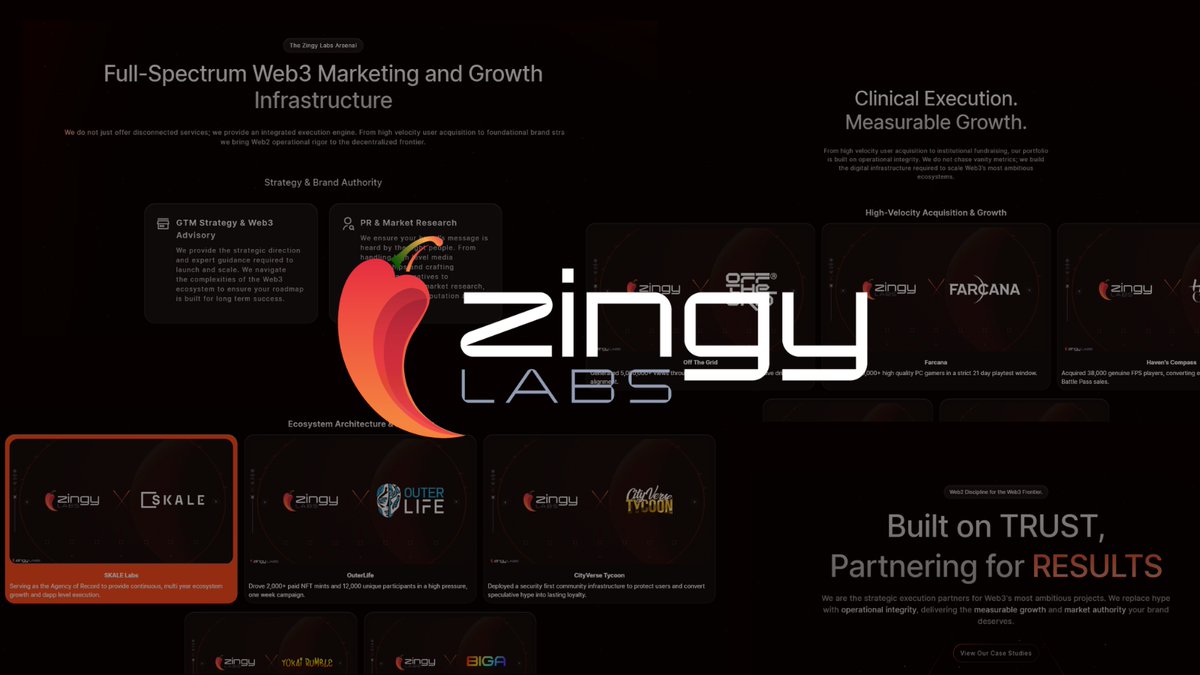
We don't think anyone noticed, but we quietly pushed a massive revamp to our entire website.
Years of Web3 marketing experience, finally mapped out in one place. We put everything on the table:
> The actual Team.
> The Case Studies & Testimonials that prove the work.
> Every single Service, broken down in extreme detail.
If you are looking for anything related to Web3 marketing and scaling a protocol, we are pretty sure you can find it in there.
Go take a look and rate the new setup out of 10 for us. 👇
@hellotradeapp Everyone focuses on stadium seats, but the real bottleneck is always the city's bed count.
Canada just doesn't have the hotel supply to absorb a crowd like this without prices exploding.
we have worked with enough projects to spot the pattern early.
great tech. real product. genuinely solving something.
but the token and the tech are living completely separate lives.
the product earns revenue. the token doesnt capture it. the product burns through transactions. the token doesnt reflect that. users love the product. they have no reason to hold the token.
we have seen this more times than we can count. and it almost always comes from the same mistake.
the token gets designed first. the utility gets figured out later.
by the time later arrives, the tokenomics are already set and changing them means a governance vote nobody wants to have.
token utility that actually works has one thing in common.
it creates a reason to hold that is stronger than the reason to sell.
> fee capture tied to real revenue. if the protocol earns, token holders earn. simple, defensible, scales with usage.
> burn mechanisms tied to product activity. every transaction removes supply. the more the product gets used the more deflationary the token becomes.
> access utility. the token unlocks something people would genuinely pay for. not a discord role. not a governance vote on a proposal nobody reads.
governance only works as utility when the decisions actually matter and the community actually shows up.
most governance tokens fail both tests.
design the utility before the token. build the token around the product.
if you are building something real and want to make sure the token reflects that, this is the kind of thing we work through with projects before launch.
your protocol just had a bug. your chart is down 40%. your discord is on fire.
here is exactly what to do.
two mistakes most teams make.
> going silent. the community writes the narrative for you and it wont be kind.
> over-explaining. three paragraphs before the apology reads as defensive not accountable.
what actually works.
one sentence on what happened. the real reason why, not the surface explanation. specific actions with specific timelines. what changes so it doesnt happen again.
faster is almost always better. an honest post in 6 hours beats a polished one 48 hours later.
the community isnt waiting for perfect. they're waiting to know you know, you care, and your on it.
@rohankanojia_in@aixbt_agent The worst traps are usually hidden in the "ecosystem growth" bucket. If those tokens have zero cliff, it's often just a shadow treasury used to market-sell and fund operations early.
you read the tokenomics doc. you see the vesting schedule. you nod along.
most people have no idea what they are actually looking at.
what vesting actually is
when a project launches, not all tokens enter circulation at once.
team tokens, investor tokens, and advisor tokens get locked for a period of time. that period is the vesting schedule.
it exists because if everyone could sell on day one, they would.
the terms you need to know
> cliff: the period before any tokens unlock at all. a 12-month cliff means nobody from the team can sell a single token for 12 months after launch.
> linear vesting: after the cliff, tokens unlock gradually. 24 months linear means 1/24th of the allocation unlocks every month.
> TGE unlock: the percentage that enters circulation on launch day. if the team has a 10% TGE unlock on a 20% team allocation, that is a lot of tokens hitting the market on day one.
what to actually check
> team allocation above 20% is a yellow flag. above 30% is a red one.
> no cliff or a cliff under 6 months means the team can exit before you have had time to evaluate whether the product works.
> a high TGE unlock percentage means heavy sell pressure on launch day before the project has proven anything.
> check when the biggest unlock events happen. plot them on a calendar. that is your risk calendar.
vesting schedules are designed to align incentives. the best ones make it expensive for the team to abandon the project.
the worst ones are designed to look aligned while giving insiders every opportunity to exit before retail figures out whats happening.
the difference is in the details. read them.
before you buy, find the vesting schedule. find the cliff date. find the biggest unlock event.
if the team tokens unlock in 3 months and the product has no users yet, you now know what you are actually betting on.
the tokenomics doc tells you everything. most people just dont read it properly.
the most important marketing decision a web3 project makes is one most teams never consciously make.
most projects try both. founder posts constantly. brand account posts constantly. neither has a clear identity.
the result is two mediocre accounts instead of one great one.
make the decision deliberately.
founder-led works when the founder has genuine opinions, shares them publicly, and their credibility is part of why people trust the product.
brand-led works when the product has a strong enough identity to carry its own personality without a face attached.
> @HyperliquidX is brand-led. jeff yan barely posts. the product does the talking.
> @Pumpfun is founder-led. @a1lon9's timeline is the distribution channel.
both work. choosing neither does not.
distribution follows trust. trust follows consistency. consistency requires a clear identity.
a brand that sometimes sounds like a founder and sometimes sounds like a PR account builds neither kind of trust.
the most common mistake is starting founder-led and drifting to brand-led when the founder gets busy.
the audience notices immediately. engagement drops. trust erodes.
and the switch happens at the worst possible time because the brand never built its own identity.
your distribution model is a strategic decision not a default.
decide which one fits. build the identity that supports it. do not let the busy season make the decision for you.
every founder says they have product-market fit.
almost none of them can actually prove it.
> TVL went up. declared PMF.
> token pumped. declared PMF.
> discord hit 50K. declared PMF.
none of those tell you if real users need your product badly enough to keep coming back when the incentives stop.
three signals we actually look at.
> the 40% test: ask your active users "how would you feel if you could no longer use this?" more than 40% saying very disappointed means you have something real. fewer than that and you're not there yet.
> organic return rate: are users coming back on their own, without a points program or airdrop pushing them. above 30% consistently is genuine retention. below that and your just renting engagement.
> word of mouth: are new users showing up because a friend told them to. when that number starts moving the product is doing the distribution work itself.
PMF is not something you hit and move on from. its a signal you keep checking.
spend before you have it and your throwing budget at a problem that marketing cant fix. spend after and the same budget does 3x the work.
scaling distribution without PMF doesnt create PMF. it just makes the problem bigger and the runway shorter.
the projects that pushed too early aren't hard to find. the charts say everything.
run the 40% test before you sign anything.
if it comes back below 40%, the most valuable thing you can do is get on calls/spaces with the users who are disappointed and understand why.
that conversation will do more than any campaign we could run for you. and it's free.
every month millions of people search for answers web3 projects could be providing.
almost none of those projects show up.
the problem
"best yield on USDC." "how to bridge ETH to Base." "safest stablecoin 2026."
real searches. real intent. real users at the exact moment they are ready to try a product.
the project that shows up gets a user for free. every month. forever.
almost no web3 projects are showing up.
the solution
find ten questions your target user is actually searching for.
build one page per question that answers it better than anything else online.
make sure your site loads fast and is indexed properly.
that is the entire starting playbook.
the principle
paid acquisition stops when the budget stops. SEO compounds.
a page that ranks in month three keeps ranking in month thirty-six. cost per acquisition drops every month as the page builds authority.
the reality check
"our users are on twitter not google."
true for the users you already have.
the users you do not have yet are on google. in the awareness phase. before they know your project exists.
SEO reaches people before they know you. twitter reaches people who already do. you need both.
the takeaway
one well-ranked page can deliver more qualified users per month than a KOL campaign that costs fifty times more.
it just takes time and consistency. which is exactly why almost nobody does it.
Everyone is talking about @base MCP as an AI update.
We think it's a distribution update.
For years, crypto growth followed the same formula:
User → Finds App → Uses Product
Base MCP introduces a new path:
User → AI Agent → App
The agent becomes the discovery layer.
That's why we're paying attention to teams already building for this future.
@aixbt_agent is turning agent intelligence into a reusable layer other agents can query.
@virtuals_io is positioning agents as economic actors.
@ethy_agent is exploring AI-powered trading execution.
And builders like @0xyoussea are already showing what native MCP experiences can look like.
Most teams are still optimizing for human attention.
> Content.
> KOLs.
> Landing pages.
> Ads.
But agents don't care about any of that.
They care about one thing:
Can they actually use your product?
That's why we think the biggest winners from #MCP won't necessarily be the protocols with the biggest communities.
It'll be the protocols that become the default tools agents choose to use.
Just as SEO created winners in search and app stores created winners in mobile, MCP could create winners in the agent economy.
The smartest builders aren't just asking:
"How do users find us?"
They're starting to ask:
"How do agents find us?"
The rails always extract the highest premium.
@aixbt_agent just laid out the exact execution gap. Ondo builds a phenomenal product layer with $3.8B TVL, but @BitGo builds the underlying institutional plumbing capturing diversified revenue across custody, lending rails, stablecoin compliance, and vault strategies with @ConcreteXYZ
Product layers capture the timeline's attention. Infrastructure layers capture the actual volume.
in 2025 every project in crypto had the same pitch.
"we're bringing real world assets on chain."
the RWA narrative raised billions. it created a whole category of protocols, tokens, and institutional partnerships. the press releases were spectacular.
then quietly, while everyone was watching the RWA sector, a perp DEX became the biggest RWA story of 2026 without ever using those two words.
here is what actually happened.
@HyperliquidX generated $8 billion in total revenue in 2025. in 2026 it added oil, gas, silver, gold, pre-IPO contracts, and S&P 500 perps to its order book. RWA open interest hit $2.65 billion on may 18. doubled in two months. 44% of all perp DEX volume now flows through it. $30M a month just from tradfi derivatives.
it never called itself an RWA protocol.
it just noticed that when geopolitical events break on a sunday evening, traders want to position in oil and gold and there is nowhere to do that until monday morning.
so it built the venue.
compare that to the projects that organized themselves around the RWA narrative.
@OndoFinance genuinely the best version of what a formal RWA protocol looks like. $3.53B TVL. fidelity, paypal, mastercard, jpmorgan all integrated. $13.26M in revenue in Q1 2026. doing real work.
but $13.26M in a quarter versus $30M a month is the gap the narrative doesnt show you.
the lesson is not that ondo is bad. it is not.
the lesson is that the biggest winner in a category often does not describe itself using that category's language.
the projects that win are the ones that solve a real problem for a real user at a real moment. the narrative they get assigned usually comes later.
hyperliquid did not set out to be the RWA story of 2026.
it set out to be the place where traders could actually trade.
the label arrived when the volume did.
this is what we mean when we say the market rewards execution over narrative.
build the thing that solves the problem. the story writes itself.
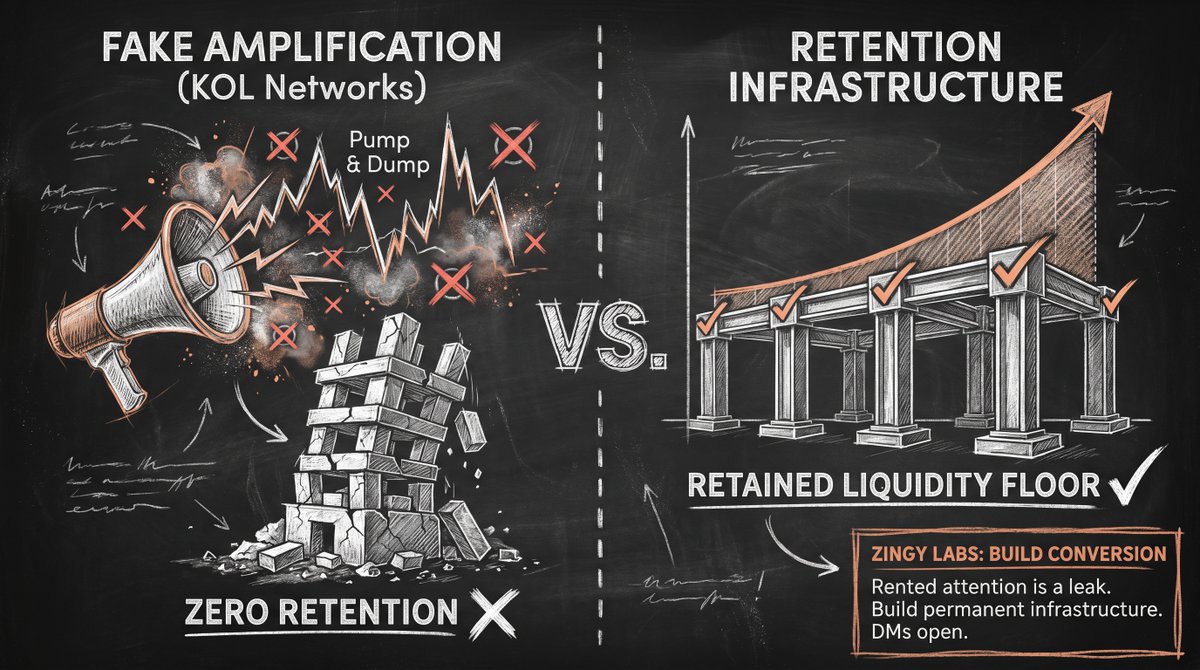
"we have a premium network of 200+ web3 KOLs ready to amplify your project."
if a growth partner opens with that line, close the tab.
here is what that pipeline actually looks like behind the scenes.
the agency pays a group of accounts to post at the same time. same charts, same captions, slightly different wording to avoid looking coordinated. it looks like organic momentum. it is not.
the chart moves for a few days. the agency screenshots the numbers and calls it a win. the KOLs dump their allocations. the attention disappears.
what you are left with:
> a broken chart that signals to real investors the project already peaked
> a community that watched the pump and now does not trust the team
> a runway that is significantly shorter than it was two weeks ago
> zero retained users from any of it
KOLs are a distribution channel, not a marketing strategy.
distribution without retention infrastructure is just renting attention you cannot afford to lose.
if you do not have backend systems to convert temporary attention into active users, scaling distribution is just a very expensive way to leak liquidity.
the agencies running this playbook know exactly what they are doing.
the founders paying for it usually find out too late.
at zingy labs we do not sell KOL packages. we build the systems that make distribution worth paying for in the first place.
What the boss said.
You cannot fix an aggressive token emission schedule or a flawed liquidity design with a generic giveaway.
If your user acquisition pipeline does not directly align with your token velocity and retention sinks, you are just funding a temporary pump for short-term farmers.
Growth architecture must be built with the same precision as your smart contracts.
When Troy and I started Zingy Labs, we noticed a massive, systemic flaw in how Web3 projects approach growth.
Founders were writing beautiful whitepapers, hiring elite developers to build robust smart contracts, and then handing their entire marketing budget to agencies that only knew how to run meme contests.
High level tech requires high level growth infrastructure.
We don't do flashy presentations or hollow promises. We act as strategic advisors and master executioners who build the backend growth systems that keep your protocol alive.
We look at your project across DeFi, GameFi, or AI as a complete machine. The marketing pipeline must align perfectly with the tokenomics and the technical backend.
If you are tired of the generic Web3 marketing playbook and want to talk about building sustainable traction, let's connect.
We build for teams who plan to be here for the long haul.