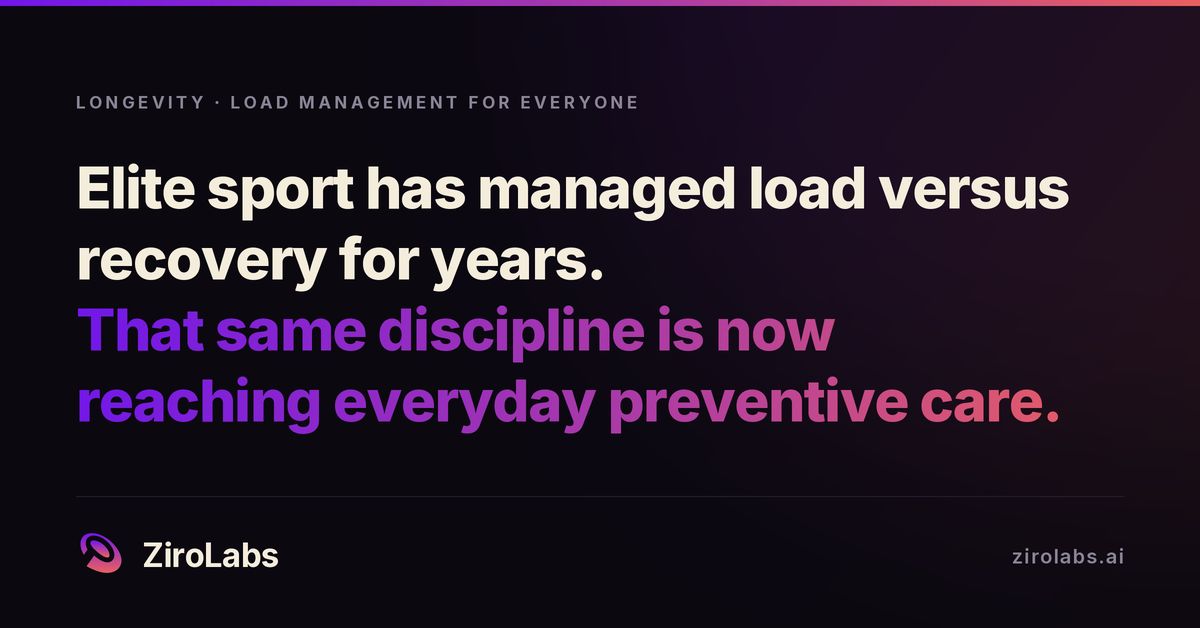
Sports teams have tracked training load against recovery for decades to cut injury risk. Ziro Labs is bringing that same load-versus-recovery logic to everyday preventive care.
https://t.co/c2L34txnuH
#preventivecare#longevity
Follow-up care is still booked by the calendar: six weeks, three months, next spring. Ziro Labs thinks the better trigger is a change in the signal, measured against the patient's own baseline.
https://t.co/c2L34txnuH
#remotemonitoring
A missing test result rarely triggers an alert, so health records tend to read silence as reassurance. At Ziro Labs, we think prevention starts by making those gaps as visible as abnormal values.
https://t.co/c2L34txnuH
#preventivecare#longevity
Reference ranges were built by measuring many people once. They tell you where you stand, not whether something has changed in you. Ziro Labs works on the second question.
https://t.co/c2L34txnuH
#precisionmedicine
Healthcare has no shortage of composite scores. It has a shortage of attribution. A score that cannot be taken apart can inform a conversation but cannot direct one. Ziro Labs thinks closing that gap is the work.
https://t.co/c2L34txnuH
#longevity#precisionmedicine
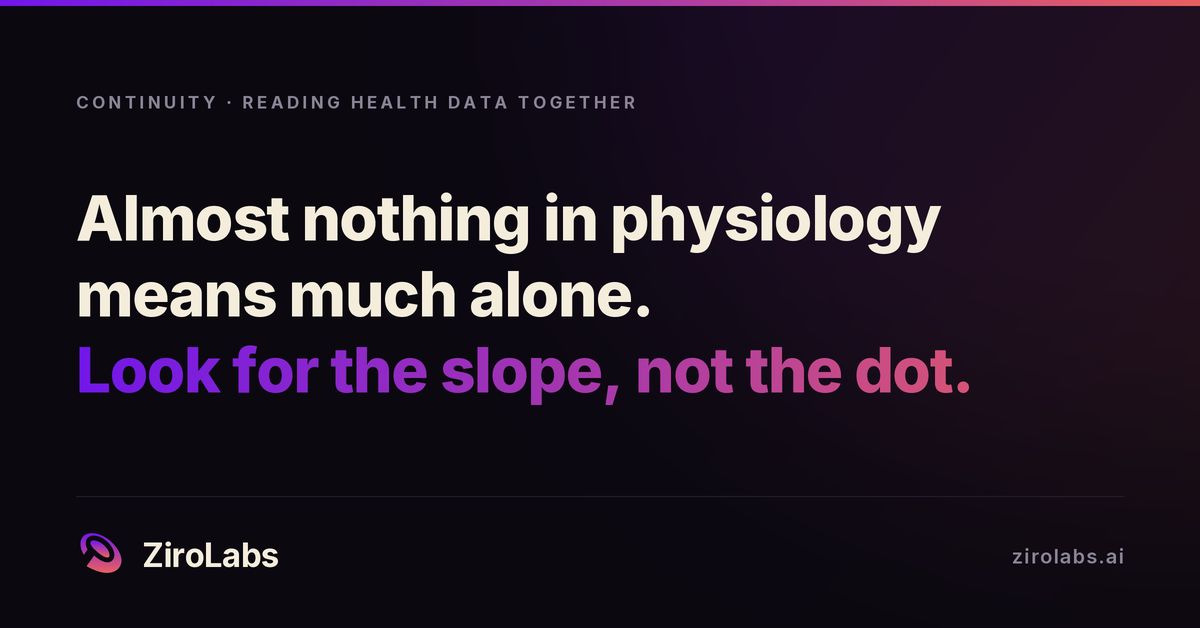
Almost nothing in physiology means much as a single measurement. Read alone, a number invites false alarm or false comfort. Ziro Labs is interested in the slope, not the dot.
https://t.co/c2L34txnuH
#longevity#preventivecare
Grip strength predicts surgical recovery and later-life independence better than most things routinely measured. It is also among the cheapest tests in medicine. Ziro Labs thinks prevention improves when the simple measures get taken early.
https://t.co/c2L34txnuH
Prevention still leans on a single annual reading compared to a population average. Continuous measurement changes the question from whether a number is normal to whether it is normal for you. That reframe is the work at Ziro Labs.
https://t.co/c2L34txnuH
A lab reference range describes a population. Your own biological variation is usually much narrower, so a result inside the range can still mark a real change. Ziro Labs thinks the next gain in healthcare is a better denominator, not a new test.
https://t.co/c2L34txnuH
Health tools are designed to look certain, because certainty keeps people coming back. The evidence underneath is rarely that firm. Ziro Labs treats calibration as a feature: say how confident a result is, and what would raise it.
https://t.co/c2L34txnuH
Clinical risk scores earned trust by publishing their inputs and their weighting. Consumer health scores mostly do not. Ziro Labs believes a score you cannot interrogate never changes behavior.
https://t.co/c2L34txnuH
Prevention used to mean waiting for a number to cross a line. With longitudinal data, it increasingly means noticing the direction years earlier, while it is still cheap to change. Ziro Labs is built around that shift.
https://t.co/c2L34txnuH
Healthcare has solved data collection. It has not solved admitting where interpretation runs out. At Ziro Labs, we think showing what is measured, what is inferred and what is missing earns more trust than a tool that always has an answer.
https://t.co/c2L34txnuH
One in twenty healthy people falls outside a normal lab range by construction. The range describes a population, not a person. Ziro Labs thinks the next decade of health measurement belongs to individual reference intervals.
https://t.co/c2L34txnuH
"normal range" was built for populations, not people. it was the best you could do when one measurement a year was all anyone had.
that constraint is gone. the useful question now is whether a value is normal for you, and which way it's been trending.
prevention starts there.
cardiology got the ecg. metabolic health got the lab panel. psychiatry got a 15-minute interview, months apart.
sleep architecture, hrv, circadian regularity — continuous signals that say something real about a nervous system. not a diagnosis. but a trend line beats a snapshot.
most people have been measured hundreds of times and still can't answer: compared to last year, am i better or worse?
that's not a data problem, it's a baseline problem. "in range" tells you that you resemble a population. it doesn't tell you anything about you.
healthcare still runs on snapshots — one physical a year, labs once something already hurts.
the shift underway is snapshot to baseline. your own history is the best control group you'll ever have.
https://t.co/c2L34txnuH
cognitive decline builds for years before symptoms show.
longevity medicine spent two decades on cardiometabolic risk. neurological is next, and it means measuring people while they still feel fine.
annual snapshots won't get you there.
healthcare doesn't have a data problem. it has a continuity problem.
labs in one portal. wearable in an app. notes you can access but can't read. every piece a snapshot, none of them a trajectory.
snapshots catch problems late. trajectories catch drift.