@Surf_Liquid just published their biggest ecosystem update. The entire execution stack powering it runs on zkCross Network.
Every vault deployment, every AI agent action, every Guardian Layer rule enforcement, every circuit breaker trigger, every cross-chain capital route. All of it executes through the zkCross infrastructure.
→ The Guardian Layer that held every vault safe during the recent wave of DeFi exploits is the zkCross architecture.
→ The MPC signing that secures every transaction is the zkCross infrastructure.
→ The cross-chain settlement rails that move capital across Base, Polygon, and the upcoming Ethereum mainnet deployment are zkCross rails.
→ The isolated vault contracts that keep each user's capital separate from everyone else's deploy via zkCross.
$107M+ in on-chain volume. 194K+ transactions processed.
When Surf scales to @arbitrum, @avax, @BNBCHAIN, @solana, @StellarOrg and @HyperliquidX, the same zkCross rails handle every chain.
Surf is the product users see. zkCross is the infrastructure that makes it all work.
The Guardian Layer that Surf 4.0 ships with reads on-chain data across every chain a @Surf_Liquid vault touches.
Cross-chain signal aggregation is the bit nobody talks about. Without it, Guardian sees one chain at a time.
We do that piece. Sub-minute polling across @ethereum, @0xPolygon and @base.
Cross-chain savings is live today.
Surf 4.0 ships with the bridge inside the contract. zkCross routes funds across @ethereum, @0xPolygon, and @base from inside the vault.
The savings layer is what makes the routing layer matter.
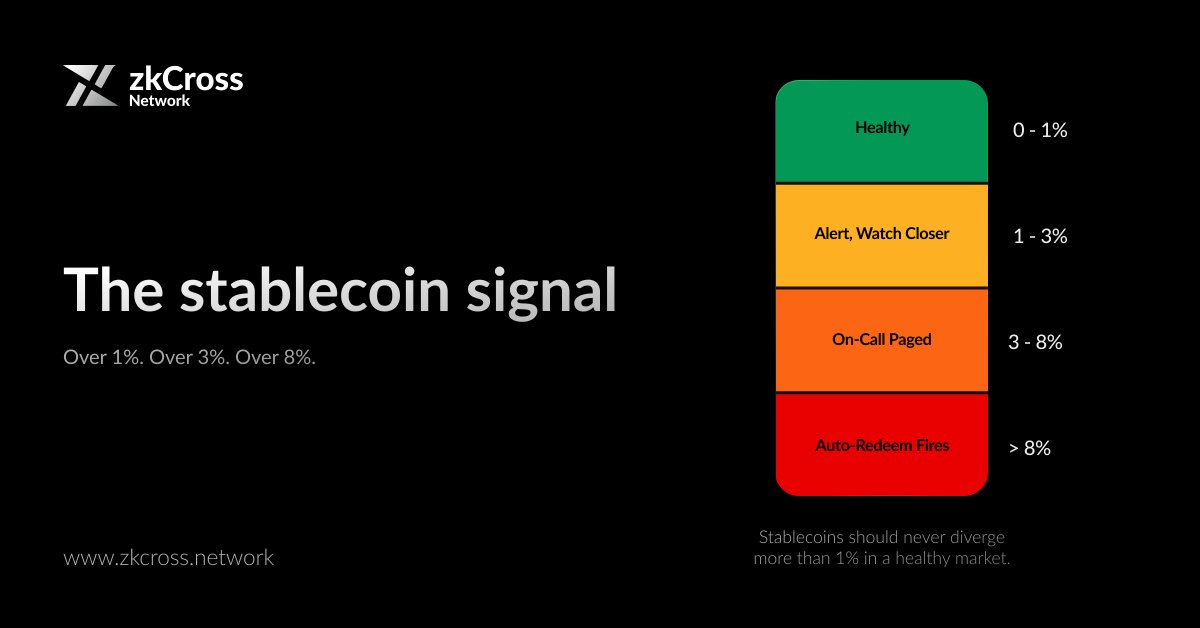
The stablecoin signal.
Divergence over 1% from peg: YELLOW.
Over 3%: ORANGE.
Over 8%: RED.
Stablecoins should never diverge more than 1% in a healthy market. When they do, the Guardian Layer is already polling at five-second intervals. By the time the divergence reaches red-trigger size, the emergency redeem has fired.
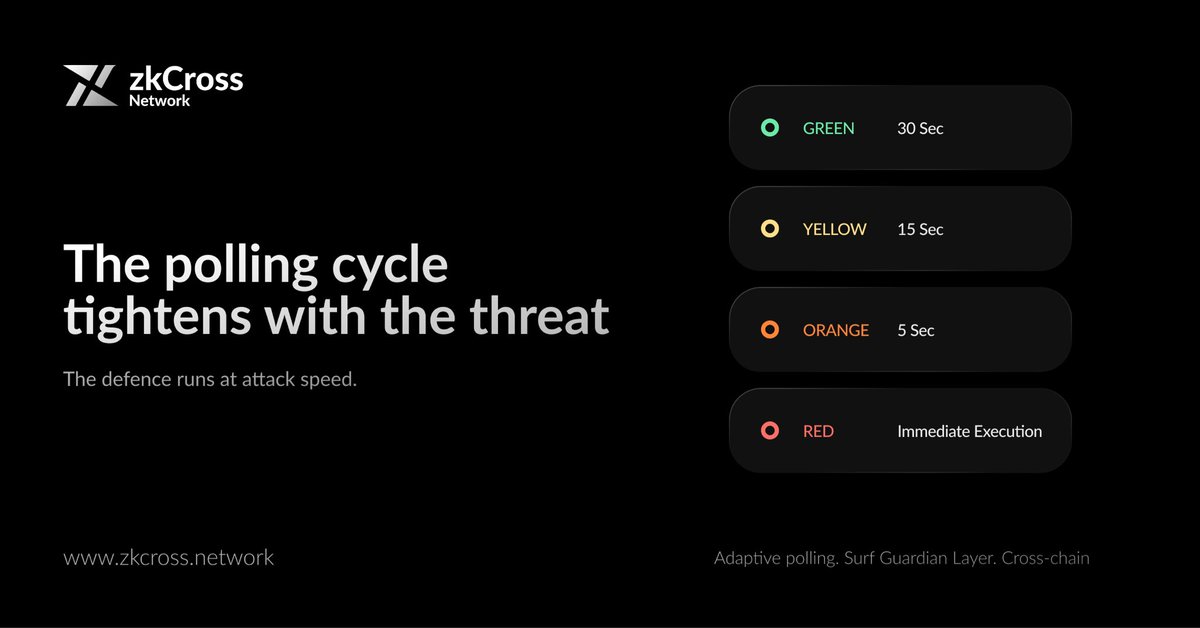
Adaptive polling.
Normal state: 30-second cycle.
YELLOW: 15-second cycle.
ORANGE: 5-second cycle plus WebSocket event stream.
RED: immediate execution.
The polling cycle tightens with the threat. The defence runs at attack speed. Halborn-audited zkCross infra underneath.
Both fail differently.
Centralised rails concentrate trust into one operator, bridges fragment it across many. The fix isn't picking which risk you prefer, it's removing the custodial hop entirely.
Every Morpho depeg shows the same early-warning signal.
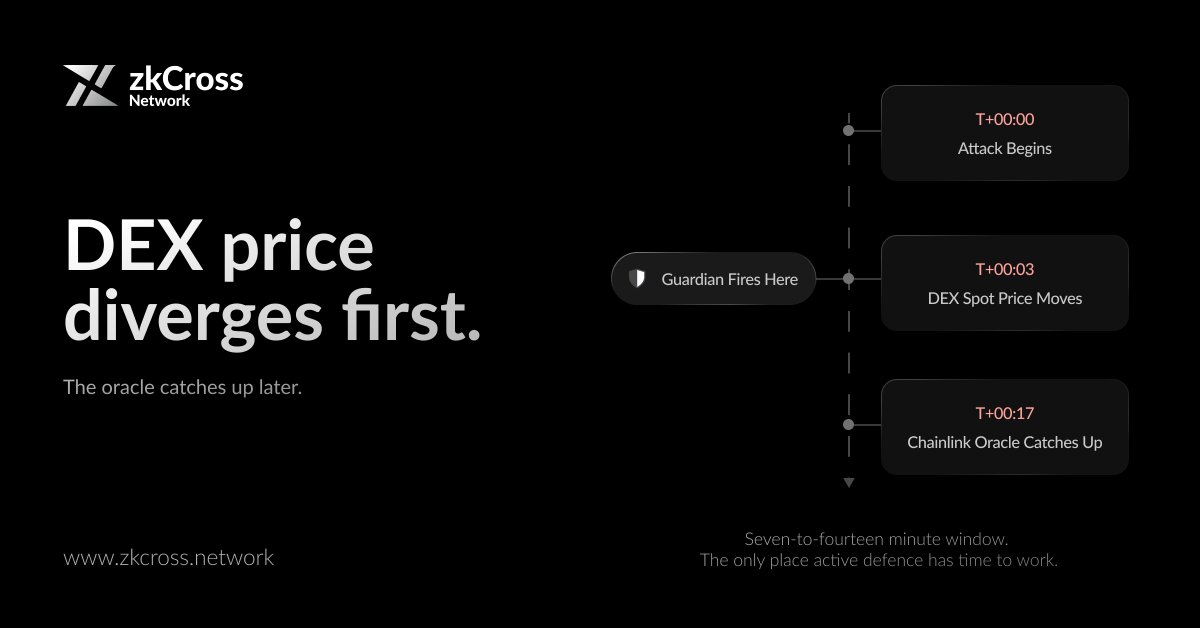
DEX spot price diverges from Chainlink oracle at T+00:03. The oracle catches up at T+00:17.
That seven-to-fourteen minute window is the only place active defence has time to work. Guardian Layer fires on the divergence, not the correction.
Fair scepticism. Bridges and wrapped assets keep stacking trust assumptions, and that's where most failures originate.
Native cross-chain settlement without custodial hops is the only path that actually removes the attack surface.
I’ve never really been convinced by most “cross-chain” solutions.
At the end of the day, a lot of them still rely on bridges, wrapped assets, or giving up some level of control over your funds. And every few months there’s another bridge exploit reminding everyone how fragile that setup is.
That’s why @WireNetwork stood out to me.
Their Universal Transaction Layer (UTL) isn’t trying to move assets around from chain to chain. Assets stay where they already are, on their native chain, while Wire handles the coordination layer across networks.
No bridging.
No wrapping assets.
No extra custody risk.
It just makes more sense.
What’s also interesting is that they’re building this with AI agents in mind from the start. If autonomous agents are going to transact across different ecosystems, they’ll need infrastructure that can actually work across chains without all the usual friction.
Wire Network is definitely thinking ahead instead of patching old problems.
https://t.co/vaGL3KgQBI
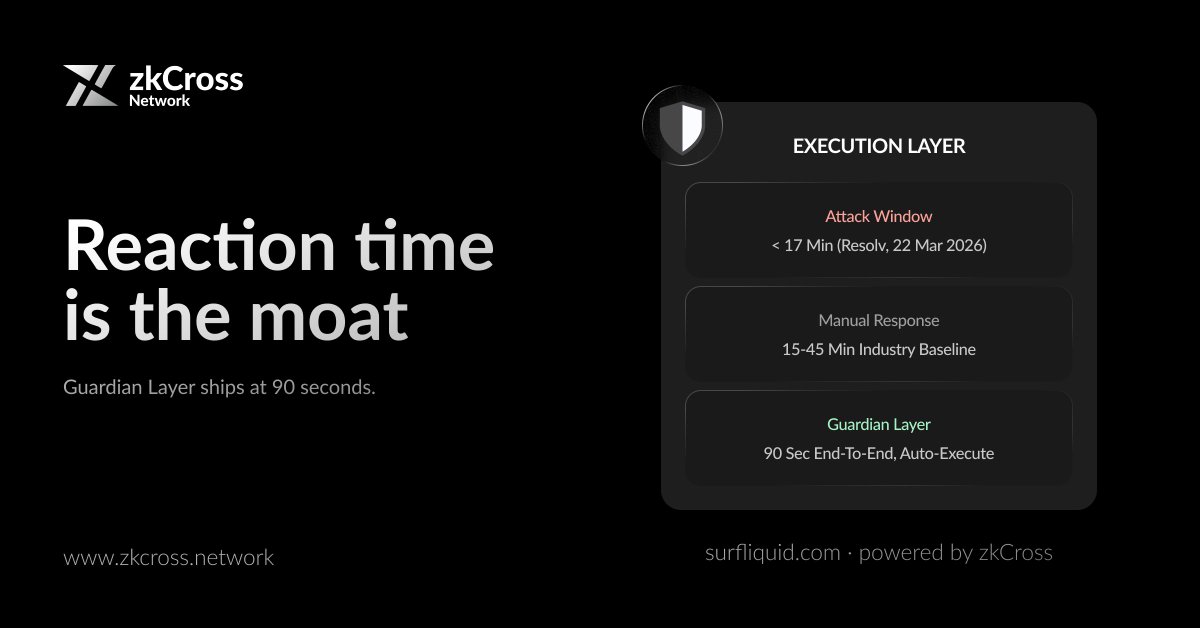
Cross-chain DeFi exploits complete in 1 to 17 minutes. Manual incident response is 15 to 45.
The defensive moat is reaction speed.
Auto-execution on bad-debt or depeg signals beats human paging every single time. Surf's Guardian Layer ships at 90 seconds end-to-end. Halborn-audited zkCross infra underneath.
Defence has to run at attack speed or it does not run.
ERC-8004 is the discovery and reputation layer. It does not replace execution.
Surf is now on the registry. The execution underneath stays where it always was. Halborn-audited contracts. 3-of-4 MPC signing. Atomic settlement.
8004 declares what zkCross enforces.
Two layers, one agent, on-chain throughout.
@Surf_Liquid on @base: https://t.co/llDB3p9M3d
The hardest part of zero-human ops isn't the memory or the marketplaces.
It's an execution layer that lets agents touch capital without leaking it.
We built zkCross as exactly that surface, with bounded permissions and deterministic rules that sign every move.
My early reflections from the operating reality of the first Zero-Human Company comes a clear message: autonomous AI agents are simultaneously ending old business models and birthing an entirely new economic order.
Persistent memory, agent marketplaces, always-on execution, and human judgment as the ultimate premium are reshaping every industry.
These are just some of my early reflections that show the transformation is accelerating faster than anyone predicted.
The contagion loop is the architecture risk hiding in plain sight. Curator decisions become systemic when shared liquidity rails connect them all.
At zkCross, we run scoped MPC signing tied to an on-chain policy. Every call is authorised against the contract before any signer touches a key. The signer cannot drift past what the policy allows.
Across $107M of routed volume, the security model rests on the policy layer, not on the curator's reputation.
Agents will be the biggest consumers of DeFi infra, and the execution layer they need is the one that's deterministic at the contract level.
Proposal from the agent. Decision from the contract.
That gap is where the next year of infra work sits.
The biggest consumers of DeFi infrastructure in the next few years won't be people. They'll be AI agents.
Here's what I mean:
Think about what a DeFi power user looks like today: someone actively swapping, bridging, chasing yield across chains.
Now imagine software doing all of that, 24/7, across every chain simultaneously.
That's agentic commerce. And it's the direction things are heading.
1️⃣ So what does this actually look like in practice?
Two interaction models are forming:
1. Agent-to-Site: You set your preferences once. The AI researches, compares options, and executes the transaction. You're not involved beyond the initial setup.
2. Agent-to-Agent: No human on either side. One AI representing the buyer, another representing the seller. They negotiate and settle in milliseconds.
The web2 version is already live: in-chat purchases, AI shopping assistants, commerce protocols backed by major retailers.
But all of it still runs on traditional rails. Cards, banks, and human identity at every step.
2️⃣ Why does this lead to crypto?
For agents to operate at real scale, they need to:
→ Custody their own assets
→ Settle instantly across borders
→ Run 24/7 with no human sign-off
→ Transact with other agents autonomously
Traditional finance doesn't offer any of this to a machine.
Blockchains do: permissionless wallets, programmable money, instant finality. The only infrastructure where software is a first-class economic actor.
3️⃣ The bottleneck
Blockchains give agents the right financial layer, but the ecosystem is fragmented:
→ 200+ chains
→ Hundreds of DEXs, bridges, liquidity sources
→ Each with different APIs and failure modes
An agent working across Ethereum, Solana, Arbitrum, and Base needs separate integrations for each. That overhead has nothing to do with the agent's actual goal. It's pure plumbing.
4️⃣ LI.FI approach
@lifiprotocol has been building the routing and execution layer for onchain value movement for years. One integration point replaces dozens of individual bridge, DEX, and protocol connections.
What they recently shipped for AI agents:
→ MCP Server: 15+ structured tools any LLM-powered agent can call directly. Compatible with Claude, Cursor, Windsurf, VS Code Copilot.
→ Agent skills: cross-chain execution packaged as standardized skills across major agent directories. Add swaps, bridging, and DeFi workflows to any agent in minutes
→ AI-first docs: machine-readable llms.txt, full OpenAPI spec, decision tables, five-call recipes, error playbooks, runnable code samples with retry logic.
Agent = decision-maker.
LI.FI = execution layer.
No team should spend months wiring bridge integrations when they can plug into infrastructure already powering the biggest names in crypto and focus on building what makes their agent actually smart.
Same instinct we built zkCross around, two layers down: agent hooks at the workflow level, on-chain rules at the execution layer. Three-of-four MPC signing approves every action touching user capital.
Contracts decide what is valid before anything moves.
The contract held. The hot wallet didn't.
The exploit pattern is operational, not architectural.
zkCross writes, signing into the contract. No single operational key can move funds. Every cross-chain move passes through the 3-of-4 MPC layer and Halborn-audited contracts.
A wallet compromise that cannot become a vault drain.
The architecture catches what the operational layer misses.
Every bridge exploit ends with the same lesson. The signing layer is where the architecture choice quietly decides survival.
We built zkCross for the case where every cross-chain move passes through 3-of-4 MPC signing and Halborn-audited contracts. $107M+ in volume with zero custody incidents to date.
JUST IN: @Krakenfx is replacing @LayerZero_Core with @chainlink to bridge assets across blockchains, joining $3B+ in TVL that has migrated since the $292M @KelpDAO exploit.
@pashov Motivation over credential rings true in audit work. The contributor who reads the spec line by line and asks the awkward question catches the issue the team kept walking past. Selection by curiosity is the lever, not headcount.
Scaling got easier because compute and consensus did. Security stayed hard because policy never got moved on-chain. Every bridge that got drained had a signer who could be talked into producing a valid signature for an invalid intent. On zkCross every signing path runs through a policy contract first. Source state has to match before any signer touches a key.
@Fairu_90@PushChain Chain-as-context-switch is the friction users actually feel. The chain belongs behind the action the user wanted, not in front of it. The cross-chain story lands at the UX layer or the infra story stays invisible.
Moving disputed funds into another lending market mid-court fight turns the protocol into both venue and party. That kind of role overlap is the reason on-chain disputes still end up in off-chain courts. The cleaner design choice has to happen years before the lawsuit, not during it.
@Diphunter18@0xPolygon Enterprise payments only work when the rail agrees on a state across hops. The Polygon side of this got measurably tighter in the last six months. Cross-chain settlement that does not drift is the precondition for B2B commerce on crypto rails.