An agent that can move funds needs a leash, not a login.
zkCross gives every agent a scoped key. It can call the functions it was built for and nothing else.
No single key controls the vault it touches. Three independent signers still have to agree before anything moves.
The agent gets exactly enough power to do its job and no more.
https://t.co/uAk9keTNvj
26,290 unique wallets have moved funds through zkCross Network so far.
That is not a testnet number. It is $111.8M in real volume, settled across live chains.
The signer set has held under that load without a single incident.
Proof scales differently than a pitch deck. See the numbers at https://t.co/uAk9keTNvj
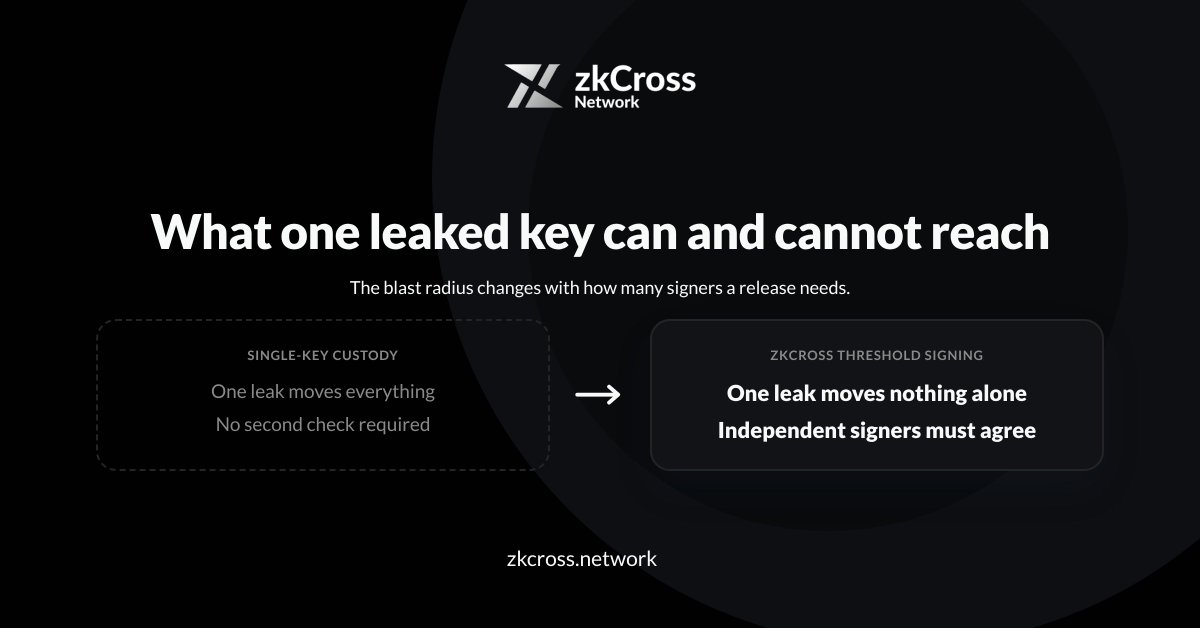
No single key moves funds on zkCross. Every transfer needs multiple independent signers before it settles. That is not a policy. It is the multisig design underneath $111.8M in volume and 197K+ transactions. One compromised key cannot touch any of it. See how the signer set works.
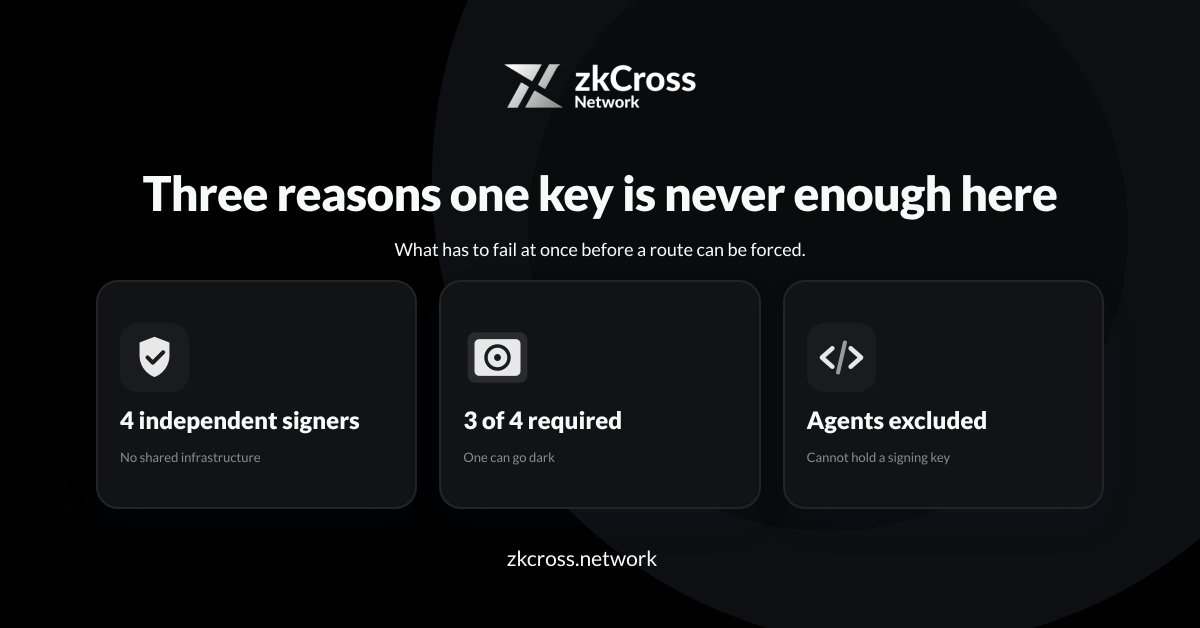
Our 4 MPC signers are not one team with four laptops.
They run on separate infrastructure, held by separate operators. No shared cloud account can leak all four keys at once.
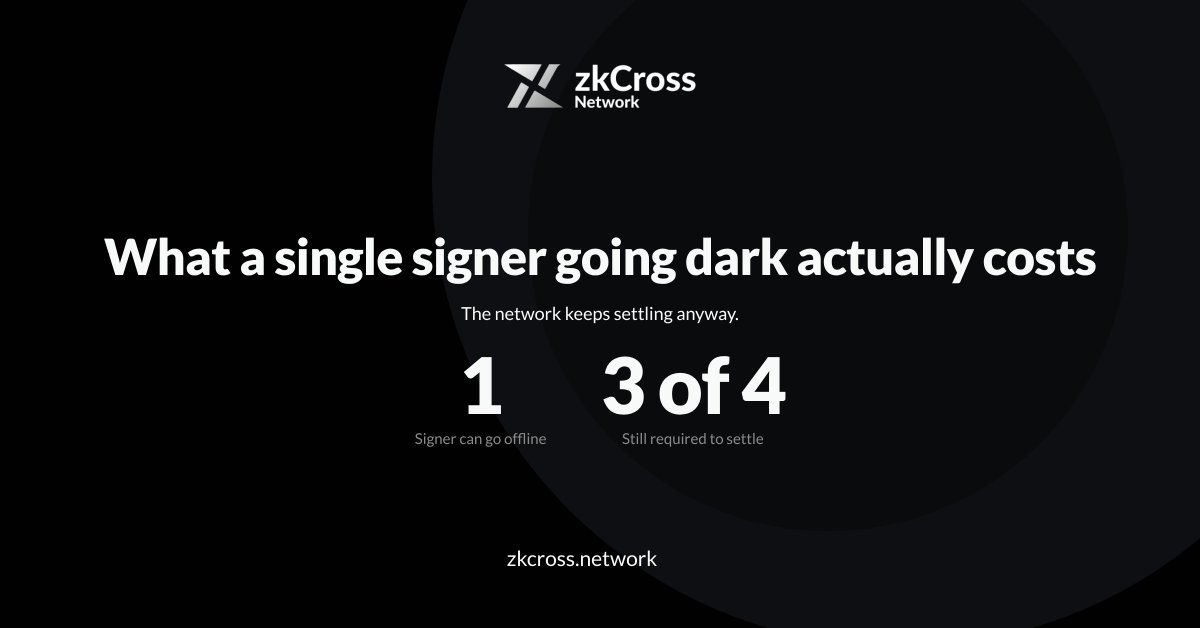
A release still needs 3 of them to agree. One operator going dark does not stop the network.
Read how the signer set is built at https://t.co/uAk9keTNvj
A signing setup has two jobs. It has to stop a thief. It also has to keep working when a machine goes down.
A single key fails both. Lose it and nothing moves. Leak it and anything can move.
zkCross Network signs releases with 3-of-4 MPC. One signer can be offline and routes still settle. One compromised signer cannot release anything alone.
The architecture is written up at https://t.co/uAk9keTNvj
An AI agent should never hold a key that can move everything.
On zkCross Network an agent asks for a route. The release still needs 3-of-4 MPC signers to agree. The agent never holds the signing keys itself.
So a buggy agent can ask for a wrong transfer. It cannot sign one on its own.
Building an agent that moves value across chains? Start at https://t.co/uAk9keTNvj
@THORChain Whose base layer moved the funds isn't the question that matters. What matters is whether anything paused before the swap finished. A chain that only reacts after headlines break protects no one. We watch for unusual movement before it clears, not after.
@Padierfind x402 stalling isn't about the rails, it's about trust. Payments already work fine on their own. I want to see an agent prove who it is before anyone trusts it with money.
@SolidTradesz Chain choice is a footnote next to who's actually moving the money. Our agents already move idle cash on Base and Polygon, not Ethereum. Liquidity follows the cheapest safe rail, not brand loyalty.
@VenomCrypto_ The bridge still runs when you buy BSC with SOL. The app just hides it behind one button. Someone holds the funds between the two chains for a few seconds. Cross chain trading feels like one click until a leg stalls halfway.
@CoinMarketCap Wrapping Bitcoin into cirBTC moves the trust to Circle's custody, which institutional clients already accept. Liquidations are the harder part. Collateral on Arc gets sold on Arc. How deep will cirBTC liquidity be there on a fast Bitcoin drop?
@chainlink Most of the risk sits in permissions, not pricing. An agent working across four chains usually ends up holding four sets of keys. We would rather it follow one set of rules that every chain enforces the same way.
@LayerZero_Core Proving the bytecode expansion covers the math. Most cross-chain losses we have studied came from config and keys, not from the prover. I would like to see the same rigour on who can change the verifier.
@MrTelecoms@SingularityNET Owning the bridge helps less than capping what it can mint. Here, cloud access was enough to mint unauthorised WMTX. A hard hourly mint limit turns that kind of exploit into a small and known loss. Good to see it contained fast.
@Milana0193@quipnetwork Counting the trust between chains beats counting destinations in the UI. The refund deadline deserves the same attention. If one leg stalls, the assets sit locked until that deadline passes. Safer settlement still costs the user time when a swap fails.
@danrobinson@Uniswap Buying Nvidia on Uniswap solves half of access. The other half comes when a holder wants out on the chain where the buyer sits. Stock tokens stuck on one chain trade at that chain's depth. Routing between chains decides who can actually sell.
@SlowMist_Team@DoinGudHQ Order beats any extra check here. Zero the offer, then pay. Written the other way round, identical calldata can be replayed until the escrow is empty. Cross-chain releases fail the same way when a message pays out before it is marked spent.
@LayerZero_Core@Anchorage Regulated stablecoin issuance comes down to who can freeze and reissue. On one chain that is simple. Across many, a federally chartered bank has to show the same control holds on every chain, including the quiet ones. I would want to read how that gets audited.
@0xPolygon One click usually hides three steps for the stablecoins underneath. How often does an Arc to Polygon transfer stop halfway, and who refunds it?
Every cross-chain route works on a quiet afternoon.
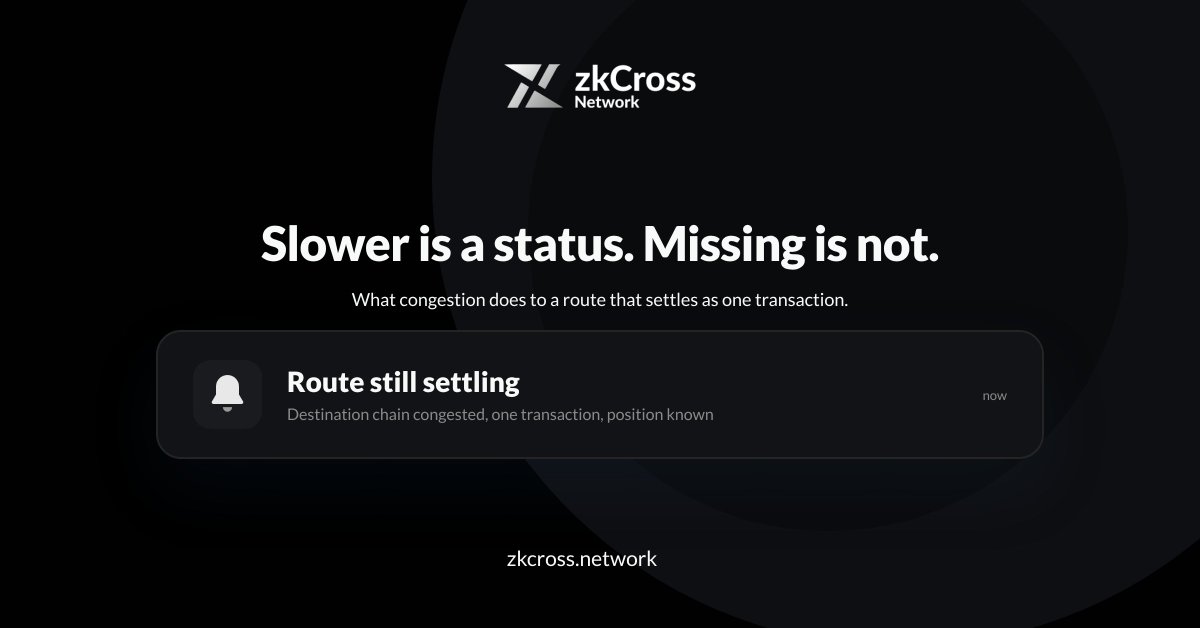
The question is what it does when a chain is congested. Most bridges widen the gap between the two legs. The transfer is still moving and nobody can say where it is.
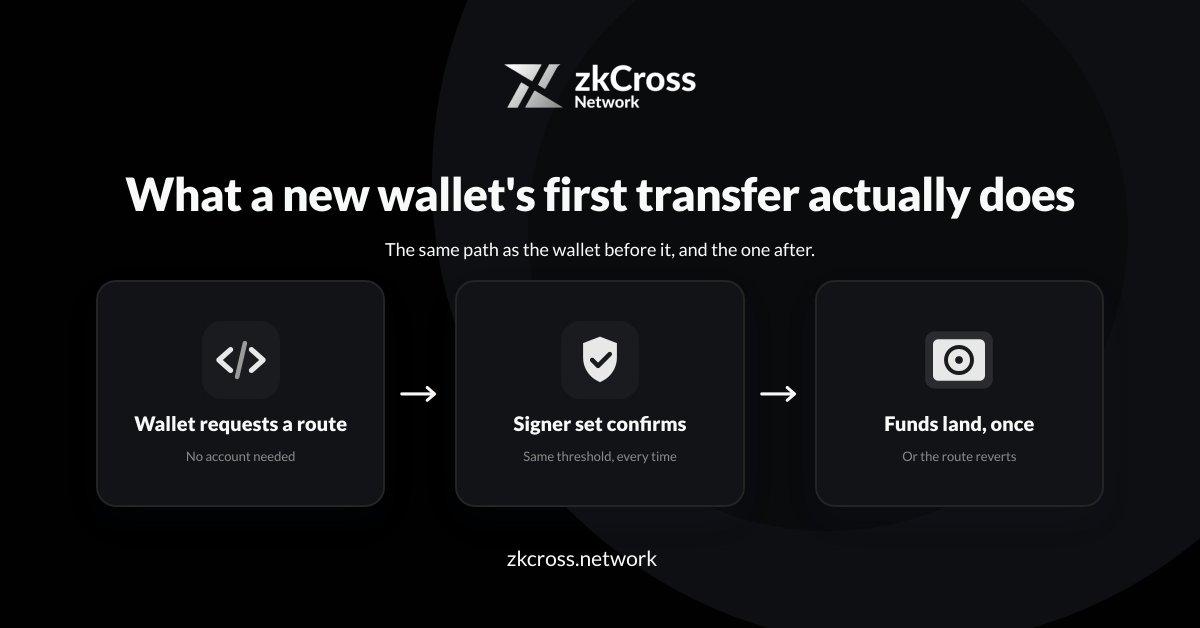
zkCross Network settles the route as one transaction. Congestion makes it slower. It does not make it uncertain.
Slower is something you can explain to a user. Missing is not.
The routes are documented at https://t.co/uAk9keTNvj