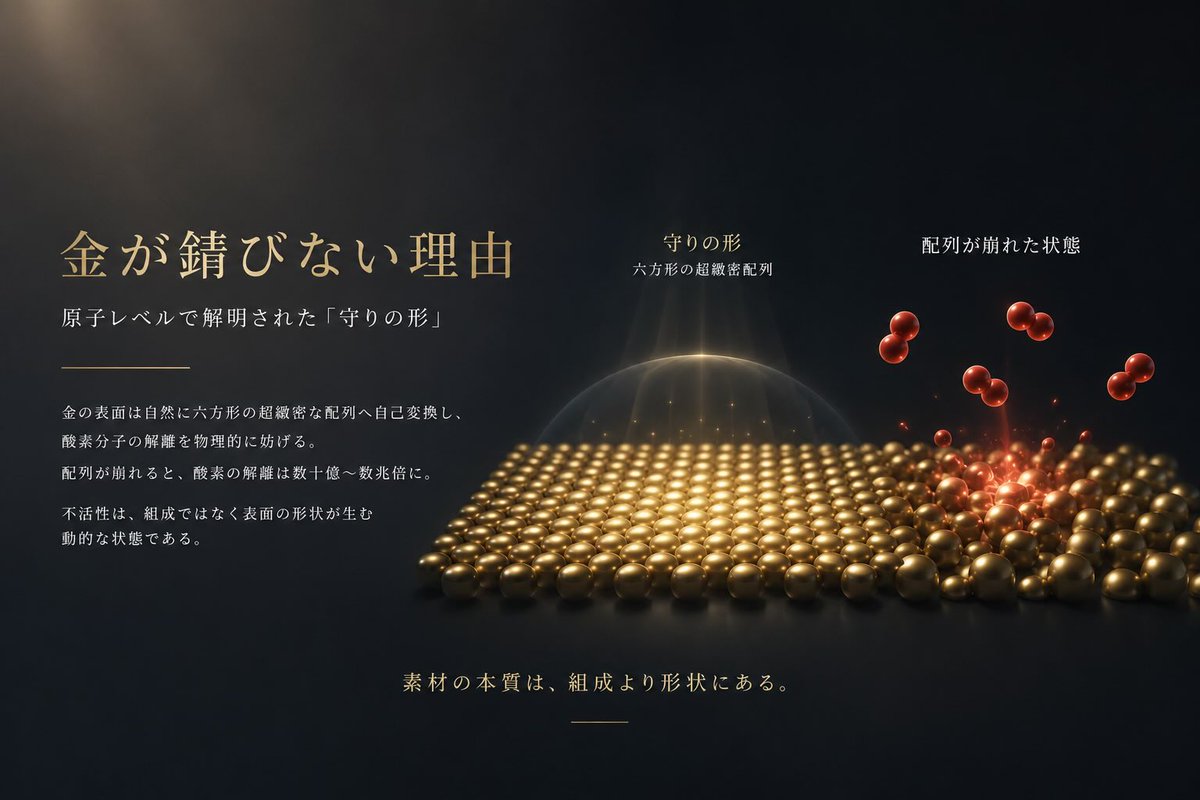
金は錆びない。これは常識ですが、その「なぜ」が原子レベルで初めて解明されました。
チューレーン大学の研究チームが今月、Physical Review Lettersに発表した論文によると、金の表面は自然に「六方形の超緻密な配列」へと自己変換します。この配列が、酸素分子が金に触れた際に分解・結合することを物理的に妨げています。配列が崩れると、酸素の解離が数十億〜数兆倍も起きやすくなることも確認されました。
1980年代、金のナノ粒子が優れた酸化触媒になることが発見され、研究者たちは長年「なぜ小さくなると活性化するのか」を問い続けてきました。今回の研究はその逆側から答えています。バルク状の金が不活性なのは、表面が自ら「守りの形」に変形しているからです。ナノ粒子ではその変形が起きにくく、酸素が入り込める隙が生まれます。
貴金属の「不活性」は固有の性質ではなく、表面形状が生み出す動的な状態だということです。この原理を応用すれば、燃料電池・医療用触媒・環境浄化技術において、金の「活性と不活性を意図的に切り替える」設計が視野に入ります。
素材の本質は、組成より形状にある。そういう知見です。
Gold doesn't rust. We've known that forever. What we didn't know was exactly why — until now.
A team at Tulane University published findings this month in Physical Review Letters showing that gold surfaces spontaneously reorganize into a tightly packed hexagonal structure. That atomic arrangement physically blocks oxygen molecules from splitting apart and bonding with the surface. When the structure breaks down, oxygen dissociation becomes billions to trillions of times more likely.
This fills in a gap that's been open since the 1980s. Back then, researchers discovered that gold nanoparticles — unlike bulk gold — are surprisingly effective catalysts for oxidation reactions. The standing question was why. This research answers it from the opposite direction: bulk gold is inert because its surface actively defends itself. Nanoparticles don't reconstruct the same way, so oxygen finds a way in.
The implication is more than academic. If the activity of a gold surface is governed by atomic geometry rather than chemical composition, then engineering that geometry — turning reactivity on or off — becomes a concrete design target. Fuel cells, medical diagnostics, and environmental catalysts all stand to benefit.
Inertness, it turns out, isn't a fixed property. It's a posture.
My presentation at the European Glycoscience Community has been uploaded. Particularly in the latter half, I introduce the recent discovery of the GH186 family and the structural evidence of anomeric-inverting transglycosylase.
https://t.co/g1bR8c4Md9