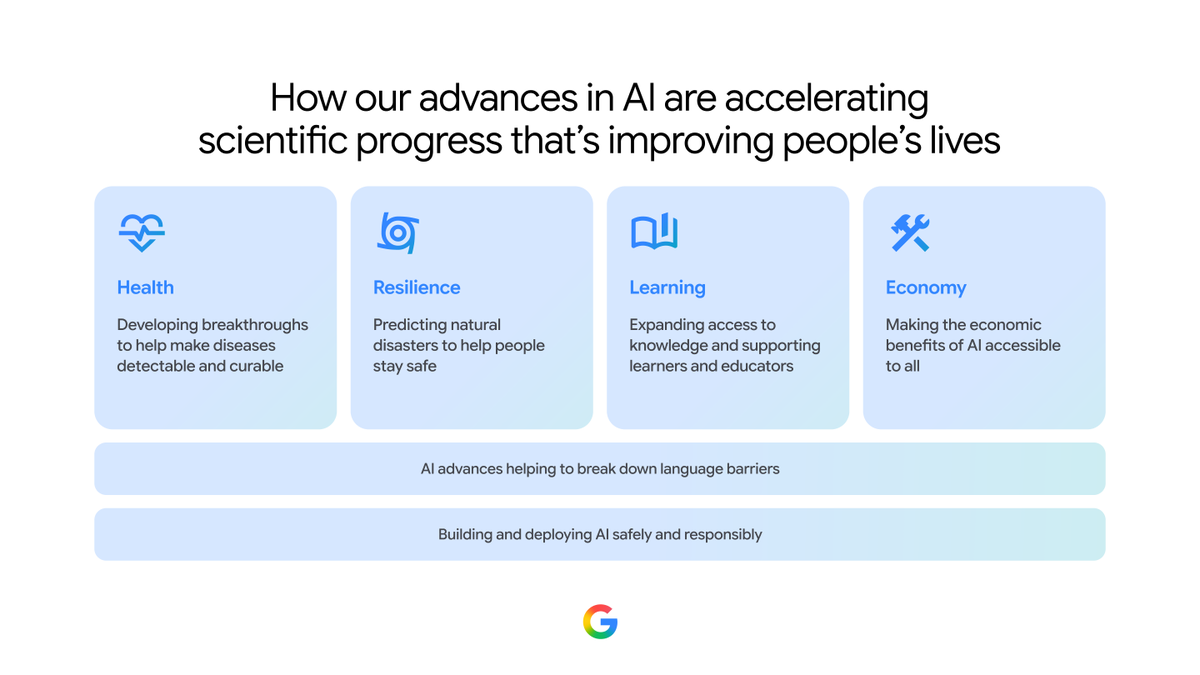
Today we have set out how we’re building AI to accelerate science and improve people’s lives. Just some examples in the last week or so:
- Mapped all 9B possible single letter genetic changes across the human genome with AlphaGenome Atlas and made it openly available to researchers.
- Billions of decisions depend on weather predictions so we introduced WeatherNext 3, our most accurate and capable global weather AI model to date.
- We published AI & Economy ATLAS, a comprehensive open-access look at how people are using AI globally.
- AI has enabled extraordinary advances in language translation. Today our services are available in nearly 300 languages, spoken by 7B people
We’re focusing our efforts on four key areas: health, natural disaster and weather resilience, learning, and economic opportunity. https://t.co/DDKcUTYj54
Update on the AI Studio mobile app 🚀
After over 800k pre-orders in over 168 countries, it’s clear folks want a way to build personal software on the go.
Instead of asking you to download yet another app we’ve decided to take an entirely different approach - one where apps emerge naturally, in the course of your everyday conversation with Gemini. So we’re partnering with the Gemini app team to make that a reality on mobile and desktop.
We’re continuing to invest in the AI Studio web experience for those who want to go from an idea to a prompt to a business.
More soon! :)
We’re launching the first iteration of the AI & Economy ATLAS (Activity, Task, Landscape, and Adoption Study), the most comprehensive study to date on how people are actually using Google’s AI products and tools.
Based on 15 million de-identified interactions across more than 800 occupations, ATLAS sheds light on how people are using Google’s AI tools at work and at home.
Today, we’re open-sourcing the draft specification for DESIGN.md, so it can be used across any tool or platform. We’re also adding new capabilities.
DESIGN.md lets you easily export and import your design rules from project to project. Instead of guessing intent, agents know exactly what a color is for and can even validate their choices against WCAG accessibility rules.
Watch David East break down this shared visual language in action👇. New capabilities and links in 🧵
I don’t really understand the maths it takes to send humans behind the Moon and bring them back safely. And the more I sit with that, the more it genuinely messes with my head even tho my love for physics and my knowledge of physics is astounding to a point
Somebody had to work out a path where the Moon’s gravity is pulling you in, the Earth is pulling you back, and you’re moving just fast enough and not slow enough not to get trapped by either. They had to figure out the exact angle to come back into Earth’s atmosphere too. Too steep, you burn up. Too shallow, you bounce off and drift into space. And they had to get all of that right at the same time, for real people sitting in a small metal capsule about 400k kilometres away from home.
Nothing in that system is standing still.
The Moon is moving.
The Earth is moving.
Even the Sun is pulling on everything. And still, some people looked at all of that motion, all of that chaos, and turned it into numbers you can follow. Go here.
Adjust here.
Come back here.
And unlike nepa light, it infact works.
There’s also that moment in the journey where the crew passes behind the Moon. No contact with Earth. No signal. Just silence, with a massive rock blocking everything they’ve ever known. The only reason they can stay calm in that moment is because someone, somewhere, did the maths and proved they’ll come out the other side.
I don’t know what it feels like to trust something that much. To put your life in an equation when you’re that far away from everything.
But I do know this for sure, whatever that level of thinking is, whatever it takes to reach it, it might be one of the most extraordinary things human beings have ever done...
its crazy that for millenials this was just a mid throwaway indie pop one hit wonder amidst hundreds of others during a golden age of indie music destined to be forgotten, but has recently been rediscovered because music right now is just that fucking bad
There's a physicist at Stanford named Safi Bahcall who modeled this exact principle and the math is wild.
He calls it "phase transitions in human networks." When you're stationary, your probability of a lucky event is limited to your existing surface area: the people you already know, the places you already go, the ideas you've already been exposed to. Your opportunity window is fixed.
When you move, your collision rate with new nodes in a network increases nonlinearly. Double your movement (new conversations, new cities, new projects) and your probability of a serendipitous encounter doesn't double. It roughly quadruples. Because each new node connects you to their entire network, not just to them.
Richard Wiseman ran a 10-year study at the University of Hertfordshire tracking self-described "lucky" and "unlucky" people. The single biggest differentiator wasn't IQ, education, or family money. Lucky people scored significantly higher on one trait: openness to experience. They talked to strangers more, varied their routines more, and said yes to invitations at nearly twice the rate.
The "unlucky" group followed the same routes, ate at the same restaurants, and talked to the same 5 people. Their networks were closed loops. No new inputs, no new collisions.
Luck isn't random. Luck is surface area. And surface area is a function of movement.
The lobster emoji is doing more work than most people realize. Lobsters grow by shedding their shell when it gets too tight. The growth requires a period of total vulnerability. No protection, no armor, soft body exposed to the ocean.
That's the cost of movement nobody posts about. You have to be uncomfortable first. The new shell only hardens after you've already moved.