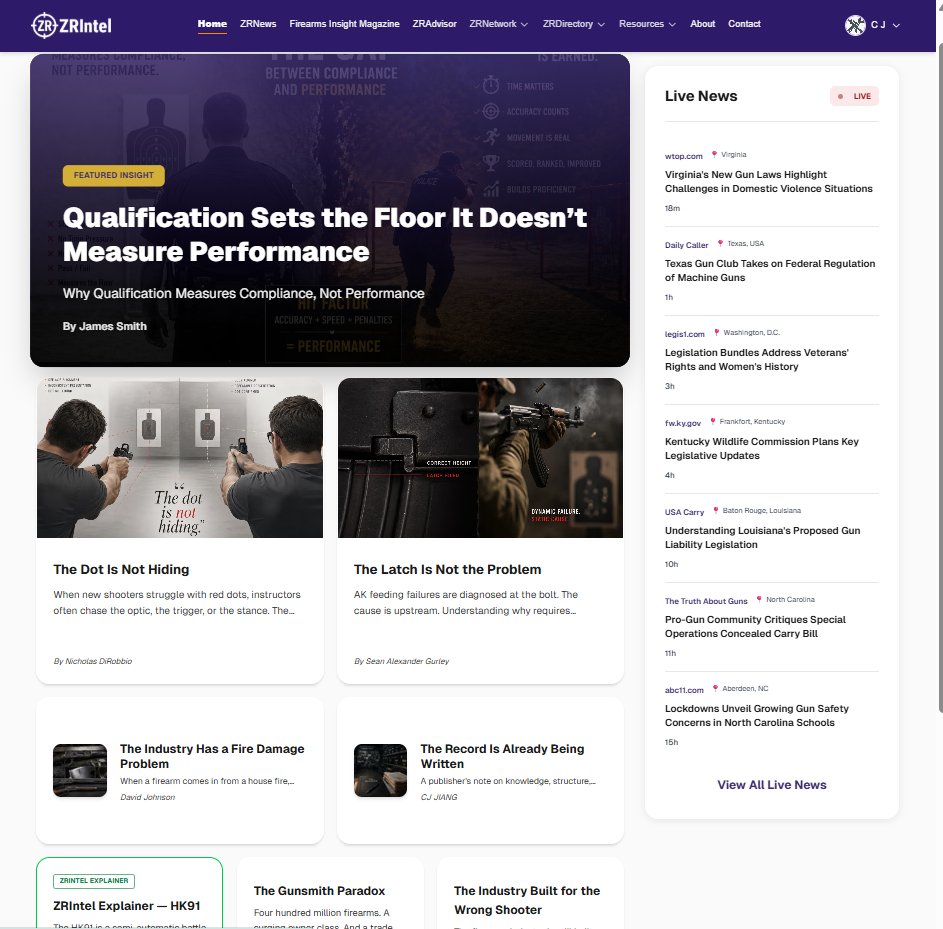
The platform is live. It looks like this.
One place for serious content about the firearms industry. Range, bench, policy, street. No filler. No press release rewrites.
Today's homepage:
James Smith on the gap between qualification and performance.
Nicholas DiRobbio on why the dot is not hiding.
Sean Gurley on AK feeding failures that start nowhere near the bolt.
David Johnson on fire damage.
Writing from people who have touched the problem.
The Live News feed pulls current.
The editorial runs deep.
The community is forming around people who treat this as a profession, not a pastime.
We are still building.
Directory. Advisor layer. Network. Trade infrastructure.
This is the foundation, not the finished product.
If you have something worth saying to this community, we want to help you say it right.
You answer the interview questions. Our editors shape the piece. You approve before it publishes.
Your byline. Our standard.
This is the intelligence layer of the firearms industry.
👉 https://t.co/y0NRQV9Y7h
#ZRIntel #FirearmsIndustry #FirearmsTraining #IntelligenceLayer #ReadyWhenItMatters
Most agencies think they have a training program. What they have is a compliance schedule.
That's the core argument in a new piece on ZRIntel by James "Jim" Smith, and it's one of the most important distinctions in law enforcement training today.
Jim isn't writing from theory. He's a Deputy Sheriff, a certified firearms instructor, a US Air Force veteran with 10 years in fire and emergency services, and a registered nurse with 17 years in critical care.
He has run into fires. He has worked trauma. He now pins on a badge.
When that man talks about the difference between being compliant and being ready, you stop scrolling.
His argument is straightforward and uncomfortable.
Qualification courses tell you whether an officer can hit a static target. No time pressure. No movement. No stakes.
They tell you nothing about what happens when all three of those conditions are present at once.
Which is the only condition that actually matters.
The system has a name. It's called a minimum standard.
What it is not, and was never designed to be, is a performance standard.
Agencies mark the box. Officers stay compliant. Everyone moves on. And the gap between compliance and capability stays invisible until it isn't.
Jim's piece explores that gap using the USPSA scoring framework as a reference point. Hit factor. Accuracy plus speed minus penalties. A system built around delivering effective fire under pressure, not standing still and punching paper.
It's a different frame. And it's one the training world needs to sit with.
Full piece here: https://t.co/tEz2vxQQuP
ZRIntel is the intelligence layer of the firearms industry. Range, bench, policy, street. We are still building, and contributors like Jim are exactly what makes this platform worth reading.
If you work in LE training, administration, or policy, this one is for you.
If you have something worth saying to this community, we want to help you say it right.
#FirearmsTraining #LawEnforcement #QualificationVsPerformance #LEInstructor #ZRIntel #ReadyWhenItMatters
Most red dot problems are not optic problems.
Nick DiRobbio of 611 Armory Training just published a training insight on ZRIntel that every pistol instructor should read. The dot is not hiding. The gun is not arriving in the same place twice. The optic is the honest reporter, not the cause.
Nick is a former Army officer, 14-year law enforcement veteran, agency firearms instructor and armorer, and the owner of 611 Armory Training LLC in Land O' Lakes, Florida. He has watched this exact student on the line more times than he can count.
https://t.co/6Hq37Ly133
This piece also opened a bigger question worth discussing.
Red dot pistols are now standard in civilian training. But does red dot proficiency belong in a universally recognized proficiency system? Is it a standard of its own, or is it simply part of precision skill: 100 score, B8 target, 10 yards, 10 seconds, 9mm?
If a student can put 10 rounds into a clean B8 at 10 yards under 10 seconds with a red dot, that result carries the same weight under any instructor, at any school, anywhere. Same target. Same distance. Same time. Same caliber. The score is objective. It belongs to the shooter, not the curriculum.
Is that a universally recognized proficiency standard? Should it be?
ZRIntel Firearms Insight Magazine exists to document questions like this and the people qualified to answer them. Not monetized. No sponsorship favors. Instructor intelligence preserved and shared with serious people in the training community.
We launched in February. More than 50 Insight pieces published. Over 40 accomplished practitioners. More scheduled every week.
If you teach and you have something worth saying, we want it on record.
https://t.co/1LY82f28UW
#FirearmsTraining #RedDot #PistolInstruction #FirearmsInstructor #CCW #ZRIntel #FirearmsInsight #2A #GunTraining #SelfDefenseTraining
Most gunsmiths can't show you their work. They tell you. There's a difference.
The firearms industry runs on reputation. But reputation without evidence is just a story someone told you. We built GunsmithZR to change that.
Here's what a real bench record looks like.
A 1911 trigger job comes in. Springfield Armory .45 ACP. Factory trigger at 6.2 lbs, heavy pull, slight creep, inconsistent break. Customer wanted a cleaner defensive-use trigger without going too light.
The smith logged everything. Tools used: Trigger Pull Gauge, Brownells Trigger Jig, Arkansas Stones, Wheeler Gauge. Work performed: trigger inspection, contact surface polish, sear and hammer engagement check, overtravel adjustment, thumb safety and grip safety verification, dry-fire function check.
Result: 4.1 lbs. Clean break. Reduced creep. Safety function verified. Defensive-use margin preserved.
That last part is the one that matters. He didn't chase the lightest number. He stopped where the gun needed to stop for its purpose. That's professional judgment. And on GunsmithZR, you can see it in the record before you ever pick up the phone.
The same profile shows a barrel crown recrown on a rifle with inconsistent groups. A stock bedding job on a bolt action with shifting point of impact after action removal. Three disciplines. Three documented outcomes. Enough for another gunsmith to decide in 30 seconds whether to pass a job his direction.
That's what we built Pass a Job for.
Not star ratings. Not reviews. Work evidence matched by AI ranking so the right job finds the right bench. Then a direct message to see if that shop is open or slammed. Then the forum when the job is genuinely hard and you want another set of eyes. Then The Bench when you have something worth sharing with the whole trade.
This is the full stack. Document. Match. Connect. Discuss. Publish.
To every gunsmith, instructor, and industry professional who has supported the build: thank you. GunsmithZR is the most complete set of tools the trade has ever had in one place.
Now let's build the network to be the best in the business.
If you're a gunsmith who documents your work, your profile belongs here. If you know one, tag them.
#GunsmithZR #Gunsmithing #1911 #TriggerJob #BarrelWork #StockBedding #FirearmsIndustry #GunsmithLife #PassAJob #TheBench #FirearmsTraining #PrecisionRifle #1911Pistol #45ACP #TheCraft #GunTech #SmithWork #BuildTheNetwork #FirearmsCommunity #GunsmithDirectory
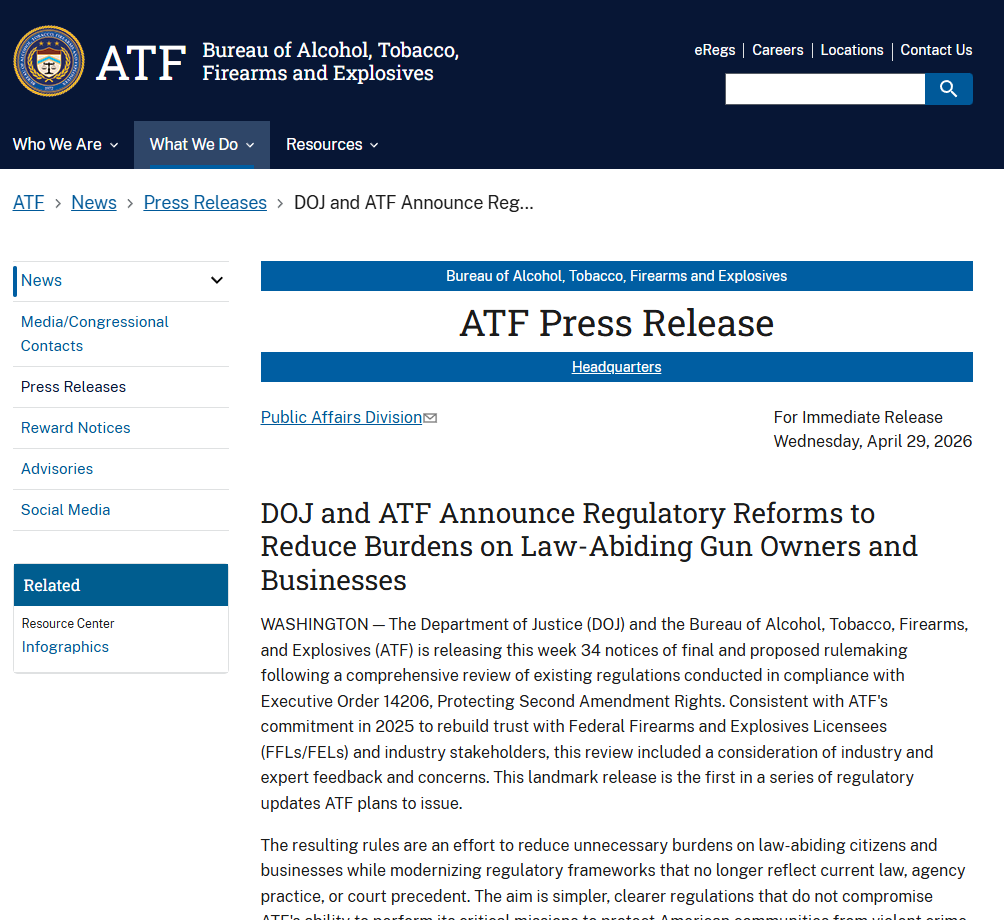
Most ATF reform coverage yesterday was either premature celebration or panic.
We did neither. Here's what we actually did. 🧵
1/ When the press release dropped, we read it. Then pulled the actual ATF summary page. Then emailed our GunsmithZR members with what it said — and what it didn't.
2/ The press release said "34 notices of final and proposed rulemaking." Influencers ran with it as if changes had materialized.
All 34 are proposed. Still in comment period. Not yet operative. Meaningful difference if you run a shop.
3/ We also separated what's already in effect:
— Zero-tolerance enforcement policy: ended
— FFLs who lost licenses under it: reapplication path now exists
— NICS alerts: restricted to federal trafficking violations only
Those are real. Today. Not proposals.
4/ One of our members lost his shop over a file maintenance violation under the old posture.
That reapplication path matters to real people. We said so directly to our community.
5/ This is what @ZRIntel is built to do.
Not hype. Not reaction. Practitioner-level intelligence — verified against primary sources, corrected when wrong, no agenda.
🔧 Gunsmith shops → https://t.co/hcH1TIeDqc
📡 Firearms intelligence → https://t.co/yi3DYWvGvY
#FFL #ATF #GunsmithZR #FirearmsIndustry
The shift from 'zero tolerance' to actual reform under Director Cekada is the biggest news here for working shops, many of them are members of our https://t.co/DBsng2R2YJ smith network.
It gets the target off FFL’s backs for typos.
However, the skepticism on the digital side is healthy. We want modernization, but we have to ensure it doesn't turn 'streamlined records' into a searchable national registry by the back door. Keeping the focus on protecting the FFL is key.
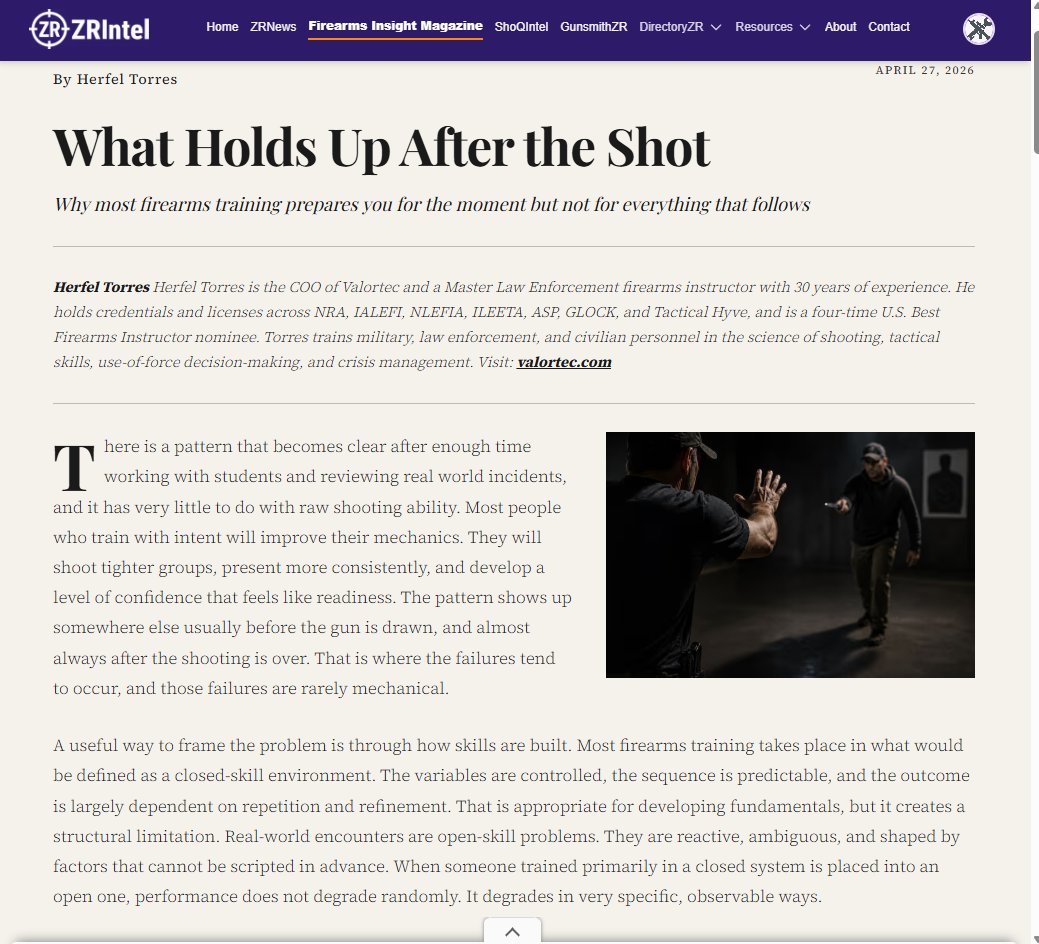
Most firearms training prepares you for the moment.
Almost none of it prepares you for what comes after.
Herfel Torres breaks down the three failure patterns that show up once legal ambiguity enters a scenario — and why Phase Three (post-incident) is where tactically correct responses become legal liabilities.
Full piece: https://t.co/kvRipDJ8dr
#FirearmsTraining #LawEnforcement #UseOfForce
Most firearms instructors never document what they've learned.
James Smith did.
"Twenty-Three Out of Twenty-Five" is live now in Firearms Insight Magazine on ZRIntel.
Here's the short version:
An 85-year-old widow found her late husband's handgun while cleaning out his belongings. She didn't recognize it. Hadn't asked for it. But she wasn't ready to let it go — so she signed up for a CWP class.
James didn't put up a target.
He had her fire five rounds into the berm. No score. No pressure. Just get familiar with how the gun moves, what it sounds like, how the grip feels when the slide cycles.
She scored 23 out of 25.
When it was over, she didn't want to leave.
That outcome didn't come from curriculum. It came from assessment — from an instructor who figured out who was standing in front of him before he started teaching.
James is a USCCA Certified Instructor, Range Safety Officer, USPSA Range Officer, registered nurse (BSN), and USAF veteran with a decade in fire and emergency services.
He draws a direct line from clinical nursing to range instruction: you don't treat the symptom until you understand the patient. You don't teach the student until you understand the student.
His argument: most instruction failures aren't curriculum failures. They're assessment failures. The instructor taught the right material to the wrong picture of the student.
That's a framework worth keeping.
Firearms Insight Magazine exists to preserve exactly this kind of practitioner knowledge — field-tested, hard-earned, written by the people actually doing the work.
Full piece linked below.
https://t.co/HlI4Cz7fBd
#FirearmsInstruction #USCCA #CWP #FirearmsTraining #FirearmsInsightMagazine #ZRIntel #GunSafety #RangeSafety #LawEnforcementTraining #SelfDefense
Six shops. Same answer. None of them ran a gauge. Not one.
A customer walked in with a lever-action that had been through a fire. Every shop she hit turned it away on sight. No inspection. No gauges. Just "fire damage — we don't touch that."
That's not a diagnosis. That's a guess dressed up as policy.
David Johnson just published a piece on The Bench that breaks down exactly what fire actually does to metal — and the one measurement that determines whether a job is dead on arrival or worth picking up.
Here's what most shops don't know:
Fire damage has a signature. Heat affects different metals at different thresholds. The receiver, the barrel, the action — they don't all tell the same story. A shop that skips the inspection sequence isn't protecting itself. It's just leaving money and knowledge on the table.
The inspection either ends the job before it starts — or earns it the right to continue.
That line matters. Because "we don't touch fire damage" is not the same as "we inspected it and here's why we can't save it." One is a trade answer. The other is a guess.
David runs Leatherneck Gunsmithing in Vinton, VA — a Service Disabled Veteran Owned shop. He also writes monthly for Modern Gun School. This piece reads like someone who has actually held the gauge.
Full article: https://t.co/AoT007qLR3
---
The Bench is where working gunsmiths publish. If you're running a shop and have something worth saying, we want to hear from you at GunsmithZR (https://t.co/hcH1TIfbfK)
#Gunsmithing #TheBench #GunsmithZR #SDVOSB
The federal government closed Bruce Simmet's shop.
19 years. Full-service. Toledo, Ohio. Everything from matchlocks to the newest polymer frames. NRA-certified instructors. CCW courses across two states. Military arms specialization. DoD background before any of that.
Gone. Political reasons, he says. Doesn't elaborate. Doesn't need to.
What he wrote afterward is one of the clearest things I've read about what's actually happening to this trade.
Most gunsmiths running shops are not doing what they love.
They're doing what pays.
Those are not the same list.
The compliance load grows every few years. The paperwork multiplies. The margins tighten. The liability exposure expands. And somewhere in the back of the shop, under a tarp, is the project that actually matters. The historical piece. The one-off. The thing that would take 40 hours and pay for 20.
It never gets touched.
Because it can't.
Simmet put it straight:
"The regulatory environment doesn't produce craftsmen. It produces compliance managers who also happen to know how to fit a barrel."
That's the layer the industry is losing.
Not just the knowledge itself — though that's real and it's going fast.
What's being lost is the kind of gunsmith who has time to go deep.
Here's the part nobody says out loud about the apprenticeship problem:
You can't pass down what you don't have time to practice.
The deepest knowledge in this trade doesn't live in a manual. It lives in the craftsman who spent 15 years on one platform. The chamber dimensions he knows by feel. The repair approach he worked out over hundreds of repetitions. The judgment that only comes from having seen the same failure mode 400 times.
When a shop closes — retirement, economics, regulatory pressure, doesn't matter — that knowledge closes with it.
It doesn't transfer automatically.
It goes quietly.
"When the government closes a shop, whatever the reason, it doesn't just close a business. It buries whatever was in that craftsman's head that never made it onto a page."
Multiply that across every shop that's closed in the last decade.
That's not a recruitment problem.
That's knowledge erosion with regulatory acceleration.
After the shop closed, Simmet built a 1840 mountain howitzer carriage from period documentation alone. No kit. No tutorial. Just mechanical intuition built over decades.
Then he taught himself blacksmithing. The real version. Where you understand what the metal is doing and why.
His client still hasn't come to pick up the howitzer. He says he doesn't mind.
"I built it because I had time to, for the first time in nineteen years."
The craft was always there.
The shop had been competing with it.
The apprenticeship problem isn't a recruitment issue.
It's a margin issue.
And until that changes, you can build all the programs you want.
The constraint isn't awareness.
It's whether the trade has enough room to exist at the depth it needs to.
Full piece on The Bench at GunsmithZR:
https://t.co/QcNTEXDDCd
A corrections officer carried a Glock 23 Gen3 as his duty weapon for 25 years. Cleaned it once. His complaint: squishy trigger.
When he handed it to me I saw immediately that the slide locking bar and spring were missing. Not worn. Not damaged. Gone. The weapon had passed every institutional checkpoint his career put in front of it — range officers, department armorers, 25 annual qualification cycles. None of those checkpoints were looking for what I was looking for.
I ordered the parts. The gun will be fixed. That is not the story.
The story is that this case is not unusual. It is the pattern.
---
I spent 26 years as a Combat Arms Training and Maintenance (CATM) instructor in the Air Force. We owned the inventory. Every weapon on the base fell under our responsibility: inspection cycles, sub-depot maintenance, serviceability documentation, range safety.
In that world, this weapon never reaches a gunsmith as a complaint. It gets caught on a scheduled inspection. Logged. Fixed. The carrier never knows it happened because the system handles it before it becomes his problem.
A weapon wasn't examined because something felt wrong. It was examined because time had passed.
That is what a firearms accountability standard looks like from the inside. Not a complaint system. A scheduled one.
In the civilian market — including most law enforcement — this standard does not exist.
---
The failure mode is quiet. A Glock with a worn recoil spring cycles normally until it doesn't. A missing slide locking bar won't announce itself before the moment it matters. The weapon that was reliable last year is still reliable this year, and the year after, right up until it isn't. Nothing in the owner's experience tells them the condition is changing.
What I hear constantly: "I've had it for years without a problem. I clean it. It still runs."
What they are describing is not a maintained firearm. It is a firearm that has not failed yet. Those are different things. Confusing them is how a duty weapon runs compromised for 25 years without anyone catching it.
---
There are practitioners in this market who came out of exactly the background it lacks. Military armorers. CATM instructors. DoD-credentialed small arms specialists who spent careers running scheduled inspections and accountability documentation on working weapons in working units. They know what a serviceability standard looks like because they lived inside one.
The structure to connect them to the work their credentials justify has not been built.
A carrier looking for a qualified duty weapon inspection has no reliable way to find one. No visible credential. No directory filtering by armorer background. No defined inspection standard. The market offers no mechanism to distinguish a smith who spent 26 years running CATM cycles from one who finished a weekend armorer course. To the carrier, they are both gunsmiths. The encounter depends on proximity and chance.
That is a coordination failure with consequences.
---
The corrections officer found me in a conversation. He came in about a trigger. He left knowing his duty pistol had been running with missing components for years. That outcome depended on luck. Most carriers in his position never have that conversation. They leave the range, reholster, and go back to work.
The G23 got fixed. That is the outcome a standard produces every time. Right now it is the outcome a lucky conversation produces occasionally.
Outside a structured accountability system, duty weapon reliability depends on nothing going wrong. That is not a standard. That is a default.
Full piece: https://t.co/mcpP8QVAod
#Gunsmithing #LawEnforcement #DutyWeapon #FirearmsMaintenance #CATM #Glock #ZRIntel
The market doesn't pay for skill. It pays for credential.
That's not a flaw in the system. That IS the system.
A customer can't evaluate your trigger work before you do it. So they default to the signal they can read: the diploma on the wall, the manufacturer cert, the published article with your name on it.
---
Seth Cohen — Editor-in-Chief of The Bench — calls this the Harvard Problem.
A Harvard Law grad can charge more than a regional state school grad. Does she win more cases? The data says no. But the client across the desk doesn't have the tools to evaluate that.
The credential removes uncertainty at the moment of decision.
Skill alone cannot do that.
---
The exceptions are real and worth naming.
Bill Wilson. Doug Turnbull. ACGG Professional Members.
These men built credentials that look different — reputation, documented mastery, peer review by the best in the trade. But Wilson's took 45 years. Turnbull's took 35.
The ceiling disappears at the apex. Getting there is the work of a lifetime.
---
For everyone operating below that level, the path is the same:
→ Recognized school credential (Trinidad, CST, Murray State)
→ Platform armorer certs in high-demand niches
→ Published work that converts private expertise into public authority
→ ACGG membership if your work qualifies
Stack the signals. The bench will pay you for it.
---
This is exactly why we built The Bench.
The Bench is the trade publication of GunsmithZR — the professional network for verified FFL gunsmiths.
You answer 11 questions about a job that stuck with you.
Our editors write it up.
You approve it before your name goes on it.
It publishes. You share it to your circle.
One article. Your expertise made legible.
---
If the market can't see your skill, it doesn't exist.
Build the signal.
Read the full piece → https://t.co/WdsqEw8ghS
Write for The Bench → https://t.co/vd0TBjwk1w
#Gunsmithing #Gunsmiths #FFL #GunsmithZR #TheBench #FirearmsIndustry #2A #GunShop #1911 #TradeSkills
17/The man with the sunglasses is still alive because enough of that work had already been done before Burris walked down that trail. Not instinct. Not luck. Work done before the moment arrived.