I mean really useful data is, well, useful, and if one use it reasonably well, one can use it to reliably improve trading. This data is expensive and tough to truly know the full picture.
For pricing, I hate tiers. Like either let me have the product or not. Don’t give me some of it if I’m paying. There are all sorts of options flow software out there. So there’s definitely established competition.
$150/mo means it’s gotta be solid. $300/mo it better be stellar or do other things you can’t reliably get elsewhere. I’m extremely likely to buy $20-50/mo subs just to see. If I don’t find something useful, I’d probably cancel after a few months to a year. Giving it a full chance to really get into it and learn.
But in reality, if it helps me make a single trade better, it’s worth it at most retail prices. Today I gave back 3% of my account because I didn’t pin the bottom. Getting closer by 50 points would have been worth it all. If it (and me) is good enough to reliably make that size of a difference 25% of the time, I’d be stoked.
But realistically you can try offering discounts and see where you optimize new accounts…
You would think that if revenue per employee is doing so well, they’d be hiring people like crazy to maximize total revenue! Instead they’re doing layoffs… hmmm
Small caps have yet to see the benefits of AI:
Magnificent 7 companies' revenue per employee is up to ~$270,000, the highest in at least 3.5 years.
Since the start of 2023, this figure has surge +$45,000, or +20%.
Over the same period, Russell 2000 companies' revenue per employee has declined -$20,500, or -14%, to $122,000, the lowest in at least 3.5 years.
By comparison, the remaining 493 S&P 500 companies stand at ~$195,000 per employee.
This means each Magnificent 7 employee now generates more than 2 times the revenue of a Russell 2000 employee and +38% more than the average S&P 493 employee.
This reflects both aggressive headcount reductions and strong revenue growth across the largest tech companies, while smaller companies show deteriorating efficiency.
Productivity is concentrated at the top of the market, while the rest continues to lose ground.
BREAKING: Iran warns that the US military response to the Apache helicopter downing will immediately place all regional Gulf energy infrastructure under continuous Iranian missile fire, costing the US oil, gas, and regional interests "for years," per Iran's Parliamentary Vice Speaker.
US senators briefed by CENTCOM Commander Admiral Brad Cooper now believe Iran intentionally struck the US Army Apache helicopter and US retaliation is "imminent," per NBC.
One way to think of it is that it needs to make you one successful SPX 5 point wide credit spread trade per month be a winner and not a loser. Using good software can help you make smart choices.
I haven’t used @OptionsDepth yet myself. Definitely like the visualizations from what they post. But am always intrigued by new tools! It’s part of the cost of trading. And in fact if you qualify for trader tax treatment it could be deductible expenses. (NFA/NTA)
@SlopeOfHope Not for anyone to believe. Just algo trades I’d bet. I dunno, I’d probably have blocked those as keywords if that’s been happening lol. https://t.co/PJO6k0OUrL
BREAKING: Iran directly rejects today's claim that Iran sent a new draft peace proposal to the US, saying "no such proposal exists," due to the suspension of talks with the US, per Fars. Iran also denied agreeing to a 15-year enrichment suspension, denied "zeroing in" on four nuclear issues, and denied Trump's claim of a deal being reachable in "two or three days" and that the Strait of Hormuz "will open up right away."
BREAKING: Iran directly rejects today's claim that Iran sent a new draft peace proposal to the US, saying "no such proposal exists," due to the suspension of talks with the US, per Fars. Iran also denied agreeing to a 15-year enrichment suspension, denied "zeroing in" on four nuclear issues, and denied Trump's claim of a deal being reachable in "two or three days" and that the Strait of Hormuz "will open up right away."
If you needed any evidence of how much complacent and idiotic markets became, look no further than US stock futures at this moment
Why so many people enjoy dancing in front an incoming steamroller is still beyond my understanding sorry
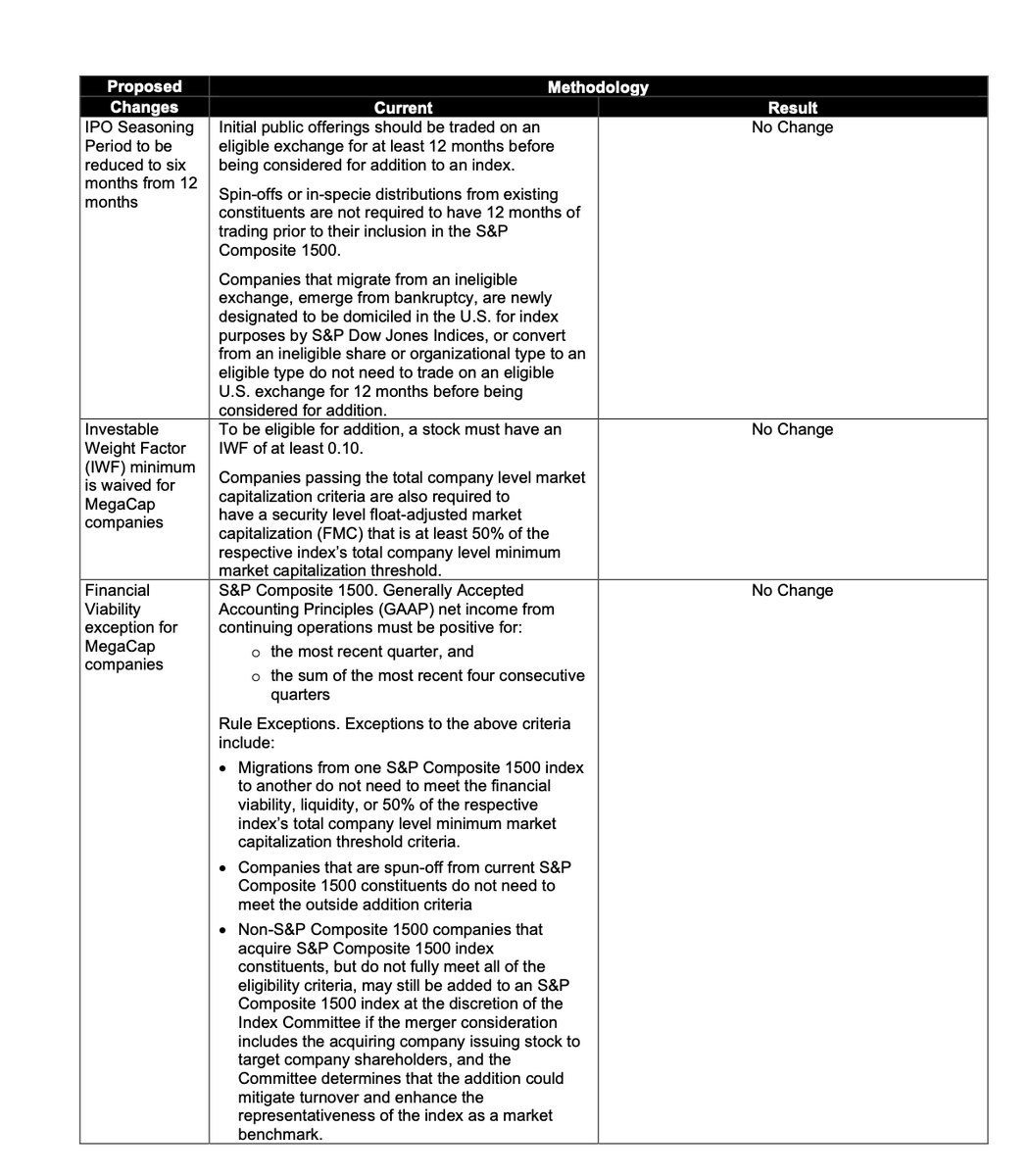
Wow, the S&P Dow Jones Indices has just officially announced that they will NOT be changing their inclusion rules to make it easier for “MegaCap” companies (such as @SpaceX) to be fast-tracked into the S&P 500.
Their reasoning:
"S&P DJI determined that exceptions to the financial viability, seasoning, and IWF requirements should not be granted solely based on market capitalization. The decision not to adopt the proposed exceptions preserves core index principles by maintaining consistent application of these key requirements. Although there may be trade-offs between strict adherence to these eligibility requirements and broad representativeness, the current methodology provides substantial market coverage and sector balance. As a result, the indices can continue to meet their stated objectives while preserving their role as representative and investable benchmarks for the U.S. equity market.
No changes will be made to the eligibility criteria including financial viability screens, seasoning period, or minimum IWF, for the S&P 500, S&P MidCap 400, or S&P SmallCap 600 as a result of the S&P Dow Jones Indices consultation on the treatment of MegaCap companies. Accordingly, there will be no changes to existing methodology for this index family."
This means that the earliest @SpaceX could be eligible to be added to the S&P 500 would now be June 2027.
The requirements that will now remain in place are:
• No changes to S&P 500 eligibility rules for mega-cap companies.
• Mega-cap companies will still need to wait 12 months after their IPO before being considered for S&P 500 inclusion.
• S&P will not waive profitability requirements for mega-cap companies. The company must have positive GAAP net income in the most recent quarter, and the sum of the most recent four consecutive quarters.
• S&P will not waive minimum public float requirements for mega-cap companies. At least 10% of a company's shares must be publicly tradable ("free float").
The S&P rejected proposals that would have:
• Reduced the IPO seasoning period from 12 months to 6 months
• Waived profitability requirements
• Waived minimum public float requirements