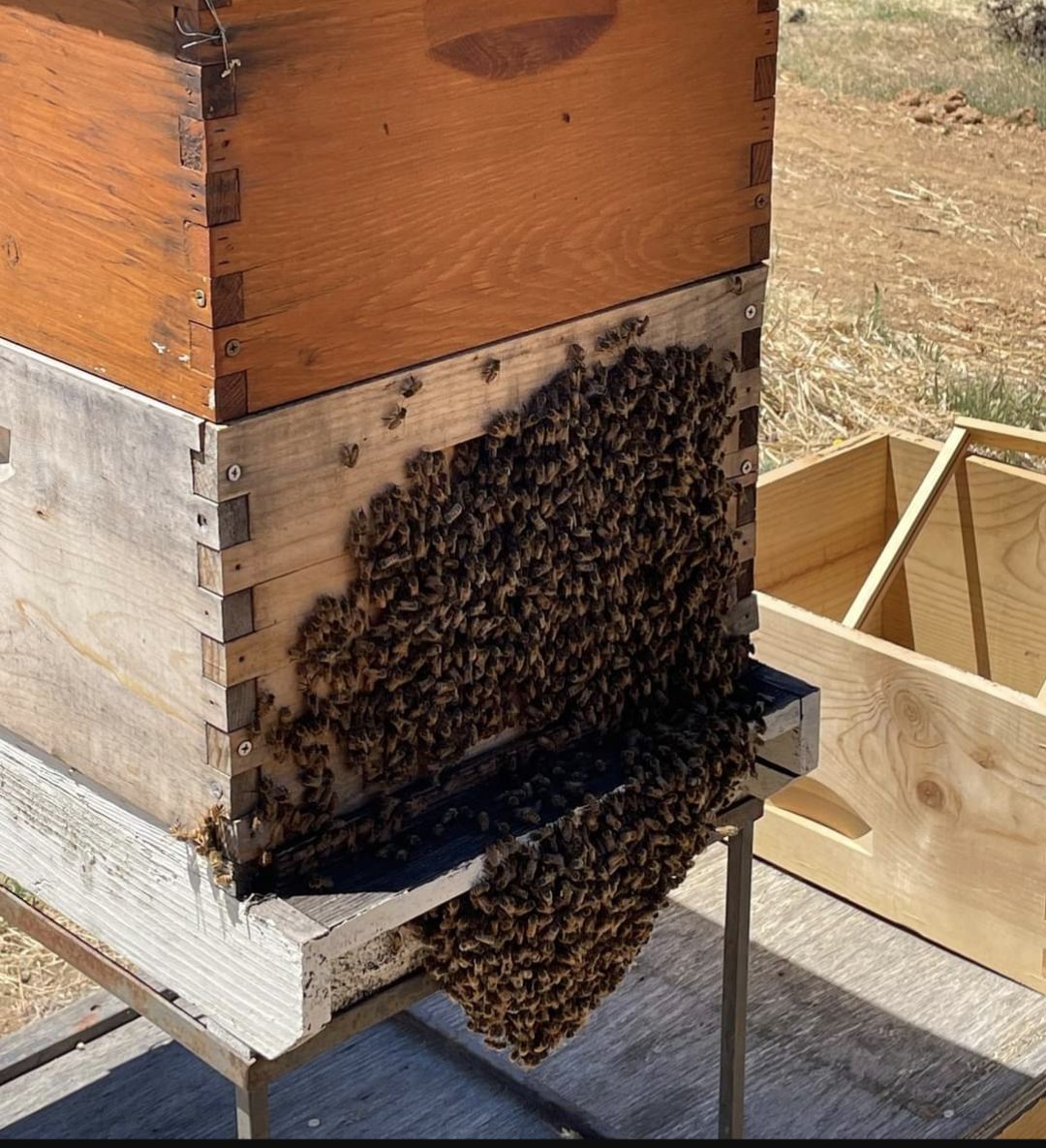
@pguythompson Can you agree that:
1. Bee movement and respiration produce heat
2. By moving outside the hive, bees remove a heat source. (This has been directly observed via FLIR imaging, showing temperature drops as bees leave the hive)
3. Bearding at lower temps may serve other functions
@pguythompson In the paper "The Upper Lethal Temperature of Honeybees" by J. B. Free et al, they determined 38C is the temperature at which hive health declines (water weight loss, etc). Temperatures exceeding 42C+ were determined to be lethal.
@pguythompson Bearding cause is not monolithic. I think you're misunderstanding (hard to convey nuance in 160 characters). When temperatures reach 38C they will beard because their survival depends on it. At lower temps they can beard for a number of reasons.
@pguythompson As mentioned, in hot and humid temperatures (to be more exact, those exceeding 38C), you will find that zoologists and beekeepers alike view bearding primarily a thermoregulation technique. That said it can be disproven if enough data says otherwise (afaik this has not occurred)
@pguythompson If you're in the latter group (scientists), I'd recommend "Coping with the cold and fighting the heat: thermal homeostasis
of a superorganism, the honeybee colony" by Stabentheiner et al.
@pguythompson Although the aforementioned paper has poor citation use, each of its assertions can be verified by data from other sources (yes it's more work on the reader which is unfortunate). It's primarily geared towards informing beekeepers rather than scientists.
Bees, like humans, become intoxicated after consuming alcohol. This often occurs with bees in the late summer when foraging from fermented food sources. Any attempts to stumble into the hive are prevented by the posted guard bees. Only sober bees are allowed entry #BeeFacts
@pguythompson Studies have shown exposing queens to 42C for as little as 4 hours reduced her sperm viability by 56%, so it's fairly accepted that bearding is primarily to reduce temperature as a matter of survival. That said there are several secondary reasons--just not on hot days
@pguythompson Brood requires temperatures up to but not exceeding 36C/97F to become viable adult bees; by moving outside and having "fanner" bees at the entrance keeps brood viable otherwise temperature would have catastrophic affects on life expectancy of the hive.
@pguythompson Excerpt: "in extremely hot weather... bees make their way out and cluster
outside. Honeybees do this
primarily to keep the inside of the hive from overheating and
killing the brood, and to help regulate the
brood nest temperature."
Australian scientists have found bee venom to have anti-cancer properties, due to the compound melittin. Melittin in certain concentrations has been shown to be effective against both melanoma and breast cancer with minimal harm to non-cancerous cells. #BeeFacts
Like humans, studies have shown that consuming caffeine improves focus and memory in bees 🐝☕ Bees that have consumed caffeinated nectar were 3x as likely to remember a nectar source 🧠 and communicate it to their hive (via dance) than their decaf counterparts 🍵 #Bees#BeeFacts
Honey bees vote to decide on a new nest site. Bees scope out potential sites and report back, using the waggle dance. The better the site, the more enthusiastic the dance! If the observers approve, they imitate the dance, until a 'critical mass' is reached, and the decision made.