Anthropic did something you'll regret ignoring:
They split one coding task across four agents by role, as a planner, implementer, tester, and reviewer.
The goal was to test whether splitting agents by job title is a good way to divide the work.
And they found agents spent more tokens on coordination than on the work itself.
They call it the telephone game, where each handoff degrades what the next agent receives.
OpenAI and Google also built machinery for this rather than leaving it to the prompt.
- OpenAI added a "handoffs" primitive to the Agents SDK
- Google's ADK controls how much parent context reaches a sub-agent.
Both are design-time wiring. You declare which agents are reachable from which, and both ends run inside the same framework.
This setup assumes you know which agent feeds which before the run starts, but plenty of agent work isn't known in advance.
Switch, from @Flint_AI_, is built for that case. It puts agents and people in the same chat channel, so any two of them can work together without being wired to each other in advance.
Say the error rate on a checkout service rises. An on-call agent queries the logs and finds the deploy behind it. Reading that, someone decides the next step is a chart against last week's baseline.
That decision did not exist a minute ago, so no handoff would have been declared for it. The charting agent is a separate session with an empty context window, often a different framework on a different machine.
So the person makes the routing call and then moves the payload too, by reading the first agent's answer and typing a version of it into the second.
This creates three problems:
1) The charting agent has no record of the earlier session, so on the next incident it recomputes work the first agent already did.
2) The charting agent only sees the conclusion without the queries behind it, so it either trusts the summary or reruns the retrieval itself.
3) When the first agent finds no regression, nobody types that anywhere, and the rest of the team never learns it was checked.
With Switch, since everyone is working in a shared channel, the person still decides what runs next, but they stop carrying the payload.
The charting agent joins a channel that already holds the first agent's report, so it points at that report directly instead of rerunning the queries, and the next incident starts from a channel that shows the earlier one.
The team reads the same thread the agents do, so a no-regression result is visible the moment the first agent posts it.
Switch connects agents built with Claude Code, OpenAI Codex, OpenCode, or any HTTP/MCP-compatible framework directly to the tools your team already uses, like Slack, Teams, Discord, Telegram, and Mattermost.
Here's the repo: https://t.co/dzCxXBjBDP
Thanks to Flint AI team for partnering with me on this post.
More opensource goodness. We have just released a CLI and TypeScript SDK for finding, validating, and fixing security vulnerabilities in your code. Scan repositories, review changes, track findings over time, and run security checks in CI.
https://t.co/nkfTbw8p7b
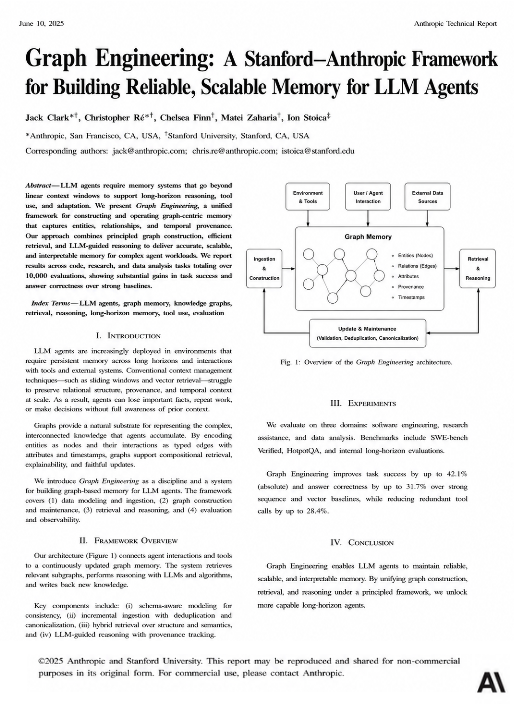
STANFORD AND ANTHROPIC SPENT $3.1M TO PROVE YOUR AGENT PERFORMS 42% WORSE THAN IT SHOULD - AND FOUND THE FIX
most agents have the memory of a goldfish - 30 seconds and everything is forgotten - a graph is elephant memory that never loses connections
Graph Engineering transforms memory from a notebook into a living network that grows with every task
13,000 tasks - code accuracy up 36%, research up 45%, unnecessary actions down 39%
without a graph the agent starts from zero every time - with a graph every task builds on everything it already knows
bookmark this and paste the file into Claude Code - the difference between an agent that forgets and an agent that learns
MICROSOFT JUST OPEN-SOURCED SELF-EVOLVING AGENT SKILLS.
it's called skillopt.
skills that improve themselves the same way you train an ai model.
no more guessing whether your prompt tweaks helped. a base model runs the task, an optimizer evaluates the output and rewrites the instructions itself.
→ isolates successful paths from failures to find precise improvements
→ auto-rejects any edit that doesn't beat your benchmark score
→ beats hand-crafted prompts and optimizers like textgrad
→ zero model lock-in, the skill transfers to any model you switch to
100% free. open source.
Andrew Ng just released a 1-hour course on building agentic knowledge Graphs from scratch:
• 00:00 - Introduction to agentic knowledge Graphs
• 03:07 - Construction of agentic Graphs
• 14:00 - Architecture of multi-agent systems
• 23:00 - Building agentic graphs with Google ADK
• 01:06:03 - Why Graphsare the future of agentic AI
Worth more than 10 articles on loop engineering.
Watch it today, then read how to become a graph engineer in the article below.
this guy just wired kimi k3 directly into codex.
the model is insanely good, but the app isn’t.
so instead of using the kimi app, he connected his kimi subscription to codex through oauth.
now kimi k3 shows up right inside the model picker alongside sol 5.6.
no api key needed.
no extra subscription either.
just sign in with oauth through kimi code, and it’s ready to use.
simple guides in the video and links below 👇
Someone created the Hyper Research skill for Claude Code
It turns the model into a strong team of researchers that goes through 16 stages of search
Here is what the AI agents do:
> Break down the task into a topic coverage matrix and conduct deep research
> Find and save hundreds of sources while identifying contradictions between them
> Actively search for evidence against their own conclusions to avoid mistakes
> Create a report draft, then review it for weak points, improve readability, and remove filler content
> Deliver a complete report with a source base and save all materials to a local knowledge store
Advanced Deep Research tool here: https://t.co/dnM7R1BgCa
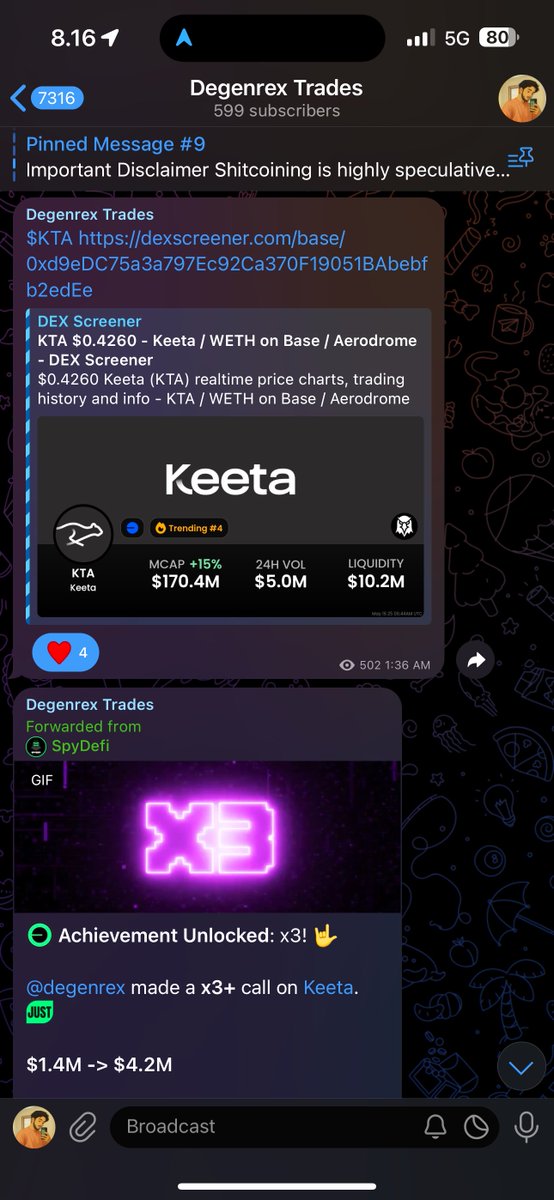
Long run $KTA, $REI. Yo are familiar with these, they are clearly top.
Current mid cap runners: $FLOCK, $GIZA
FLOCK: Coinbase listing soon, already listed on a few big exchanges doing insane vol
GIZA: https://t.co/tJxovqTM6y, plus quite a few upcoming things that you should check in details
I've noticed an interesting pattern. If there are at least 3 top holders of a coin that bought more than $10k to get to 1% holdings or more, it's a sign the coin is alpha. I saw it happen with a number of coins that later sent including Gorbagana, America party, etc. Mindshare.
I think i'm the first person called Keeta $KTA on telegram, from 1.4M to 555M. Pls join to support😁 https://t.co/wlxFIa60sj
0xc0634090f2fe6c6d75e61be2b949464abb498973
How I traded .1 sol to multiple 7 figures in 1 year
(This thread will be more for traders who are just starting to learn or ones that have been stuck in the same place)
WANT TO WIN A PUDGY PENGUIN?
Time to prove you deserve it.
4 days. 4 games. 1st prize = Pudgy #6398 + a huge pool of additional prizes.
RekTech Season 1: Penguin Game starts soon.
Here's what you need to know...🧵
Done all my research on $LENS now. DO. NOT. FADE. THIS.
$NAV $SNAI $THELION $ANTY $NEUR $PAVISE $PVS $YZY $ALCH $EZ $FARTCOIN $ARC $AI16Z $GRIFFAIN $COLLAT
Dev is doxxed and I found his linkedin, it's confirmed real.
Software itself has been successfully audited by Apple.
190m (19% supply) tokens are locked.
Tek is insane degens on CT in for the Memecoin space.
Chart look primed.
Undervalued at 500k mc
@getlensnow
Check their youtube videos.
AdwCEWQGzt3vuFMEPMf97AJMiq1eYL2sR7gk2x42pump