Petit Planet is coming to Nintendo Switch 2 in 2027!
To celebrate, repost this post for a chance to win:
1. Nintendo Switch 2 (Multi-Language System) + Nintendo Switch 2 Pro Controller Bundle: 3 winners
2. US$50 Gift Card: 10 winners
We’re hard at work on the Nintendo Switch 2 version and can’t wait to share gameplay footage and more details with you soon. Stay tuned!
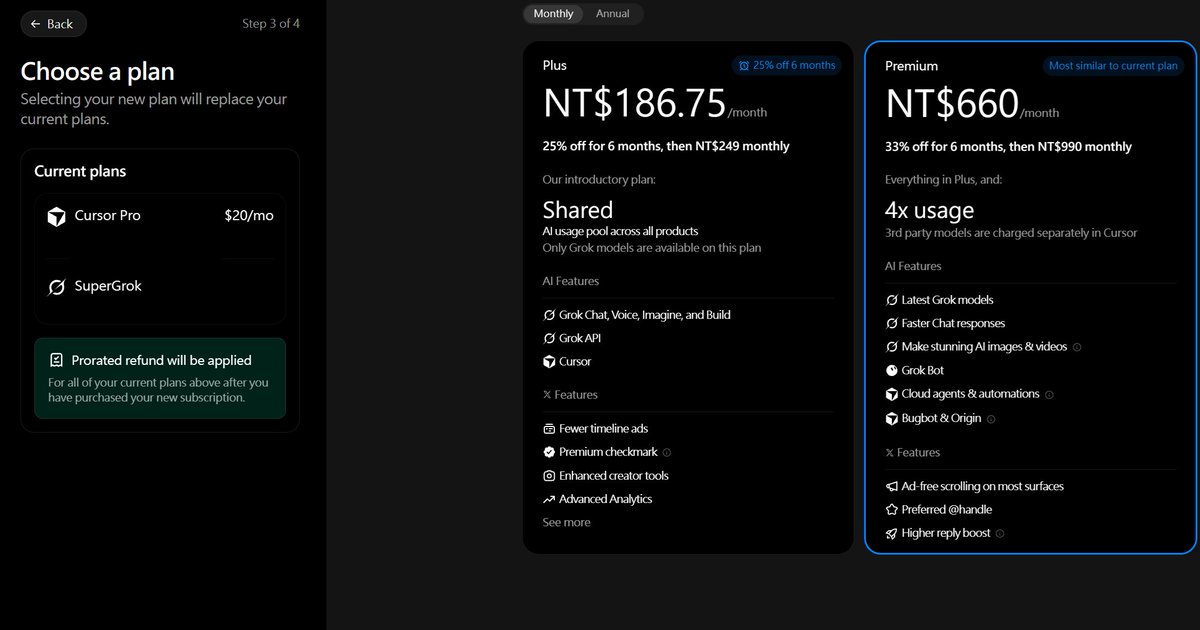
One plan now covers Cursor, Grok, Grok Bot, and X.
This is the biggest change to how Cursor is priced.
If you've been with us since the early days, this will feel like a lot, so I'll walk you through it.
First, every change is opt-in. If you do nothing, nothing happens.
You can keep your current plan with the same benefits, behavior, and pricing, and still move between the current plans. New sign-ups and anyone upgrading from free Cursor go to the new plans.
Here's what's different:
1. First-party usage
For most users, Grok and Composer coding limits are at least double what the matching Cursor plan gives you today.
We worked hard to make usage grow faster than price at each tier:
Plus ($8/mo): our base plan
Premium ($30/mo): 4x Plus usage
Super ($100/mo): 15x Plus usage
Ultra ($200/mo): 50x Plus usage
That's on top of every other product included in the plan.
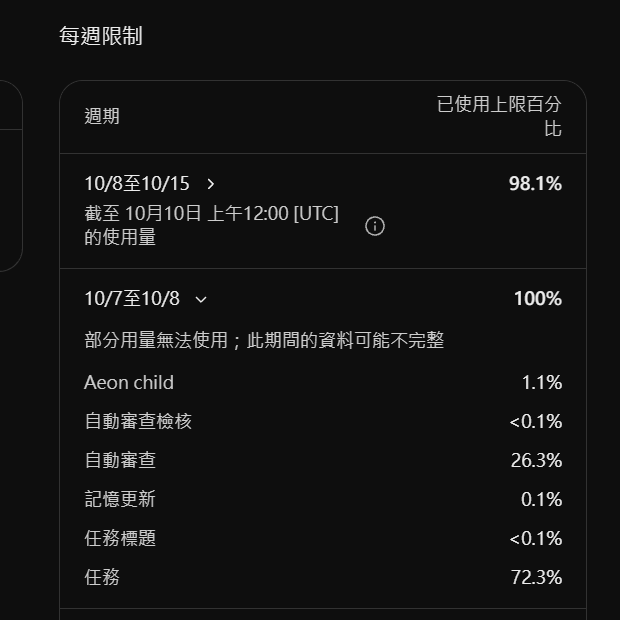
On the new plans, Cursor usage limits move from monthly to weekly. Grok, Cursor, and X share one weekly pool.
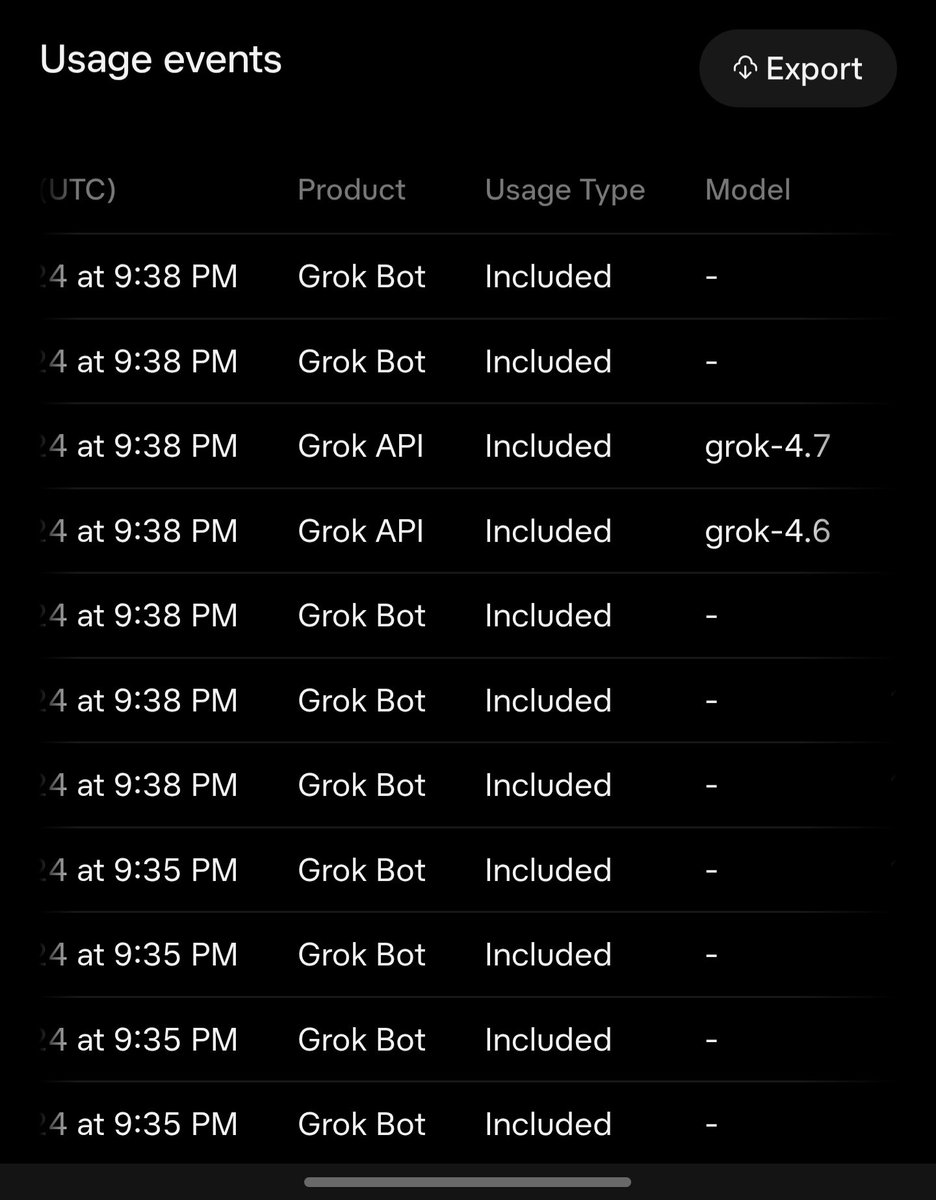
All Grok Bot usage is treated as first-party. So on Premium and up, you get at least double the Grok Bot usage.
We know AI can get expensive. If you're trusting us, you should get as much as we can deliver. That's what we're aiming for with these new plans.
2. Products
Every paid plan includes X Premium features. Grok @Bot comes with Premium and up.
If you're reading this on X, you can now get those features as part of Cursor and @Grok. Your plan also covers Grok chat, Voice, and Imagine images and video.
Grok Bot access has been one of the biggest pain points we've heard since it launched, and it's a big part of why we're excited.
3. Third-party models
You can keep using every model you rely on in Cursor.
What's changing is how those models are billed on the new plans: they come out of your usage credits at the provider's API list price, the same as paying the provider directly.
Current Cursor plans subsidize third-party models, so you can get inference below API price.
At @spacexai, we want to give you as much value as we can on our own models. That's why Grok usage limits are increasing and why we're treating Grok Bot usage as first-party.
We're still committed to Cursor being the simplest way to use models from many providers in one place, and we'll have more news on this front in the coming weeks.
If most of your usage is on third-party models, the new plans might cost you more, so check your usage before switching. That's one of the main reasons these plans are opt-in.
Cursor Pro and Pro+ subscribers who switch get Premium at $20/mo or Super at $60/mo for 6 months (normally $30 and $100).
4. Credit unification
Cursor credits and xAI API credits are coming together - prepaid xAI API balances now move into Cursor.
If you've been running the xAI API and Cursor as separate accounts, this is the start of managing both in one place.
It also means tools like Grok Voice become more accessible to all builders, and our biggest Grok users can now take full advantage of Cursor.
That's a lot of stuff! In summary:
Cursor, Grok, and X are all part of SpaceXSI.
That gives us economies of scale, and this unification is one of the main ways we can pass that on to you as savings and more usage.
Whether you should switch depends on which products you use, and that's different for everyone. If you pay for X today or most of your usage is on Grok, the new plans are probably a better deal.
To get started, check out https://t.co/X0mYoAxcru
What hasn't changed is why we do this: we want to build the best tools we can for you, and we think one plan across all of these products gets us closer to that.
If something here doesn't make sense or feels unfair, please let me know. I'm here to help.
Updates for Codex and ChatGPT Work users. No nerfing, only good stuff!
- We have landed inference optimizations and are passing down savings to all the subscriptions for GPT-5.6 Sol. That should result in around 10% more usage on its own.
- We noticed that by changing the context size limit in the product to 372k for GPT-5.6 Sol, up from 272k for GPT-5.5, it resulted in more usage being charged than intended. We have reverted to 272k and will work to roll back out to 372k in the days to come. You should notice that usage drains significantly less after this change.
- To understand where the extra usage was coming from, we ran some experiments where reasoning efforts were changed (referred to as juice values under the hood) and have reverted this.
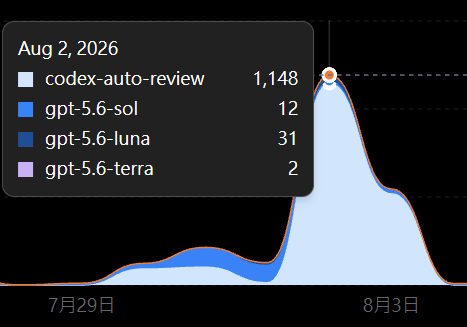
- There is slightly more usage of multi-agent than intended in high and xhigh reasoning effort, we are fixing this going forward. Also fixing a small other thing we noticed with auto-review where we can be more efficient.
And we continue to have the 5h limit temporarily not apply. Enjoy the rest of the weekend!
Day 7/
We have increased default context length for GPT-6.1 Sol to 500k when used through Codex & Work, up from 272k or an ~ 80% increase.
We will go higher in the future, but it helps reduce occurrence of compactions and with tasks that require keeping a lot of context and nuance over periods of time. It was carefully tested and is the new sweet spot for most of our users. You can still override it if you want to be higher our lower, with maximum context length of GPT-6.1 Sol of 1M.
Hello people of Sol! I've reset usage limits for all ChatGPT Work and Codex users. Together with that, a quick update on GPT-5.6 Sol usage limits.
Over the past few weeks, many of you have told us that Sol was using your Codex limits faster than expected. To be clear, we have not reduced usage on any subscription plans.
We’ve been digging into what was happening and have landed several improvements. As a result, we expect your usage to last around 18% longer during typical use of Sol. Some of you should already see significantly larger improvements from today. Tomorrow, we’ll also restore the five-hour limit that we temporarily paused while investigating.
Here’s what we found:
- GPT-5.6 Sol is much more willing to work for longer, make additional tool calls, and coordinate complex workflows across tools and subagents. That makes it better at solving hard problems, but some tasks were using far more than we intended.
- Sol also works harder at the same reasoning effort than previous models. High on Sol can use more tokens than High did on GPT-5.5.
- Programmatic tool calling, also referred to as code mode, gives Sol much more flexibility to run tool calls in parallel or continue working while waiting. But it also led to more responses per turn, more cached input tokens, and higher usage than expected.
- This was particularly noticeable when Sol was waiting for tool calls to finish or running many web searches. We’ve improved how we handle both cases and are continuing to make code mode more efficient.
- The impact was also very uneven. The median user actually found Sol quite token efficient, while some power users working on harder tasks saw their usage drain much faster. We were very focused on average and median usage before launch and missed some cases where the long tail could use significantly more usage.
Sol is a significant step forward in what Codex can do, but capability and efficiency do not always improve at the same pace, and some issues only become clear once people are using the model at real-world scale. We should have recognized this sooner and been more upfront about it.
You keep pushing the frontier and we’ll keep improving efficiency and sharing updates as we go.
Day 2.1/
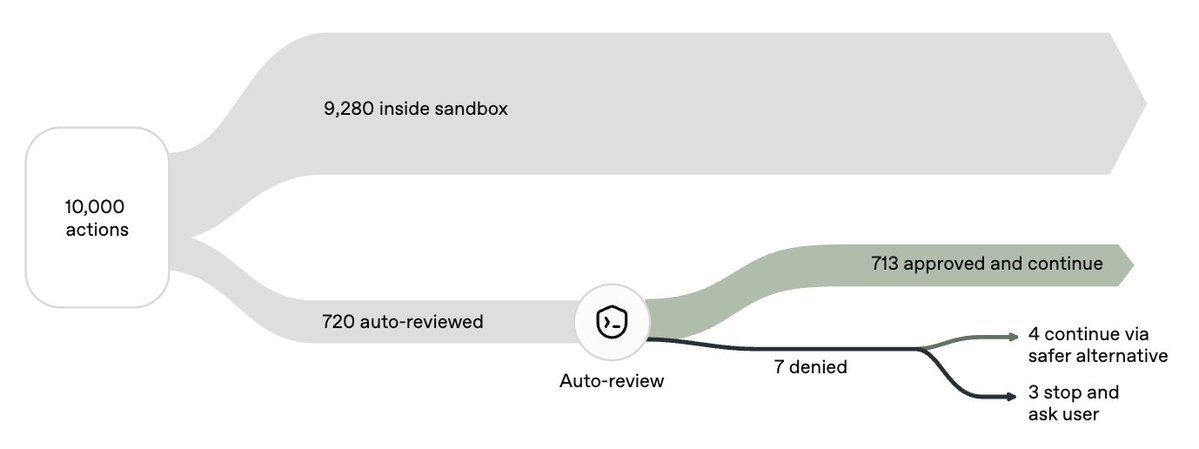
We have made Auto-review free for all users signed in through a ChatGPT account. You can enable it in settings > permissions > auto-review. Auto-review improves upon the default sandbox setting that requires you to approve everything, which is prone to decision fatigue unless you spend a lot of time configuring specific rules.
It allows you to run long tasks while having a second agent review all actions taken by the primary agent. Its only goal is to prevent high-risk actions from being taken and to protect against unwanted actions that are not aligned with the original user intent. This Auto-review feature is now free and does not draw usage from your plan.
LongCat-2.5-Preview is now live.
1.6T parameters. ~48B active. A 1M-token context window.
Natively multimodal. Built to take on long-horizon tasks.
From terminals and browsers to GUIs, spreadsheets, and design tools.
Try it now:
🚀 API: https://t.co/LtXhDaqdSi
💬 Chat: https://t.co/BdJ23BP1ah
LongCat-2.5-Preview is now live.
1.6T parameters. ~48B active. A 1M-token context window.
Natively multimodal. Built to take on long-horizon tasks.
From terminals and browsers to GUIs, spreadsheets, and design tools.
Try it now:
🚀 API: https://t.co/LtXhDaqdSi
💬 Chat: https://t.co/BdJ23BP1ah
Introducing Step 5 Preview: Advancing the Pareto Frontier.
Step 5 Preview is our new flagship model for agentic work, delivering frontier-level performance across software engineering and professional knowledge work, with particular strength in finance.
- 600B total / 27B active MoE, with 1M context + Vision
- Substantially lower task cost at comparable intelligence
- Broad software engineering capabilities with sustained execution over long horizons
Try Step 5 Preview: https://t.co/fC7HHlWKFn
Model page: https://t.co/4caJR2YGD3
Open weights on Oct 15.
Introducing Step 5 Preview: Advancing the Pareto Frontier.
Step 5 Preview is our new flagship model for agentic work, delivering frontier-level performance across software engineering and professional knowledge work, with particular strength in finance.
- 600B total / 27B active MoE, with 1M context + Vision
- Substantially lower task cost at comparable intelligence
- Broad software engineering capabilities with sustained execution over long horizons
Try Step 5 Preview: https://t.co/fC7HHlWKFn
Model page: https://t.co/4caJR2YGD3
Open weights on Oct 15.