2024: don't click suspicious links. 2026: your AI agent clicks them for you, at scale, with your credentials. Progress.
@holtars releasing soon........
David Sacks says China's open-source push was always a tactic. You go open until you catch the frontier, then you close. Exactly what Sam Altman did at OpenAI.
"Last week I explained why it would be harmful to the US to ban open models. So if you're China and you want to harm the US, maybe you would want to. It does kind of make sense, because our companies are benefiting a lot from all this R&D that they're doing."
"For example, the number one model in China, as I understand it, is ByteDance's model, which is already closed. That's kind of like their ChatGPT equivalent and it's always been closed. Then you've got Alibaba's Qwen, which was open and now I think is going closed, and https://t.co/kmZ0IB5oi1, which has GLM 5.2, catching up to what was then commercially available as the American frontier at certain tasks. They're going closed too, after having been open."
"So this is, I think, the tactic. You stay open until you catch the frontier or you get close to it, and then there's a really compelling incentive to go close, because you want to capture all the value for yourself. Which by the way is exactly what Sam Altman did famously at OpenAI."
Jason:
"Not only did they go from a nonprofit to a for-profit, they went from open models to closed models. So it's exactly paralleling what Sam realized 3 years ago."
Reuters reported this month that China's Ministry of Commerce is already discussing exactly this — restricting foreign access to top models from Alibaba, ByteDance and https://t.co/kmZ0IB5oi1, the lab behind GLM 5.2.
Sacks, on why open source works when you're behind:
"If you want to catch up, you go open. Because you're not going to make any meaningful revenue on closed anyway, because you're not close enough to the frontier. So why would anyone buy your product? But if you go open, you get the developer community on your side."
Jason:
"And you get utilization, more people use it, which in AI gives you reinforcement learning."
a team of researchers just proved you don't need a bigger model, you need a smarter plan
researchers from Tsinghua and South China University of Technology built a framework called Atomic Task Graph. it turned 7B-8B open-source models into GPT-4 competitors on complex agent benchmarks, beating it on two out of three. no fine-tuning. no extra training. zero parameter updates.
current AI agents plan in a straight line. step 1, step 2, step 3. when step 4 fails, the whole chain breaks. and the longer the chain gets, the more the model hallucinates because it's reasoning over a ballooning text history.
here's how it works.
1. instead of a linear chain, ATG breaks any complex task into a directed graph where subtask inputs and outputs are explicitly mapped
2. it recursively decomposes each subtask until every node is one atomic tool call
3. independent branches run in parallel instead of waiting in line
4. before anything executes, a lightweight "thought experiment" simulates the plan internally to catch bad dependencies and missing steps early
5. when something breaks at runtime, ATG traces the failure to the exact subgraph that caused it and repairs only that piece. validated work stays frozen.
the old way meant a failure at step 5 forced a full replan from scratch. hallucinated actions piled up the longer the task ran. ReAct hit a 43% hallucination rate on household tasks.
ATG on an 8B Llama model scored 63.65 on ALFWorld. GPT-4 with ReAct scored 41.24 on the same benchmark. hallucinated actions dropped to 12%.
those numbers happened because someone stopped throwing compute at the problem and started thinking about how work gets organized.
that's the part that gets me. the industry is spending billions on scale. this team spent time on architecture. and the architecture won.
there's always something distracting us from shipping
- the new ai model (agi is now)
- open claw/any claw
- the best ai coding agent (from this week)
- cluely/meeting ai copycats
- the new md based rag system
- the skill that replaced all other skills
- another mcp server I absolutely need
friendly reminder to myself: forget them and ship
The production runtime for AI agents is quietly splitting from the Python tooling ecosystem.
Google shipped an official ADK for Go with full MCP and Agent2Agent protocol support. Microsoft's Agent Framework added Go in public preview. Microsoft's Agent Governance Toolkit ships in Go, Python, TypeScript, Rust, and .NET. That's two of the three biggest cloud providers making official bets on Go for agent infrastructure.
OpenAI has a community port. Anthropic has no official Go SDK for agent orchestration.
What's driving this: Go's production characteristics map almost perfectly onto what production AI agents need. Goroutines are purpose-built for running parallel tool calls without blocking threads. The binary size is small for container deployment. The type system enforces schema correctness across MCP interfaces at compile time. Cold start is measured in milliseconds, not seconds.
The pattern I keep seeing: the teams deploying agents at scale are not the same teams that built the Python SDKs. Platform engineering teams at enterprise companies live in Go and Rust. They need agents to fit into their existing infrastructure, not the other way around.
This is the same split that happened in the web layer. Python dominated machine learning. Node.js dominated web APIs. Go dominated infrastructure. The convergence of AI and production infrastructure is creating the same division in the agent layer: Python for experimentation, Go for the production control plane.
The hidden bottleneck: every major framework has a Python-first bias because the research teams that built the models live in Python. The gap between what you can prototype in Python and what you can safely deploy at scale is where the Go ecosystem is filling in.
My read: Google ADK for Go and Microsoft's Agent Framework in Go are early signals that production AI agent infrastructure will look more like Kubernetes than Jupyter. OpenAI and Anthropic will catch up. But the Go ecosystem has a real head start on the people actually running production agents today.
https://t.co/gIBA32zuh7
🚀 These GitHub projects are quietly changing the future of AI, browser automation, and productivity.
Here are 10 powerful open-source tools you should check out:
🔹 CloakBrowser
https://t.co/sVqg3sZ2cW�
🔹 Camofox Browser
https://t.co/jKXR4X5Zfq�
🔹 Claw Router
https://t.co/uRYcqsxPRW�
🔹 Hyperframes
https://t.co/FtsCXYjo3g�
🔹 Agentic Inbox
https://t.co/DKd6L9AREB�
🔹 Open Higgsfield AI
https://t.co/BnPetNeP90�
🔹 Fincept Terminal
https://t.co/shbsbggPXi�
🔹 AutoHedge
https://t.co/O34iTuru16�
🔹 Vibe Trader
https://t.co/BKKKe62bVB�
🔹 NotFair
https://t.co/qK8hhIXPRA�
⭐ Save this post for later.
💬 Which project caught your attention the most?
Follow @abir35627 for more AI tools,
GitHub projects, and tech resources. 🔥
As AI teams adopt more autonomous agents, one challenge becomes clear: they don't naturally work together.
Omnigent is an open-source meta-harness that sits above individual agent harnesses, routing work across multiple agents through a single orchestration layer.
Instead of managing agents in isolation, teams can compose different models and agent harnesses into unified workflows, with shared governance and collaboration built in.
Explore the project on GitHub: https://t.co/6j9MQMMYrJ
GLM Tang Jie's internal letter; machine-translating what I think is worth noting (i.e., RSI and safety):
"Third, Fully Self-Training. As the supply of high-quality human-generated data approaches exhaustion, we must convert computing power into the fuel for evolution by building high-quality synthetic data factories. Through AI-versus-AI adversarial learning (self-play), we can generate new knowledge "from nothing" and, within secure sandbox environments, give systems the ability to rewrite and improve their own code. This will allow the pace of AI evolution to break free from the physical limitations of human engineers.
Fourth, Ultimate AI Safety Governance. This is one of the four pillars that I want to emphasize the most.
The more powerful AI becomes, the stronger its safety constraints must be. From its founding, Zhipu established a clear principle: AI must serve human well-being and national strategic interests. The company has rejected superficial, bolt-on safety measures. Instead, it embeds human ethics, social norms, and national laws and regulations into the model's value function as foundational principles.
The company plans to invest resources on the order of tens of billions of yuan to tackle mechanistic interpretability—understanding the neural mechanisms behind model decisions and transforming black-box systems into transparent, explainable ones. At the same time, it will actively participate in international AI governance efforts to prevent AI technologies from being misused.
This sense of urgency is not unique to us. As some of the world's leading frontier AI models have delayed their full public release because of safety concerns, and as industry leaders have openly warned that AI's profound impact could fundamentally reshape the global balance of power, we must remain clear-headed: research on superintelligence and superalignment must advance in parallel.
This is also a crucial lesson we have repeatedly reflected upon while confronting disruptive technologies. History has shown that when a technology becomes powerful enough to transform the course of civilization, safety is no longer an optional add-on—it becomes the fundamental prerequisite for that technology to continue developing and to be widely accepted and deployed."
--> Note that this is immediately followed by continuing to open source.
Claude Fable 5 orchestrating Grok 4.5 is now my favorite real workflow.
all you need is this free Claude Code plugin that makes Grok the default implementer. Fable writes the specs and reviews every diff, Grok 4.5 does the typing through the Grok CLI.
- Grok handles the volume, Fable handles the judgment - Every diff gets cross-vendor review for free
- Specs run as parallel agents when they're independent
I've been testing it for a few days and the part that sold me is watching Fable refuse to write code. It sends specs down, judges what comes back, and that's it.
setup:
1. claude plugin marketplace add DannyMac180/fable-advisor && claude plugin install fable-advisor
2. Install the Grok CLI from https://t.co/z3jmWbBsYd, then grok login
3. /model fable
It's open source, so you can read the agent files and tweak the routing however you want.
I ran GPT-5.6 Sol in the new Codex for 2 hours. it burned through 5 hours of my 20x Max quota.
xhigh is the top reasoning level. sol ultra behaves like claude code's ultracode, spawning subagents that inherit the main agent's reasoning level and burn quota at the same setting, all in one run.
i locked subagents to high yesterday. it was still overkill, so i dropped them all to medium. at medium, the model handled jobs covered by several skills. i deleted another batch.
my ideal split:
→ 𝗵𝗶𝗴𝗵 for coding and bug fixes
→ 𝗺𝗲𝗱𝗶𝘂𝗺 for search, docs, and tests
→ 𝘂𝗹𝘁𝗿𝗮 only for tasks i won't trust to a lower setting
the cleanup prompt:
audit all local codex and claude code skills, plus any plugins related to session context.
1. find duplicate capabilities, conflicting rules, stale content, and anything the models now handle natively.
2. for each item, recommend keep / merge / archive / delete, with one-line reasoning.
3. preserve project-specific rules, real commands, current decisions, and open loops.
4. output a dry run only. do not modify files without approval.
OpenAI just shipped the biggest release in their history. I got in before launch.
GPT-5.6 family : Sol, Terra, Luna. A new super app that merges @ChatGPTapp and Codex. Three modes: Chat, Work, Code.
I sat down with @wulfie_bain_ from @OpenAI and we built a full startup on camera. Pitch deck, working web app, computer-use agents finding and fixing bugs live, and an autonomous 16-hour overnight run.
The idea that changes everything: stop writing prompts. Start writing loops. Give the agent a goal and a way to check its own work. That's how a model runs overnight and comes back finished.
We also answer the real questions what you build that OpenAI won't kill, tokens vs engineers, and why India wins in this era.
Coder or not watch this one.
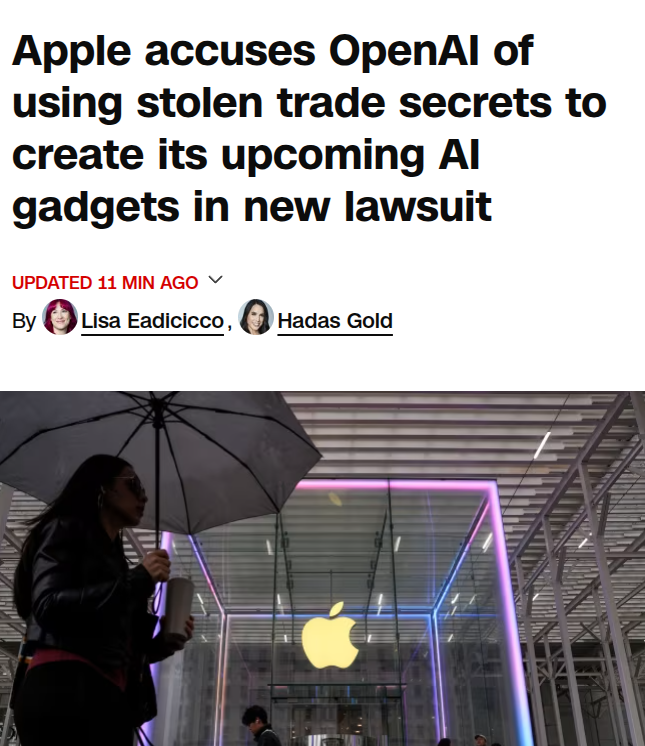
wow, Apple just sued OpenAI, alleging stolen hardware secrets now underpin its $6.5B device push.
The complaint names former Apple employees Tang Yew Tan and Chang Liu as central actors.
Apple alleges Liu kept an Apple laptop and retained access after leaving for OpenAI.
An authentication bug supposedly let that laptop enter Apple’s internal network despite his departure.
Apple says he then downloaded files about unreleased hardware, specifications, and engineering projects.
For Tan, Apple alleges he emailed himself supplier details and internal industry summaries before leaving.
Apple also says Tan encouraged candidates to bring physical Apple parts into OpenAI interviews.
Those sessions allegedly let OpenAI inspect components directly, while supplier contacts exposed hidden manufacturing methods.
Apple’s claim is that files, parts, and supplier knowledge jointly accelerated OpenAI’s hardware work.
---
Apple alleges OpenAI asked an Apple supplier to apply a secret metal-finishing method.
The supplier reportedly believed Apple had approved this use, so it performed the process.
That could save OpenAI months of testing because the supplier already knew the proven recipe.
OpenAI accelerated its hardware program after acquiring Jony Ive’s io Products for $6.5 B.
More than 400 former Apple employees now work there, although employment alone proves nothing.
OpenAI however, denies seeking competitors’ trade secrets, while Apple demands destruction and product redesigns.
---
Now, Apple must prove OpenAI used protected information, rather than general experience carried by departing workers.
Detailed allegations create serious discovery risk, even before a judge tests their accuracy.
The case could delay OpenAI’s hardware schedule and permanently fracture a strategically useful partnership.
---
To note, Apple and OpenAI already have a broad partnership across eligible iPhones, iPads, Macs, and Vision Pro devices.
Apple Intelligence can send selected requests from Siri, Writing Tools, Visual Intelligence, Image Playground, and Shortcuts to ChatGPT.
---
edition. cnn .com/2026/07/10/tech/apple-openai-devices-lawsuit
Java developers often find that wiring up AI models is the most tedious part of a project. It's tough to handle different providers without writing tons of boilerplate. Spring AI solves this by applying standard Spring design principles to the AI domain.
This project offers a modular API for features like chat, embeddings, and text to image generation. It uses strongly typed structures to connect your data with AI models. The goal is to make these integrations feel like a native part of your application stack.
The tool works with modern Spring Boot versions and includes detailed reference documentation. You'll find it easier to switch between different model providers because of the portable abstractions. It simplifies the bridge between your enterprise APIs and external AI services.
https://t.co/4uOpEBNvew
#Java #SpringAI #LLM #SoftwareEngineering
Opus 5 Leaks
- Opus 5 is targeting a launch by the end of this month.
- A "Honeycomb EAP" model appeared in Cursor for some users before disappearing, and it could be an early Opus 5 preview.
- Honeycomb EAP has a 1M context window, making - Opus 5 most likely (Haiku is expected to have 300K context).
- Hopefully, Opus 5 reaches Fable/Mythos-level capabilities.
companies get a bunch of GPUs to do model hosting
they realize model hosting is hard and they could just rent the GPUs given how much demand there is right now
so now there's like 2 companies who who do model hosting well
EveryInc/compound-engineering-plugin is built with TypeScript to add specialized slash commands directly into Claude Code and Cursor. It creates a structured loop that moves from initial requirements to codified documentation.
The workflow focuses on heavy planning so it doesn't accumulate technical debt. You'll use /ce-brainstorm and /ce-plan to build readiness artifacts that make the actual coding phase much faster.
To keep quality high, it provides /ce-code-review and /ce-simplify-code. Once you're done, /ce-compound helps store lessons in a documentation catalog so every unit of work is easier than the last.
https://t.co/GVOL11bgF0
#TypeScript #AI #Programming #GitHub
Grok 4.5 reached GPT-5.6 Sol level across 3 browser physics demos for free.
Prompts were for robot combat, hydraulic pressing, and a canyon-jumping truck.
Test was done on atomic chat (@atomic_chat_hq), a desktop app that runs LLMs locally.
Each answer had to package rendering and physics inside self-contained HTML5 canvas code.
These tasks force generated JavaScript to draw frames, apply gravity, detect collisions, and manage controls.
Outputs:
GPT-5.6 Sol: 12.9K tokens, $0.51 (~7 min)
Grok 4.5: 10.8K tokens, $0 (~5 min)
Muse Spark 1.1: 26.8K tokens, $0.12 (~7.5 min)
GLM 5.2: 10.9K tokens, $0.02 (~12 min)
Physics demos expose a weakness that ordinary coding benchmarks often hide: a model can spend more tokens describing a richer scene while still failing the hard part, which is maintaining force, momentum, collision timing, and believable object behavior across frames.
(Note, Grok 4.5 is currently free only through Grok Build and Cursor)