Publication alert 🥳 Our article "Decoding the New Cold War" is out in Geopolitics (open access!).
Everyone talks about the New Cold War, but what kind of animal is it? Concept, analogy, process? And does it matter? Yes, we argue!
Find out more here: https://t.co/VYItsWCsVU
Western media censors evidence-based scholarly studies & propagates disinformation by self-proclaimed experts who claim 8 to 1 Russian to Ukrainian casualty ratio. My in press book: circa 230,000 Russian & separatist forces & 250,000 Ukrainian forces members killed in Russia-Ukraine war.
"The estimate is based on identification by name by BBC Russian and Mediazona of over 223,000 killed Russian military, National Guard, FSB, police, border guard members, and since the end of 2022 killed Donbas residents serving in the Russian forces, and Wagner mercenaries during four years and three months of the war. The number is adjusted by a rough estimate of those missing in action who were killed and prorated for another month.
The combined number of killed and missing in action Ukrainian forces members, who are identified by name by the Ualosses site in the first four years and three months of the war, was nearly 187,000 and close to 5,000 prisoners of war (POWs). However, the identification by name significantly undercounted the casualties because it was based only on obituaries and other public data available online and limited data from many cities and regions of Ukraine and did not include data from cemeteries, in contrast to the identification of Russian casualties by BBC Russian and Mediazona.
Claims of 500,000, 1.7 million, or similar numbers of Ukrainian forces members killed lack any reliable sources, and such casualties are physically impossible because they imply that all members of the Ukrainian forces were killed or wounded during the war. The same concerns about the claims of a similar magnitude of the Russian forces casualties. Various official casualties of the adversaries and supposedly leaked or unsourced military casualty numbers have all the features of fakes because they lack validity and reliability. The Russian, Ukrainian, and Western governments inflate the military casualties of their respective adversaries for propaganda and disinformation purposes." https://t.co/uPjUzwTxpK
The Russian case may be different. But I haven't seen evidence that China perceives a U.S. tactical nuclear deterrence gap. Rather, PLA and civilian experts alike continue to perceive clear, enduring U.S. nuclear advantages across the full tactical-strategic spectrum.
Russia is negotiating imports of about 50,000 tonnes of AI-92 gasoline from Kazakhstan to address fuel shortages caused by Ukrainian drone attacks on refineries, Reuters reported. The supplies could be exchanged for Russian aviation fuel, although Kazakhstan says it has not yet received a formal request. Russian authorities are also preparing for gasoline imports from India, with proposed tax changes linking compensation payments for imported fuel to Indian market prices and shipping costs.
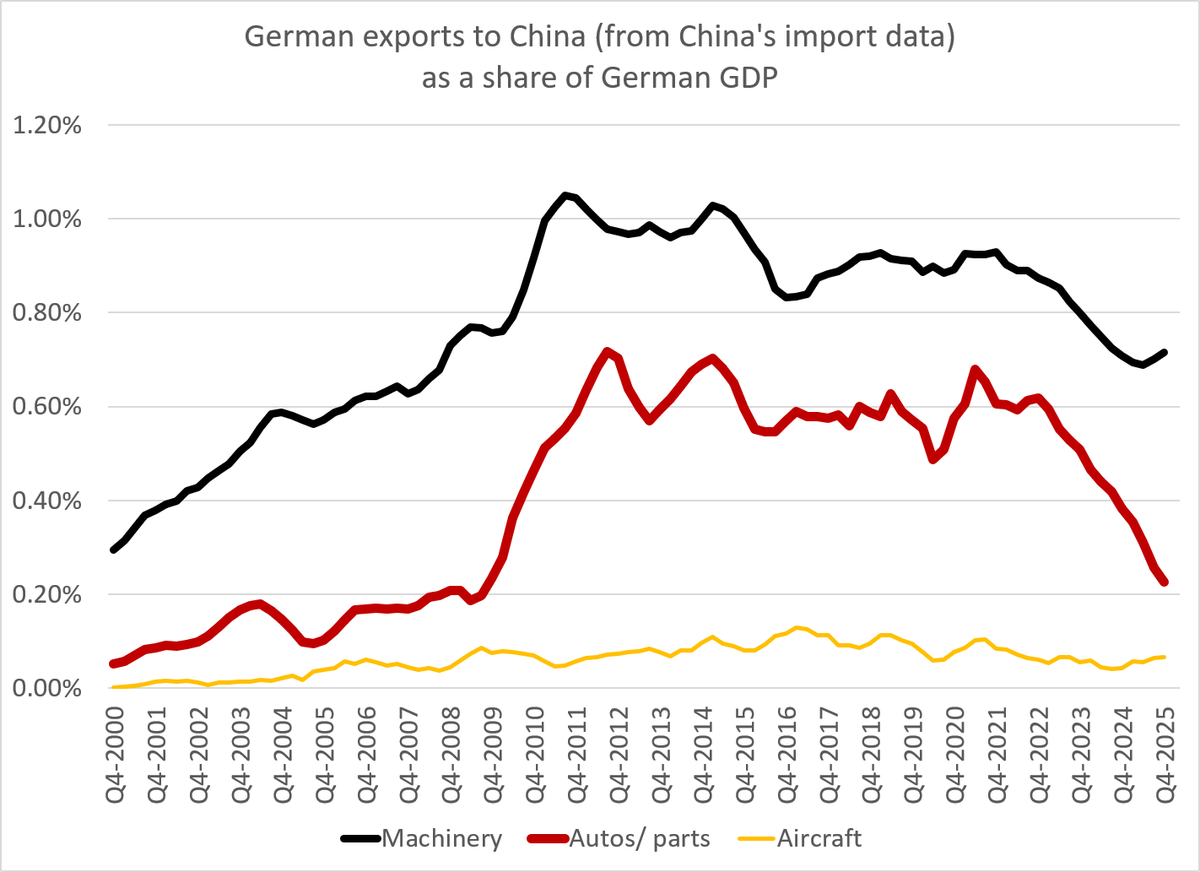
There *is* a problem with China's domestic overcapacity.
But VW (or any EU industrial firm) problem is not created by China.
Lots of domestic levers *within* Europe to solve problems like lack of demand, cheaper energy, regs etc.
ht Dwayne Woods @twittwoods excellent graphic
I gather that in the eyes of some of the leader writers at the Economist the collapse of German exports to China (down a pp of German GDP led by autos) doesn't have anything to do with today's announced layoffs at VW ...
1/
Glad to share my latest piece @RStatecraft exploring the unspoken, structural risks of Europe’s current strategy in Ukraine.
While the mainstream narrative insists Russia is under unsustainable strain and that deep strikes are a low-cost method to force a ceasefire, this ignores a perilous reality: the erosion of Cold War-era redlines.
We are entering uncharted waters. With decision-making authority dangerously dispersed across Western capitals and no functional diplomatic track, the prevailing belief that escalation can be precisely managed is a comforting but dangerous illusion.
As the conflict intensifies, European leaders must urgently restore conflict guardrails and develop a viable diplomatic off-ramp.
Read the full analysis here:
🔗 https://t.co/70otl3CyCu
Ivanov could have become the president in 2008 instead of Medvedev. He was also higher up the KGB ranks than Putin. Spoke good English and hit it off with Condi Rice - as shown on the 2012 BBC documentary where Ivanov features prominently.
‘The period 2010–25 has been characterized by wide-ranging developments and events that have affected the provision of EU military assistance to the EU’s Southern Neighbourhood. The Arab uprisings, war in Syria, Libya and Gaza, and war between Iran and Israel, are just some examples.’
Read more in this fact sheet by Zain Hussain on military assistance by the EU and other external actors to the EU's Southern Neighbourhood ➡️https://t.co/x07aL2kRtB
Explore the centerfold ➡️ https://t.co/7k2OKXDQAr
@MercatorDE
The New Great Wall: The Logic of China’s Foreign Policy Behavior by V. Kashin. Chinese foreign policy’s apparent contradictions (global ambitions + strategic caution & risk aversion) partly because China anticipates severe military-political crisis https://t.co/rAMwSnBbp4
Ukrainian outlet “Local history” interviewed Carlo #Ginzburg in 2022. His father, antifascist Leon Ginzburg was from Odesa, a leading activist of Carlo Rosselli’s antifascist group Giustizia e Liberta.
https://t.co/O2iNFzF5GD #history#localhistoryua
A summary of my small and very informal survey about media coverage on China (below):
Among clearly mainstream outlets, Bloomberg was the overwhelming favorite. The Guardian also got good support.
Caixin got a decent amount of love, which I think it has earned, but it probably would be a stretch to call it MSM. SCMP is also borderline - highly relevant for the China beat, but overall much more of a regional outlet than a truly global mainstream one.
On the negative side, the BBC, WSJ, and The Economist were the outlets most strongly criticized.
NYT was criticized too, but it also had its defenders too, so the overall picture was mixed there. Same with the FT. Sentiment seemed to learn towards: "it depends on the journalist" which I think is right.
I found it interesting the global wire services - Reuters, AP, AFP - were hardly mentioned at all. Perhaps this is a good thing? After all, if they don't come to mind as being bad OR good, then it suggests they're largely doing what they're supposed to do - providing neutral baseline reporting and leaving interpretation to others.
Also notably, few thought to mention CNBC, CNN, WaPo, either positively or negatively.
As for my own take: I'd go with Bloomberg for best (along with Caixin, although it's outside the MSM category) and The Economist and WSJ tied for worst.
If we expand the definition of "MSM" to include more regional outlets like leading national dailies, smaller-country papers, or second-tier publications, I suspect we'd find a higher signal-to-noise ratio overall. For example, I've generally had positive interview experiences and impressions of coverage from various European outlets, which often seem less locked into the dominant Anglo media framing.
I could perhaps re-do this survey more "properly" with something more shareable (e.g. on SurveyMonkey) to gather more data...if there's interest in that.
🇸🇦🌍
"محفظة الممرات" السعودية والقلق الإسرائيلي
ربما يكشف الممر التركي–السعودي عن تحول حاسم في تفكير الرياض: الممرات لم تعد بنية نقل، بل أدوات سيادة ونفوذ وأمن اقتصادي. ومع تصاعد مخاطر هرمز وباب المندب، تعمل السعودية على تقليل ارتهانها للمضائق عبر شبكة بدائل تجمع البحر الأحمر، الأنابيب، السكك الحديدية، والربط البري عبر الأردن وسوريا وتركيا وربما العراق وعمان.
من هنا ينبع القلق الإسرائيلي. فإسرائيل لا تخشى طريقاً تجارياً جديداً، بل تخشى فقدان فرصة التحول إلى بوابة الخليج نحو أوروبا. السعودية لا تغلق الباب أمام إسرائيل، لكنها ترفض تحويلها إلى ممر إلزامي.
جوهر الاستراتيجية هو بناء "محفظة ممرات" تمنح الرياض حرية مناورة وقت الأزمات، وتحول الجغرافيا السعودية من موقع عبور إلى قوة جيوسياسية واقتصادية.
Iran got a hard kill on 14 radars, at least 4 aerial tankers and an E-3 on the first day or so with big salvos. It recently bagged more radars; at least one in Bahrain and another in Kuwait. It has fired more SRBMs and MRBMs than the Pentagon told Congress were in the Chinese arsenal. The CEPs of these missiles were closer to 5m than 20m, smaller than those assumed by Anderson and Press (2025) or @ka_grieco et al (2024) for China (20m). Iran is a great missile power and it showed.
Kyrgyzstan and Georgia are exploring transport links that could connect the China-Kyrgyzstan-Uzbekistan railway to Black Sea ports, expanding trade routes between Central Asia, the Caucasus, and global markets. @StephenMBland
https://t.co/2tWELKPoZN
💵 Ukrainian Currency in 1917
The graphic creator of the Ukrainian currency was the prominent graphic artist Heorhiy Narbut. The Ukrainian banknotes featured inscriptions in four languages: Ukrainian, Polish, Jewish (Yiddish), and Russian—the languages of the three largest national minorities in Ukraine at the time. By the way, this was the first instance in the 20th century where an inscription in Yiddish appeared on state currency.
At that time, "Russia" as a stable state did not exist. A coup d'état had occurred there, and two sides were fighting for power, engaging in terror and pogroms.
By early 1918, the Central Rada of Ukraine introduced a new currency—the Hryvnia. Not only Narbut, but also the artist Ivan Krychevsky worked on these designs. They looked even more vibrant and striking.