邓小平菸抽不停吐痰技术高超
前加拿大驻美大使伯尼(Derek H. Burney)一九八六年陪同当时加拿大总统莫朗尼访华,在会见邓小平时他观察到,「会上邓小平菸抽个不停,偶尔使用痰盂,惟弹无虚发.」一名曾於一九八八年陪同时任菲律宾副总统的劳雷尔到北京会见邓小平的菲律宾官员也对邓的吐痰技术印象深 刻:「他菸抽个不停,一支抽完就用余烬来点另一支。他也向着痰盂吐痰,奇准无比。」
从若干曾与邓小平打交道的观察家的分析,邓小平的吐痰行为似乎具有一定模式和助语作用。也有参与中美建交前多次会谈、时任总统国家安全事务助理的史考克罗夫特(Brent Scowcroft)回忆说,「他菸抽个不停,我的意思是指他一支又一支的抽,一支抽完就用它来点另一支。他总会有个痰盂,每隔一会儿,他就会提意见,然后转过身去「咳吐」」。於七○年代在美国国务院驻外事务处工作的尼克斯(Robert Nichols)也察觉到邓有类似的吐痰模式,「邓小平身边有个痰盂,当他提完一个意见,就会向着痰盂吐痰,响起「乓」的一声。」
邓有时也会借助吐痰以示鄙夷,卡特总统时代任安全会议中国事务主管并亲北京的奥森伯格(Michel Oksenberg)这样形容邓小平,「他经常吐痰,声情并茂。一次,他为了骂苏联的扩张主义骂得更起劲,就向痰盂吐了一口痰。」一位泰国外交家这样描述邓在入侵越南前夕的表现:「邓对越南恨入心脾,他使劲的向痰盂吐了一口痰,把越南人骂作狗。」从会谈的记录也可见,单刀直入的邓小平并不把油腔滑调的基辛格放在眼内,他经常在基辛格发言时痰兴大作,也可能有恶搞的成份。
外国政要深受邓小平吐痰困扰
基辛格其后在其回忆录《白宫岁月》(White House Years)里,就形容邓小平是个 「nasty little man」(肮髒小矮人)。最近基辛格也再提到对邓吐痰不敢恭维,「邓放个痰盂在前面,并不时向着痰盂吐痰,所以他没有周恩来的优雅……。」
一九七五年,快将出任美国国务卿的美国外交官万斯(Cyrus Vance)到中国会见邓小平时,就深受邓吐痰所困扰.据国际礼仪专家罗傑(Roger E. Axtell)在其畅销书《世界身体语言之礼与非礼》(The Do’s and Taboos of Body Language Around the World)的叙述,「每当邓清喉咙,俯身吐痰之际,万斯都不动声色。但观察家的确注意到,每次邓吐痰时,万斯都本能地把腿移离痰盂六吋,并在邓完事之后,把腿移回原位。」
要是连洋男士都对邓当众吐痰那样感到不安,那些洋女士料必更感困扰.戴卓尔夫人因香港前途问题被迫要近距离会见邓小平时,肯定如受酷刑。失魂落魄之余,可能与她在会见邓小平后在人民大会堂外台阶摔倒有直接关系.英国资深传媒人安妮。罗宾森(Anne Robinson)女士很同情戴卓尔夫人的遭遇,她在自传里说「那个时为中央军委会主席,却实为最高领导的邓小平坚持要在自己和戴卓尔夫人中间放个痰盂。到底他是否知道,或者是否真的不知道他的欧洲客人会对这非常噁心?知道也好,不知道也好,反正据报导他吐了很多次痰就是。」
由此可见,我们大有理由假设,不论邓小平是蓄意还是无法自控,其痰盂及其频频吐痰的行为,曾经在中国政治,起码是中国外交史上产生过一定作用,就是令对手感到厌恶,坐立不安,神不守舍,进而为减轻痛苦欲速战速决而乱章法。戴卓尔夫人若因而表现失准,以致未能捍卫香港人的利益,也毫不出奇。
---锺祖康:邓小平的吐痰外交
No complexity. No accident.
10/10 was caused by irresponsible marketing campaigns by certain companies.
On October 10, tens of billions of dollars were liquidated. As CEO of OKX, we observed clearly that the crypto market’s microstructure fundamentally changed after that day.
Many industry participants believe the damage was more severe than the FTX collapse. Since then, there has been extensive discussion about why it happened and how to prevent a recurrence. The root causes are not difficult to identify.
⸻
What actually happened
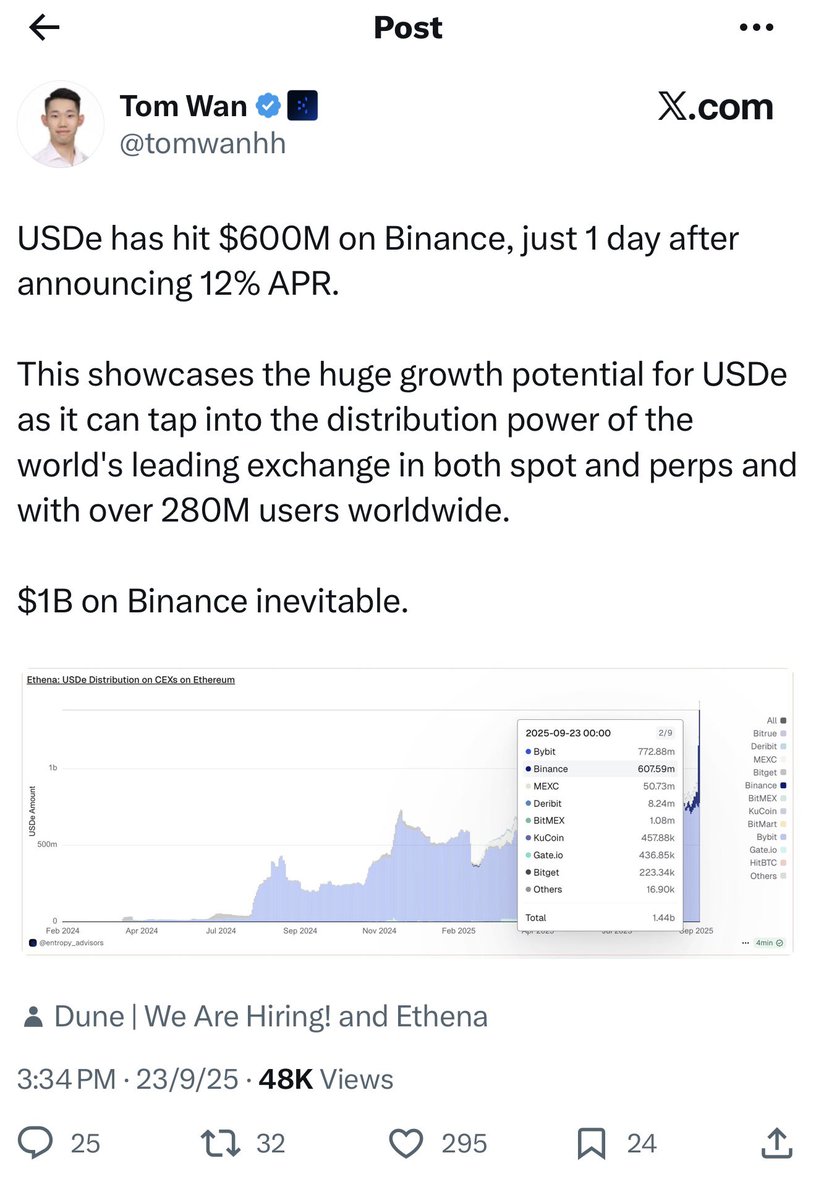
1.Binance launched a temporary user-acquisition campaign offering 12% APY on USDe, while allowing USDe to be used as collateral with the same treatment as USDT and USDC, and without effective limits.
2.USDe is a tokenized hedge fund product.
Ethena raises capital via a so-called “stablecoin,” deploys it into index arbitrage and algorithmic trading strategies, and tokenizes the resulting fund. The token can then be deposited on exchanges to earn yield.
3.USDe is fundamentally different from products such as
BlackRock BUIDL and Franklin Templeton BENJI, which are tokenized money market funds with low-risk profiles.
USDe, by contrast, embeds hedge-fund-level risk. This difference is structural, not cosmetic.
4.Binance users were encouraged to convert USDT and USDC into USDe to earn attractive yields, without sufficient emphasis on the underlying risks. From a user’s perspective, trading with USDe appeared no different from trading with traditional stablecoins—while the actual risk profile was materially higher.
5.Risk escalated further as users:
•converted USDT/USDC into USDe,
•used USDe as collateral to borrow USDT,
•converted the borrowed USDT back into USDe,
•and repeated the cycle.
This leverage loop produced artificial APYs of 24%, 36%, and even 70%+, widely perceived as “low risk” simply because they were offered by a major platform. Systemic risk accumulated rapidly across the global crypto market.
https://t.co/IK2gW4xUOP that point, even a small market shock was sufficient to trigger a collapse.
When volatility hit, USDe depegged quickly. Cascading liquidations followed, and weaknesses in risk management around assets such as WETH and BNSOL further amplified the crash. Some tokens briefly traded near zero.
The damage to global users and companies—including OKX customers—was severe, and recovery will take time.
⸻
Why this matters
I am discussing the root cause, not assigning blame or launching an attack on Binance. Speaking openly about systemic risks is sometimes uncomfortable, but it is necessary if the industry is to mature responsibly.
I expect there may be significant misinformation and coordinated FUD directed at OKX in the near future. Even so, speaking honestly about systemic risk is the right thing to do—and we will continue to do so.
As the largest global platform, Binance has outsized influence—and corresponding responsibility—as an industry leader. Long-term trust in crypto cannot be built on short-term yield games, excessive leverage, or marketing practices that obscure risk.
The industry needs leaders who prioritize market stability, transparency, and responsible innovation—not a winner-take-all mentality where criticism is treated as hostility.
Crypto is still early.
What we choose to normalize today will determine whether this industry earns lasting trust—or repeats the same mistakes again.