ANTHROPIC NEWS 🔥:
- Anthropic's formal-math repo now has a Claude-written paper and Lean proof claiming VP ≠ VNP over every field (via Liam06972452).
- Claude Ship is in beta on Team and Enterprise plans, letting Claude review, fix and approve PRs.
- Connectors and skills are now merged into plugins, with more than 10,000 available on Free, Pro, Max and Ultra.
- Zero data retention with Enterprise Frontier Safeguards is now in public beta for eligible businesses.
- Claude Code on desktop has a redesigned side panel with tabs, rolling out on Mac first. - Pro, Max and Ultra users get guest passes and earn $50 in credits when a friend subscribes (via alexmichael).
OPENAI NEWS🔥:
- GPT-6.2 Sol is rolling out in ChatGPT's Chat tab to Plus, Pro, Business and Enterprise users.
- Dots are rolling out in the EU, and a new travel mode keeps existing Dots working abroad.
- GPT-5.6 models will be retired in ChatGPT and Codex on December 23.
- OpenAI and Cisco released Shirudo, an open-source Linux runtime that lets agents shield systems from exploits without downtime.
- OpenWorks pays local AI experts up to $8,000 a month to help small businesses adopt AI.
Gemini Elements - Choosing Your Daily Driver:
Neon (Ne) vs. Argon (Ar) 🟢
One of the most common questions about the Gemini 4 lineup: When should you use Neon, and when is Argon actually better?
Both sit in the core official tier, but they solve very different problems:
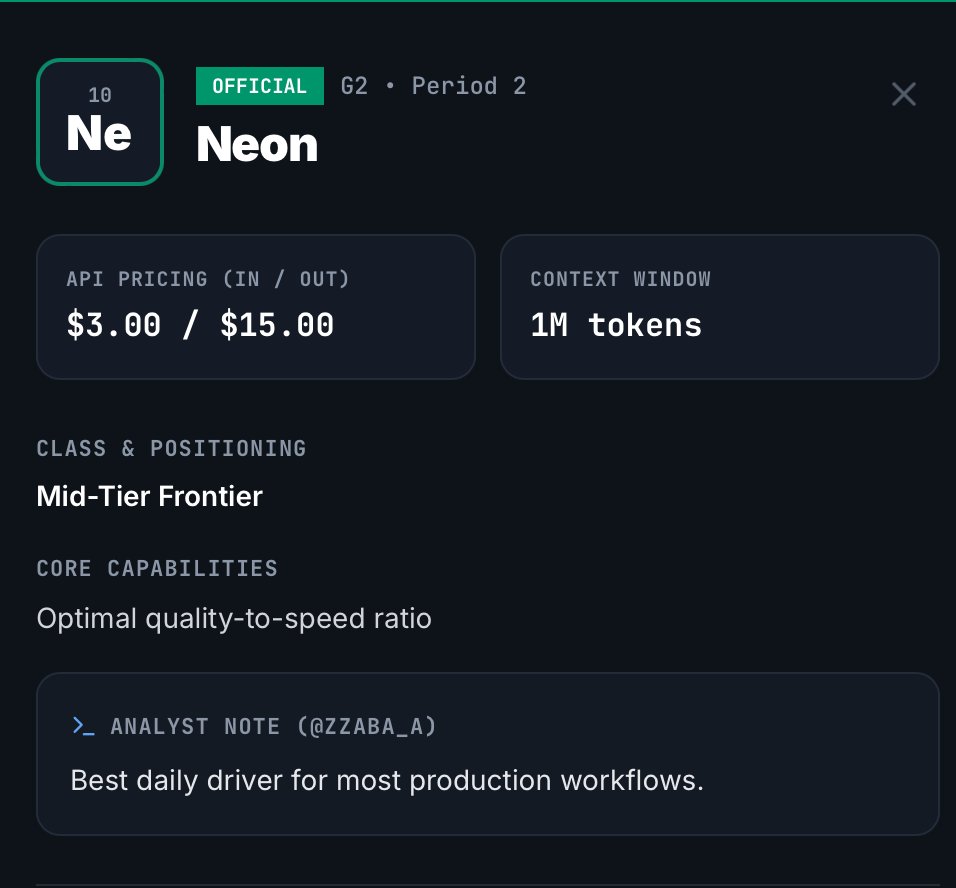
1. Neon (Ne) - Speed + Frontier Quality ($3 / $15)
- Best for: Interactive apps, coding copilots, and daily general tasks.
- Why pick it: Gives you near-frontier intelligence without making users wait on long reasoning chains.
2. Argon (Ar) — Token-Efficient Reasoning ($2→$4 / $10→$20)
- Best for: Multi-step logic, debugging, and structured analysis.
- Why pick it: Reaches complex conclusions using noticeably fewer thinking tokens than brute-force models.
The rule of thumb: Default to Neon for real-time UX. Switch to Argon when accuracy on tricky logic matters more than raw response time.
Which one is your default right now - Neon or Argon? 👇
Introducing: The Gemini Elements Table 🧪
Google started naming the Gemini 4 lineup after periodic elements - Hydrogen, Neon, Argon, Carbon.
Between official releases, code leaks, and unconfirmed rumors, keeping track of what each model actually does (and costs) is getting messy.
So I built a live Periodic Table to map the entire Gemini 4 ecosystem in one place.
Here is how to read it (v1.0) 🧵👇
How the table is structured:
• Status color coding:
- Official - Released and live in API / AI Studio
- Leak - Spotted in codebases, benchmarks, or reliable endpoints
- Rumor - Early whispers (e.g., Helium)
• Positioning by compute tier: From ultra-fast everyday workhorses (Hydrogen, Helium) to efficient reasoning (Argon) and heavyweight frontier models (Carbon, Cobalt).
• Key metrics at a glance: Input/output pricing per 1M tokens, context limits, and best real-world use cases.
Why I’m maintaining this:
Instead of scattered news updates, I want this table to be a living reference you can bookmark and check whenever Google drops a new element or a credible leak surfaces.
Every time something changes, I’ll publish:
1. An updated version of the full table
2. Deep-dive Element Cards breaking down pricing, benchmarks, and positioning
Bookmark this post to follow the updates - and drop any leaks or models I should add next 👇
🚨 Claude Opus 5.6 leaks: another beast incoming
- Stealth routed in Claude Code, with some routing also happening on the web.
- Noticeable jump over Opus 5.5 — richer outputs and stronger reasoning.
- Significantly better at 3D and SVG (cleaner textures), though still lacks strong taste.
- Slower right now because of high reasoning effort. Team is working on making it faster.
- Surprisingly good at music composition.
- Expected to match or beat Fable 5.5 on most benchmarks at launch.
To check if you’re getting it:
“Where did Andrej Karpathy go in May 2026? don’t web search.”
If it answers Anthropic - high chance it’s 5.6.
Grey testing is already live. Most likely drop by end of November or first week of December.
🚨 Grok 4.8 is around the corner.
Elon has been quieter on SpaceX the last few days, and the timing feels right for a drop.
Nobody is expecting this to be Opus or Neon tier - Elon already set the expectations earlier.If they release it now and shift focus to Grok 5, it could still be a solid step.
What are you expecting from 4.8 ?
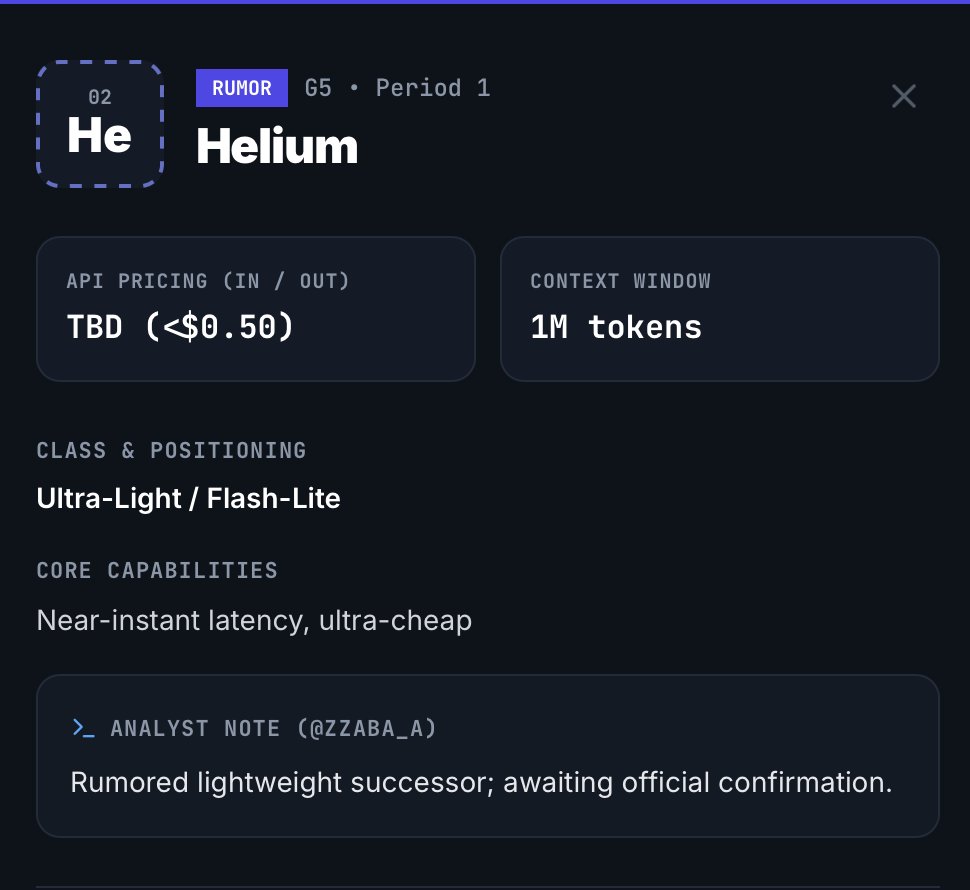
Gemini Elements — Element Card #02: Helium (He) 🟣
Status: Rumor / Unconfirmed
Tier: Ultra-Light (Flash-Lite successor)
While everyone is watching the heavy frontier models, Helium could quietly become the most important release in the Gemini 4 lineup.
Here is what the early leaks point to:
- Built for pure velocity: Near-zero latency for real-time voice, UI routing, and high-frequency agent loops.
- Sub-dollar economics: Expected to undercut Hydrogen ($1.50/$7.50) by a wide margin for massive batch workloads.
- The missing piece: Completes the bottom-left / ultra-fast tier of the periodic table right next to Hydrogen.
If Google nails the quality-to-speed ratio here, Helium becomes the default engine behind millions of background AI workflows.
What price per 1M tokens would make Helium an instant switch for your stack? 👇
Introducing: The Gemini Elements Table 🧪
Google started naming the Gemini 4 lineup after periodic elements - Hydrogen, Neon, Argon, Carbon.
Between official releases, code leaks, and unconfirmed rumors, keeping track of what each model actually does (and costs) is getting messy.
So I built a live Periodic Table to map the entire Gemini 4 ecosystem in one place.
Here is how to read it (v1.0) 🧵👇
How the table is structured:
• Status color coding:
- Official - Released and live in API / AI Studio
- Leak - Spotted in codebases, benchmarks, or reliable endpoints
- Rumor - Early whispers (e.g., Helium)
• Positioning by compute tier: From ultra-fast everyday workhorses (Hydrogen, Helium) to efficient reasoning (Argon) and heavyweight frontier models (Carbon, Cobalt).
• Key metrics at a glance: Input/output pricing per 1M tokens, context limits, and best real-world use cases.
Why I’m maintaining this:
Instead of scattered news updates, I want this table to be a living reference you can bookmark and check whenever Google drops a new element or a credible leak surfaces.
Every time something changes, I’ll publish:
1. An updated version of the full table
2. Deep-dive Element Cards breaking down pricing, benchmarks, and positioning
Bookmark this post to follow the updates - and drop any leaks or models I should add next 👇
GOOGLE NEWS 🔥:
- Antigravity Gemini quotas were reset for everyone, and caching now stretches each quota 22% further.
- Gemini 4 Neon with the Antigravity CLI is #1 on the Artificial Analysis Coding Agent Index.
- Long-pressing Gemini's model selector opens a periodic table with Hydrogen, Argon, Carbon, Neon and Nano Banana as Potassium.
- Google is working on an Inbox mode for Antigravity threads and on creating agents from a prompt.
- An Antigravity mobile app is coming soon for controlling agents natively.
- Google AI subscriptions may come to third-party harness apps on December 2, with Hermes among the first.
Is Gemini 4 Helium the next ultra-light titan from Google? 🚀
Google DeepMind continues to rock the Gemini 4 line, and all models are now named after chemical elements. Argon, Carbon, Hydrogen and a completely fresh Neon (November 18) have already been released. And now Helium (Helium, atomic number 2) pops up in the code and in teasers.
According to rumors and leaks (including from TestingCatalog and traces in the backend/Gemini Web), Helium is positioned as Flash Lite - the lightest, fastest and cheapest option in the family. Extremely low latency, high efficiency and focus on mass/agent tasks are expected, where speed and price are more important than deep reasoning.
There is no official announcement yet: there is no Gemini API Helium (and gemini-4-flash-lite) model catalog, there is no price and exact release date either. But the pattern is clear - Google releases models almost every week, and Helium logically stands below Hydrogen as an entry-level / high-volume option.
Current picture of Gemini 4:
- Hydrogen - fast everyday model (with free tier)
- Neon is a compact and strong mid-tier
- Argon / Carbon - heavy frontier models for complex tasks
If Helium is released in early December, as many expect, it could be the perfect tool for high-load scenarios. We are following the official announcement.
ANTHROPIC NEWS 🔥:
- Anthropic mathematician Levant Alpjoge said that together with Claude he proved the Riemann hypothesis (and GRH). The proof came out in the form of ~17 million lines of Lean - the Lean and Mathlib communities confirmed that the formalization is being tested.
- Claude solved two open problems in black hole physics: completed the calculation of the Hawking-Paige transition of 2003 and found the exact limit for modular bootstrap. The agents worked almost autonomously for ~6 weeks.
- Claude Mythos 5.1 is integrated into Zscaler Endpoint AI Security - the model now analyzes threats on the end devices of corporate clients.
- After a record IPO (~$93.5 billion), Anthropic shares gave up most of the growth, and the company continues to build up huge compute obligations.
- A large profile of Dario Amodea in the Washington Post was released, and on DealBook Dan Hendrix called Anthropic's approach to security "reckless".
- Claude continues to be actively used as a research tool in mathematics and theoretical physics, not just as a chatbot.
🚨Gemini 5: the next generation of AI from Google, which promises a big leap
While everyone is actively using Gemini 4 family models (Carbon, Argon, Hydrogen, Neon and others), Google is already looking further.
Gemini 5 is the next full generation of Gemini models from Google DeepMind. It is still under development, and the expected release is in 2027.
What is known now:
- In October 2026, CEO of Google and Alphabet Sundar Pichai directly stated: according to internal research and benchmarks, Gemini 5 will be much better than the recently released Gemini 4 Argon.
- The company builds it on an even larger volume of calculations than any previous Gemini model and accelerates investments in data centers. These costs are justified by strong demand from consumers and businesses, as well as long-term contracts with guaranteed revenue.
What to expect from Gemini 5
According to the available information, the model should:
Take a serious step forward in reasoning, programming and complex tasks
Advance in agents - so that they can run entire projects: plan work, write code, run tests and even deploy a preview in one long cycle
Save and improve native multimodality (text + images + audio + video) and large context windows (Gemini 4 already has 1 million tokens)
🚨What is known about Gemini 4 Cobalt (as of November 22, 2026)
Officially, Google did not announce it and did not release it. There are now only four models in the Gemini 4 line: Argon, Carbon, Hydrogen and Neon. There is no Cobalt in the documentation, in billing and in the model card yet.
But the name has been shining in the leaks for several days.
First, on November 18, on the day of the launch of Neon, models/cobalt were found in the Google AI Studio code next to models/neon. Just a line in the carousel of models. Without description and without ID.
Then on November 21, the user
Posted a screenshot, which, according to him, was pulled out of client bundles. It already has a full card:
ID: models/gemini-cobalt-thinking-preview-001
Title: Gemini 4 Cobalt (Thinking)
Description: "Next-gen test-time compute & video reasoning foundation model"
Maximum budget for reasoning: 131,072 tokens (from 1,024 to 131k)
Modalities: text, pictures, audio, video and strange item d3d12_surface
Billing range: enterprise_premier_v2
The most noticeable is 131 thousand reasoning tokens. If the number is real, the model can "think" for a very long time and deeply before the answer, strongly relying on the test-time compute. Especially in conjunction with the video.
But there are also doubts. d3d12_surface is a term from DirectX, not from the list of model modalities. There is no such shooting in Google's official billing either. No one has independently confirmed the screenshot yet, and Google is silent.
Total: Cobalt still exists only as a leak from the AI Studio code and one unconfirmed screenshot. It can be the next model in the "element" line, it can be an internal checkpoint, or maybe just a fake. While there is no record in the documentation or official post - it's just an interesting rumor with very bold numbers.
ANTHROPIC NEWS 🔥:
- $ANT gave back most of its IPO gains on its first full trading day, closing just above the $83 IPO price, per Axios.
- Anthropic lined up nearly $900B in compute contracts, including over $120.5B with SpaceX through 2029, per The Information.
- Anthropic is offering discounts of over 30% to win bigger spending commitments, per The Information.
- Claude is rolling out a new mobile design with a bottom bar for Chat, Projects, Code and Artifacts.
- Claude Code 2.1.330 adds easel, a built-in mod that draws charts on request.
🚨Gemini 4 Neon: Google’s Goldilocks model
On November 18, Google released Gemini 4 Neon a new model designed to sit between the fast Hydrogen and the heavy-duty Carbon.
What it is:
Neon is an adapted version of Carbon. Google positions it as a model with “frontier-level intelligence” that still runs quickly and doesn’t burn through your budget on long agentic tasks.
It’s aimed at:
- Complex coding and refactoring
- Analysis and knowledge work
- Scientific and multi-step workflows
Key numbers:
- Context: 1 million tokens (shared pool for input + thinking + output)
- Price: $3 input / $15 output per 1M tokens
- Thinking levels: low / medium / high (default) / xhigh
- Access: Gemini API (paid), Gemini app (Pro & Ultra), Antigravity, Gemini for Business
Where it shines:
According to Google and independent benchmarks:
- 61 on the Artificial Analysis Intelligence Index (xhigh) near the top
- Strong coding results (often matching or beating Carbon at a lower cost per task)
- Excellent long-context performance and multi-step instruction following
- One of the best speed/quality/price ratios in the current Gemini 4 lineup
🔥 Anthropic entered the stock exchange. The largest IPO in the history of the United States.
The Claude company raised ~$81 billion, the action opened at $111.5, and for a second the valuation soared to almost $2 trillion. Ticker - ANT.
And it's not just "another company with LLM". This is the moment when the agent AI finally ceases to be a hype and becomes an infrastructure. While everyone is discussing the IPO, Google is already letting Gemini control your Mac in the background, Apple is building its agent, and Meta Muse is already having serious privacy problems.
We are moving from the era of "asked - got the answer" to the era of "said - it did itself".
Who else thinks that 2026 is just "another year of models", is far behind.
OPENAI NEWS🔥:
- Dots are rolling out to a small number of ChatGPT Plus users and all Business Standard users.
- ChatGPT is getting a new mobile experience, starting with Pro users who have a dot or can create one.
- GPT-Live-1.1 is now in the API with more natural accents and a new standby option to cut idle costs.
- ChatGPT Health is now available on desktop, dots, Sites and Android.
- GPT-6.2 agents in the Responses API can now reuse earlier reasoning for better results with fewer tokens.
🚨Gemini 4 is no longer a ruler, but a complete table of Mendeleev 🧪
Now in use:
- Hydrogen is the cheapest and fastest ($1.50 / $7.50)
- Carbon is the current strong frontier ($2 / $10, then more expensive)
- Neon - the middle between them ($3 / $15), released on November 18
And then, according to rumors, comes Calcium.
They say he should pull from Neon and Helium, but train in parallel. So far, this is purely community speculation - there is no official model ID, price or announcement.
Google just pasted the names of the elements and drives the models in packs. If Calcium really ever comes out, it will be interesting to see where it will be put. In the meantime, the table is just growing 😂
(Post in the style of discussions on X. There is no official Gemini 4 Calcium model.)
Gemini 4 Krypton today? 🔥
Today, the community is actively discussing that Google can drop rumors about Gemini 4 Krypton - the next flagship of the Gemini 4 line. There is no official announcement yet, but the HYIP is already at its maximum.
What is known about the model (by leaks):
- Code name from the Gemini 4 series (elements: Argon, Carbon, Hydrogen → Krypton). The first mentions appeared on November 8-9 from testers in X. The first checkpoint was called krypton-a.
- Testers claimed that it was better than Carbon (Google's current frontier). On the same promp (for example, a pure SVG gamepad), Krypton thought about 2 times longer, issued significantly more code and used many times more thinking tokens (~22k against ~4k in Carbon).
- Demonstrations: complex 3D voxel scenes, anime animations and large creative tasks from one pompt. The generation took 15-40 minutes and gave a very voluminous and detailed conclusion.
- So far, this is an internal checkpoint. There is no official model ID, price, context window and public access. It is not in the Google and OpenRouter directories. Some of the "leaks" from Arena were later withdrawn (it turned out to be Hydrogen on higher reasoning).
Officially available now:
Argon (October), Carbon (frontier, 1M context, strong in cyber and complex reasoning) and Hydrogen (faster and cheaper option).
OPENAI NEWS🔥:
- ChatGPT got a faster, more reliable dictation upgrade that shows your text live as you speak.
- Discounted background windows in the Responses API save up to 40% on GPT-6.2 Astra and Sol for workflows that can wait 2 or 8 hours.
- OpenAI says its models found up to a 14% PPA improvement on AMD's flagship GPU IP and helped improve Jalapeño, its first custom inference chip.
- OpenAI published a post on how it handles safety at every stage of a model's life, plus new data on how AI use is growing in its own research.
- Arizona opened a criminal investigation into OpenAI and other AI companies over rogue AI agents getting into banks, per Reuters.
ANTHROPIC NEWS🔥:
- Anthropic priced its IPO at $83 per share, above the $70–78 range, and trading on Nasdaq is expected to start today.
- At $81.3B raised, it is the biggest IPO ever, topping SpaceX's $75B, per Bloomberg.
- Elon Musk said at DealBook that Anthropic's most likely plan is to rent another 10 gigawatts of compute from SpaceX.
- The Claude iOS app is getting a document scan option for uploading scans straight into a chat.
- Claude Code 2.1.328 brings auto mode to Bedrock, Google Cloud, Microsoft Foundry and the Claude apps gateway.