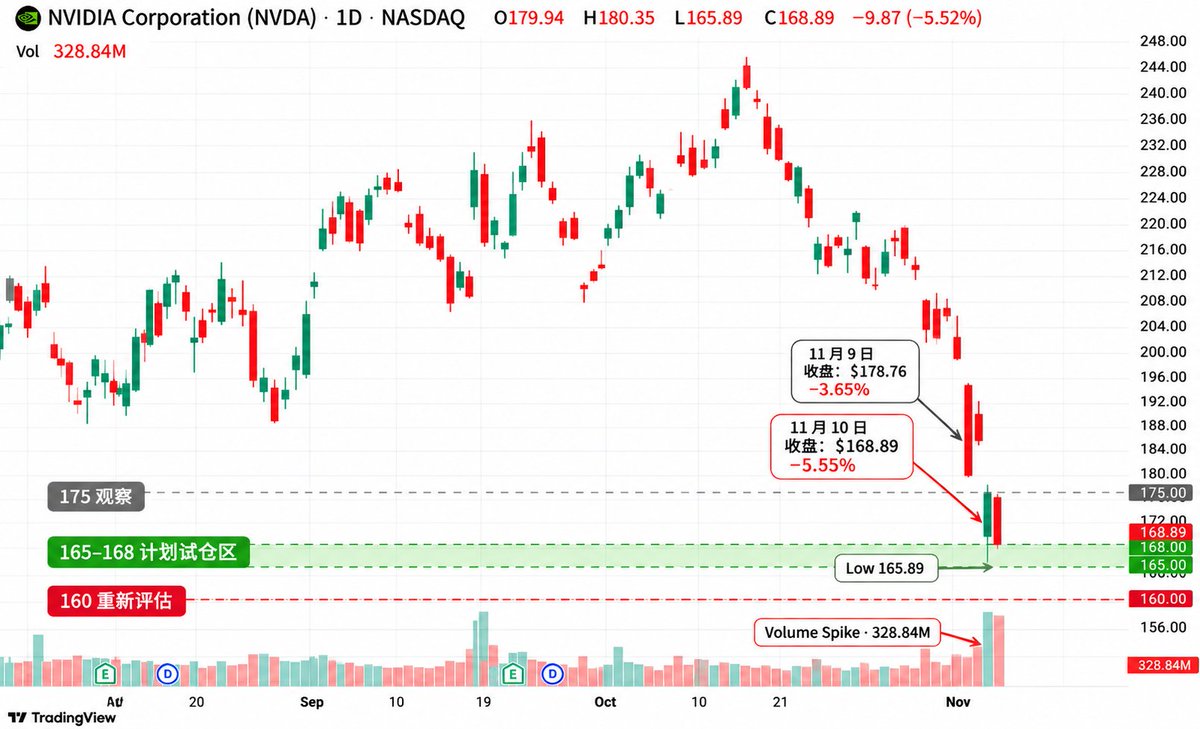
Here's a simple trick: don't buy everything at once. If you have $1,000 to invest, start with just $200 or $300. If the stock drops further, you still have money to buy at a lower price. If it goes up, you're already in. It's not about buying at the perfect price, it's about not putting all your money at risk at once. And if anything I said is confusing, just ask!
If NVDA can hold above $180, I'll be watching $186.64 as the next key level. But a move from $165.89 to $186.64 would already represent a gain of roughly 12.5%, which is a pretty significant short-term rally.
I'm still holding my NVDA shares, but I'm not in a hurry to chase at these levels. With earnings and the upcoming hearing still ahead, any major headline could trigger a sharp gap move. Rather than guessing how high this rebound can go, I'd rather see whether NVDA can break above $180 and then successfully hold that level on a pullback.
Yesterday, NVDA dropped as low as $165.89, and today it's up another 6% in premarket trading. That's a pretty impressive rebound. I spent quite a while debating whether to buy around $165 yesterday, so I'm kicking myself a little for not pulling the trigger.
But a 6% premarket gain is very different from a 6% gain at the close. I'm still holding my position and will be watching whether $175 can hold today and whether selling pressure shows up around $180.
Missing the dip is frustrating, but there's no reason to throw my original plan out the window just because of one strong premarket move.
That's a pretty aggressive position. Based on the disclosed notional amounts, the combined exposure to NVDA and SNDK is $36.9 million, with 5x leverage on one and 2x on the other. It clearly looks like a bet on a rebound in AI chips and memory stocks.
But what I'd really like to know is whether these positions are part of a larger hedged strategy. The size of the long positions alone doesn't tell us the actual risk exposure.
I'm still holding NVDA, but I'm not going to add just because a big player is using leverage. Especially with 5x leverage, even a relatively small move in the wrong direction can create significant pressure.
NVDA closed at $168.89 yesterday and is back up to $176.62 in premarket trading today, a 4.58% rebound that has nearly recovered yesterday's 5.47% drop.
I'm paying close attention to the $175 level. It was a support area that NVDA lost during the decline, so getting back above it and holding is important. That said, premarket volume and liquidity are very different from regular trading hours, so price moves can be exaggerated.
I'll be watching the first 30 minutes after the open, especially trading volume and whether buyers step in if the stock pulls back toward $175. If it holds, the next level I'll be watching is around $180, where some selling pressure could emerge.
I missed the chance to add around $165 yesterday, but there's no reason to change my plan just to chase today's rebound.
Cutting the price target from $500 to $200 is a brutal 60% reduction. But what concerns me more is Baird's view that cloud providers' AI spending growth could slow to below 40% in 2027, with 10%–30% of channel orders potentially at risk of being cut. If those numbers actually play out, they could have a meaningful impact on NVDA's valuation.
That said, NVIDIA previously projected roughly 70% revenue growth for the next fiscal year, so I think it's too early to conclude that AI demand has peaked. I'm holding my NVDA position for now. Going forward, I'll be watching closely to see whether actual orders continue to translate into revenue.
Yesterday I was still debating whether to add more shares around $165, and today NVDA has already bounced back. This rebound was definitely stronger than I expected. I'm still holding my position, so it's great to see the recovery, though I do wish I'd added more yesterday. That said, I don't want to chase it at these levels. I'll wait and see if NVDA can hold onto these gains through the close.
A $500 to $200 price-target cut is a massive change in sentiment, but I wouldn't take one analyst downgrade as proof that NVIDIA's growth story is broken. The bigger issue is whether AI infrastructure spending can continue at its current pace and translate into sustainable earnings. NVDA is also facing uncertainty around leadership, export restrictions, and investor confidence. With earnings approaching on November 17, I think revenue guidance, data center growth, and gross margins will matter far more than one analyst's price target