At the turn of the 18th century, mathematics was exploding with new ideas.
Calculus had just been invented.
Guillaume de l’Hôpital was a wealthy French nobleman passionate about math, but not exactly a genius.
He hired one of the brightest young mathematicians of the time, Johann Bernoulli, as a personal tutor. Bernoulli was so talented that L’Hôpital made him an incredible offer: a yearly salary of 300 francs in exchange for every new discovery he made.
Yes, L’Hôpital bought theorems. Whenever Bernoulli found something new, he sent it to his employer.
In 1696, L’Hôpital published the first calculus textbook, Analyse des Infiniment Petits.
It introduced the famous L’Hôpital’s Rule, how to handle indeterminate limits like 0/0.
But here’s the twist: the rule, and much of the book, were actually written by Bernoulli. After L’Hôpital’s death, Bernoulli revealed the truth and showed the letters proving the arrangement.
Still, L’Hôpital’s name stayed attached to the rule—a reminder that sometimes in science, money buys fame.
Today, every calculus student learns L’Hôpital’s Rule, even if the real author was Johann Bernoulli.
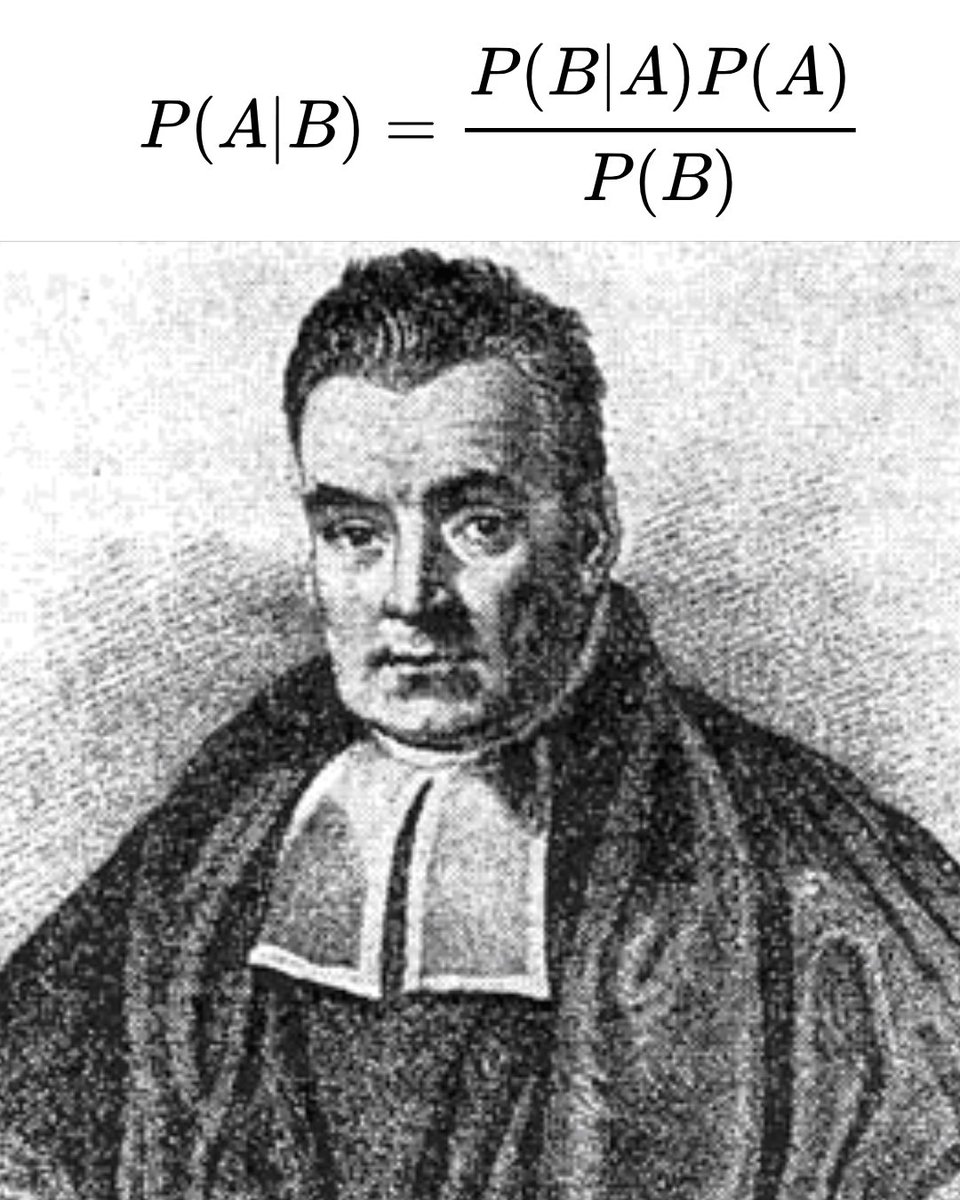
Bayes’ theorem is probably the single most important thing any rational person can learn.
So many of our debates and disagreements that we shout about are because we don’t understand Bayes’ theorem or how human rationality often works.
Bayes’ theorem is named after the 18th-century Thomas Bayes, and essentially it’s a formula that asks: when you are presented with all of the evidence for something, how much should you believe it?
Bayes’ theorem teaches us that our beliefs are not fixed; they are probabilities. Our beliefs change as we weigh new evidence against our assumptions, or our priors. In other words, we all carry certain ideas about how the world works, and new evidence can challenge them.
For example, somebody might believe that smoking is safe, that stress causes mouth ulcers, or that human activity is unrelated to climate change. These are their priors, their starting points. They can be formed by our culture, our biases, or even incomplete information.
Now imagine a new study comes along that challenges one of your priors. A single study might not carry enough weight to overturn your existing beliefs. But as studies accumulate, eventually the scales may tip. At some point, your prior will become less and less plausible.
Bayes’ theorem argues that being rational is not about black and white. It’s not even about true or false. It’s about what is most reasonable based on the best available evidence. But for this to work, we need to be presented with as much high-quality data as possible. Without evidence—without belief-forming data—we are left only with our priors and biases. And those aren’t all that rational.
في هذا الشهر المبارك، ندعوكم للمساهمة في وقف دار ميمونة دعمًا لحفظة القرآن وطالبات العلم، ليكون لك سهم في تعليم كتاب الله ونشر نوره
https://t.co/PV3WJWaE2m
في هذا الشهر المبارك، ندعوكم للمساهمة في وقف دار ميمونة دعمًا لحفظة القرآن وطالبات العلم، ليكون لك سهم في تعليم كتاب الله ونشر نوره
https://t.co/vvgw8yuRLc
https://t.co/vvgw8yuRLc
سهم البحر الاحمر يصل للهدف ٣١ ريال #البحر_الأحمر
ولكن غير مناسب لدخول حتى الان ع الوضع الحالي ٣٤.٤٠ اذا صعد اعلاها ٥٢ و ٧٢ ريال لسهم المهم اختراق ٣٤.٤٠