The Artemis Generation is here.
Artemis III will help us get into the rhythm of multi-launch campaigns, test new capabilities close to home, and then take the next step toward building a sustained human presence at the lunar South Pole.
Elon Musk just got featured at #2 on the Forbes 250 list of America’s Most Successful Living Immigrants.
The world’s richest-ever person grew up in Pretoria, South Africa, where he taught himself to code. He became a U.S. citizen in 2002, the same year he founded SpaceX.
Little Elon and Kimbal as kids ❤️
Growing up in South Africa, the brothers faced a tough and often violent world together. They survived bullying, dangerous streets, and a difficult home life, but stuck by each other.
From those early days, two brothers who would later go on to change the world in their own ways.
This is not just another satellite. This is SpaceX’s AI satellite
SpaceX has officially unveiled AI1, its first-generation AI-focused compute satellite. It is designed to bring powerful AI computing into orbit, with a 150 kW peak compute payload, a 120 kW average compute payload, advanced liquid-radiator cooling, and massive solar arrays built with SpaceX-manufactured solar technology from Bastrop, Texas
AI1 is huge, with a 70-meter wingspan and a deployed height of 20 meters. It is built around a centralized compute module, large deployable solar arrays, and a thermal system designed to keep high-power AI hardware running in space
This could be the beginning of a new era where satellites do more than connect the world
They could help power artificial intelligence from orbit.
🎂 Happy Birthday to our absolute LEGEND, @kdallasAT 🤍
Some people join the club. Karina IS the club.
For years now she has been there. Every meet. Every rallye. Every crazy idea we said yes to 🚗⚡
The events do not run on electrons alone. They run on people like Karina 🙌
Today we celebrate you. Thank you for years of showing up, lifting up everyone around you, and being one of the truest hearts in this community.
Have the best day. You earned it 🥳
Alles Gute, Karina 🤍
#TeslaClubAustria #TeslaFam
The Moon looks even more beautiful when it’s bathing in some Earthglow – let’s hear it for Earth Joy! Congratulations to my friends and colleagues on the Artemis III crew: @AstroKomrade, Frank Rubio, @astro_luca, and @Astro_AndreD. This mission in low Earth orbit will pave the way for our subsequent @NASAArtemis missions to land humans on the Moon.
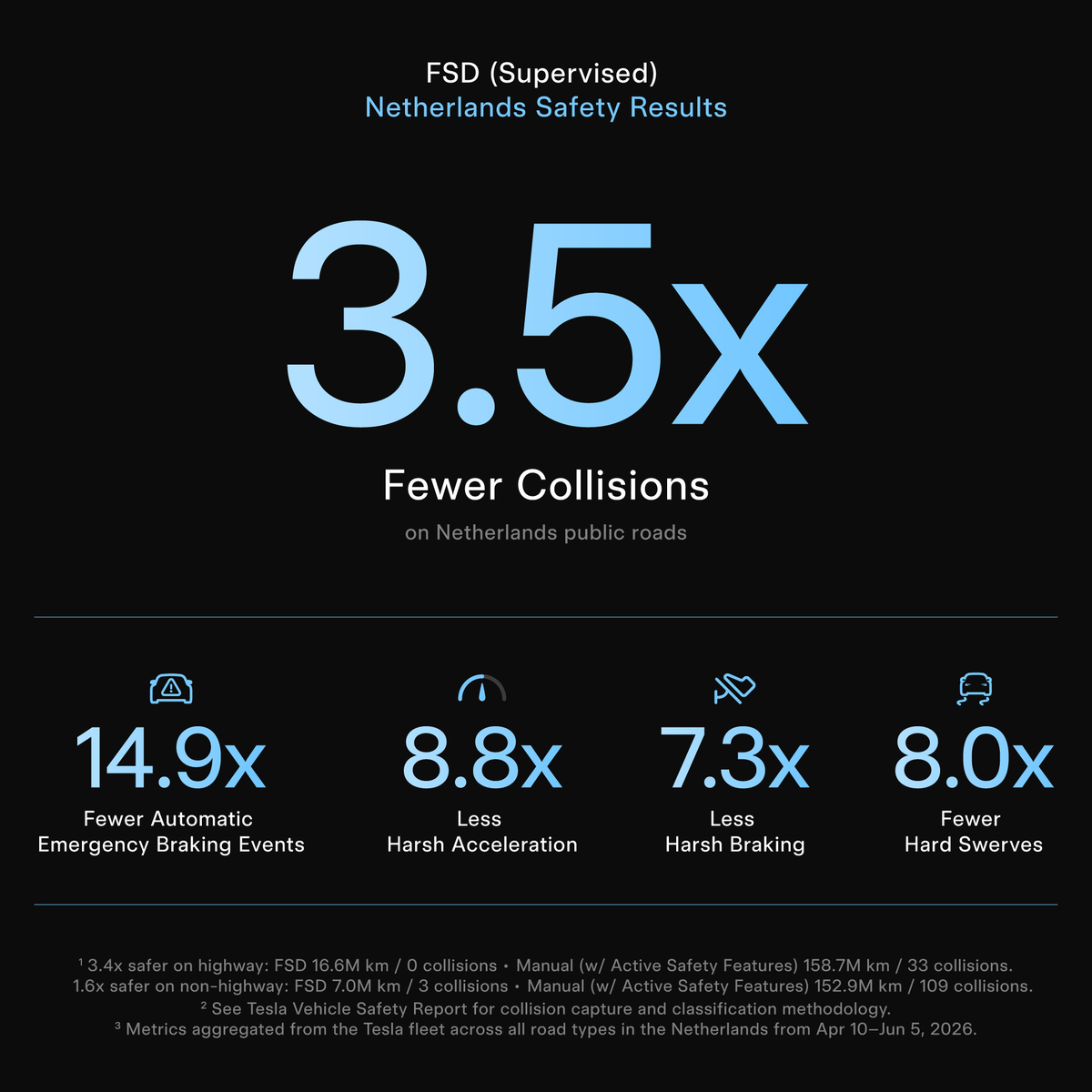
Tesla has released its first-ever FSD (Supervised) safety data from its Netherlands fleet.
• 3.5x fewer collisions
• 3.4x safer on highway: FSD 16.6M km/0 collisions
• 14.9x fewer automatic emergency braking events
• 8.8x less harsh acceleration
• 7.3x less harsh braking
• 8x fewer hard swerves
Tesla "Metrics aggregated from the Tesla fleet across all road types in the Netherlands from Apr 10-Jun 5, 2026."
Elon explains why the Tesla Semi is so much more energy efficient than any diesel truck:
“I’d certainly encourage people to look at our semi truck presentation
Because one of the things we emphasize with an electric semi truck is that it’s, it’s much more energy efficient than a diesel truck.
You get things like regenerative braking. So like, let’s say you’re going over a mountain range
In diesel truck, you have to actually spend a lot of money on expensive brakes going down the other side so you don’t run out of control, whereas an electric semi truck, is able to recapture the gravitational potential energy, and, when it goes down the other side, it does not overheat the brakes and in fact puts the energy back in the pack.
So, things like that are incredibly helpful for energy efficiency."
Elon Musk sparked a major online conversation by sharing a unique viewpoint on parental responsibility and choice.
He pointed out that because children cannot choose to be born, the decision to bring them into the world is made entirely by their parents.
Therefore, the people who choose to have children must take full accountability for that choice.
Under this perspective, children do not owe their parents anything in return for being raised and cared for.
Instead, mothers and fathers have an absolute duty to provide unconditional love, guidance, and support throughout a child's upbringing.
This idea completely flips traditional expectations, where parents often look for appreciation or future support from their offspring.
Musk’s comments have pushed people to rethink the deep meaning of family dynamics and what it truly means to raise a human being.
The viewpoint challenges old social habits and encourages a more selfless approach to parenting.
By removing the idea of debt from the parent-child relationship, this philosophy emphasizes that caring for the next generation is a profound duty rather than an investment meant to bring personal rewards later in life.
Image is for representation purpose only.
Historian Victor Davis Hanson on Elon Musk:
“Elon Musk is a Renaissance man of the 21st century.
He reinvented social media. He's saving NASA.
He created the EV industry, basically single-handedly.
Let's not even get into the other things.
He's a Da Vinci of our age.”
NEWS: A school leader in Kenya drove nine hours to pick up a single Starlink kit for a school with almost no internet.
The results across the program came fast. One month in, teachers using digital tools jumped from 57% to 82%. The share of students completing digital tasks doubled, according to Grow X Education, which runs the rollout.
Starlink says it is now connecting 30 schools in remote parts of Kenya, lifting digital literacy for students and teachers.
40 airlines have now signed on to use Starlink for in-flight Wi-Fi.
Not 40 that are testing it.
~ 5 fully installed and operational
~ 11 actively rolling out
~ 24 announced or in testing
When we wrote about 37 airlines a few weeks ago, it was already the fastest adoption in aviation history.
It is now 40.
The chart tells the story. Every other in-flight Wi-Fi provider is flat. Starlink is vertical.
The in-flight internet market did not gradually shift toward Starlink.
It collapsed into it.
Elon Musk is essentially saying that, if his claim holds true, Tesla’s upcoming AI6 chip may extract an unusually high amount of working AI computing power from each silicon wafer 🔥
Here is exactly what it means in plain English 🧵
BREAKING DOWN THE JARGON
💿 Wafer: Computer chips aren't manufactured one by one. They are printed by the dozens or hundreds onto a giant, shiny, pizza-sized disc of silicon called a "wafer." Once the intricate printing process is done, this wafer is sliced up into individual square chips.
🏭 Yield: When you manufacture chips on a silicon wafer, not all of them come out usable. A microscopic speck of dust or a tiny printing flaw can damage a chip. "Yield" is the percentage of chips on the wafer that work well enough to be used. Sometimes a chip with a small flaw can still be used by disabling the damaged part or running it at a lower performance level.
🧠 Usable intelligence: This is Elon's phrase, not a standard chip-industry metric. He likely means useful AI processing power: how much real neural-network work Tesla can get from the chips that actually work. It is not "intelligence" in the human sense.
CONNECTING THE PIECES
Think of a silicon wafer like a large baking sheet, and the individual chips as cookies being baked on that sheet.
🍪 Every chip design tries to pack as many transistors—the brain cells of a chip—into a given area as possible to maximize computing power. However, silicon manufacturing is incredibly delicate.
📉 Imagine that every time you bake, a few random drops of liquid soap fall onto the baking sheet. If a drop lands on a cookie, that cookie is ruined. This is the reality of manufacturing defects.
🎯 This creates a massive trade-off problem. A bigger chip hurts you twice: fewer of them fit on each wafer, and each one is a bigger target with a higher chance of being ruined by a random defect. If you make the chips very small, more of them fit on the wafer and yield may improve, but each chip may not have enough computing power for serious AI workloads.
HOW TESLA MIGHT PULL THIS OFF
No one outside Tesla knows the exact AI6 design yet, so this part is best understood as an educated guess.
To maximize real neural-network work from each wafer, Tesla would likely need to optimize several things at once:
1️⃣ First, the chip must be the right size. Public reporting suggests AI5 is not a maximum-size chip, but closer to a more practical size that still leaves room for strong performance. That matters because a chip that is too large may be powerful, but fewer fit on each wafer and each one has a higher chance of being ruined by defects.
2️⃣ Second, the chip can be specialized for Tesla’s own AI workloads instead of being a general-purpose processor. If the hardware is designed mainly around the kinds of neural networks Tesla actually runs in cars, robots, and data centers, more of the silicon can be spent on useful AI work.
3️⃣ Third, Tesla may be able to improve yield by designing in redundancy, meaning a chip with a small defect could still be salvaged and used instead of being thrown away. This is common in advanced chip design, though we do not know the exact AI6 approach.
4️⃣ Fourth, memory bandwidth and power efficiency matter immensely. Public AI5 details suggest Tesla is paying close attention to feeding data quickly into the chip. That is important because an AI chip is only useful if it can keep its AI engines busy without wasting too much energy.
So the achievement would not come from one magic trick. It would come from balancing chip size, specialization, memory, power, and manufacturability better than competitors.
THE BOTTOM LINE
The key point is that Elon’s claim is not just about making the most powerful individual chip. It is about maximizing the total amount of useful AI compute Tesla gets from each wafer.
The rough equation is:
Usable AI compute per wafer = how many chips fit on the wafer × how many survive manufacturing × how powerful each working chip is
So when Elon says AI6 might set a record for "the most amount of usable intelligence from a wafer when factoring in yield," he is saying Tesla may have optimized the whole system: chip size, defect tolerance, AI specialization, memory, power efficiency, and manufacturing yield.
In plain English, the win would not simply be:
"We made a giant chip".
It would be:
"We got the most working AI brainpower out of each expensive silicon wafer".
That is why the yield part matters. A chip only counts if it actually works, and the real engineering achievement is maximizing the amount of useful AI work that survives the manufacturing process.