Council of Trent, Session VI
Canon 1. If anyone says that man can be justified before God by his own works, whether done by his own natural powers or through the teaching of the law, without divine grace through Jesus Christ, let him be anathema.
"The irregularity is not ours. It is that of Rome. A Modernist Rome. A Liberal Rome that has renounced Christ the King." - Bishop Bernard Tissier de Mallerais, SSPX, 2012
Read more: https://t.co/Qfp1pSKTkR
Most Catholics are unaware that the "Mystery of Faith" which is "proclaimed" in the Novus Ordo was originally nothing to do with Christ's death, resurrection and second coming, but, in the Old Mass, was the transubstantiation of the species into the Body and Blood of Christ.
The Novus Ordo has moved these words away from the words of consecration, in order to deprive them of their original meaning.
“Today, to be in full communion with the Holy See, one must accept those affirmations and teachings of Vatican II that are pastoral and certainly non-definitive in terms of their magisterial nature. This raises an important question: Why is the unconditional acceptance of the texts of Vatican II presented as a conditio sine qua non for full communion with the Holy See, while no comparable requirement exists with respect to the pastoral, disciplinary, or non-definitive teachings of the preceding twenty Ecumenical Councils?” — Bishop Athanasius Schneider
«La revolución conciliar destruyó la Misa católica; eliminó el respeto al Tremendum ac vivificum Sacramentum; impuso la administración sacrílega de la Comunión en la mano y de pie; oscureció el dogma de la Presencia Real; confinó el Tabernáculo a un rincón de la iglesia, demolió altares y balaustradas; indujo a los fieles a considerar al Rey Eucarístico como un símbolo de fraternidad humana, como un pretexto para la auto-celebración de la comunidad; ha vaciado seminarios e iglesias, descristianizado la sociedad y demolido la fe católica.
Pero si la Iglesia conciliar y sinodal tolera e incluso fomenta las liturgias más irreverentes y autoriza la Comunión a los indignos en estado de pecado público en nombre de la inclusión y del diálogo, esa misma amplitud y comprensión no tienen cabida para los católicos, reducidos a mendigar una Misa celebrada dignamente por un sacerdote que cree en ella, como si fuera una excentricidad digna de compasión, si no es indicio de sedición peligrosa.»
https://t.co/yzzvyGSXda
@DrThaddeusJ@EricRSammons You should read the canons and anathemas of Vatican II.. btw Vatican II and the New Mass were just an experiment. On the contrary Trent was no experiment, and its canons and anathemas are binding.
The nastiness of some conservative Catholics toward the SSPX reveals both a lack of charity and a worry that the Society’s critiques of the postconciliar era hit close to home.
And I say this as one who has reservations about the SSPX and its decision to consecrate new bishops.
@Saul_CZa@TEOFOROS Cristo no fundó una Iglesia Sinodal, ni mandó abstenernos de “proselitismo” en pro del ecumenismo, ni mandó que los adúlteros cohabitaran y comulgaran. En fin, los procesos.
@bonbin7788@PaulinusOfTrier Differently from penance absolution it is only helpful for those who are in state of grace, thus it doesn’t command absolution for everyone…
An absolution formula is a formula that contains the verb ‘absolvo’. If the formula lacks that verb it is not an absolution.
The prayer you have quoted is not an absolution is just a prayer hoping for God’s Mercy just that.
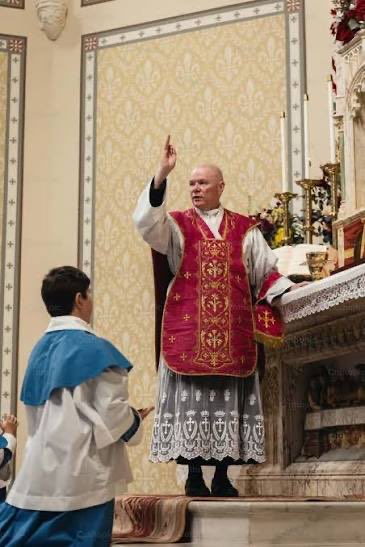
No specific ‘absolution’ reference as before. In the TLM the priest says “indulgentiam…” and gives the absolution making the sign of the cross (see the picture). That doesn’t happen at the new mass.
The doc you quoted its mistaken.
Father, of course the Mass isn’t render invalid for this change. One can still receive Communion with venial sin. But that’s not really the question. The real question is: why would we want to?
The suppressed formula specifically prepared for approaching the altar without even venial sin. Removing the explicit ‘indulgentiam, absolutionem et remissionem’ was not a neutral change.
Modifying non-essential parts of the rite is one thing. Removing something that was good and helpful is another (& replacing the received and approved rite with a new one is something else entirely…).
It’s like telling people they no longer need to wash their hands before eating …technically you can do it, but why remove a practice that made sense?
(I’m obviously not saying the Sacrifice of the Mass is a meal, Im just using an analogy).
Respectfully, some questions regarding the Novus Ordo deserve more serious theological examination than a simple “so what?”.
“Prophets of Doom?” Maybe. But these are imo legitimate questions that need serious attention. I’d genuinely be interested to hear your thoughts on this, Father. Thank you for your time. God bless you.
@davidpaulyoung@PaulinusOfTrier You are being redundant. You may call the example absolution, and yet without an *absolution formula* it isn’t an absolution.
The absolution formula was present before (TLM) and it was suppressed from the New Mass.
The title of your example is mistaken.
Rome is gleefully willing to meet with literally anyone, no matter how evil for a hefty price tag, yet when asked to meet with the largest traditionalist group on the planet, who uphold the faith more than most dioceses, they can only bother to send their top pornographer.
@LateHaveILoved@Bavarican_Guy@lukei4655 Consecrating Bishops is not sinful per se, what’s sinful is to deny pastorship to the faithful.
The grace for salvation shall not be subject to the will* of the Pope.
The will of the Pope is not a source of law and to do so is sinful. Prudence and wisdom are the sources of law.