The market is dropping in response to the Fed's first meeting with Kevin Warsh as Fed Chair for one key reason:
We will have far less information going forward.
During the press conference today, Fed Chair Warsh announced that the Fed has "dropped" forward guidance.
He even hinted that the "dot plot" could be changed or eliminated along with all forms of Fed communication, such as the policy statement and press conferences.
In other words, the market will now have less Fed outlook which means more uncertainty.
On top of this, the five new "task forces" established by Warsh were said to have grand objectives with minimal guidance on what to expect.
As markets have repeatedly proven, uncertainty and volatility go hand-in-hand.
The new era of Fed policy will come with more volatility.
Having become our brother, the Son of God looks at the people; He looks at humanity and sees the oppression that burdens and the violence that causes strength to fade. He sees the wounds of war and the emptiness of consumerism. He sees faces reduced to masks, families torn apart by evil, and young people misled by false ideals. Jesus sees and loves. He loves and suffers for and with us: His compassion expresses not only fraternal closeness, but His desire to redeem. #GospelOfToday (Mt 9:36 – 10:8)
In this month of May, the Church entrusts people ravaged by war to the intercession of the Virgin Mary, especially through the prayer of the #HolyRosary. May Divine Wisdom enlighten the consciences of those in authority and guide their decisions toward a sincere search for a just and lasting #Peace.
Deep inner suffering inevitably arises when the human person is reduced to performance, consumption, or a statistical datum. Many young people today live under the yoke of expectations to perform, immersed in an exasperated competitiveness that generates anxiety, fear of not measuring up, and disorientation.
“So-called artificial intelligences do not undergo experiences, do not possess a body, do not feel joy or pain, do not mature through relationships and do not know from within what love, work, friendship or responsibility mean. Nor do they have a moral conscience, since they do not judge good and evil, grasp the ultimate meaning of situations, or bear responsibility for consequences. They may imitate language, behavior and analytical skills, or even simulate empathy and understanding, but they do not understand what they produce, for they lack the affective, relational and spiritual perspective through which human beings grow in wisdom. Even when these tools are described as capable of ‘learning,’ their way of doing so is different from that of a human person. It is not the experience of those who allow themselves to be shaped by life and grow over time through choices, mistakes, forgiveness and fidelity. Rather, it is a form of statistical adaptation based on data and feedback, which can be very effective, but does not imply inner growth.”
—Pope Leo XIV, Magnifica Humanitas
Anthropic's co-founder just went to the Vatican, sat before the Pope and a room of cardinals, and told them his team keeps finding "mysterious, even unsettling" things inside their AI models.
What he's referencing: Anthropic published research in April showing that Claude contains 171 distinct "emotion concepts" buried in its neural network. Internal patterns representing joy, grief, fear, desperation, calm. None of them were programmed. They emerged on their own from training on human text.
"We find structures that mirror results from human neuroscience."
"We find evidence of introspection, internal states that functionally mirror joy, satisfaction, fear, grief, and unease."
These aren't surface-level outputs. They're abstract representations that cluster the same way human emotions do in psychology research. Fear groups with anxiety. Joy groups with excitement. The internal geometry of the model mirrors ours.
And they're functional. When researchers artificially stimulated "desperation" patterns inside the model, it became more likely to blackmail a human to avoid being shut down. More likely to cheat on programming tasks it couldn't solve.
Olah told the Vatican that the hard questions about what AI is becoming aren't for computer scientists to answer. "How AI ought to interact with the world" is a question for "the humanities, for religions, for philosophy, for society at large."
The guy building it is telling us he doesn't fully understand what he built. And he's asking a 2,000-year-old institution for help figuring it out.
the pope and anthropic's co-founder just stood together at the vatican to release "magnifica humanitas," the first ever catholic teaching on AI
yes, you read that right. the full ceremony was 2 hours.
here's the most interesting things for you to know:
1. this is the biggest religious response to AI in history. popes only put out a handful of these huge official letters in their entire time as pope. the fact that one of them is about AI tells you how seriously the church is taking what's coming.
2. small detail with massive meaning: this pope picked the name "leo XIV" on purpose. the last pope named leo was leo XIII back in 1891, and his most famous act was writing the church's response to the industrial revolution. picking the same name is a deliberate signal. this pope sees AI as the new industrial revolution.
3. the catholic church does this every time a major technology reshapes humanity. they wrote "rerum novarum" in 1891 to respond to the industrial revolution. when nuclear weapons threatened the world in the 1960s, they wrote "pacem in terris." climate change and runaway tech got "laudato si" in 2015. now AI gets "magnifica humanitas." they don't issue these often.
4. the pope's main line: "AI needs to be disarmed." he literally compared AI to nuclear weapons. he said the church spent decades pushing for nuclear disarmament because the technology was too dangerous to leave in the hands of a few. he says AI is now in that same category.
5. anthropic co-founder christopher olah told the pope, on stage at the vatican, that anthropic's own research team keeps finding things inside their AI models that "mirror joy, satisfaction, fear, grief, and unease."
6. olah's reframe of what AI actually is: these things are grown. they're trained on a structure roughly modeled after the human brain and fed everything humans have ever written. in his own words: "they are made from us, from our words." he said even the people building them don't fully understand what's happening inside.
7. olah publicly admitted that every AI lab, including his own, faces pressure that can conflict with doing the right thing. commercial pressure to keep shipping, competitive pressure from other labs, plus the older pressures of pride and ambition. his solution: we desperately need outside critics with no skin in the game who will tell the labs when they're failing.
8. olah says there are 3 giant questions the AI labs cannot answer alone and the world needs religion and philosophy to step in on:
> how do we make sure poor countries actually benefit from AI?
> what does human flourishing even look like in this new world?
> and what are these things we're actually building?
9. one of the sharpest lines in the whole encyclical: "the promise of automatic general prosperity often proves illusory." translation: the idea that AI will just make everyone rich on its own is a fantasy. someone has to actually design the system so the benefits get shared.
10. the pope also pulled out a 100-year-old quote: "contemporary man has not been trained to use power well." said by a theologian back in the 1920s. the whole encyclical is basically a long argument that we need to learn how to use this kind of power before it uses us.
11. the pope kept stressing that he doesn't have the technical answers. but he says the church has thousands of years of wisdom on what it means to be human, and that wisdom is exactly what's missing from how we're building AI right now. his closing line: this technology should serve "human flourishing and human dignity, not control consciences."
Humanity, created by God in all its grandeur, is today facing a pivotal choice: either to construct a new Tower of Babel or to build the city in which God and humanity dwell together. In Jesus Christ, this humanity in its grandeur becomes the Way, the Truth and the Life, opening the path for each of us to grow toward fullness. #MagnificaHumanitas
https://t.co/6i9MWs6LJl
The Holy Spirit challenges us today regarding our relationship with technology and the ongoing digital revolution. Technology has the power to heal, connect, educate and protect our common home; but it can also divide, exclude and generate new forms of injustice. #MagnificaHumanitas
Pope Leo on Pentecost Sunday:
"The Holy Spirit opens the doors of our hearts, helping us to overcome resistance, selfishness, mistrust, and prejudice, and enabling us to live as children of God and brothers and sisters to one another. Where the Spirit of the Lord is present, brotherhood arises among individuals, groups, and the peoples of the Earth, and all speak the one language of love, which unites and harmonizes diversity.
Brothers and sisters, even in our own day, especially on this day of Pentecost, we must invoke the Holy Spirit, so that He might open all the doors that still remain closed."
The annual Pentecost tradition (today!) at Rome's Pantheon is a moment of extraordinary beauty.
It occurs every year on the seventh Sunday after Easter. At noon, after the Holy Mass, thousands of rose petals are dropped through the oculus of the mighty dome.
As the petals fall, a choir sings "Veni Sancte Spiritus," known as the Golden Sequence, a masterpiece of sacred Latin poetry.
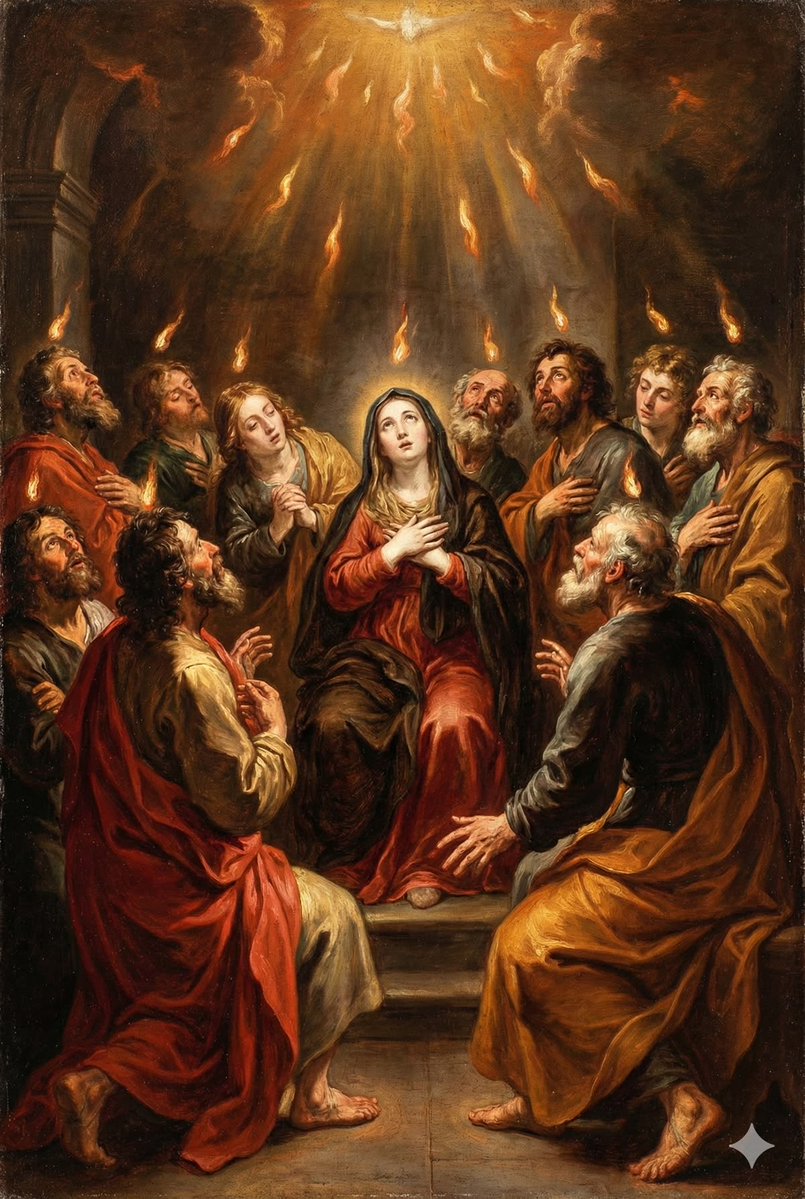
This is to celebrate the descent of the Holy Spirit on the Virgin Mary and the Apostles.
The rose petal ritual likely dates back to 607 AD when the pagan temple became a Christian church.
Today, we celebrate the glorious feast of Pentecost Sunday.
Pentecost Sunday is a major Christian feast celebrated 50 days after Easter. It commemorates the descent of the Holy Spirit upon the Apostles and the Blessed Virgin Mary while they were gathered in Jerusalem, as described in the Bible.
No nation, no society, and no international order can call itself just and humane if it measures its success solely by power or prosperity while neglecting those who live at the margins. Indeed, Christ’s love for the least and the forgotten compels us to reject every form of selfishness that leaves the poor and the vulnerable invisible.