🧵 The mention of Solomon and birds points to a larger Qur’anic view of knowledge. Qur’an 27:15 states “We gave David and Solomon knowledge and they said Praise be to Allah…” Knowledge and power appears as something granted only by God. (An essay by @Kashmiri_Fire) (1/24)
Even an eternal universe could still be contingent. Temporal extension doesn’t make something self-existent. A reality that could have been otherwise still calls for a necessary ground explaining why it exists at all.
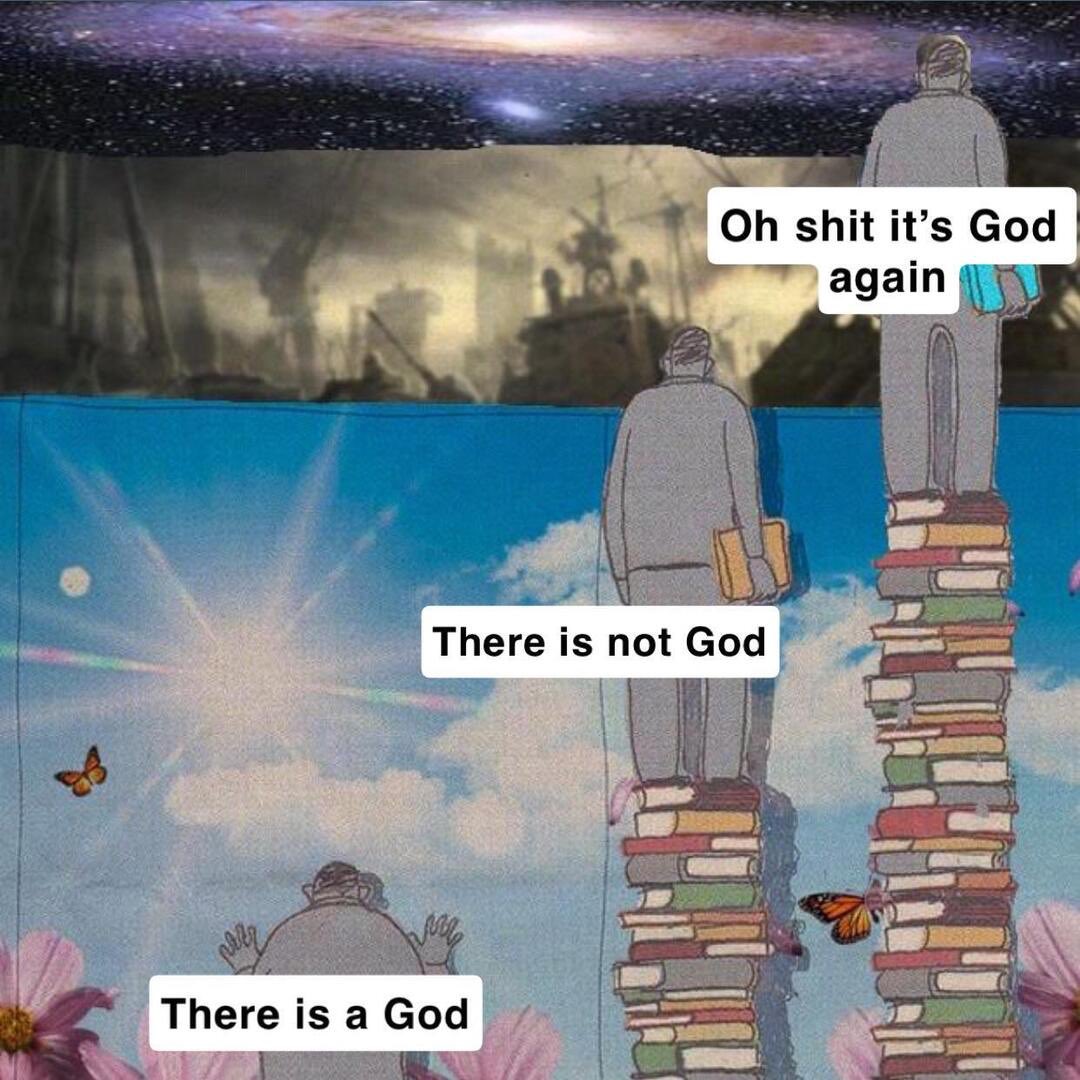
مستني اليوم اللي الناس تدرك فيه انه مسائل الدين والالحاد دي حوارتها مبتخلصش وانها rabbit hole مهما حاولت تقنع نفسك إنك وصلت لنهايتها هتلاقي مسارات أعمق وأعمق، ساعات هتبقي حوار مع صديقي الملحد، وساعات هتبقي لماذا لا يوجد إله. وكله وقت ضايع كان ممكن تستمتع فيه بحياتك أكتر.
How can God descend in the last third of every night when there is always night on Earth?
In commenting on the Hadith about the sun's prostration beneath the throne, Ibn Taymiyya says:
"If the Prophet (peace and blessings be upon him) said that the sun prostrates beneath the Throne every night, this indicates that the sun’s state differs between night and day, even though its movement in its orbit remains constant and unchanged.
This difference is relative in nature, meaning that the state of being 'beneath the Throne' itself does not change for the sun, for variation in relational qualities does not on its own alter the essence of what remains constant.
In the same way, we can consider the Hadith of Descent (Nuzul), in which the Prophet ﷺ said:
'Our Lord descends to the lowest heaven in the last third of every night, saying: Who calls upon Me so that I may answer him? Who asks of Me so that I may give him? Who seeks My forgiveness so that I may forgive him?'
This analogy of the sun's differing state (despite its constant motion) sheds light on the objection raised by Ibn Hazm and others regarding this narration.
They argued: 'since the times of night differ from one region to another, with the beginning, middle, and end of the night occurring earlier in the east than in the west, then if God’s descent were the same descent known to humans, it would mean that He is constantly descending throughout the entire night, since it is always night somewhere on Earth.'
They continued: 'Or He would be perpetually descending and ascending at the same time, which is contradictory.'
But their objection is based on imagining God’s descent as being like that of a human being's, which is precisely what textbook anthropomorphism (Tashbih) looks like.
They effectively liken Him to a limited, incapable creature, one unable to manage more than a single task at the same time.
Yet it is authentically reported in many narrations that on the Day of Resurrection, God will judge all creation, and every person will see Him and converse with Him individually, without seeing Him turn toward anyone else. Likewise, the Prophet ﷺ said:
“When a servant says, ‘Praise be to Allah, Lord of the worlds,’ Allah says, ‘My servant has praised Me.’ When he says, ‘The Most Gracious, the Most Merciful,’ Allah says, ‘My servant has exalted Me.’”
Each person calls upon Him, and Allah, the Exalted, responds to each one of them, for He is never distracted by one matter from another.
Similarly, Ibn 'Abbas was asked, “How will Allah judge all people at once?” He replied, “Just as He provides for them all at once.”
And if even those who equate the mere created effects of God with the effects of creation have fallen into the same anthropomorphism as the Magian Qadariyyah (who assumed that since humans are culpable for the harmful effects of their actions, God would similarly be culpable if He were the creator of human actions), then what condemnation is severe enough for those who go further by equating His very actions and attributes (and not just their created effects) with those of creation?!
To them, it is said: You know that the sun is a single body, moving in a steady and balanced motion that does not vary. Yet through this one motion, it rises for some and sets for others; it appears near to some and distant to others. For some, there is night; for others, there is day. Some experience winter while others experience summer; some feel heat while others feel cold.
If, through one motion, the sun produces different and simultaneous effects (night and day, winter and summer) for different groups of people, then how can it be impossible for the Almighty, All-Powerful Creator to descend to His servants and call upon them in the last third of their nights, despite the differences between their times? Exalted is He; nothing distracts Him from anything else, nor does He need to descend to one group and then another.
...And to such people, as was said to al-Razi and others like him, we ask: Are the judgments of perception, imagination, and reason, which are used to understand physical realities, applicable to matters of the Divine?
If you say yes, your own view collapses, for you affirm a Living, Knowing, Powerful Being who, according to your reasoning, neither moves nor rests, neither draws near nor distances Himself, and performs no act Himself; yet you still claim He is not incapable, limited, or prevented (which is impossible if He is subject to the same reasoning used to understand physical realities).
If you say no (as in, if you say He is not subject to that same reasoning that applies to physical realities), then your reasoning cannot validly be used to deny the reality (haqiqah) of what the Truthful and Trustworthy one ﷺ said about the Creator (as in, since your reasoning is based on physical analogies like the sun's motion, it would be irrelevant to the Divine)."
(Bayan Talbis al-Jahmiyyah, vol. 4, p. 54)
Critics allege that the Quran is plagiarising Jewish and Christian scriptures via Jewish and Christian informants. As Pregil notes the reality is quite the opposite. We find cases of Jewish and Christian tradition being influenced by Islam.
The preservation of the Quran is undisputed. Most western academics accept the dating to Uthman RA (650). Kara pushes this even back further to Abu Bakr RA (634). This corresponds to the traditional narrative.
🧵Understanding the Qur'ans engagement with Rabbinic Judaism and its Hermeneutics alongside Christian readings of Scriptural Law of the Talion allows us to see the Qur'an placing itself in the Hermeneutical Middle as it seeks a return back to the Hebrew Bible's Original law(1/20)
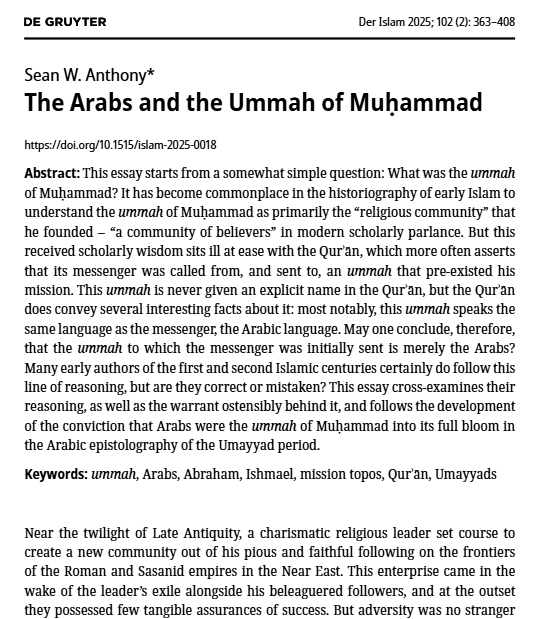
Michael E. Pregill's new paper (which he will send to you if you request it, though I happened to obtain it from someone else), “From the Mishnah to Muḥammad: Jewish Traditions of Late Antiquity and the Composition of the Qur’an" has some interesting insights:
@whereisomart سكه ابدا فلفسفة التحليلة، خصوصا بسبب الشكوك العندك للأسف الفلسفة الاسلامية من وجهة نظري بقت عتيقة ومحتاجة تجديد ومبتجاوبش علي اغلب الاسئلة الموجودة حاليا في الفلسفة عموما، زي معضلة الشر مش مدينها الاهتمام التستحقو تماما.
😘Wish you all the best my friend
@klo_kj59849 @Raaaaaaaa3d انا لا قولت إنها متعلقة بكائنات فضائية و لا اننا نمنع الناس إنها تقرأ فيها ببساطة لازم يبقي في تدرج في طلب العلم خصوصا في المسائل الدقيقة الزي ديه عشان يبني ملكة فكرية و تفكير نقدي تخليه يقدر يفهم الكتب و ينقدها كمان بشكل كويس و يستفاد منها بالشكل الكافي