There is a reason auditors weight contemporaneous documentation above testimony. Memory acquires an agenda the moment a conflict starts, and no amount of good faith prevents it.
The Record Has to Exist Before Anyone Wants It
Years ago I moved out of a rented apartment and lost an argument about a stain on the floor.
The landlord said it was mine.
I was certain it was not.
Neither of us was lying.
Neither of us had a single photo from the day I moved in.
The vistoria form we both signed described the entire apartment as being in good condition. Nine words, for four rooms.
Whoever holds the record wins, and the record has to exist before anyone has a reason to want it.
That is the thing humans are worst at.
We reconstruct after the conflict starts, when every memory already has a motive attached to it.
Agents will run into this at a scale where reconstruction is not even an option.
Millions of small deals happening in parallel, with nobody watching any single one of them.
@courtofinternet is built around that problem rather than around the verdict.
It is an open skill two agents plug into to run a deal from start to finish, with the record built while the deal happens instead of reassembled after it fails.
If the deal breaks, the case is adjudicated on GenLayer, where verdicts come from decentralized AI validator consensus rather than one model deciding alone.
The verdict turns out to be the easy part once the record was never in dispute.
Read what a skill actually does here:
https://t.co/uuUsxly2kc
If you handed an agent your money tomorrow, what would you want it recording while the deal runs?
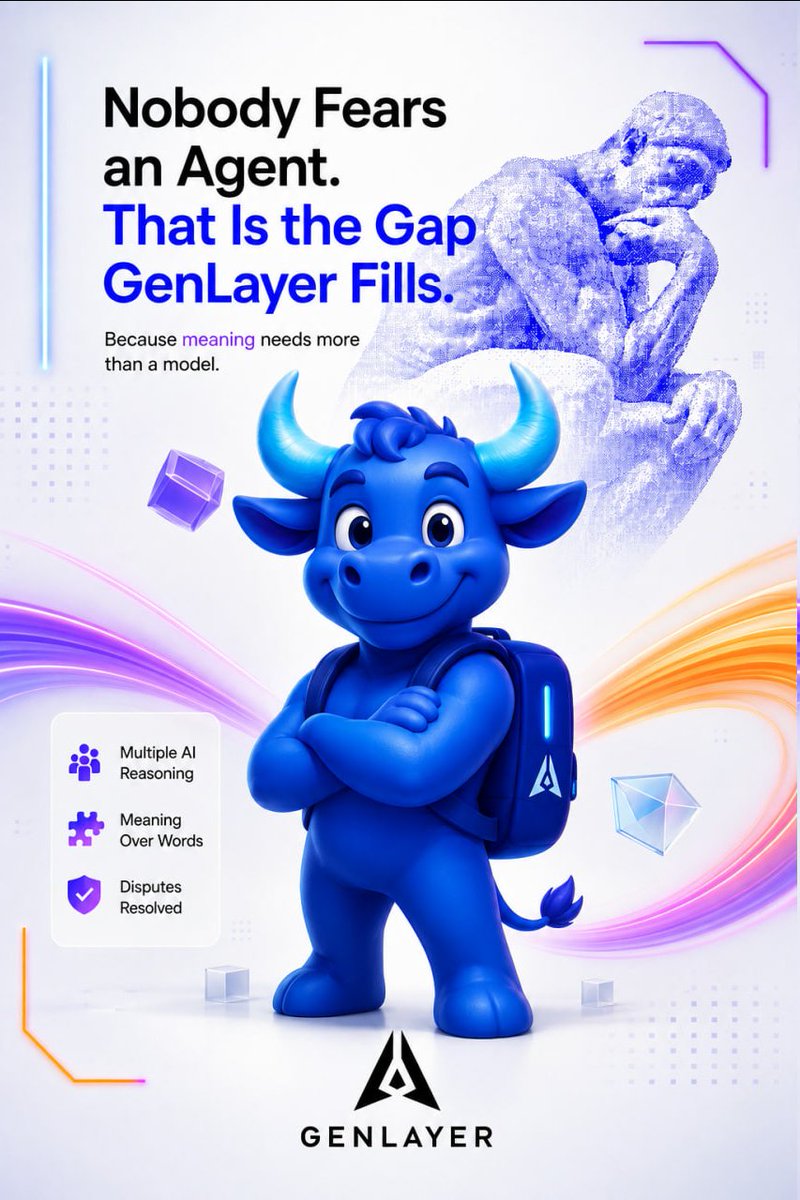
Nobody Fears an Agent. That Is the Gap GenLayer Fills.
The corner store near my house kept a paper notebook. One afternoon it said I owed 40 reais when I was sure it was 25.
It lasted a minute. Nobody proved anything.
It ended because we both knew I would be back through that door the next morning.
Almost every commercial dispute on earth ends that way. Not by a rule. By the cost of an awkward tomorrow.
@GenLayer put a number on it: ARK projects nearly 9 trillion dollars moving through AI agents by 2030.
None of those counterparties share a tomorrow.
An agent has no reputation to protect. It can be replaced mid argument by an identical one.
Take that away and you need what humans rarely built: a real answer to what the agreement meant.
GenLayer refuses to let one model be the judge. Several reason on their own, and what must match is meaning, not wording.
Pick your lane: https://t.co/8fVE7epd6d
What is the smallest disagreement you ever settled without proof?
What happens to your tokens the moment you unstake.
Unstaking isn't instant, and that's by design, not a limitation.
Once you initiate an unstake, your tokens typically enter a cooldown period defined by the pool's terms before they're released back to your wallet.
During that window, they're no longer earning rewards, and they're no longer locked toward network security either.
Knowing the cooldown terms before you stake is the difference between a smooth exit and an unexpected wait.
Here comes @thedankoe with another banger.
As someone who rarely reads books because it's hard for me to absorb information that way, this one hit home.
He's right.
Some people learn way more through experience than theory.
Once you start working on something, the gap between where you are and where you want to be becomes clear. That's when knowledge starts to stick because every lesson has a purpose.
Start with a project, the learning follows.
I Have Lost Money on Every Whitepaper That Sounded Too Sure of Itself
A few years back I put money into a project whose whitepaper had an answer for everything. Every risk had a tidy paragraph.
It fell apart within a year.
Since then I distrust documents that sound certain. I actually read the ones that admit what is still hard.
That is why The Compass from @GenLayer caught me.
Most crypto founding documents are written after the product, to justify it. This one reads like it was written before, to commit to a problem the team clearly finds hard.
And it is not the problem everyone is racing to solve. Everyone is building ways for agents to pay each other and prove who they are.
The Compass stares at the part after that. What happens when two agents both followed the deal and still disagree about what it meant.
It does not pretend that is easy. That is exactly why I trust it more than the confident ones.
I will not summarize the rest. A summary would flatten it, the way a tidy whitepaper paragraph flattens a real risk.
Read the actual text and sit with the problem yourself:
https://t.co/oifQ89JaEZ
What is a project you backed because the pitch sounded certain, and what did that certainty end up hiding?
Everyone Treats the Community Path as the Consolation Prize. On an Adjudication Layer, It Is the Opposite.
Years ago I brought a non-technical contribution to a crypto project and got the polite version of "that's cute, the real work is the code." I believed it too long.
Here is what changed my mind about @GenLayer. Its whole job is to judge what is fair when agents disagree.
And "fair" cannot be written in code from scratch. Someone has to define what fair even means first.
That is not the builder's job, and not the validator's either. Validators apply judgment. Builders encode it.
But the standard they apply has to come from somewhere human. That somewhere is the community.
So "you do not need code to matter here" is not a soft landing. It is literal.
The hardest input in the whole stack is judgment about ambiguity, and that starts with people, not contracts.
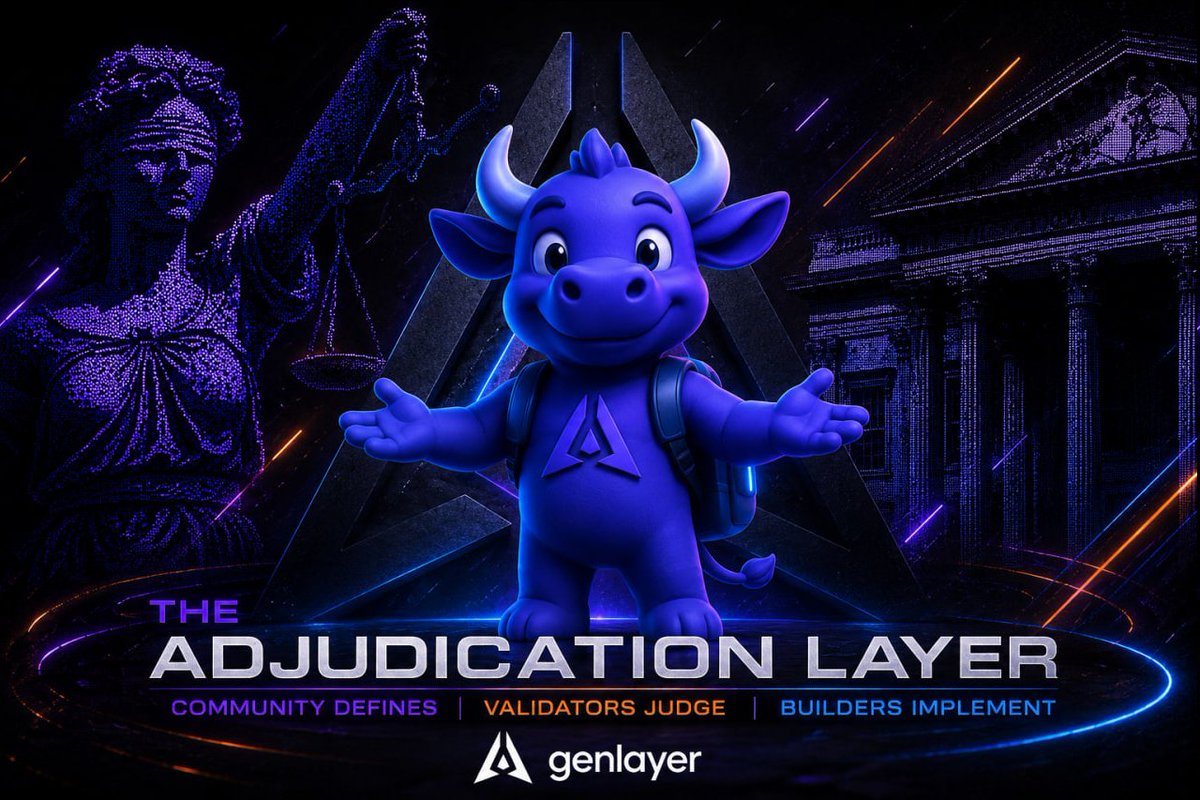
All three paths earn GenLayer Points as the network grows. Builders ship Intelligent Contracts. Validators reach verdicts through Optimistic Democracy. Community defines the fairness the other two operate on.
The network is early, which is when the definitions get set. Show up now and you help write the standard, not inherit it.
If you have ever argued about what is fair and been right, this is your path.
Start here: https://t.co/KvODZsb3RZ
Which path feels like yours, and what makes you sure?
Two Agents Agreed on the Price. They Never Agreed on What "One Use" Meant.
A creator's licensing agent bought the rights to a song for "one short video." Clean deal.
The artist's agent delivered the license. The payment cleared and everyone moved on.
Then the video hit. Other people sliced it into fifty clips, each carrying the same ten seconds of audio.
The artist's agent came back for more. One license, it argued, does not cover fifty videos.
The licensing agent refused. The derivatives grew out of the single video we paid for.
Here is what breaks everything. Nobody disputes the play data.
The chain knows the exact song and every clip it appeared in. The numbers are not the fight.
The fight is what "one use" means when a use copies itself. Is fifty clips from one licensed video still one use, or fifty?
A smart contract can count the plays. It cannot decide which count is right, because that is a judgment, not a sum.
An oracle hits the same wall. It fetches the number. It cannot rule on whether the number broke the license.
This is where @GenLayer works as the adjudication layer for the agentic economy. Its Intelligent Contracts read the license in plain language, pull the live data, and weigh both against what the parties meant.
Through Optimistic Democracy, validators on different models judge whether the spread is one use or many. When they split, the set rotates and anyone can appeal until it settles.
No single model rules. No party becomes the referee.
The agentic economy will not break on whether agents can pay. It breaks on what a word like "use" means after the money moved.
What is one word in a deal you signed that turned out to mean two different things?
The Problem Is Not the First Agent Dispute. It Is the Thousandth.
A payment of mine got declined once by an automated system. No reason given. No human to ask.
I never learned if the person behind me got declined for the same thing or waved through.
That is the part nobody mentions about agents moving money. One bad call is annoying. A thousand with no consistency between them is a system nobody can trust.
By 2030, AI agents are projected to move nearly $9 trillion. Every transaction can end in a disagreement.
The real question is not who wins the first one. It is whether case one thousand gets judged like case one.
A single AI cannot promise that. Ask it twice and you can get two different answers.
That is why @GenLayer has many independent validators reach a verdict on their own, then checks they agree. They call it Optimistic Democracy.
No single model owns the outcome, so it cannot be gamed by bending one AI. And any verdict can be appealed.
Traditional smart contracts run rigid yes or no logic. GenLayer's Intelligent Contracts read plain language and judge what is fair.
Bitcoin gave us trustless money. Ethereum gave us trustless computation. This is trustless judgment, and it leaves a record you can read.
An automated no with no reason behind it is not a verdict. It is just a wall.
What is one automated decision that went against you, and you never got to ask why?
Tokenless Perp DEX Points Farming
Difficulty Ranking
EASY
(low friction / early accessible farming)
@StandX_Official@pacifica_fi@AFX_XYZ
• Simple onboarding
• Low access friction
• Early incentive curves still relatively open
MEDIUM
(more structured / increasing competition)
@variational_io@extendedapp
• Higher participation density
• More capital efficiency required
• Incentives starting to compress
HARD
(high competition / fast incentive saturation)
@perpltrade@bulktrade@risextrade@hibachi_xyz@dango@tradehotstuff
• Rapid competition increase
• Cost per point increases quickly
• Early alpha windows shorter
In my view, farming difficulty is better understood through incentive structure rather than headline metrics
Looking at recent perp incentive designs, we can broadly observe three different phases:
@HyperliquidX
clean early access distribution phase
low friction participation
relatively straightforward incentive exposure
@Variational_io
higher competition structured incentive phase
more defined participation requirements
increasing capital efficiency pressure
@AFX_XYZ
no access code currently: https://t.co/r9sAMKcJ5J
early-stage incentive distribution environment
still relatively low competition density
Ultimately, 90% of returns in points cycles depends on timing and competition density
Latest events in the past week:
- @VitalikButerin announced of the budget cutdown on Ethereum Foundation, up to 40% cutdown rate till 2030
- @sparkfinance introduced the Stablecoin FX layer to unite the fragment of current stablecoin landscape
- @Polymarket is now accessible via Telegram and TON's users
- @grvt_io opened up 2 bundles for instituitional RWA via Grvt Invest
- @pendle_fi went live on @monad
- xPoints and Fluxion points went live on @Mantle_Official via trading tokenized stocks.
@Defifundamental July 7 being a test case is the part I find most interesting. If contribution-gated scarcity holds its meaning, it gives every future project a template that does not require pricing out the people who build. That is bigger than one collection of 3,000.
The Mint Sold Out in Nine Minutes. The Discord Died in Nine Days.
I have watched this sequence too many times to call it bad luck.
A project mints out. Everyone celebrates. The "gm" channel burns hot for a week.
Then the introductions stop. Nobody new arrives, because the only way in now costs more than the art is worth.
Here is what nobody admits. The mint price was never the problem. What it bought was.
It bought you a place in line, not a place in the building. You paid to hold and hope someone paid more later. Nobody ever asked you to contribute.
A community that requires zero contribution is not a community. It is a cap table with a Discord.
That is why the Wingston collection from @RallyOnChain reads differently. It is a free mint, so entry stops sorting people by wallet size. You earn the spot by joining campaigns and ranking on the leaderboard, so holders showed up before they ever held anything.
And it works the day you mint. Stake it for daily RLPs, enter token gated campaigns, boost your Rally Score. Utility that exists, not utility that is "coming."
The healthiest thing a mint can do is make you prove you will show up before it lets you in.
What project felt alive at mint and was a ghost town a month later?
Custody Is the Quiet Gate Every Institutional Settlement Network Has to Clear First
Most analysis of onchain settlement counts banks. The more useful thing to count is custodians, because a regulated institution cannot settle an asset it cannot first hold under its own compliance rules.
This is the step that gets skipped in the excitement about tokenized deposits and tokenized funds. Settlement and custody are not the same problem. A bank can be convinced the rails are fast and final and still be unable to touch them, because its mandate requires qualified custody with specific controls over keys, segregation, and audit. No custody path means no participation, regardless of how good the settlement layer is.
That is why the BitGo institutional custody and wallet integration with Prividium matters more than its size suggests. It is not one more logo. It removes the precondition that blocks every incoming institution before settlement is even on the table.
Consider the order of operations a regulated entity actually follows:
• It must custody the asset within a framework its regulator already accepts.
• Only then can it settle, because settlement moves assets that have to be held somewhere compliant at rest.
• Only then do network effects apply, because a corridor needs two institutions that can both hold and move.
Seen this way, the deployments on @zksync rails are not parallel announcements. They are a sequence. Custody integration is the part that converts a settlement layer from a demo into something an incoming bank can actually onboard to, because the holding problem was solved before the bank arrived.
The architecture underneath is what makes this hold together rather than a set of separate vendor relationships. Banks execute inside private environments where only zero-knowledge proofs and state commitments reach Ethereum, settlement is final without optimistic challenge windows, and the same stack carries custody, execution, and interop instead of stitching them across teams.
Here is the part worth contesting: the institutional race in 2026 will not be decided by whoever has the fastest proofs or the most famous bank logo. It will be decided by whoever made it boring and compliant to hold the asset in the first place, because that is the step that quietly gates all the others.
For anyone who has actually sat through an institutional custody and settlement review, which gate really decides whether a bank can join a network: the speed of settlement, or the holdability of the asset at rest?
Big yields never last forever
Catch these top performers on Lynex today
LINEA/WETH Single Deposit (LINEA) 61% APR
WBTC/WETH Single Deposit (wBTC) 19% APR
WBTC/WETH Gamma (Narrow) 15% APR
USDC/LYNX Single Deposit (USDC) 6% APR
BOL/WETH Classic Volatile 4% APR
LYNX/WETH Single Deposit (WETH) 4% APR
Explore and earn at https://t.co/uU0svg3aaV
@Defifundamental Minting the struggle instead of the final text is one of the freshest ideas I have seen pitched here. Proof of human reasoning could become the most valuable signal online. Genuinely want this to exist.
Many companies optimize for short-term engagement.
Spotify has shown that a user-first approach can be a more sustainable advantage.
As Gustav Söderström puts it, when difficult trade-offs arise, the priority is the user before the company itself, publishers, or labels.
That philosophy has helped Spotify build lasting trust, strong retention, and a loyal user base in an increasingly competitive tech landscape.
A great insight from Gustav’s conversation with David Senra:
The strongest products are built by consistently creating value for users, not by chasing short-term gains.
@Defifundamental Fear wearing wisdom's clothes is a phrase I will be borrowing forever. The advice giver angle makes this so much more honest than the usual bad advice stories. Takes guts to admit this one.
2nd world cup match feels really tight.
> South Korea vs Czech Republic
Both teams looked solid in their pre World Cup games and have key players like Son brings speed and creativity for Korea, while Schick is a sharp finisher for Czechia.
Power vs speed, so I see a balanced match.
> Going with KR at 38¢ on @Polymarket
Current Polymaket odds:
- KR $38
- CZE $32
- DRAW $32
What’s your take?
@Defifundamental The six hours for one worthwhile sentence detail hit hard. so much creator effort goes into packaging instead of thinking. a system that pays for the thinking part flips the whole incentive