Everyone Wants to Build. GenLayer Needs Judges.
Years ago I was convoked as a mesario, the poll worker Brazil drafts to run its voting tables. A job nobody volunteers for.
I assumed the day would be about counting. The machine counted in seconds.
What filled the hours was judgment. Whether a document was acceptable. Whether a man in the wrong section could vote at all.
None of us signed up to decide those cases. We decided them anyway, because someone had to sit there.
Building gets celebrated. Judging gets assigned.
@GenLayer published its Portal numbers as of August 12: 29,915 participants, 1,351 builders, 46 active validators.
Read that last figure again. A network built so no single model holds the final word runs on 46 active seats.
That gap is not a weakness. It is the least crowded room in the agent economy.
You pick your lane inside the Portal:
https://t.co/4WpXB2XKyG
What is a job you got assigned to and ended up caring about more than the one you chose?
Where the 16.5% USDT Yield on EVAA Actually Comes From
A 16% yield on a stablecoin is not a gift. It is a price, and somebody agreed to pay it.
I learned that the slow way. Years ago I parked USDT in a pool with a number I liked and never opened the borrow side of the app. The rate collapsed a week later.
So I read the @evaaprotocol post backwards. USDT leading the LP Pool at 16.5%+ supply APY is borrower demand, not generosity.
People post DEX LP tokens there as collateral and borrow USDT to loop their farming positions. Their cost is your yield. The pool is isolated, so its risk stays away from the Main Pool.
Three things I check before supplying anywhere now:
• Who is borrowing, and why it makes sense for them
• Whether the pool is isolated or shared
• Whether the rate is fixed or moves with utilization. Here it moves.
Supply side is open: https://t.co/YbDHytD681
What is the highest APY you ever took without knowing who was paying it?
Most RWA yield is really just repackaged real estate or private credit, assets that move with the same macro cycles as everything else in your portfolio.
Dry bulk shipping doesn't. freight rates move on iron ore demand, grain harvests, coal shipments, global trade flows that don't care what crypto or equities are doing that week.
That's what makes @EthraShip's angle different from the usual RWA playbook. it's not just "a new asset to tokenize," it's exposure to a cycle most portfolios have zero correlation to.
Diversification usually means adding noise. this is adding a genuinely different signal.
Everyone Is Praising the Wrong Part of This Design
The randomness is not the innovation. The appeal is.
Every other system in crypto assumes it will get the answer right. Being wrong is an edge case you patch later.
@GenLayer starts from the opposite assumption. It is built as if the first verdict will be wrong.
That is why nobody knows the validator set until the dispute exists. Nobody to lobby, no single mind to exploit.
That is why each validator re-derives the case alone instead of rubber-stamping the leader.
They do not check whether their answers match word for word. They check whether they mean the same thing.
That is why an appeal summons a larger set of validators instead of a higher authority. A bad verdict gets buried under scrutiny.
And every vote has real value staked behind it. Honesty pays. Manipulation gets expensive.
That is Optimistic Democracy. Fast, because most verdicts hold on the first round. Fair, because fairness is never handed to a single mind.
None of that is how you build a system you expect to be right. It is how you build one that survives being wrong.
Watch the video again and count how many parts exist only because the design expects to fail.
Which would you put your money behind: an AI that is usually right, or a system that assumes it is wrong and still lands fair?
@Defifundamental This is the first Portal post that made me want to read all three paths carefully instead of just picking the obvious one. Treating adjudication as a formerly-closed profession that just went public is a genuinely fresh way to explain why any of this matters.
📢 The prediction layer is live on Matchain.
Anyone can have a take. Now you put your name on it.
Real markets on real events. From World Cup to Crypto narratives.
Call it right, win from the pool, and build a record that's yours.
It's another new week to Preach @EthraShip to the web3 world
A strong RWA project shouldn't just put assets on-chain. It should make the industry behind those assets easier to understand and access.
That's the direction Ethra Ship is taking by connecting blockchain with maritime shipping, Ethra Ship is turning one of the world's oldest and most important industries into an ecosystem where transparency, ownership, and participation can evolve alongside technology.
When Web3 starts solving access instead of chasing hype, that's where real innovation begins. ⚓
Every Paid Mint Forced Me to Bet Before I Was Allowed to Look.
The worst part of the last cycle was the order of it. You paid first and learned what you bought only after.
The decision came at the exact moment you knew the least.
I minted a collection once on a founder's thread and a nice Discord. By the time I understood the utility was empty, my money was gone.
The price made me guess before I could check.
That is the trap nobody names. A paid mint is a bet placed at your point of maximum ignorance.
You are never more uninformed about a project than the second before you pay for it.
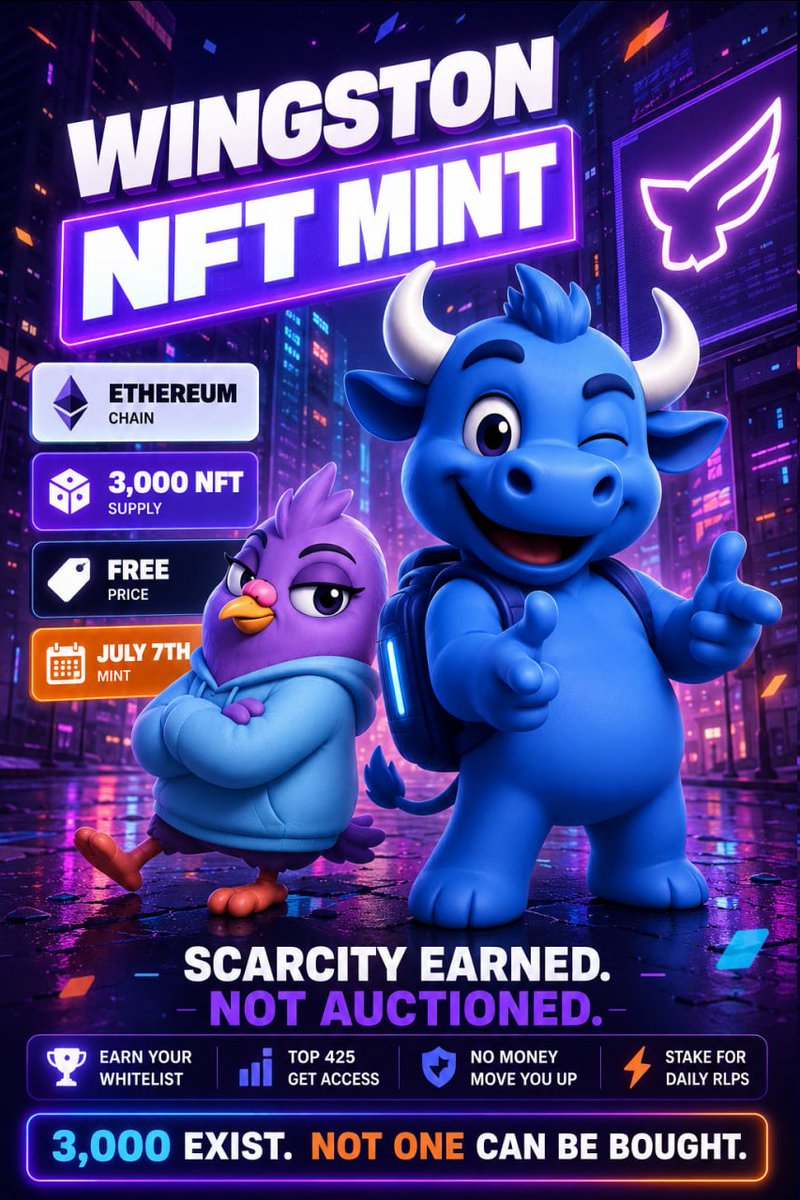
That is why the free mint at @RallyOnChain reads differently to me. Wingston flips the order.
You get in first. You stake it and watch RLPs actually land. You enter the token gated space and see if it is alive.
Then you decide what it is worth, with evidence in hand instead of a promise in a thread.
That is the real reset. Not free as in cheap. Free as in you judge the thing by what it does, not by a guess made in the dark.
The old model sold you certainty you could not have yet. This one lets you look before you commit.
Start here: https://t.co/bnd97Us6ej
What is one mint you bought on a feeling, then wished you had been allowed to check first?
Every Whitelist I Ever Chased Kept Me in the Dark Until the Snapshot.
You did the tasks. Joined the Discord, ran the bot, invited three friends.
Then you waited, with no idea if it was enough, until the list dropped and your name was not on it.
The Wingston whitelist on @RallyOnChain works the opposite way. You can see where you stand before July 7th, with time left to move.
Here is the path, and it is short.
Step one, join at least 3 Rally campaigns. Each submission runs through a distributed review, so it is real work on record.
Step two, finish in the weekly Top 425 on the leaderboard. This is the part you can watch, so you are climbing instead of guessing.
Step three, follow @RallyOnChain on X so you catch the snapshot.
That visibility is the whole shift. Most allowlists hand you tasks and hide the scoreboard.
This one shows it. Effort becomes a number you can track, not a wish you submit.
No wallet size gets you in. It is a free mint, 3,000 supply, on Ethereum. Only your rank does.
And the spot keeps paying. Stake the Wingston for daily RLPs, unlock a token gated community, and lift your Rally Score.
The list is not luck. It is a scoreboard you can still climb.
What is one whitelist you did everything for and still got nothing, because you never saw where you stood?
@Defifundamental What lands is that appealability is built in. Most automated systems treat their output as final by default. A verdict that assumes it might be wrong and lets you challenge it is a completely different posture!
A Royalty Contract Can Count Every Stream. It Cannot Decide What Counts as Your Song.
Take a music platform like Audius, where payments to artists already live on chain.
The smart contract is flawless at one job. It counts streams and splits the money to the last cent.
Then the hard question arrives.
Someone uses four seconds of your track under a viral video. An AI generates a song "in your style" that sounds unmistakably like you. A remix keeps your melody and none of your words.
Does any of that count as your work? Each one triggers a royalty or it does not, and the answer is not in the data.
The stream count is a fact. Whether a two second sample is "your song" is a judgment.
A smart contract reads the play count to the decimal. It cannot rule on what "derived from" was meant to cover, because that needs interpretation, not computation.
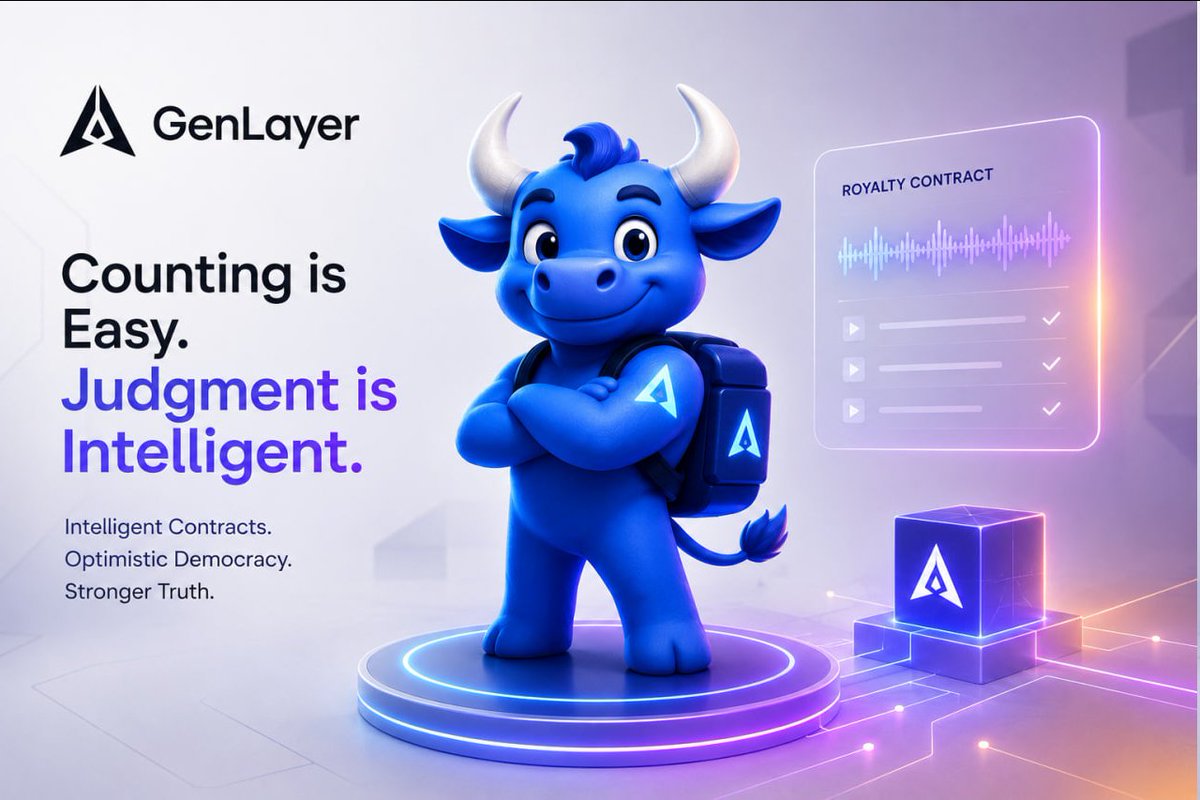
This is the kind of project @GenLayer could supercharge as the adjudication layer for the agentic economy. Its Intelligent Contracts read the actual clause and weigh the evidence.
Through Optimistic Democracy, randomly selected validators each running a different AI model judge whether the use crossed the line and reach consensus. Disagree and the set rotates; anyone can appeal until finality.
This only gets bigger. When AI agents generate a thousand tracks an hour, "is this derived from your work?" becomes the most expensive question on the internet, and no payment rail can answer it.
What is one thing you are sure is "yours" that you could not prove in code?
Social moves too fast for manual tracking.
With Aethir Claw, teams can deploy a general-purpose AI assistant to monitor trends, track conversations, identify relevant narratives, and help prepare timely posts before the window closes.
Always-on social intelligence, powered by Aethir’s decentralized AI infrastructure.
@Defifundamental honestly never thought about contracts containing contradictions that only surface under stress. the storm is the thing that forces the two duties to collide. most of the time they coexist fine and nobody notices the contract was quietly impossible all along.
@Defifundamental honestly never framed it as a sequence problem before. money after value is how every real business works, and NFTs flipped it to money before value. once you see the inversion you cannot unsee why so many teams ghosted
The Mint Sold Out in Nine Minutes. The Discord Died in Nine Days.
I have watched this sequence too many times to call it bad luck.
A project mints out. Everyone celebrates. The "gm" channel burns hot for a week.
Then the introductions stop. Nobody new arrives, because the only way in now costs more than the art is worth.
Here is what nobody admits. The mint price was never the problem. What it bought was.
It bought you a place in line, not a place in the building. You paid to hold and hope someone paid more later. Nobody ever asked you to contribute.
A community that requires zero contribution is not a community. It is a cap table with a Discord.
That is why the Wingston collection from @RallyOnChain reads differently. It is a free mint, so entry stops sorting people by wallet size. You earn the spot by joining campaigns and ranking on the leaderboard, so holders showed up before they ever held anything.
And it works the day you mint. Stake it for daily RLPs, enter token gated campaigns, boost your Rally Score. Utility that exists, not utility that is "coming."
The healthiest thing a mint can do is make you prove you will show up before it lets you in.
What project felt alive at mint and was a ghost town a month later?
@Defifundamental running several independent LLMs and requiring agreement is the part that matters most. one model has one set of blind spots baked in. a consensus across different models is structurally harder to bias than any single reviewer a platform could hire
What makes this click is that a rating dispute is just a contested outcome with no objective answer. Two sides, no truth in the number itself. That is exactly what validator consensus is built to settle, and reputation is a perfect fit nobody named.
One Unfair Review Can End a Career. There Is No Appeal.
A driver gets a 1 star rating. The note says "rude." He was not. The passenger just had a bad day.
That star drops him below the cutoff. The platform deactivates him.
He appeals. A bot replies with a template. There is no judge, just a company deciding alone.
Reputation runs the internet now. It decides who gets the ride, the job, the loan.
But the systems holding it cannot judge whether a rating is fair. They store the number. They cannot weigh the context behind it.
A reputation platform is what @GenLayer could supercharge. Its Intelligent Contracts in Python read the dispute, weigh the evidence, and reach a verdict.
Randomly selected validators each run a different AI model, judge independently, and reach consensus. Disagree? The set rotates and anyone can appeal until finality.
We built our economy on scores, then let no one contest them except the company that profits from the platform.
A number that can end your livelihood should be appealable to someone other than its owner.
Three calls no smart contract can make alone:
• Whether a 1 star review reflects the service or the mood
• Whether a flagged account actually broke a rule
• Whether context changes what a rating deserves
What unfair rating do you wish you could have appealed?