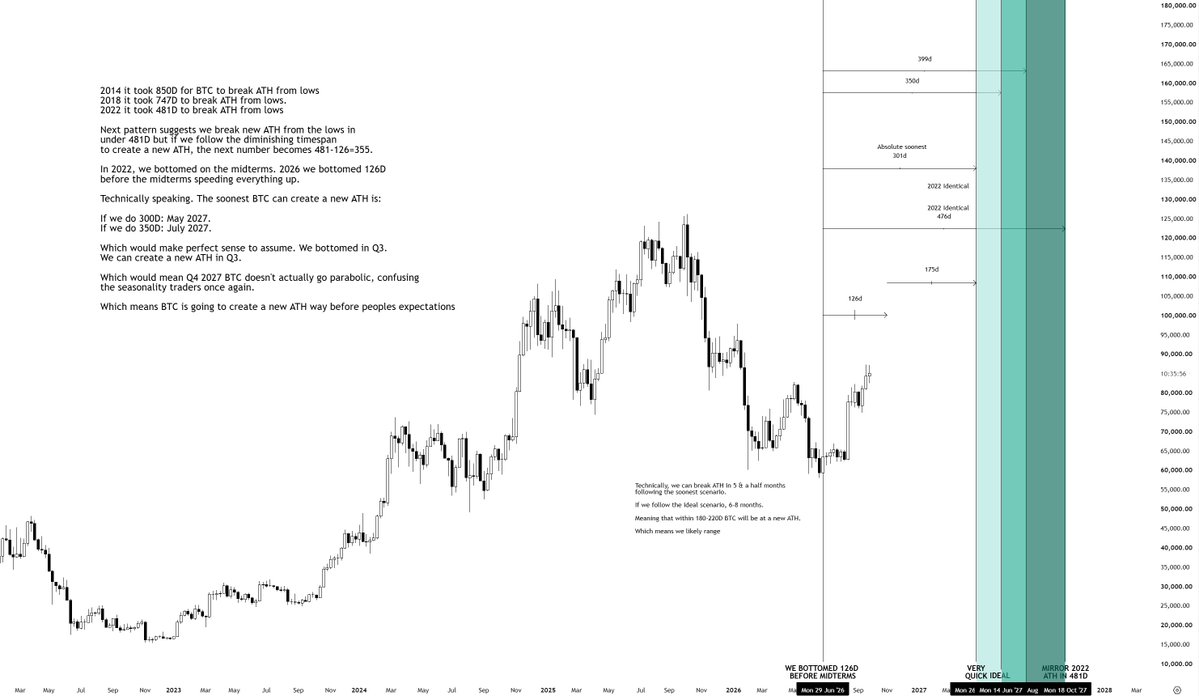
$BTC will break ATH between April 26th-August 2nd.
I said we would bottom sooner, we did. Now, we will form a new ATH quicker than everyone's expectations.
Maybe you should start listening.
@MuhammadIlkdt7@thee_hamza001@ngxgrp@TemiPopoola_ I'm not sure this people are willing to fix these issue. They've stopped responding to my emails.
We'll see how they respond if they get invited to court!
@TemiPopoola_ Hello Mr. Temi, I want to bring to your attention the issues concerning the NGX platform. I'm one of the victims: after a successful payment was made, I've been unable to Login my account on NGX. Please attend to this matter by calling on the technical team to look into this.
@MuhammadIlkdt7@ngxgrp@TemiPopoola_ Hello bro, I had same issue since last week after I subscribe to the IPO, I've not been able to login my account because they didn't send me a password after the successful payment. And their customer service is not helping. Have you been able to login?
@Teddybrucksho18@ngxgrp Hello bro, I had same issue since last week after I subscribe to the IPO, I've not been able to login my account because they didn't send me a password after the successful payment. And their customer service is not helping.
@ngxgrp@ngxgrp I didn't receive my login details after registering and made payment for the Dangote IPO yesterday
I'm supposed to receive a temporary password in my email to login my account but didn't receive anything. Is this a glitch?
I know some that are able to login already
The smarter you are, the longer it may take you to become a profitable trader. The dumber you are, the faster it may take you to become a profitable trader.
That statement sounds offensive until you understand what it actually means. Trading is one of the few professions where intelligence alone does not create better results.
The market does not reward the person with the highest IQ. It rewards the person who can repeatedly execute an edge without interfering.
Lawyers, doctors, and engineers belong to professions that demand a high level of intellectual discipline. You must be smart. You cannot afford to be dumb.
A lawyer is trained to analyze facts, challenge assumptions, identify weaknesses in arguments, and anticipate every possible outcome before reaching a conclusion.
A doctor is trained to evaluate symptoms, interpret evidence, rule out alternatives, and arrive at the most accurate diagnosis before prescribing treatment.
An engineer is trained to design, test, refine, and optimize systems until they achieve the highest level of safety, efficiency, and performance.
These are highly respected professions because they reward deep thinking, precision, continuous improvement, and sound judgment.
The challenge is that trading rewards a different skill once a proven edge exists.
After the research is complete and the system has been validated, success depends less on finding better answers and more on executing the same proven process with discipline and consistency.
Those professions demand analysis, skepticism, and optimization. The better you become, the more you are expected to think.
Trading is different.
Once your trading system has a statistical edge, your job is no longer to think your way through every trade. Your job is to execute.
That is where many intelligent people struggle.
An intelligent trader constantly asks:
“Can I improve this entry?”
“What if I wait for one more confirmation?”
“Maybe I should reduce the stop loss.”
“What if this setup fails?”
“What if I combine another indicator?”
Those questions sound intelligent. But they often destroy consistency.
Every unnecessary adjustment changes the expectancy of the trading system. One change is harmless. Hundreds of changes completely alter the edge.
Meanwhile, another trader receives a simple set of rules. Wait for Setup A. Risk 1%. Place the stop. Take profit at the planned target. Repeat.
They simply execute. They do not argue with the system. They do not negotiate with the market. They do not try to predict every candle. Over hundreds of trades, consistency beats brilliance.
This is why trading often feels frustrating for highly analytical people. Their education taught them that more thinking produces better outcomes. Trading teaches the opposite.
Once the work has been done, more thinking often produces more mistakes.
This is not because thinking is bad. It is because the thinking should happen before execution, not during execution.
Professional traders spend far more time building their process than changing it. They test. They collect data. They measure expectancy.
They calculate risk-adjusted returns. They study drawdowns. Once they have evidence that the edge works, they trust the process. Execution becomes mechanical.
The market is uncertain by nature. No amount of intelligence removes uncertainty. A perfect analysis can still produce a losing trade. A poor analysis can still produce a winner.
That is why professionals focus less on being right and more on managing probabilities. The market pays probability, not certainty.
This is where many intelligent people make another mistake. They judge each trade individually. Professionals judge hundreds of trades together.
One trade proves nothing. A large sample reveals whether the edge actually exists.
Thinking in probabilities requires emotional discipline more than intellectual ability.
So when people say you must become “dumb” to succeed in trading, they do not mean you should become unintelligent. They mean you must become simple.
Simple enough to trust tested rules. Simple enough to respect risk. Simple enough to stop searching for perfection. Simple enough to accept that losses are part of the business.
Ironically, once an intelligent trader learns this lesson, they often become exceptional. Their intelligence is no longer spent fighting the market.
It is spent improving research, refining risk management, understanding macroeconomic drivers, developing robust trading systems, and maintaining discipline. Their intelligence finally serves the process instead of disrupting it. That is when they become difficult to compete with.
The goal is not to become less intelligent. The goal is to become disciplined enough that your intelligence no longer gets in the way of your execution.
Because in trading, the market does not reward the smartest trader. It rewards the trader who can execute a profitable edge with discipline, consistency, and patience over a very large sample of trades.
I have cracked the fucking code.
We bottom this year August-September latest. Earlier than previous cycles.
It then takes $BTC just under a year to create a new ATH.
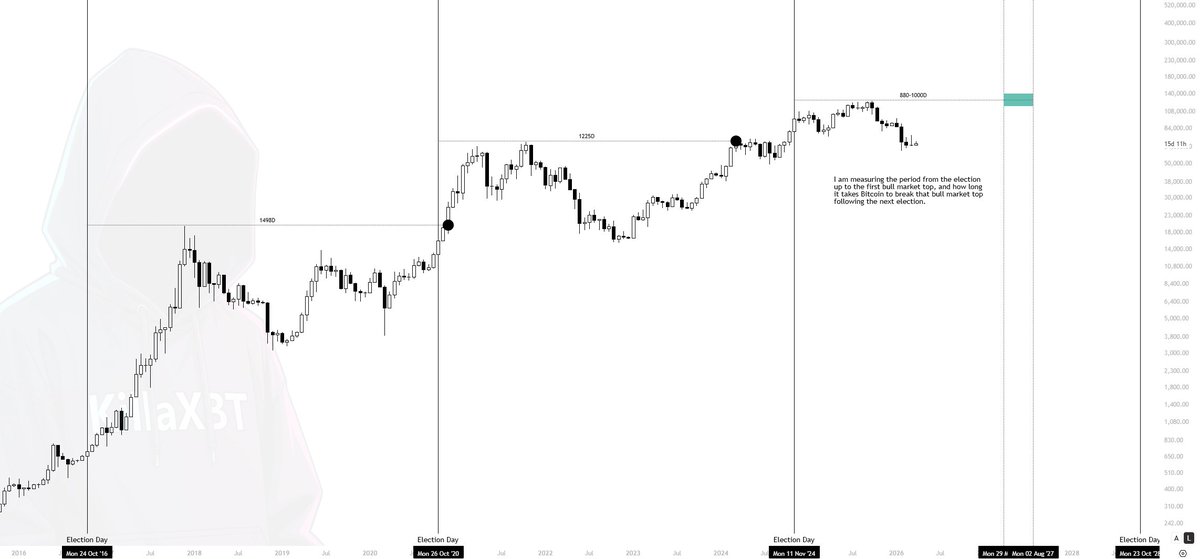
Based on the math, we are 427 days from creating a new all time high.
And we are 120 days from creating a bottom. That means... we form a new ATH precisely between April and August 2027.
Based on this metric, we have completed 75% of the bear market.
In this image, I am measuring the time from each election to the first bull market peak, as well as how long it takes Bitcoin to surpass that peak following the subsequent election day.
The cycles are accelerating, with shorter bear markets and faster recoveries.
In the next 1 year, I’m either going to look like a genius or a complete fool. This is my prediction based on current patterns and their timing.
If Dollar is bullish:
EURUSD bearish
GBPUSD bearish
AUDUSD bearish
NZDUSD bearish
USDJPY bullish
USDCAD bullish
USDCHF bullish
Before you enter any Forex trade, check the Dollar first.
It controls everything.
The pinned tweet shows you how to combine this with the full entry model.
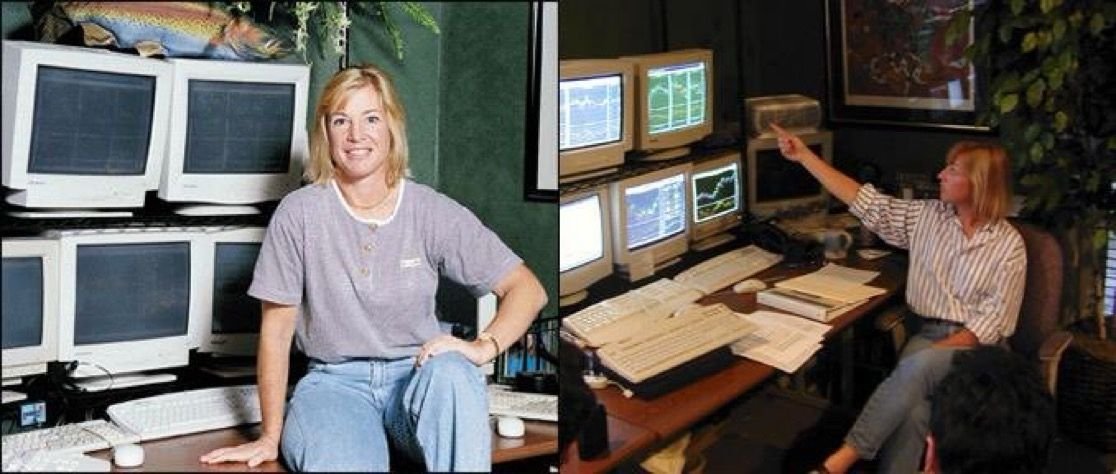
Market Wizard Linda Raschke's 12 Technical Trading Rules
1. Buy the first pullback after a new high. Sell the first rally after a new low.
2. Afternoon strength or weakness should have follow‑through the next day.
3. The best trading reversals occur in the morning, not the afternoon.
4. The larger the market gaps, the greater the odds of continuation and a trend.
5. The way the market trades around the previous day’s high or low is a good indicator of the market’s technical strength or weakness.
6. The previous day’s high and low are two very important “pivot” points, for this was the definitive point where buyers or sellers came in the day before. Look for the market to either test and reverse off these points, or push through and show signs of continuation.
7. The last hour often tells the truth about how strong a trend truly is. “Smart money” shows their hand in the last hour, continuing to mark positions in their favor. As long as a market is having consecutive strong closes, look for the up‑trend to continue. The up‑trend is most likely to end when there is a morning rally first, followed by a weak close.
8. High volume on the close implies continuity the next morning in the direction of the last half‑hour. In a strongly trending market, look for resumption of the trend in the last hour.
9. The first hour’s range establishes the framework for the rest of the trading day.
10. A greater percentage of the day’s range occurs in the first hour than was the case in the past, and thus it has become increasingly important to trade aggressively if there are early signs of a strong trend for the day.
11. There are four basic principles of price behavior which have held up over time. Confidence that a type of price action is a true principle is what allows a trader to develop a systematic approach.
The following four principles can be modeled and quantified and hold true for all time frames, all markets. The majority of patterns or systems that have a demonstrable edge are based on one of these four enduring principles of price behavior. Charles Dow was one of the first to touch on them in his writings.
Principle One: A Trend Has a Higher Probability of Continuation than Reversal
Principle Two: Momentum Precedes Price
Principle Three: Trends End in a Climax
Principle Four: The Market Alternates between Range Expansion and Range Contraction
In the world of money, which is a world shaped by human behavior, nobody has the foggiest notion of what will happen in the future. Mark that word – Nobody! Thus the successful trader does not base moves on what supposedly will happen but reacts instead to what does happen.