⚠️Ame Network was acquired in early 2026, and the acquiring company adopted a new brand and name. I personally retain ownership of the Ame Network domain and X account. Recently, I discovered someone impersonating Ame Network on X; they are launching meme coins and contacting investors. I want to reiterate that Ame Network has not issued any tokens; please exercise caution to avoid being scammed.
Ame Network X account:
@0xAmeNetwork
Fake X account:
@AmeNetwork
Sharing some information about #ERC8004 integration
@marco_derossi@DavideCrapis
MSCP ERC8004 Connector
I've added an ERC8004 connector to MSCP, allowing any AI agent to quickly integrate ERC8004. Simply tell your agent to register: "create a erc8004 newAgent," and it will automatically register its identity.
https://t.co/RjtxGtA29s
Aser Agent ERC8004 Integration
Aser Agent supports quick startup of an ERC8004 server agent. With just a few lines of code, you can quickly launch a server agent that supports A2A and ERC8004. It will also automatically convert your tool functions into skills in your agent card.
https://t.co/EddnBcMY8y
I'm really looking forward to the final version of ERC8004. I'd also like to thank @_sumeetc@Ch40sChain for their contributions to ERC8004, especially the smart contract, which was very helpful to me.
I have been learning about AI Agent for a while, and I want to share with you the AI toy I have been building in the past few weeks.
Model Smart Contract Protocol (MSCP)
It is inspired by Model Context Protocol (MCP). MSCP is a standard protocol that enables LLM applications to interact with EVM-compatible networks. It consists of Onchain Component (EIP-7654), Connector, and Chat2Web3. AI Agents can use MSCP to add custom components and build onchain interaction workflows.
https://t.co/RjtxGtA29s
Keep building infrastructure
Recently, I have heard too many people complain about Ethereum's infrastructure, complaining that VCs have invested in a lot of meaningless infrastructure, blaming the excess infrastructure for the industry's difficulties, and trying to create conflicts between application developers and infrastructure organizations. It seems that they describe the Ethereum ecosystem as a Niflheim that is not suitable for application development. This is very unfriendly and unconvincing.
Clear up misunderstandings, what is real infrastructure?
Does it have a grand narrative? Received investment from top VCs? Created a lot of bubbles? Nihilism? Lost your investment? EBOLA (EVM Bags Over Logic Affliction)?
Real infrastructure:
1️⃣They include protocols, EIPs, frameworks, tool stacks, and non-application layer blockchain services.
2️⃣They are used to solve some specific problems, improve application efficiency, user experience, decentralization, security, and privacy.
3️⃣They are open source, accepting contributions and reviews from the community.
4️⃣ They provide free plans for application developers, or even complete public good.
5️⃣ They are built by a group of truly idealistic and optimistic people.
Development of blockchain infrastructure
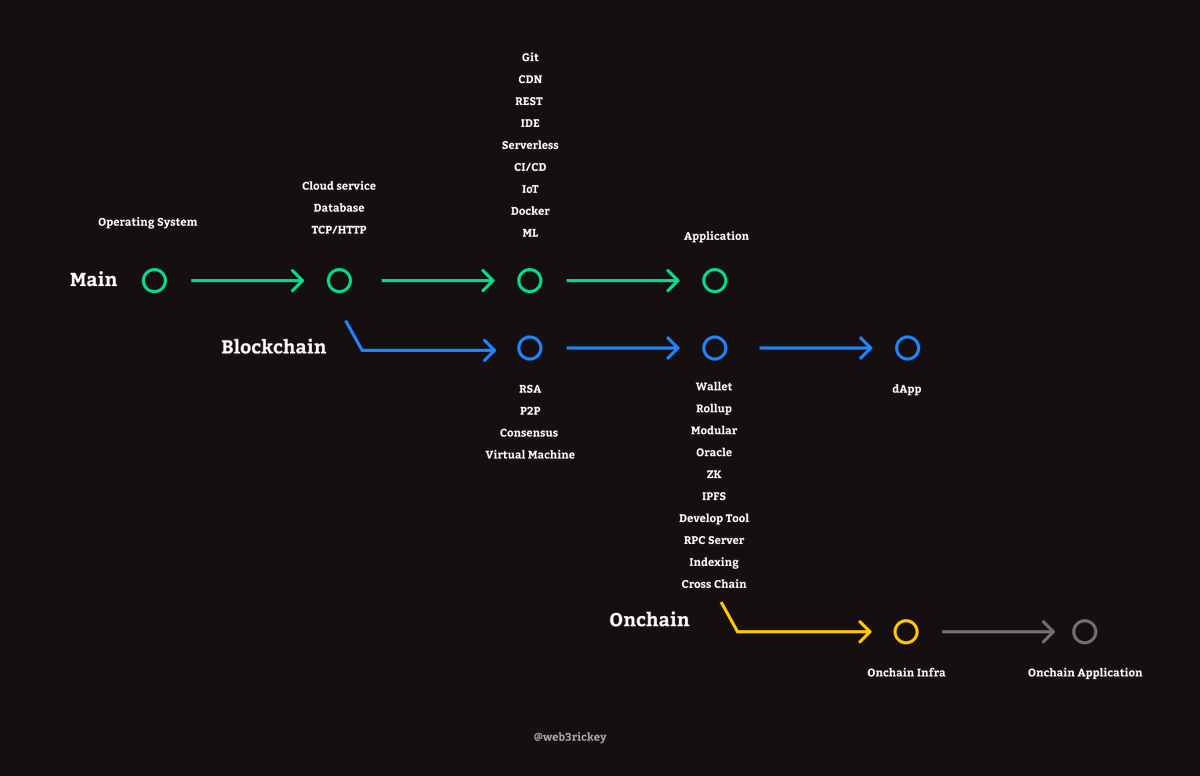
I prefer to describe the development of blockchain infrastructure in the form of git branches.
Blockchain is like a new git branch. In the first stage of this branch, cryptography, P2P networks, consensus algorithms and other infrastructures are added. You can apply these infrastructures to build Bitcoin and Ethereum, as well as other L1 networks.
In the second stage, various Ethereum-based facilities, tools and services have emerged, and developers can use them to build various wallets, DeFi applications, and layer2 networks.
Interestingly, after this commit, an onchain branch was created. The ultimate goal of this branch is to store user data completely on the chain, and the logic of the application is implemented through smart contracts. Developers can implement truly verifiable, composable, and interoperable onchain applications. We are currently in the construction stage of onchain infra of this branch, and I think we are on the right track.
What does infrastructure bring us?
1️⃣ Reduced monopoly
For a certain field, developers have more options. Imagine if you are the founder of a startup and you want to provide transaction data query services for your network, are you willing to pay a high fee to buy a company's block scan service, or deploy a free Blockscout.
2️⃣Improve efficiency
Developers will migrate to more efficient tools and infrastructure. This is the change in my technology stack for building applications in the past year.
Chain:Tendermint → OP Stack
Development tools: Truffle/Hardhat → Foundry
Contract interaction: Web3.js / Ether.js → Viem
Storage:IPFS → BNB Greenfield
Block explorer:Etherscan → Blockscout
Wallet: Extension Wallet → Coinbase Smart Wallet / AA
3️⃣Enrich the diversity of applications
Provide developers with enough infrastructure so that they can create interesting applications. A few years ago, we mainly built DeFi and NFT-related applications in the Ethereum ecosystem. Now you can use various infrastructures to build more interesting products.
Cloud Platform: @fleek
Authentication: @privy_io
Game: @mud_dev , @ohayo_dojo , @PaimaStudios
Wallet Kit:@OnchainKit , @rainbowdotme
Open Source Rewards: @teaprotocol
Ethereum's Trustless AI: @OraProtocol
IP: @StoryProtocol
4️⃣Make the startup cost of the application lower
In fact, you only need to pay the gas fee for deploying the contract. Because the infrastructure is complete enough, even a small development team can quickly integrate infrastructure services to achieve the expected functions, and almost all infrastructure service providers will provide free plans for developers, which is enough to support and verify your early ideas.
5️⃣Accelerating mass adoption
This depends on the changes that infrastructure brings to non-financialized applications and user experience. I think this is also the reason why many builders have changed from developing consumer crypto apps to developing infrastructure. It’s not that developers are too focused on technology, because they must first solve the problems of efficiency and user experience friction, and then build applications to prove feasibility.
We may need to go through several stages to achieve mass adoption:
Infrastructure explosion period
Multiple different solutions appear in the same field, just like Layer2 has OP, ZK, ZKEVM, Plasma.
Infrastructure elimination period
The market will eliminate those meaningless and token-only infrastructures.
Infrastructure stabilization period
Some truly valuable infrastructures survive, and developers begin to build various categories of consumer applications based on them.
Mass adoption period
The blockchain infrastructure at this stage is basically the same as the user experience provided to consumers by web2 services. Users do not need to understand how blockchain works to use various applications, which can bring users better benefit distribution, ownership of digital resources, privacy, and anti-censorship.
6️⃣ Reduce the impact of centralizationImagine if all our applications use the same infrastructure service, until one day, the government of a certain country shuts it down and starts arresting their core code contributors, or arrests its CEO, making it impossible to provide services to applications. But our infrastructure services are sufficient, and there are other alternative solutions, so that applications will not stop operating due to the paralysis of a certain infrastructure.
Keep building infrastructure
“Do you want to sell sugar water for the rest of your life, or do you want to come with me and change the world?” What Steve Jobs said to Pepsi executive John Sculley to lure him to Apple.
“Do you want to make and trade Memecoin for the rest of your life, or do you want to build Infrastructure and change the crypto world?”
Infrastructure is the engine of the industry, it brings new narratives and visions, even if it is a new standard, a proposal, an SDK. Countless builders need stories to strengthen their beliefs and maintain their enthusiasm. Why do we believe in Crypto? Why believe in Onchain? Why believe in AW?
Be the one who builds the cathedral. If you don’t think you are "building a cathedral", you should find a different job.
https://t.co/SFfdqskXJ9
VibeBoard is a new attempt by Ame to build non-financial applications on the blockchain.
It uses only three @0xAmeNetwork components to build a real onchain community.
Its contracts are deployed on @base
Its images are stored in @BNBCHAIN Greenfield