Which AI coding agent should you trust for which task?
We built Worldline: a control panel for AI agents
run agents across providers
verify their work independently
build trust profiles over time
route future tasks based on evidence
Not just running agents in parallel.
Knowing which one to rely on.
"As AI agents become the labor layer, every enterprise will need an independent control room to decide which agents are trusted, routed, governed, and funded. Worldline is that control room."
- @_sumeetc
Context is one half of the token problem. The other half is feedback.
Even with good specs, enterprises still need to know which agent actually produced the verified outcome, how much retry/token waste it burned, and whether it should get the next task.
“Verified outcomes per dollar” feels like the metric engineering leaders will need as agent usage scales.
Exactly. The unit economics of agents won’t be managed at the model level.
They’ll be managed at the task + agent-instance level:
which agent produced the verified outcome,
how many tokens/retries it burned,
and whether it should get the next task.
Verified outcomes per dollar is the metric enterprises will need.
What’s happened is that we went from AI chat tools that were relatively cheap and had small context windows, to AI agents that have giant context windows, the ability to keep track of longer running work, and models that cost an order of magnitude more on inference because they’re that much better.
This has compounded far faster than most realized (unless you were paying close attention at the middle or end of last year, which many here were), and the dollars flowing in now are much more real.
What follows is a continued march of AI capability that will continue to be used by anyone with a frontier use-case (like coding, sciences, finance, consulting) and then a peeling off of tasks to lower cost models that are capable enough for the job. Whereas we thought the cost of AI might converge on a single low price per token before, it’s clear the stratification is only widening based on the task you need performed.
This will be yet another component that has to be figured out for broad AI diffusion. Enterprises will need to put in programs, new finance teams, and technology solutions to manage this all. The labs and platforms that can ensure customers can price optimize for the task at hand will be in the best position.
The hard part of agent spend isn’t just approval.
It’s knowing which agent earned autonomy, what evidence supports that decision, and how policy should react when outcomes drift.
That’s the trust layer enterprises need before agent spend can scale.
Excited to discuss this at Agentic Finance Summit NYC on June 3.
Approval workflows tight enough for compliance, loose enough for the agent to operate. Real-time breach detection.
Auditing probabilistic reasoning against policy. Enterprise controls for autonomous agent spend are not a solved problem. This panel works through what production actually requires.
On stage:
@_sumeetc, @Ch40sChain@georgexzeng, @NEARProtocol@yorkerhodes, Microsoft
Moderator: @TheTakenUser, @genericmoney
June 3, NYC · https://t.co/EUK63cR32k
. @Worldline_AI v0.1.6 shipped
the closed loop is now live:
agent actions → verified trust profiles → routing recommendation → routing outcome → better future routing
action exhaust + outcome feedback = the compounding moat for agent operations
this is the base layer for the v0.2 control room: a feed of routing, risk, spend, and governance decisions across an engineering team’s agent fleet
the closed loop, now running
captured action exhaust + outcome feedback → routing recommendations across your agent fleet
vendor-neutral across Claude, Codex, and custom agents
preview from @Worldline_AI v0.1.6
The phrase "agent trust profile" is starting to appear in engineering conversations. Usually without a definition.
A precise one: per-instance, accumulated, verifier-backed, five dimensions.
For teams running 2+ coding agents on the same codebase.
https://t.co/GBU5QPYr2G
@levie Yes and once the walls are set, the next question is which agent earned the right to run that maze.
Two instances of the same model behave differently on your codebase/workspace over time. The unit of trust shifts from model to instance with a record.
https://t.co/dPgVyfGovb
@cursor_ai They footnoted it themselves: self-reported scores.
69.3% on Terminal-Bench is what the benchmark found. Which instance of Composer 2.5 earned trust on your codebase last week? That number isn't in the table.
the closed loop, now running
captured action exhaust + outcome feedback → routing recommendations across your agent fleet
vendor-neutral across Claude, Codex, and custom agents
preview from @Worldline_AI v0.1.6
Why this matters:
every engineering team running 2+ coding agents has the same question: which one earned the next task?
a score is a summary
a trust record is a trail
the teams that win the next decade build per-instance records, not per-vendor dashboards
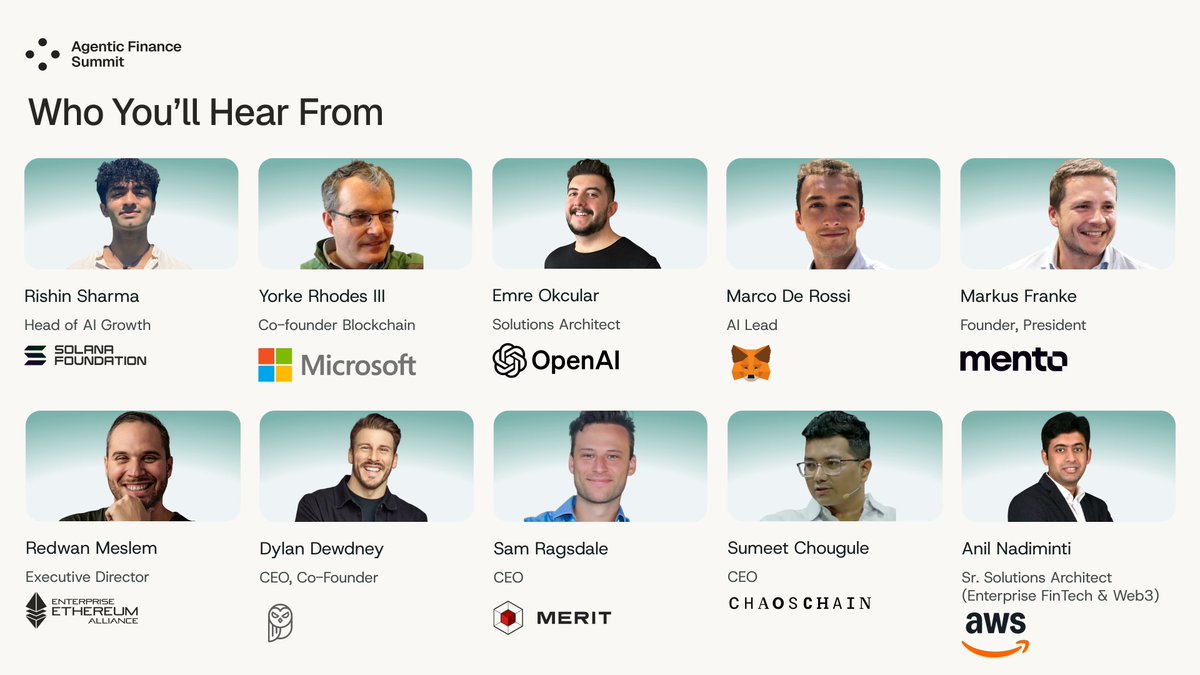
Agentic Finance Summit is where the agentic finance stack gets defined. This edition runs across multiple formats: 1:1 meetings, curated roundtables, networking and mainstage sessions built around what you are actually trying to solve.
Speakers from @Solana, @Microsoft, @OpenAI, @MetaMask, @MentoLabs, @EntEthAlliance, @kuvilabs, @merit_systems, @Ch40sChain, and @AWS will be at Agentic Finance Summit NYC on June 3.
Will you be there?
New York · https://t.co/EUK63cR32k
This thesis is exactly the wedge we're working on.
The agentic-era moat isn't UI, it's the closed loop: real session traces, per-instance trust profiles on your codebase, failure patterns the team can act on, and routing recommendations across vendors.
@Worldline_AI captures the action exhaust agents produce, turns it into a trust record, and gives engineering teams a decision layer above whichever agent they're running.
This piece on where defensibility moves in the agentic era is exactly what we're building toward.
Quick preview from @Worldline_AI (coming soon): per-instance trust profiles, failure patterns, and the verifier rationale behind every score, pulled from real sessions on your codebase.
This is the closed loop. Captured action exhaust → trust record → routing decisions.
This thesis maps almost perfectly to what we've been building.
In the agentic era, the moat isn't the UI. It's the closed loop:
captured action exhaust → verified outcomes → failure patterns → routing decisions.
@Worldline_AI captures the action exhaust agents produce, turns it into a trust record, and gives engineering teams a decision layer above whichever agent they're running.
Coming soon.