What is @pendle_fi? A Quick & Easy Breakdown
Pendle is not just a place to trade yield. It is also a powerful building block that can be composed with money markets.
Suppose you have $10,000 of sUSDat earning around 7% APY.
If you hold it for one year, in theory:
$10,000 → ~$10,700
But what if you do not want to wait a full year to receive that yield?
Pendle solves this by splitting a yield-bearing asset into two parts:
+ PT (Principal Token) → represents the principal.
+ YT (Yield Token) → represents the future yield until maturity.
You can sell YT to cash out part of that future yield today, then hold PT until maturity to redeem the underlying asset.
Or, if you think future yield will be higher than what the market is currently pricing in, you can buy YT to bet on higher yield.
At maturity:
PT → converges toward the redeemable value of the underlying
YT → converges toward 0, because the right to receive future yield has expired
-----
But Pendle gets more interesting because PT and YT can also be used across other protocols.
For example, if a money market accepts PT as collateral:
Buy PT at a discount → deposit PT as collateral → borrow stablecoins → deploy those stablecoins again.
Now, a position that originally looked like simple fixed yield can be composed into:
fixed yield + collateral + borrowing + leverage
Pendle is not only making yield tradable. It is turning yield into a financial primitive that money markets, leverage protocols, and structured products can build on top of.
↪ That is the real power of DeFi composability.
RWAs should follow liquidity and stay composable without rebuilding for every chain.
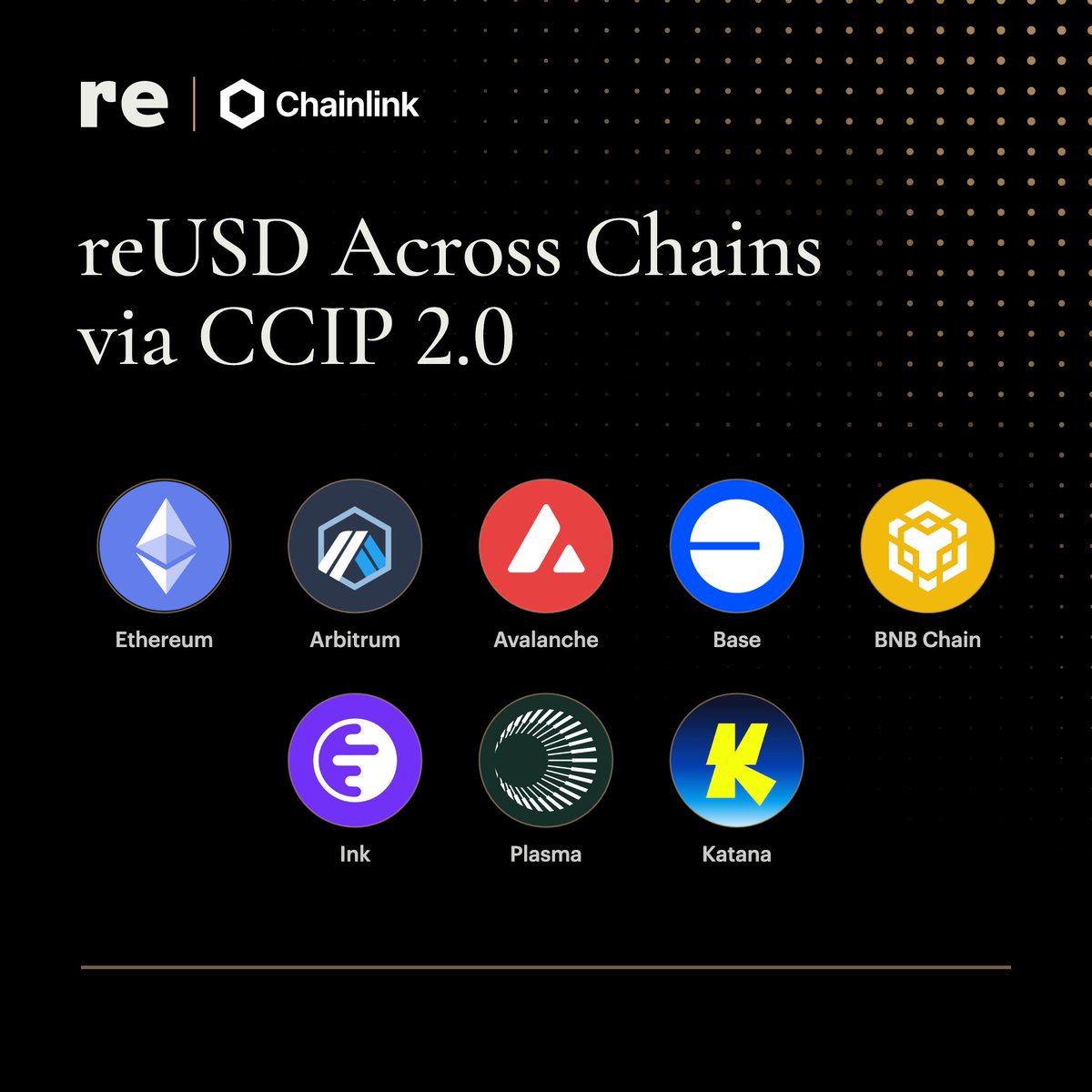
reUSD reaches 8 chains via @chainlink CCIP, connecting users & liquidity across fragmented ecosystems. CCIP 2.0 adds issuer-defined controls per transfer.
Re is proud to be a launch partner.
Market Outlook #16
➥ The Top10 protocols by 7D revenue.
Here's who earned the most and what drove it 🧵
Summary:
▪︎ Crypto's top revenue earners made $233M last week, and stablecoins took 73% of it.
▪︎ Outside tether and circle, the money went to perps, memecoin launchpads and trading bots.
1/ Stablecoins
▪︎ @tether: $120.6M (+2.0% WoW)
▪︎ @circle: $49.8M (+3.5%)
USDT supply was flat, while USDC added roughly $300M in the week to Sep 21 (making $74.6B total).
2/ @HyperliquidX: $16.1M (+19.3%)
BTC broke $85K on Sep 21 and ~$599M got liquidated across the market, 84% of it was from shorts.
Hyperliquid's daily revenue hit $3.54M the next day and that was its best day in the two weeks prior.
3/ Launchpad wars
▪︎ @Pumpfun: $12.0M (+15.4%)
The major driver was the pumpfun iOS app coming back in the US & India stores on Sep 18. Half of revenue buys and burns $PUMP ($460M so far).
▪︎ @LaunchOnSF: $8.9M (+47.8%)
Memecoins paired with tokenized stocks, their revenue did a jump, briefly beating Pump on 7d revenue table.
4/ Trading terminals
▪︎ @AxiomExchange: $7.7M (+8.9%) carried by Solana
▪︎ @gmgnai: $5.7M (-29.8%)
▪︎ @fomo: $4.7M (-29.2%)
The Robinhood Chain memecoin frenzy is cooling. GMGN's and Fomo's revenue there roughly halved week over week but still up enough to rank them #7 & #8.
5/ The outliers
▪︎ @Grayscale: $4.3M (+7.7%)
It charges fees on fund assets, so it's most likely a lift from the BTC move.
▪︎ @Collector_Crypt: $3.5M (+44.1%)
A new entrant on the revenue table. Their physical card packs on Solana coupled with its September "Gacha Games" running (couldn't find much data on them).
6/ Takeaway
Take out the stablecoin interest and last week's revenue came from mostly from BTC volatility and memecoin trading.
Meanwhile launchpads and trading terminals are fighting over the same liquidity and traders.