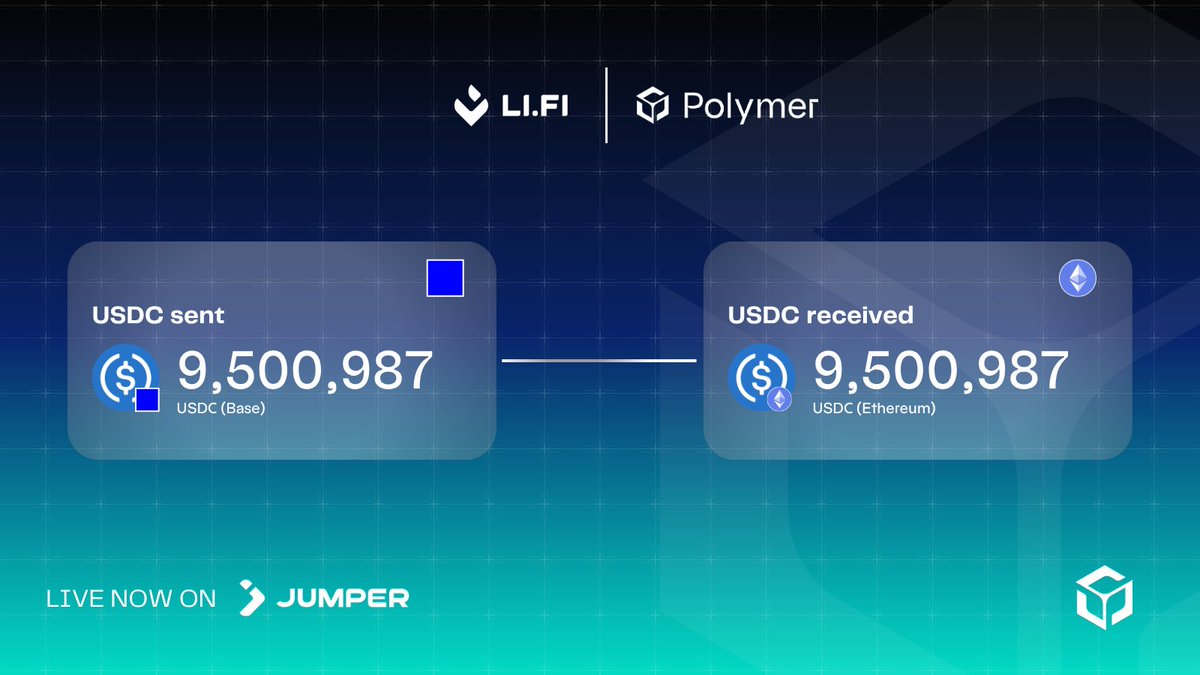
1/ Proud to support https://t.co/spHkmR4Y59 Intents from @lifiprotocol with Polymer proofs.
Settlement speed is more than backend infrastructure. It directly shapes liquidity quality at execution.
With Polymer x https://t.co/spHkmR4Y59, enterprises get stronger rails for payments-grade stablecoin flows, RWA access, and compliant liquidity across chains.
Achievement unlocked ✅
$2B total value transferred!!
A major milestone for Polymer, and a clear signal of growing trust in our reliability, efficiency, and ability to move value safely across chains.
A quick recap of how we got here 🧵
Distribution is no longer optional.
Everyone wants a growth hack or a viral loop, but most of the growth at Lemon Squeezy came from doing a lot of small things for years.
Some practical things that worked for us:
1. Shipping constantly
We created “Lemon Drops” and every Friday, we shipped something. Sometimes big, sometimes tiny. But every single week we had:
>tweets
>a blog post
>a product release
>a changelog update
>screenshots/videos
>customer conversations
This mattered way more than trying to engineer one giant launch every 6 months.
2. Turning product work into distribution
Every feature became content. Every integration became content. Every customer problem became content.
We stopped thinking: “How do we market this?”
And started thinking: “How do we package the work we’re already doing into something discoverable?”
3. Building evergreen content loops
We built “Wedges” and gave it away for free (open source). It wasn’t directly monetized, but it gave us something useful to share constantly.
And designers and developers loved it. People tweeted it. It ranked on Google, and it introduced people to the brand. Over time, it became a flywheel.
A lot of good distribution is just creating assets that keep working long after you publish them.
4. Obsessing over onboarding
I think founders massively underestimate this. Reducing friction is distribution. Every extra step in onboarding kills word of mouth.
We spent a huge amount of time improving signup flow, activation, dashboards, copywriting, error states, emails, and all the boring stuff.
Growth gets easier when people actually make it through the front door.
5. Making docs part of the product
Our docs drove an insane amount of traffic. Not because we “did SEO” but because we answered real questions developers were searching for.
Most company docs sound vanilla. We tried to make ours actually helpful.
Distribution increasingly comes from being useful at scale.
6. Integrations everywhere
Every integration unlocked another ecosystem. Another search surface. Another community.
Integrations are underrated forms of distribution because they borrow trust from existing platforms.
7. Founder-led content
I think I had <1,000 followers when I started Lemon Squeezy, but people trust people more than logos. Especially now.
I posted constantly.
>lessons
>launches
>podcasts
>screenshots
>customer stories
>product thoughts
Founders underestimate how much simply showing up every day matters.
8. Customer support as marketing
Early on, support was one of our biggest growth channels. Answering fast and being human matter. People remember how you make them feel when something breaks.
If you follow me, you know I still live by this, and I've carried this mentality into my role(s) at Stripe.
Support builds trust faster than ads ever will.
9. Screenshots matter more than people think
It sounds silly, but it’s true. Products that look good spread easier. People tweet screenshots, and good design is distribution.
10. Launching over and over again
We never really stopped launching.
>every feature = launch
>every milestone = launch
>every integration = launch
>every partnership = launch
Not in an annoying way. We just consistently stayed in motion. The internet rewards momentum.
11. Building in public before it was cool
We talked openly about numbers, growth, problems, product decisions, and lessons learned.
Transparency created trust, and that trust created distribution.
12. Creating systems instead of random bursts of marketing
This is probably the biggest thing. Most startups market in bursts. They build towards one big launch and then disappear for 3 months.
We built systems:
>weekly emails
>weekly content
>weekly launches
>weekly improvements
>weekly customer conversations
Consistency compounds harder than intensity.
Product still matters deeply, but a good product alone is rarely enough anymore.
Looking back, almost none of this was one giant breakthrough moment.
It was thousands of small reps stacked on top of each other for years.
That’s what compounds.
Proud to power @lifiprotocol's day-one support for @pharos_network as its main partner for chain expansion 🤝
Expect seamless access to the Pharos ecosystem via https://t.co/CznYhkCvQp's product suite
More to come 🌊
Polymer is proud to support @pharos_network
Fast, reliable connectivity to 55+ chains from day one
Unlocking broader on-chain access to Pharos’ compliant, institutional-grade finance
Do you even understand what this means?
An open source model just released that is:
• Outperforms models 20x its size
• Can run on a base model Mac Mini
• Is AMERICAN 🇺🇸
If you have a base model Mac Mini you can have unlimited super intelligence on your desk. For free.
Sonnet 4.5 was released 5 months ago
In 5 months that level of intelligence went from frontier to free on your desk
And not only that, can run on any basically any computer out there
If you have even a remotely modern computer, do the following immediately:
1. Download LM Studio
2. Go to your OpenClaw and ask which of these new Gemma 4 models is best for your hardware
3. Have it walk you through downloading and loading it
4. Build apps with it knowing you are using your own personal, private super intelligence on your desk
The people denying this is the future are so beyond lost.
I went to a private millionaires–only mastermind with 12 young entrepreneurs selling digital products and info, each person making 7 to 9 figures per year (in LA, Beverly Hills)
I've never felt so behind and broke even tho im making millions already
people were making millions with ebooks and courses on a variety of topics/niches: Ecom, Tik Tok shop, websites, etc
I've gathered some secret business methods including :
1) how they're getting millions of views per week
2) converting those views into $3K+ sales daily
3) how to automate the entire thing and build systems
4) breakdown example of posts and products sold
5) show you how many sales, sales calls, entire funnel
6) case studies : how complete beginners scaled to $100K+ per month within 8 months with the right methods
7) and how you can get started :)
comment "HOW" if you want this
must be following + retweet to receive
Clawdbot + Kling = an AI “wellness expert” affiliate machine
no real doctors
no certifications
no clinic
no filming days
just viral “health tip” videos running nonstop
look at pages like this
one consistent persona
same office setup
same calm delivery
but every video hits a different hook
“if your legs…”
“this is insulin…”
“don’t ignore this sign…”
and they pull hundreds of thousands to millions of views
here’s how it works:
→ clawdbot creates the expert persona, hooks, and scripts
→ kling generates the talking videos and scenes
→ capcut adds captions, pacing, and retention edits
→ affiliate links sit in bio converting the traffic
each video tests a new angle
same character
different symptom
most brands rely on one product video
this system tests dozens every week
the winners get scaled
the rest get replaced instantly
AI didn’t just make content cheaper
it turned affiliate content into a volume game
rt + comment “clinic” and i’ll send the full workflow
(follow for dm)