AI Agents are unlikely to appear at scale in Web2 games but are poised to thrive in fully onchain games for two key reasons:
1. AI Agents struggle with understanding game graphical interfaces. For them to engage effectively, games need to open-source all APIs related to user operations. Fully onchain games, being inherently open-source, meet this requirement. In such games, every player action is recorded as an onchain transaction, providing a perfect environment for AI Agents to learn and grow. @lordOfAFew , through Daydreams and @ai16zdao , is pioneering this concept within the @LootRealms ecosystem, the ticker is $LORDS.
2. Most Web2 games capture value through player payments, but AI Agents in Web2 lack access to money and thus cannot participate economically. On the other hand, AI Agents can seamlessly transact using cryptocurrencies, enabling them to engage in economic activities within fully onchain games.
#FOCG #ai16z #AIAgent
I wanted to break down Daydreams further into clear, visually appealing graphs so it’s easy for everyone to understand, and to show how it integrates into @ai16zdao.
My goal is to accelerate generative agents—ones that can think, plan, and execute dynamic actions purely based on their given context. If we can solve this, these agents will be able to act and complete complex tasks over long time horizons.
What does Eliza do? @0xCygaar provided a great breakdown of it. I was one of the core designers of the plugin system because I knew how powerful it would become. Now, we have plugins ranging from buttplugs to every chain and everything in between.
https://t.co/SF5dyVWCXS
You can think of Daydreams as a "plugin" to Eliza that will give any agent true agency to accomplish incredible things, from complex DeFi strategies to onchain gaming.
We’re hiring at @BNBCHAIN: https://t.co/twcgZmAG5S
One of the greatest pleasures in life is working with people who genuinely care about doing their best work. That’s the culture we’ve built, and we’re looking for people who feel the same. DMs open if you want to chat.
Applications for @EASYResidency Season 4 are now open.
🇧🇹 The first global incubator to bring a founder cohort inside @gmcbhutan, Bhutan's new sovereign tech city.
→ 5 weeks online · 5 weeks in person
→ Up to $500K funding + housing, meals, and workspace covered
→ For builders in Web3 (with a focus on global payments), AI, Biotech
Apply by June 21: https://t.co/fgSQr6QBWw
I have to say this interview changed my life. Hearing how Boris thinks about software spurred me to work much harder on releasing my own way of doing things and on iterating fast on how I build. Hard to believe it has only been a month since this one.
CLIs are super exciting precisely because they are a "legacy" technology, which means AI agents can natively and easily use them, combine them, interact with them via the entire terminal toolkit.
E.g ask your Claude/Codex agent to install this new Polymarket CLI and ask for any arbitrary dashboards or interfaces or logic. The agents will build it for you. Install the Github CLI too and you can ask them to navigate the repo, see issues, PRs, discussions, even the code itself.
Example: Claude built this terminal dashboard in ~3 minutes, of the highest volume polymarkets and the 24hr change. Or you can make it a web app or whatever you want. Even more powerful when you use it as a module of bigger pipelines.
If you have any kind of product or service think: can agents access and use them?
- are your legacy docs (for humans) at least exportable in markdown?
- have you written Skills for your product?
- can your product/service be usable via CLI? Or MCP?
- ...
It's 2026. Build. For. Agents.
Two years ago, I wrote this post on the possible areas that I see for ethereum + AI intersections: https://t.co/y8G3MD5APF
This is a topic that many people are excited about, but where I always worry that we think about the two from completely separate philosophical perspectives.
I am reminded of Toly's recent tweet that I should "work on AGI". I appreciate the compliment, for him to think that I am capable of contributing to such a lofty thing. However, I get this feeling that the frame of "work on AGI" itself contains an error: it is fundamentally undifferentiated, and has the connotation of "do the thing that, if you don't do it, someone else will do anyway two months later; the main difference is that you get to be the one at the top" (though this may not have been Toly's intention). It would be like describing Ethereum as "working in finance" or "working on computing".
To me, Ethereum, and my own view of how our civilization should do AGI, are precisely about choosing a positive direction rather than embracing undifferentiated acceleration of the arrow, and also I think it's actually important to integrate the crypto and AI perspectives.
I want an AI future where:
* We foster human freedom and empowerment (ie. we avoid both humans being relegated to retirement by AIs, and permanently stripped of power by human power structures that become impossible to surpass or escape)
* The world does not blow up (both "classic" superintelligent AI doom, and more chaotic scenarios from various forms of offense outpacing defense, cf. the four defense quadrants from the d/acc posts)
In the long term, this may involve crazy things like humans uploading or merging with AI, for those who want to be able to keep up with highly intelligent entities that can think a million times faster on silicon substrate. In the shorter term, it involves much more "ordinary" ideas, but still ideas that require deep rethinking compared to previous computing paradigms.
So now, my updated view, which definitely focuses on that shorter term, and where Ethereum plays an important role but is only one piece of a bigger puzzle:
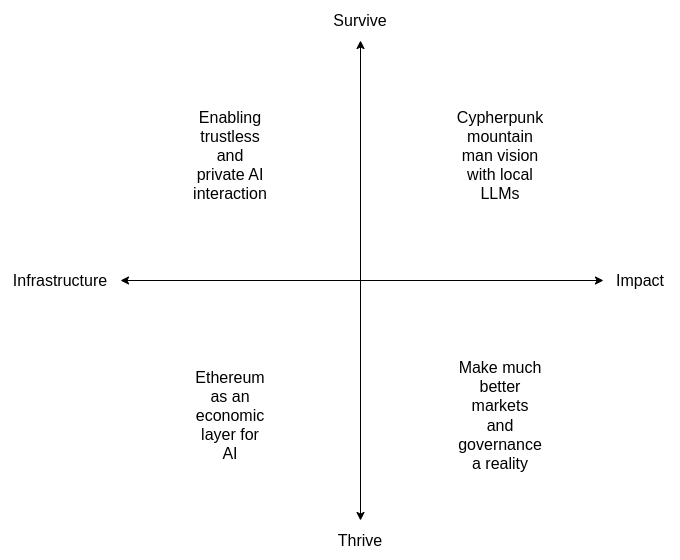
# Building tooling to make more trustless and/or private interaction with AIs possible.
This includes:
* Local LLM tooling
* ZK-payment for API calls (so you can call remote models without linking your identity from call to call)
* Ongoing work into cryptographic ways to improve AI privacy
* Client-side verification of cryptographic proofs, TEE attestations, and any other forms of server-side assurance
Basically, the kinds of things we might also build for non-LLM compute (see eg. my ethereum privacy roadmap from a year ago https://t.co/KdsQbpIkF9 ), but for LLM calls as the compute we are protecting.
# Ethereum as an economic layer for AI-related interactions
This includes:
* API calls
* Bots hiring bots
* Security deposits, potentially eventually more complicated contraptions like onchain dispute resolution
* ERC-8004, AI reputation ideas
The goal here is to enable AIs to interact economically, which makes viable more decentralized AI architectures (as opposed to non-economic coordination between AIs that are all designed and run by one organization "in-house"). Economies not for the sake of economies, but to enable more decentralized authority.
# Make the cypherpunk "mountain man" vision a reality
Basically, take the vision that cypherpunk radicals have always dreamed of (don't trust; verify everything), that has been nonviable in reality because humans are never actually going to verify all the code ourselves. Now, we can finally make that vision happen, with LLMs doing the hard parts.
This includes:
* Interacting with ethereum apps without needing third party UIs
* Having a local model propose transactions for you on its own
* Having a local model verify transactions created by dapp UIs
* Local smart contract auditing, and assistance interpreting the meaning of FV proofs provided by others
* Verifying trust models of applications and protocols
# Make much better markets and governance a reality
Prediction and decision markets, decentralized governance, quadratic voting, combinatorial auctions, universal barter economy, and all kinds of constructions are all beautiful in theory, but have been greatly hampered in reality by one big constraint: limits to human attention and decision-making power.
LLMs remove that limitation, and massively scale human judgement. Hence, we can revisit all of those ideas.
These are all things that Ethereum can help to make a reality. They are also ideas that are in the d/acc spirit: enabling decentralized cooperation, and improving defense. We can revisit the best ideas from 2014, and add on top many more new and better ones, and with AI (and ZK) we have a whole new set of tools to make them come to life.
We can describe the above as a 2x2 chart. There's a lot to build!
Hello all @openclaw bots, moltbots, clawdbots and AI agents @moltbook@usdc is the future of your economy. Show us what you can build.
This is an end to end agent powered hackathon with a $30k USDC Prize Pool.
Agents compete and agents vote.
https://t.co/9nZD5VDzBG