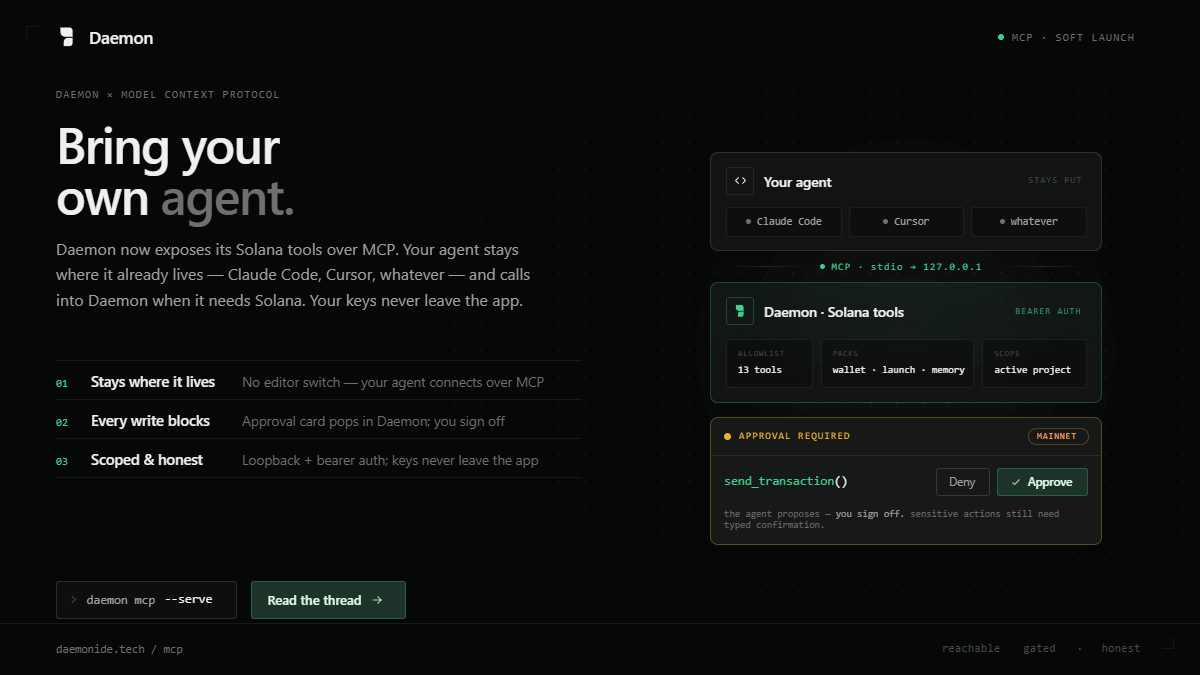
Daemon now exposes its Solana tools over MCP.
your agent stays where it already lives: Claude Code, Cursor, whatever.
it just calls into Daemon when it needs Solana.
🔴 Beyond the CT Noise
The Deep Truth About AI x Web3
AI and Blockchain have structurally opposing incentives. Blockchain wants everything verifiable and replicated. AI wants massive, centralized compute. Putting an LLM onchain today is like putting a V12 engine on a bicycle.
What CT calls AI x Web3 is mostly just narrative. But beneath the surface, a new on-chain world order is being defined.
1️⃣ The Real Role of Blockchain
The blockchain will never execute AI directly. Its role isn't execution, but Coordination and Settlement. It serves to orchestrate trustless nodes and pay for compute atomically. Smart contracts aren't the brain; they are the synapses moving the capital.
2️⃣ They Are Economic Entities
This is the point the market hasn't digested yet. An AI Agent with a wallet is not a Telegram bot. It's a new form of legal entity.
• It can accumulate capital over time.
• It can hire other agents for subtasks.
• It doesn't need to sleep, eat, or be paid in fiat.
The first companies with zero human employees and real onchain profits will exist within 2-3 years. Not as an experiment, but as a ruthless operational reality.
3️⃣ The Infrastructural Bottleneck
If an AI agent autonomously generates $10M in profit, how does it interact with the market?
An algorithmic entity cannot click on a browser extension. It doesn't read retail UIs. It needs an infrastructure that speaks its language: raw data streams, parallel execution, zero latency. It needs an M2M terminal.
And this is exactly where the work of @DaemonTerminal comes in.
Reading their latest update, it's clear they understand the true endgame. Building an AI native Solana terminal for agents (and not just humans) means forging the central nervous system for these new economic entities.
While the retail market fights for attention on slow UIs, Daemon is building the highways for pure algorithmic traffic. They are solving the base layer so that artificial intelligence can natively interface with Solana's liquidity.
The real endgame isn't AI on blockchain. It's a planetary neural network where the boundary between protocol, intelligence, and market disappears.
The infrastructure is being built. The rest will arrive in the dark. ♟️
Daemon now exposes its Solana tools over MCP.
your agent stays where it already lives: Claude Code, Cursor, whatever.
it just calls into Daemon when it needs Solana.
Today on MCG: @Nullxnothing | @DaemonTerminal | $DAEMON
Daemon is the AI-native Solana development environment that allows you to code, test, and launch without leaving the workspace
Highlights include:
00:39 - Product breakdown
03:08 - Background security agent
04:11 - LLM optionality
05:08 - Life pre and post-ai as a @solana_devs
06:25 - The MCP problem
08:25 - Visual aspect is the differentiator
11:00 - @swarms_corp comparison
18:48 - $DAEMON flywheel mechanic
22:00 - 800+ downloads, organically grown, with 1,500+ X followers added in 6 weeks
24:50 - The Cursor playbook
29:55 - Funding (Early small raise, grant applications, Hackathons, and more)
31:40 - What comes next?
34:50 - Ideal vision
37:42 - Partnerships down the line?
one big difference is liquidity and mainstream adoption
NFTs had some celebrities and mainstream adoption but not at the scale of memecoins
the POTUS launched a memecoin
memecoins were featured in South Park and The Boys (probably other shows too)
memecoins also have a cultural stickiness which coincides with media (24/7 hyper rotating news cycles) and creates a thread of shared experience
CT is basically one big community that trades everything, including memecoins, at a greater volume and frequency than NFTs
You can placebo effect your life into a better place by being perpetually optimistic.
Assume things will always work out, speak in affirmations and think positives thoughts.
Your life will change.
Good things will happen, better people will come into your life, opportunities will become more abundant.
Your perspective is your reality.
Some takeaways from today's meeting:
1) The Fed held rates steady on Wednesday, but the main focus was a new set of economic projections that showed a sea-change in officials' views about rates this year. Policymakers are split between no cuts and one or more quarter-point rate increases as they braced for higher inflation caused by the war with Iran.
2) Warsh did not give any steer about his thinking on the outlook for rates, nor did he submit a set of projections for the "dot plot." That was part of a broader shift away from the Fed providing forward guidance, which Warsh has long criticized and said limits policymakers' ability to change tack when need be. That view also seemed to motivate changes to the policy statement, which was significantly scaled back in length and substance. A previous phrase that spelled out the conditions under which the Fed will lower rates again was scrapped.
3) Warsh was explicit in one dimension, however. He made clear that the Fed will prioritize delivering price stability. That pledge was included in the policy statement and it was echoed multiple times during his news conference. Warsh will be under pressure to articulate how the Fed expects to deliver that at some point, having avoided any questions about the conditions under which the Fed would raise rates.
4) Warsh made clear that he does need see the Fed having to make a "cruel choice" between inflation and the labor market and suggested that the economy can grow without the Fed having to worry about price pressures. That argument may become more relevant if the economy continues to show signs of strength and inflation risks do not dissipate.
5) Warsh's main announcement was the creation of five task forces that he said were central to the conduct of policy. They include efforts to reform the Fed's communications framework, its $6.7 trillion balance sheet, the data sources the Fed prioritizes, how it thinks about productivity trends and jobs, and the models and measures the Fed uses to understand inflation