Still trading on polymarket events?
We made it more interesting.
Introducing perpetuals on binary markets.
Eros lets you trade YES/NO tokens with leverage 😱
Built on @monad
Try it out ↓
https://t.co/LWURGBapJ5
Currently live on testnet
TRADE WHAT HAPPENS NEXT.
@monad_dev
Still trading on polymarket events?
We made it more interesting.
Introducing perpetuals on binary markets.
Eros lets you trade YES/NO tokens with leverage 😱
Built on @monad
Try it out ↓
https://t.co/LWURGBapJ5
Currently live on testnet
TRADE WHAT HAPPENS NEXT.
@monad_dev
What if you could trade the future itself?
Presenting EROS MARKETS!
Leveraged perps on Real-World Events
Fully on-chain order book, built on Monad, with its own risk management and its own resolution oracle.
Trade what happens next.
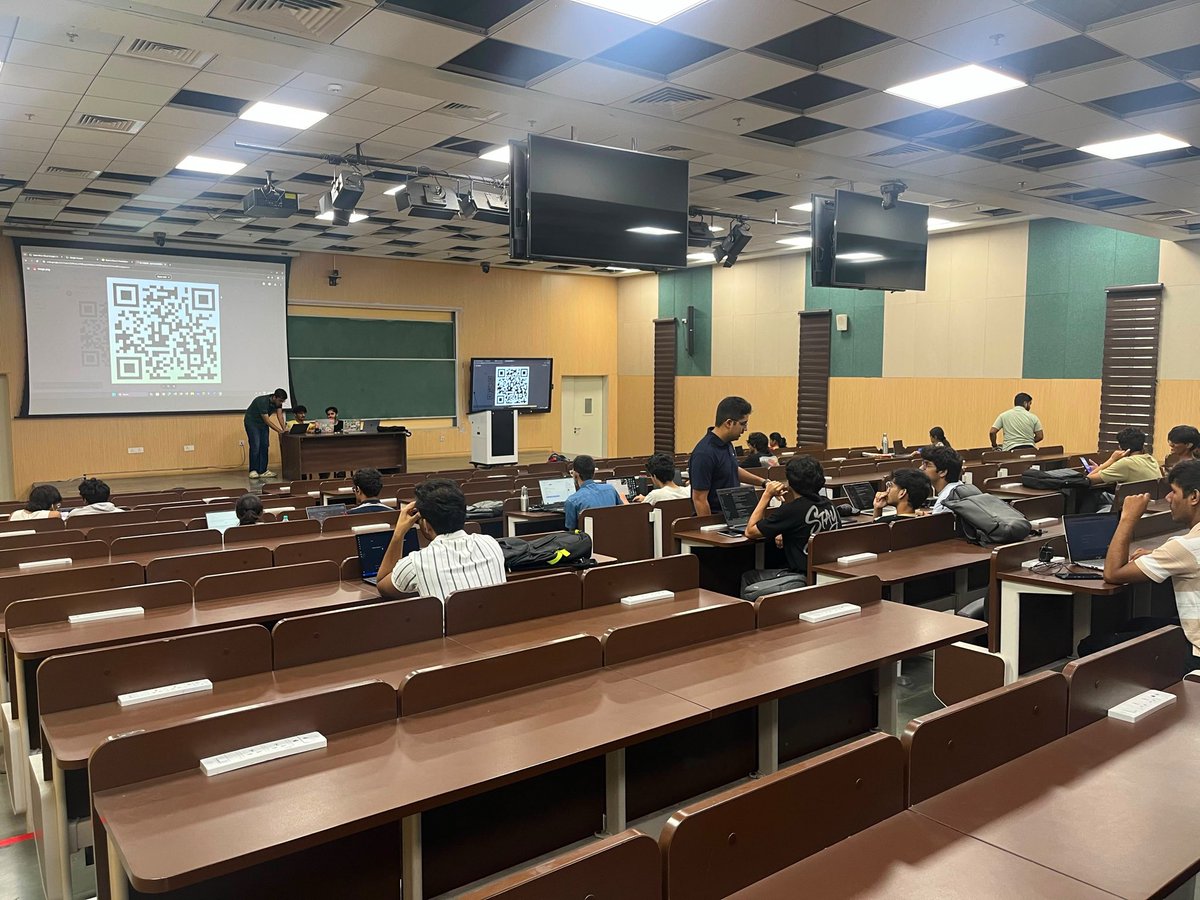
Road to Devcon 2026, that’s a wrap. 🛣️
Blockchain Society IIT Roorkee just hosted our campus edition of the Ethereum Foundation’s Road to Devcon initiative: a 12-hour hackathon leading up to Devcon in Mumbai, backed by @EFDevcon and @geodelabs.
🧵
Registrations for the Road to Devcon Hackathon are now LIVE!
Blocsoc IITR, with support from @EFDevcon and @geodelabs, is bringing you a vibecoding sprint built around the core of Web3: self-sovereignty, censorship resistance, and privacy-first systems.
Grab your team, bring your technical curiosity, and let’s build. Head over to https://t.co/5YAWHByotk and confirm your spot now.
Applications close soon. Don't delay!
Exclusively for IITR students.
I was going through how Curve handles imbalanced trades and found a very interesting formula for the liquidity fee:
Fee = SwapFee * N / (4 * (N - 1))
I couldn't find much derivation for it anywhere. Is it really that obvious?
Sharing my understanding below 🧵👇
Since 1 Swap = 1 Deposit + 1 Withdrawal, the total imbalance across both steps is:
2 * 2S(1 - 1/N) = 4S(1 - 1/N)
Now, equate the total imbalance fee to the standard swap fee (SwapFee * S):
ImbalanceFee * 4S(1 - 1/N) = SwapFee * S
In a balanced N-token pool, adding S of Token A increases each token's ideal share by S/N.
• Token A diff: S - S/N = S(1 - 1/N)
• Other (N-1) tokens diff: (N-1) * (S/N) = S(1 - 1/N)
Total imbalance for 1 deposit = 2S(1 - 1/N).
Any standard swap of amount S can be decomposed into two sequential steps:
Adding single-sided liquidity of amount S (Token A)
Removing single-sided liquidity of amount S (Token B)
For fee consistency, a swap fee MUST equal the fee of both actions combined.
Because there is no closed-form algebraic solution for D, it must be solved numerically using Newton's method: xₙ₊₁ = xₙ − f(xₙ)/f'(xₙ), iterated until convergence.
In code, get_D() and get_y() handle the core math heavy lifting
Decided to build Curve's StableSwap AMM from scratch (Solidity + Foundry) instead of just reading the whitepaper — best way I know to actually understand an invariant is to implement it and watch it break.
Repo: https://t.co/NZMDbdvmOs
Sharing what I'm learning as I go 🧵
AM-GM inequality guarantees P ≤ (D/n)ⁿ always.
Common misconception: D is NOT the literal sum of balances when off-balance. It's a dynamic invariant you must solve for. The math is built so any deviation from balance cleanly nets out to zero.
he invariant, in its "leveraged" form: χ·Dⁿ⁻¹·S + P = χ·Dⁿ + (D/n)ⁿ
Where S = sum of balances, P = product of balances, and D = the invariant value.
The key trick here is χ = A·P/(D/n)ⁿ. χ = A at perfect balance, and drops → 0 as any balance shrinks toward zero.
StableSwap blends both: it acts flat like a constant-sum model when balances are equal, but curves sharply like a constant-product model at the edges.
This reintroduces exactly the dynamic execution resistance that constant-sum is missing.
Why StableSwap exists: Constant-product (x·y=k) causes high slippage even near perfect balance — bad for assets that should trade 1:1.
Constant-sum (x+y=k) gives zero slippage but zero resistance: if an asset de-pegs, arbitrageurs will drain the pool entirely for free.
🏆 Honourable Mention at @EthGlobal OpenAgents Hackathon!
We built KeeperKit — a TypeScript SDK + @ElizaOS plugin for @KeeperHub's automation protocol, plus a full consumer dApp (KeeperUniversity) on top.
🔗 https://t.co/PDLh0xl09W
#EthGlobal#Web3#BuildInPublic