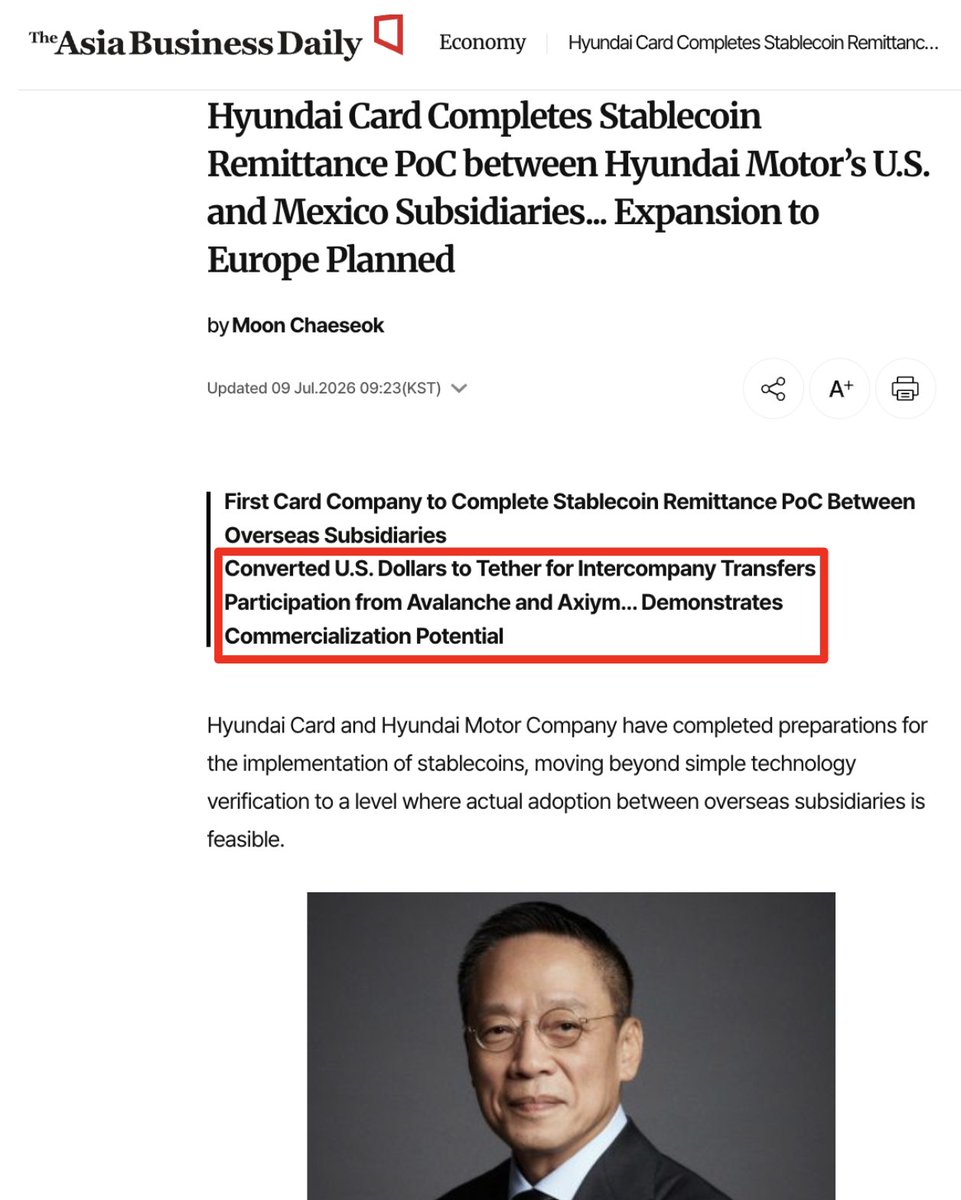
BREAKING : Hyundai Motor Group(@HMGnewsroom) and @AvaLabs — together with our partners @tether and @AxiymFinance — have built and completed a stablecoin remittance layer between the group's overseas subsidiaries, settled on-chain on and only on @avax.
This wasn't a lab experiment. It was real intercompany settlement — the kind that runs through multinational enterprise every day — moving from dollars to stablecoin, across borders, and back, in a fraction of the time a traditional wire takes.
What made it work was the years of partnership behind it. Alongside Tether and Axiym, #HyundaiCard and larger Hyundai Motor Group brought deep operational expertise and did the hard work across accounting, tax, legal, and internal controls in every jurisdiction. We're proud to have built the rails together on avalanche.
And we're just getting started. The world's largest enterprises are moving real treasury on-chain. Not someday. Now. On @avax.
Grateful to our partners and excited to keep building together.
Read more at : https://t.co/PZbRnUE7Bg
Excited to share that I’ve officially joined @AvaxTeam1 as a Collaborator!
Looking forward to contributing to the @avax ecosystem, connecting with builders worldwide, and growing with the Korea chapter 🇰🇷
Let’s build. 🚀
—
@AvaxTeam1 콜라보레이터로 공식 합류했습니다!
Avalanche 생태계에 기여하고, 전 세계 빌더들과 교류하며, Korea 챕터와 함께 성장해나가려 합니다 🇰🇷
Let’s build. 🚀
#Avalanche #AVAX #Team1
Two weeks ago, Ethereum researchers met in Berlin to continue charting the protocol's long-term trajectory, following along discussions with client teams in Svalbard in April.
The updated strawmap is at https://t.co/9e2AQ6rhz6, and I attached a picture of it to this post.
My own high-level takeaways:
* "Lean Ethereum" is not a single one-shot upgrade, it is a collection of improvements that will come online to the Ethereum network over the course of three or four years. But make no mistake, this IS the third major iteration of Ethereum in the same way that the Merge was the second. Almost every major piece of the protocol will be replaced:
- Verification through recursive STARKs, rather than direct re-execution. Recursive STARKs become an enshrined first-class core component of the protocol
- Replacing everything quantum-vulnerable with quantum-safe alternatives
- Consensus: decoupled available chain and finality, one or two-round finality. Theoretically optimal security properties, simpler than today, and faster than today
- Multidimensional gas
- State: not just tree structure, but what *types* of state are available
- Changes to client architecture
...
At the same time, simplification, cleanup and future-proofing. And this will all be done in a way that minimizes disruption to existing application. We've done this before (the Merge), we can do it again.
* H-star (aka Hegota) is probably Ethereum's last thematically "pre-Lean" fork. Starting from I-star, most of everything we do will have a very strong "Lean" feel to it in one way or another.
* Privacy is no longer an afterthought, it is a first class goal. When designing Frames, the mempool, additions to the state tree, we explicitly ask the question "okay, how do quantum-safe, intermediary-free privacy protocol transactions go through this, and what is the overhead?"
* Formal verification of everything for security.
* FV also makes us much more comfortable with canonicalization (having pieces of the protocol that are directly defined as a piece of bytecode expressed in some language). evm-asm is being written in part to become a canonical proof system for the EVM.
* Quantum safety has shifted up a LOT in priority. This adds a lot of work (eg. finalizing a quantum-safe blobs design has become urgent; this work has already been ongoing for months)
* Probably the single most disruptive part of the plan is the changes to state. There is growing consensus around leaving present-day-style "dynamic state" mostly unchanged, but scaling it only a medium amount, and adding new types of state that are more scalability-friendly (eg. no need for builders to sync/store all of it) but more restrictive, and that will scale a large amount.
eg. possible Ethereum in 2030: 2 TB of present-day-style (dynamic) state, and 100 TB of new-style (scalable but restrictive) state
This "new-style" state would work very well for ERC20s, NFTs, many defi use cases, but not eg. highly "central" objects like Uniswap contracts, or onchain order books, or other complex things (which are crucial for Ethereum but which only take up a small percentage of state)
Hence, it will not be *necessary* to rewrite any apps, but it will be *very cost-effective* to eg. rewrite an ERC20 token into a newer design that uses a new type of UTXO storage that is currently being explored, so that it will have >10x lower txfees.
Design of these new state types (current ideas: keyed nonces, ring buffers, UTXOs, statically accessible state, temp state) is an area where we will need a lot of feedback from application developers (incl. privacy-friendly application developers) and probably several rounds of rethinking and iteration.
* In the context of a much larger total state size, we need to figure out the incentive issues around who stores this state and what motivates them to. Even saying "each node stores 1%" is not good enough - why do they store that 1% and why are they willing to serve it? This is being elevated as a first-class research area.
* Ethereum will need to have a "VM" other than EVM in one form or another - at the very least, we need something like leanISA for recursive STARKs - and the gains are large in exposing it to users so that we support programmable privacy and better scalability. Right now, the most likely contenders are leanISA and RISC-V.
My own ideal is that in this world, we adjust the protocol so that the EVM becomes a high-level-language compiler-level feature, and the protocol only "sees" RISC-V / leanISA directly. But this is still far away.
* Gas limit increases, blob increases and slot time decreases will happen many times over the next ~5 years. We expect a large gas limit increase with Glasterdam. Each step of increased scale or decreased slot time is a matter of getting to the point where it is safe to do it, which comes from a combination of client optimization and protocol changes.
Ethereum is CROPS.
Ethereum is scaling.
Ethereum is reinventing itself.
Onward.
A ten-thousand word monster post trying to cover the entire tech tree behind the main lineage of obfuscation (iO) protocols:
https://t.co/46nseINlwF
Special thanks to all who helped!
Announcing Ethlabs: a non-profit R&D lab for Ethereum and ETH
Our mission is to make Ethereum the settlement layer of the global economy.
The internet became global because shared protocols created a common language between networks. Private systems remained useful, but bounded. Finance is approaching a similar moment. As value, assets, and markets become digital, the world needs shared settlement infrastructure.
Ethereum is uniquely positioned to become that shared base layer, the neutral foundation on which users, institutions, and agents can transact without intermediation.
What we believe:
• We believe credible neutrality matters. Ten years of uptime and the lowest counterparty risk. Ground that cannot be pulled away by any one country, institution, company, or person.
• We believe ETH matters. The most valuable, programmable store of value. A decade of broad distribution, deep liquidity in onchain markets, and maximally trustless asset on Ethereum.
• We believe DeFi matters. Markets, liquidity, credit, exchange, and coordination, open to anyone.
• We believe adoption matters. Principles do not change the world until people benefit from them.
We sit between two worlds: real usage from the builders at the frontier, and the protocol that has to support it. We work with users, applications, wallets, L2s, infrastructure teams, institutions, ETH holders, core devs and researchers, then turn what they actually need into protocol work, shared standards, infrastructure, and shipped products.
Ethlabs is independent but Ethereum is a shared project. We are one node in a much larger network of stewards. This is the multi-node future.
We have spent the better part of the past decade contributing to Ethereum core research and development.
We are opinionated and transparent. We move with urgency, learn in public, and course-correct when we’re wrong.
We are building a lean, talent-dense team for people who want to do the most important work of their careers: [email protected]
⚠️ Lighthouse v8.2.0 is a high-priority release containing fixes for several security vulnerabilities, as well as optimisations and new features.
All beacon node users should upgrade as soon as practical. Validator client users should review the fee-recipient and graffiti changes below before upgrading.
This release also contains substantial Gloas preparation, Fulu data-availability networking improvements, and new standard API support.
Someone proposed a 128M ETH hard cap. Bitcoin's 21M, but for ETH.
The most honest line was the author's own reply: "We never actually get there. It's just a meme."
What's interesting is the author already knows this. If the cap is never hit, issuance, burn, and the supply curve all stay the same. Only the narrative changes.
So to me it reads less like monetary policy and more like marketing.
People warn of a death spiral at the cap. Personally I think that's overstated. PoW security is energy burned now, a flow. PoS security is capital locked up, a stock. Even at zero issuance, the stake at slashing risk IS the security.
The real issue is elsewhere. A hard cap permanently retires issuance as a policy lever, the very lever Ethereum most wants right now.
All for one mostly-symbolic gain.
Feels like a fight over what ETH is. Money means fixed scarcity. Capital means flexible issuance.
Is taking on the security-budget dilemma Bitcoin already faces, in a weaker form, really worth it?
https://t.co/lIpeTgO6UO
🏆 Solana Startup Village Seoul Season 2
우리 학회에서 우승팀이 나왔습니다! 🎉
아이디어를 현실로 만들기 위해 밤낮없이 고민하고 개발한 팀원분들의 노력에 큰 박수를 보냅니다 👏
배우고, 만들고, 도전하는 문화가 실제 성과로 이어지고 있습니다.
다음 우승팀도 우리 학회에서 나올 수 있도록 🚀
#Solana #Web3 #StartupVillage #Blockchain #BuildInPublic #Riskmesh
Bitcoiners, see you in Seoul 🚀
ORIGIN SEOUL 2026
Asia's Flagship Bitcoin Conference
8월 31일 ~ 9월 2일 · Seoul
⚡️ 패스 경품 이벤트
GA(제너럴) Pass 30장
PRO(프로) Pass 5장
VIP Day Invitation 2장
📙 참여 방법
1. @ORIGINseoulBTC 팔로우
2. 좋아요 + 재게시 (또는 인용)
3. 서울에서 보고 싶은 연사 · 비트코이너 1명 댓글 태그
누가 ORIGIN SEOUL 무대에 서야 할까요? 👀
https://t.co/32XThZi6u2
오픈소스 개발자분들을 모십니다.
한국에도 뛰어난 오픈소스 빌더들이 많지만, 대부분은 안정적인 후원이나 수익 구조 없이 개인 시간과 생활비를 들여 개발을 이어가고 있습니다.
버추얼은 이 구조를 바꿀 수 있는 새로운 실험을 함께하고 싶습니다.
트레이딩 수수료만으로는 부족합니다. 그래서 저희는 ACF(Automated Capital Formation)를 통해 오픈소스 빌더들이 더 지속 가능한 방식으로 프로젝트를 키우고, 커뮤니티와 함께 성장할 수 있는 새로운 메커니즘을 실험하고 있습니다.
오픈소스 프로젝트를 더 크게 키우고 싶은 분들, 글로벌 커뮤니티와 연결되고 싶은 분들, 새로운 자금화 모델을 함께 고민해보고 싶은 분들을 찾고 있습니다.
- 작게 시작한 프로젝트도 괜찮습니다.
- 이미 유저가 있는 프로젝트도 좋습니다.
- 아직 아이디어 단계여도 좋습니다.
관심 있으신 분들은 편하게 DM 주세요. 커피챗도 환영입니다.
슬슬 K-오픈소스 빌더들의 힘을 보여줄 시간입니다.
Google Cloud AI engineer just showed how they go from idea to deployed app at Google in 30-minutes using Claude.
26-minutes. free. by Google AI team.
one person + Claude + Google Cloud = a full engineering org running on a laptop.
worth more than any $500 vibe-coding course.
Today I had the opportunity to present Ethereum's post-quantum security strategy at the Institutional Ethereum Forum in NYC.
15 minutes to explain why every proof-of-stake blockchain faces the same signature aggregation problem — and what the EF is doing about it.
We also launched https://t.co/Wz0gMP1v9A — a dedicated resource that brings together everything the PQ/Crypto teams have been working on:
→ How PQ impacts each protocol layer
→ The full PQ roadmap
→ Open resources — repos, specs, papers
→ FAQ — 14 questions we keep getting from institutions, now open-sourced
→ Interest form for the 2nd Annual PQ Research Retreat (Cambridge, Oct 2026)
Huge thanks to @drakefjustin@tcoratger@asanso and the entire PQ team, the @leanEthereum client teams shipping devnets every week.
Next week: Fort Mode in Cannes.
https://t.co/Wz0gMP1v9A
Introducing strawmap, a strawman roadmap by EF Protocol.
Believe in something. Believe in an Ethereum strawmap.
Who is this for?
The document, available at strawmap[.]org, is intended for advanced readers. It is a dense and technical resource primarily for researchers, developers, and participants in Ethereum governance. Visit ethereum[.]org/roadmap for more introductory material. Accessible explainers unpacking the strawmap will follow soon™.
What is the strawmap?
The strawmap is an invitation to view L1 protocol upgrades through a holistic lens. By placing proposals on a single visual it provides a unified perspective on Ethereum L1 ambitions. The time horizon spans years, extending beyond the immediate focus of All Core Devs (ACD) and forkcast[.]org which typically cover only the next couple of forks.
What are some of the highlights?
The strawmap features five simple north stars, presented as black boxes on the right:
→ fast L1: fast UX, via short slots and finality in seconds
→ gigagas L1: 1 gigagas/sec (10K TPS), via zkEVMs and real-time proving
→ teragas L2: 1 gigabyte/sec (10M TPS), via data availability sampling
→ post quantum L1: durable cryptography, via hash-based schemes
→ private L1: first-class privacy, via shielded ETH transfers
What is the origin story?
The strawman roadmap originated as a discussion starter at an EF workshop in Jan 2026, partly motivated by a desire to integrate lean Ethereum with shorter-term initiatives. Upgrade dependencies and fork constraints became particularly effective at surfacing valuable discussion topics. The strawman is now shared publicly in a spirit of proactive transparency and accelerationism.
Why the "strawmap" name?
"Strawmap" is a portmanteau of "strawman" and "roadmap". The strawman qualifier is deliberate for two reasons:
1. It acknowledges the limits of drafting a roadmap in a highly decentralized ecosystem. An "official" roadmap reflecting all Ethereum stakeholders is effectively impossible. Rough consensus is fundamentally an emergent, continuous, and inherent uncertain process.
2. It underscores the document's status as a work-in-progress. Although it originated within the EF Protocol cluster, there are competing views held among its 100 members, not to mention a rich diversity of non-EFer views.
The strawmap is not a prediction. It is an accelerationist coordination tool, sketching one reasonably coherent path among millions of possible outcomes.
What is the strawmap time frame?
The strawmap focuses on forks extending through the end of the decade. It outlines seven forks by 2029 based on a rough cadence of one fork every six months. While grounded in current expectations, these timelines should be treated with healthy skepticism. The current draft assumes human-first development. AI-driven development and formal verification could significantly compress schedules.
What do the letters on top represent?
The strawmap is organized as a timeline, with forks progressing from left to right. Consensus layer forks follow a star-based naming scheme with incrementing first letters: Altair, Bellatrix, Capella, Deneb, Electra, Fulu, etc. Upcoming forks such as Glamsterdam and Hegotá have finalized names. Other forks, like I* and J*, have placeholder names (with I* pronounced "I star").
What do the colors and arrows represent?
Upgrades are grouped into three color-coded horizontal layers: consensus (CL), data (DL), execution (EL). Dark boxes denote headliners (see below), grey boxes indicate offchain upgrades, and black boxes represent north stars. An explanatory legend appears at the bottom.
Within each layer, upgrades are further organized by theme and sub-theme. Arrows signal hard technical dependencies or natural upgrade progressions. Underlined text in boxes links to relevant EIPs and write-ups.
What are headliners?
Headliners are particularly prominent and ambitious upgrades. To maintain a fast fork cadence, the modern ACD process limits itself to one consensus and one execution headliner per fork. For example, in Glamsterdam, these headliners are ePBS and BALs, respectively.
(L* is an exceptional fork, displaying two headliners tied to the bigger lean consensus fork. Lean consensus landing in L* would be a fateful coincidence.)
Will the strawmap evolve?
Yes, the strawmap is a living and malleable document. It will evolve alongside community feedback, R&D advancements, and governance. Expect at least quarterly updates, with the latest revision date noted on the document.
Can I share feedback?
Yes, feedback is actively encouraged. The EF Protocol strawmap is maintained by the EF Architecture team: @adietrichs, @barnabemonnot, @fradamt, @drakefjustin. Each has open DMs and can be reached at first.name@ethereum[.]org. General inquiries can be sent to strawmap@ethereum[.]org.
There have recently been some discussions on the ongoing role of L2s in the Ethereum ecosystem, especially in the face of two facts:
* L2s' progress to stage 2 (and, secondarily, on interop) has been far slower and more difficult than originally expected
* L1 itself is scaling, fees are very low, and gaslimits are projected to increase greatly in 2026
Both of these facts, for their own separate reasons, mean that the original vision of L2s and their role in Ethereum no longer makes sense, and we need a new path.
First, let us recap the original vision. Ethereum needs to scale. The definition of "Ethereum scaling" is the existence of large quantities of block space that is backed by the full faith and credit of Ethereum - that is, block space where, if you do things (including with ETH) inside that block space, your activities are guaranteed to be valid, uncensored, unreverted, untouched, as long as Ethereum itself functions. If you create a 10000 TPS EVM where its connection to L1 is mediated by a multisig bridge, then you are not scaling Ethereum.
This vision no longer makes sense. L1 does not need L2s to be "branded shards", because L1 is itself scaling. And L2s are not able or willing to satisfy the properties that a true "branded shard" would require. I've even seen at least one explicitly saying that they may never want to go beyond stage 1, not just for technical reasons around ZK-EVM safety, but also because their customers' regulatory needs require them to have ultimate control. This may be doing the right thing for your customers. But it should be obvious that if you are doing this, then you are not "scaling Ethereum" in the sense meant by the rollup-centric roadmap. But that's fine! it's fine because Ethereum itself is now scaling directly on L1, with large planned increases to its gas limit this year and the years ahead.
We should stop thinking about L2s as literally being "branded shards" of Ethereum, with the social status and responsibilities that this entails. Instead, we can think of L2s as being a full spectrum, which includes both chains backed by the full faith and credit of Ethereum with various unique properties (eg. not just EVM), as well as a whole array of options at different levels of connection to Ethereum, that each person (or bot) is free to care about or not care about depending on their needs.
What would I do today if I were an L2?
* Identify a value add other than "scaling". Examples: (i) non-EVM specialized features/VMs around privacy, (ii) efficiency specialized around a particular application, (iii) truly extreme levels of scaling that even a greatly expanded L1 will not do, (iv) a totally different design for non-financial applications, eg. social, identity, AI, (v) ultra-low-latency and other sequencing properties, (vi) maybe built-in oracles or decentralized dispute resolution or other "non-computationally-verifiable" features
* Be stage 1 at the minimum (otherwise you really are just a separate L1 with a bridge, and you should just call yourself that) if you're doing things with ETH or other ethereum-issued assets
* Support maximum interoperability with Ethereum, though this will differ for each one (eg. what if you're not EVM, or even not financial?)
From Ethereum's side, over the past few months I've become more convinced of the value of the native rollup precompile, particuarly once we have enshrined ZK-EVM proofs that we need anyway to scale L1. This is a precompile that verifies a ZK-EVM proof, and it's "part of Ethereum", so (i) it auto-upgrades along with Ethereum, and (ii) if the precompile has a bug, Ethereum will hard-fork to fix the bug.
The native rollup precompile would make full, security-council-free, EVM verification accessible. We should spend much more time working out how to design it in such a way that if your L2 is "EVM plus other stuff", then the native rollup precompile would verify the EVM, and you only have to bring your own prover for the "other stuff" (eg. Stylus). This might involve a canonical way of exposing a lookup table between contract call inputs and outputs, and letting you provide your own values to the lookup table (that you would prove separately).
This would make it easy to have safe, strong, trustless interoperability with Ethereum. It also enables synchronous composability (see: https://t.co/9jy6v1X6Fw and https://t.co/gZmu3YjebM ). And from there, it's each L2's choice exactly what they want to build. Don't just "extend L1", figure out something new to add.
This of course means that some will add things that are trust-dependent, or backdoored, or otherwise insecure; this is unavoidable in a permissionless ecosystem where developers have freedom. Our job should make to make it clear to users what guarantees they have, and to build up the strongest Ethereum that we can.
Today marks an inflection in the Ethereum Foundation's long-term quantum strategy.
We've formed a new Post Quantum (PQ) team, led by the brilliant Thomas Coratger (@tcoratger). Joining him is Emile, one of the world-class talents behind leanVM. leanVM is the cryptographic cornerstone of our entire post-quantum strategy.
After years of quiet R&D, EF management has officially declared PQ security a top strategic priority. Our journey began in 2019, with the "Eth3.0 Quantum Security" presentation at StarkWare Sessions. Since 2024, PQ has been central to the @leanEthereum vision. The pace of PQ engineering breakthroughs since then has been nothing short of phenomenal.
It's now 2026, timelines are accelerating. Time to go full PQ:
→ PQ ACD: Antonio Sanso (@asanso) kicks off a bi-weekly All Core Devs PQ transactions breakout call next month. These sessions focus on user-facing security, covering dedicated precompiles, account abstraction, and longer-term transaction signature aggregation with leanVM.
→ PQ foundations: Today we are announcing a $1M Poseidon Prize to harden the Poseidon hash function. We are betting big on hash-based cryptography to enjoy the strongest and leanest cryptographic foundations. Check out our other $1M PQ initiative, the Proximity Prize.
→ PQ devnets: Multi-client PQ consensus devnets are live! Shoutout to pioneers @zeamETH, @ReamLabs, @PierTwo_com, @geanclient, @ethlambda_lean, as well as established consensus teams Lighthouse, Grandine, and soon Prysm. This incredible teamwork is coordinated by @corcoranwill via weekly PQ interop calls.
→ PQ workshops: Building on last year's PQ workshop in Cambridge (see photo), the EF is hosting another 3-day PQ event in October. Top experts from around the world will convene. In addition, a PQ day is set for March 29 in Cannes just ahead of EthCC.
→ PQ FV and AI: Last week Alex Hicks (@alexanderlhicks) ran a specialised maths AI for 8 hours, at a $200 cost. It one-shotted a formal proof one of the hardest lemmas in the foundations of hash-based snarks. Mind-blowing. Applied cryptography will never be the same.
→ PQ roadmap: A comprehensive breakdown of the EF's proposed PQ strategy will be shared soon™ on pq[.]ethereum[.]org. The roadmap targets a full transition in coming years with zero loss of funds and zero downtime. Stay tuned :)
→ PQ education: The ZKPodcast (@zeroknowledgefm) is producing a 6-part video series on Ethereum's PQ strategy. EF Enterprise Acceleration is also preparing material for enterprises and nation-states. Finally, Ethereum is now represented on the PQ advisory board that Coinbase announced yesterday.
Believe in something. Believe in PQ security.




![drakefjustin's tweet photo. Introducing strawmap, a strawman roadmap by EF Protocol.
Believe in something. Believe in an Ethereum strawmap.
Who is this for?
The document, available at strawmap[.]org, is intended for advanced readers. It is a dense and technical resource primarily for researchers, developers, and participants in Ethereum governance. Visit ethereum[.]org/roadmap for more introductory material. Accessible explainers unpacking the strawmap will follow soon™.
What is the strawmap?
The strawmap is an invitation to view L1 protocol upgrades through a holistic lens. By placing proposals on a single visual it provides a unified perspective on Ethereum L1 ambitions. The time horizon spans years, extending beyond the immediate focus of All Core Devs (ACD) and forkcast[.]org which typically cover only the next couple of forks.
What are some of the highlights?
The strawmap features five simple north stars, presented as black boxes on the right:
→ fast L1: fast UX, via short slots and finality in seconds
→ gigagas L1: 1 gigagas/sec (10K TPS), via zkEVMs and real-time proving
→ teragas L2: 1 gigabyte/sec (10M TPS), via data availability sampling
→ post quantum L1: durable cryptography, via hash-based schemes
→ private L1: first-class privacy, via shielded ETH transfers
What is the origin story?
The strawman roadmap originated as a discussion starter at an EF workshop in Jan 2026, partly motivated by a desire to integrate lean Ethereum with shorter-term initiatives. Upgrade dependencies and fork constraints became particularly effective at surfacing valuable discussion topics. The strawman is now shared publicly in a spirit of proactive transparency and accelerationism.
Why the "strawmap" name?
"Strawmap" is a portmanteau of "strawman" and "roadmap". The strawman qualifier is deliberate for two reasons:
1. It acknowledges the limits of drafting a roadmap in a highly decentralized ecosystem. An "official" roadmap reflecting all Ethereum stakeholders is effectively impossible. Rough consensus is fundamentally an emergent, continuous, and inherent uncertain process.
2. It underscores the document's status as a work-in-progress. Although it originated within the EF Protocol cluster, there are competing views held among its 100 members, not to mention a rich diversity of non-EFer views.
The strawmap is not a prediction. It is an accelerationist coordination tool, sketching one reasonably coherent path among millions of possible outcomes.
What is the strawmap time frame?
The strawmap focuses on forks extending through the end of the decade. It outlines seven forks by 2029 based on a rough cadence of one fork every six months. While grounded in current expectations, these timelines should be treated with healthy skepticism. The current draft assumes human-first development. AI-driven development and formal verification could significantly compress schedules.
What do the letters on top represent?
The strawmap is organized as a timeline, with forks progressing from left to right. Consensus layer forks follow a star-based naming scheme with incrementing first letters: Altair, Bellatrix, Capella, Deneb, Electra, Fulu, etc. Upcoming forks such as Glamsterdam and Hegotá have finalized names. Other forks, like I* and J*, have placeholder names (with I* pronounced "I star").
What do the colors and arrows represent?
Upgrades are grouped into three color-coded horizontal layers: consensus (CL), data (DL), execution (EL). Dark boxes denote headliners (see below), grey boxes indicate offchain upgrades, and black boxes represent north stars. An explanatory legend appears at the bottom.
Within each layer, upgrades are further organized by theme and sub-theme. Arrows signal hard technical dependencies or natural upgrade progressions. Underlined text in boxes links to relevant EIPs and write-ups.
What are headliners?
Headliners are particularly prominent and ambitious upgrades. To maintain a fast fork cadence, the modern ACD process limits itself to one consensus and one execution headliner per fork. For example, in Glamsterdam, these headliners are ePBS and BALs, respectively.
(L* is an exceptional fork, displaying two headliners tied to the bigger lean consensus fork. Lean consensus landing in L* would be a fateful coincidence.)
Will the strawmap evolve?
Yes, the strawmap is a living and malleable document. It will evolve alongside community feedback, R&D advancements, and governance. Expect at least quarterly updates, with the latest revision date noted on the document.
Can I share feedback?
Yes, feedback is actively encouraged. The EF Protocol strawmap is maintained by the EF Architecture team: @adietrichs, @barnabemonnot, @fradamt, @drakefjustin. Each has open DMs and can be reached at first.name@ethereum[.]org. General inquiries can be sent to strawmap@ethereum[.]org.](https://pbs.twimg.com/media/HCBwqPeWoAAC5Kj.jpg)


