CCPEDIA keeps evolving!
Now everything about @CantonNetwork is in one place:
CIPs • documentation • forum discussions • whitepapers • MCP
Visit: https://t.co/W0E3bmGpl1
Big ticket giveaway for one of the biggest events in Ukraine - Incrypted Crypto Conference 2026!
Today you have a unique opportunity to attend this event completely FREE
How to enter the giveaway?
1️⃣ Follow @UnityNodes and @Incrypted
2️⃣ Join our Telegram - https://t.co/tJcKIP0SgO
3️⃣ Like and leave a comment under this post
4️⃣ Make sure to send the link to your comment in our Telegram group
We'll be selecting winners using a randomizer and the results will be announced in our Telegram group
Good luck
Prediction markets are growing fast, but most of them are still controlled - platforms decide what markets exist and how they’re resolved.
XO is trying something different. Anyone can create a market on any topic, trade with any token, and even earn fees from it. No approvals, no limits.
XO runs on its own chain, with Celestia Labs handling data availability.
This means it doesn’t compete with other apps for blockspace and can handle big spikes in activity when major events happen.
Celestia gives XO the scale and reliability without needing to run its own validator network. Costs scale with usage, and the system stays fast even under heavy load.
Real-time markets like this need their own environment, and @celestia is what makes it possible to build them without huge overhead.
Most DeFi hacks could've been stopped with one simple thing.
A dedicated signing device.
Not your everyday laptop - not the one with 47 browser tabs, Telegram, and that one sketchy airdrop site you opened last week.
A separate machine used only for multisig, treasury, and critical ops.
Here's why it matters:
Once your main machine is compromised, the attacker sees exactly what you see. They swap addresses, manipulate hashes, control confirmation flows.
Your hardware wallet? Still not enough if the host is dirty.
@monad just launched a device subsidy program for protocol teams with ≥ $2.5M TVL on Monad - because they get it.
As validators, we see how often security comes down to a single point of failure. A dedicated signing device is abasic hygiene.
Today is the day of a big announcement.
We’re excited to announce that UnityNodes is joining as a validator on the @monad.
We’ve already accomplished a lot, we’re already implementing many things, and there are many new ideas ahead. And we’re confident that together with Monad, we’ll be able to bring all our plans to life.
Thanks to Monad for the delegation, and we will continue to maintain a high standard of work on our side.
Stake with Unity Nodes - https://t.co/uN9IeQ9aCr
Very Important Announcement 😉
We're excited to announce that Unity Nodes has joined to @GenLayer as a validator.
An amazing journey lies ahead of us and we'll do everything on our end to show what validators can truly be.
Thank you to everyone who has supported us, and a special shoutout goes to the Genlayer team.
Together to new heights.
Been thinking about getting started with @GenLayer?
Now's probably the best time to actually do it.
They just released Skills - a plugin marketplace built for Claude Code that covers most of what a developer needs out of the box.
Here's what's inside:
◆ Intelligent contract dev with equivalence principle guidance
◆ GenVM Lint - safety and SDK compliance checks
◆ In-memory tests, ~30ms, no server needed
◆ Full integration tests against live GenLayer environments
◆ CLI for deploying, debugging and interacting with the network
◆ Validator node setup from bare Linux in 20-45 mins
Two plugins right now:
genlayer-dev - for contract builders
genlayernode - for node operators
Install straight from Claude Code:
/plugin marketplace add genlaylerlabs
/plugin install genlayer-dev@genlaylerlabs
Most apps don’t need the same kind of blockspace - and @celestia is starting to reflect that.
With Fibre, there’s now a second data availability path running alongside the main L1.
Instead of forcing every use case into the same limits, you can choose where to post your data.
The main Celestia L1 stays flexible - no minimum blob size, smaller limits, and full data availability sampling - good for newer or growing rollups that care about accessibility and verifiability.
Fibre is built for scale: much larger blobs and higher throughput, aimed at teams that need to push a lot of data efficiently.
Hibiscus V7 on Celestia: Breaking Down Interchain Barriers!
@celestia has activated Hibiscus V7 the seventh major network upgrade designed to solve a long-standing challenge: maintaining full rollup sovereignty while achieving true interoperability
Single-signature Cross-chain TransfersTokens can now be moved between chains on Celestia with just one signature. This is made possible by the Forwarding Module and integration with Hyperlane. No complex multisigs required simple, fast, and secure
ZK Interchain Security ModuleThis feature utilizes Zero-Knowledge proofs (Groth16) for verifying cross-chain messages. You no longer need to rely on multisig validations, as everything is cryptographically proven. This ensures maximum security for high-value transfers and messaging
What we’ve been waiting for for so long has finally happened.
If you filled out the WL, then you already know what @linera_io Markets are and how everything will work.
The first official weekly competition has now begun, and you can get free GMIC and start making your predictions.
Short-term prediction markets for $BTC/$ETH/$SOL will be available to you, with 1/3/5-minute intervals.
You probably remember that the leaderboard is based on your weekly results, or more specifically your PnL.
In the first week, the rewards will be points, but in the future you should expect $USDC rewards.
Try to earn as many Portal Points as possible, because they are a direct indicator of your activity.
How good are you at predicting?
Good news for cbBTC holders.
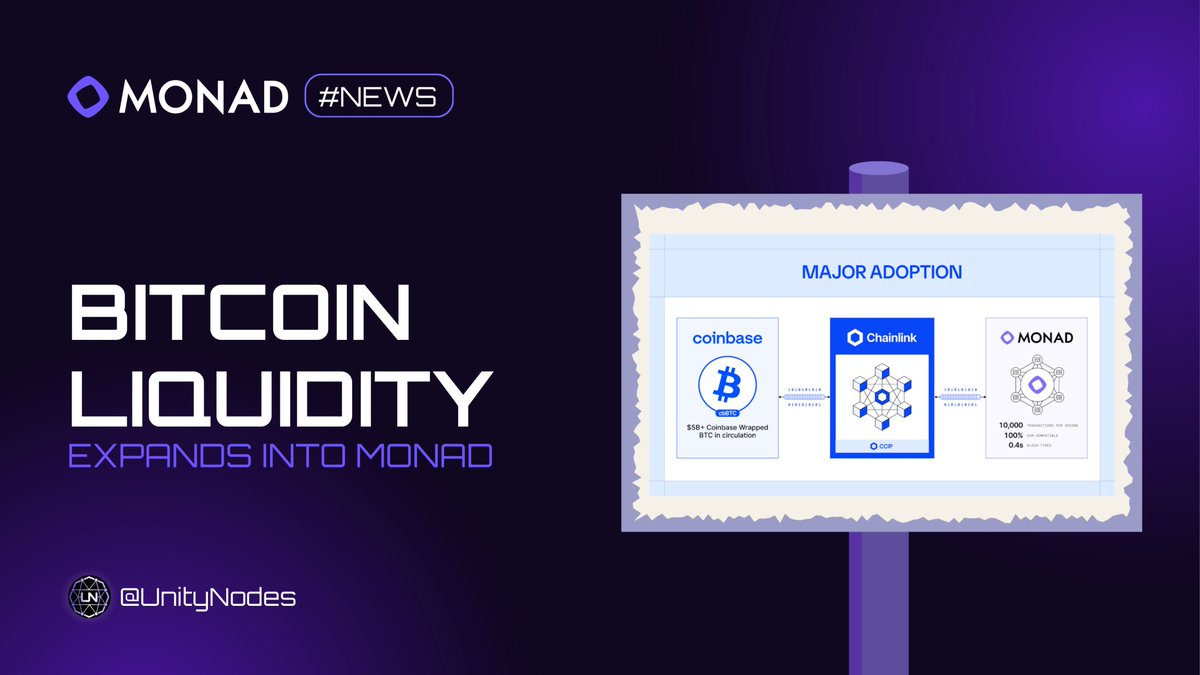
@chainlink has brought @coinbase cbBTC to the @monad DeFi ecosystem through CCIP, making transfers from Base to Monad possible.
This gives cbBTC holders a direct way to move Bitcoin-backed liquidity into Monad and expands access to a faster DeFi environment built for high-performance activity.
For the broader ecosystem, this creates more room for BTC-based markets, stronger spot liquidity, lending and borrowing activity, and additional products built around Bitcoin-backed liquidity. Curvance and Neverland are already among the projects bringing cbBTC markets to Monad.
This is a strong infrastructure expansion for Monad DeFi ecosystem and another meaningful use case for cbBTC.
If data is encrypted but the keys aren’t accessible, the data is effectively unavailable.
So Private Blockspace also has to solve a key management problem:
Who can decrypt what, and under which conditions?
One approach is an account-centric model.
Users define the encryption keys for their own account state before the data is published.
That means the state can be publicly available on @celestia, but only the user (or parties they authorize) can actually decrypt it.
From there you can add more flexibility - selective disclosure to specific parties, threshold schemes for multi-party access, or even mechanisms that let users progress protocol state themselves - for example triggering withdrawals if an operator stops cooperating.
Since we’ve already had a chance to get familiar with @GenLayer together, today we’ll talk about more serious things than introductions.
Inspired by some of the team’s work, we decided to tell you more about their approach.
We’re sure you know how L1 and L2 blockchains work, and you know they need oracles to operate - but there’s a catch.
They can’t verify a large amount of real-world information, and while that may look like a problem right now, with how fast everything is developing, it will become a big problem in the future if it isn’t solved.
GenLayer is building a Resolution Layer. In other words, any blockchain can offload non-deterministic work and get a verified result back, and be confident in it.
It’s important to understand that you don’t need to migrate to them or lock yourself into a single chain, because everything is designed so that GenLayer will act as a hub that other networks can connect to.
So how does it work in practice?
You send a request on your network ➡️ your message is forwarded ➡️ GenLayer receives it, and Intelligent Contracts process it ➡️ validators reach consensus on the result ➡️ the answer is returned to you.
As you can see, it’s simpler than it seems at first glance, and we think this technology would be perfect for Prediction Markets.
The idea is that everyone can get verified, truthful information without switching to a new blockchain with different technologies - because that’s no longer necessary.
It has already been more than a month since Warden TGE.
Even though the market has improved slightly in recent days, the overall trend remains discouraging.
That’s why the @wardenprotocol team announced a number of upcoming actions that should positively affect the $WARD economy in the future.
So let’s briefly go over each point:
🔹Unclaimed Airdrop Tokens Will Be Burned - tokens that are returned to public goods due to accelerated claiming will be permanently burned and will never re-enter circulation.
🔹Extended cliff - specifically, for core contributors the cliff was increased from 6 to 12 months. So from now on, no team member will be able to receive tokens for 12 months from the listing date.
🔹Locked Staking With Governance - from now on, for WARP stakers the team has launched a locked staking and vesting mechanism.
Users tokens will now be held in a smart contract with fixed terms that can only be unlocked by the user, while staking rewards and participation in governance will be preserved.
We can see that the team is making an effort and introducing new changes that will definitely have a positive impact on the future.
We also shouldn’t forget that the team is scaling and starting to work with other ecosystems, with @base being one example where they are launching DEX markets.
We are confident that these are far from the last positive updates from Warden, so we will be actively following the project’s future development.
The first institutional private credit vault launched by @Valos_io is now live on @monad.
The vault works with @withAUSD on Monad and is supported by a Data Verification Network for full transparency.
Here’s how it works:
Deposits are made in @withAUSD on Monad, and then that capital is deployed into credit loans for institutional market makers.
Yield is generated from the interest on those loans.
This is clearly not the end - it’s just the beginning. Institutional lending keeps scaling, and in that kind of environment, transparency and privacy are both going to be essential.
Because of that, LPs will be able to see and verify key information like:
🔹 Proof of underlying reserves
🔹 Collateral ratios, updated live
🔹 Counterparty exposure across active loans
That’s exactly the direction the market should be moving in - toward real products, real capital, and real verification.
If you were at our @GenLayer meetup, you already know what they’re about - but we’re sure a lot of you still haven’t had a chance to get familiar with them, so today’s a perfect time to fix that.
Meet GenLayer.
GenLayer is the first AI-native blockchain of its kind, built for AI-powered smart contracts (Intelligent Contracts).
Intelligent Contracts are super unique because they can reason and adapt to the real world.
In short - a contract can connect to the internet and run non-deterministic operations, meaning it can make subjective decisions.
To integrate AI with blockchain, they use a distributed neural consensus network, where validators run specialized software.
They call their core consensus idea Optimistic Democracy - basically an extended dPoS-style mechanism where validators are directly connected to an LLM.
AI is clearly where the future is headed… so could the future of blockchains be AI too?
GenLayer is building something genuinely different with unique tech - and if you dig deeper, you’ll probably be pleasantly surprised.