Correcto. Yo te recomiendo al 100% @RamsesExchange
Son developers con mucha experiencia en este mercado.
Si quieres conocer mas, puedes leer los documentos del protocolo en https://t.co/xglwTBdxje
Y si quieres ver los stats mas potentes y como se comparan con otros protocolos como Nest aqui puedes ver
https://t.co/5qtWksaCTn
Y para comprar $RAM, puedes ir a la pagina oficial de Ramses; https://t.co/Fpk9P4PPO6
gRAM
Only to those who celebrate 🎉
Ramses is projected to make $135,000+ in revenue for the epoch 🚀
Track it live on:
https://t.co/ibXJQkvLHP
That's an increase of 90% over last epoch without increasing the emissions spend.
Of course, this is a projection and it is still early.
hyperliquid:native
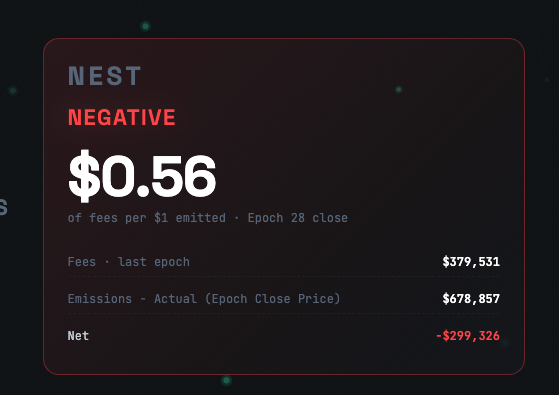
Damn based on that stats competition page, as I previously discussed on one of my tweets, the $NEST lockers are going to have a rough time if the income does not catch up to emissions fast enough.
Thats why the people that know about these systems are already selling $veNEST at a 48% discount.
hyperliquid:native
gRAM
Ramses is projected to make $70,090 for their $xRAM voters this epoch. 🔥
The protocol is only spending $31,579 in emissions to achieve this.
$RAM is the MOST efficient/healthy protocol in the history of emission-based protocols.
https://t.co/rRHJ5AytNV
hyperliquid:native
Important difference between @RamsesExchange and @NestExchange :
Both use emissions to pay LPs, but the claim path is different with a very different trust model.
On Nest, gauge-level emissions are stored on-chain, but user-level LP claims depend on an off-chain signer. Users claim through GaugeRewarder with:
claim(totalAmount, deadline, signature)
The contract checks that the signature came from signer() before releasing $NEST.
That means Nest has a trust assumption in the emissions claim layer.
But what does it mean exactly?
->signer compromised -> invalid claims can be authorized up to the funded balance
-> signer offline -> new claims cannot be signed
->signer refuses to sign -> a user can be censored at the claim layer
-> admin changes signer -> same trust surface moves to the new key
-> That also means the displayed APR "can" be different than the realized claim.
$RAM does not have that off-chain signer step.
Ramses emissions flow through on-chain voter/gauge accounting. Allocation is derived from votes and gauge state, and LP rewards do not depend on a separate signer approving each user’s claim.
That is the design difference.
Nest manages rewards off-chain.
Ramses keeps the emission path on-chain. NO trust assumption. NO operational risk.
hyperliquid:native