Clavicular had a girl sitting RIGHT next to him, but one casual confession made the whole ride awkward 😭
“I don’t even know her name.” #influencerproject
i still don't understand why people let opus 5.5 grade its OWN homework
your agent calls a frontier model to write the draft, then calls it AGAIN to ask "is this good?"
you're paying frontier rates for a yes or no
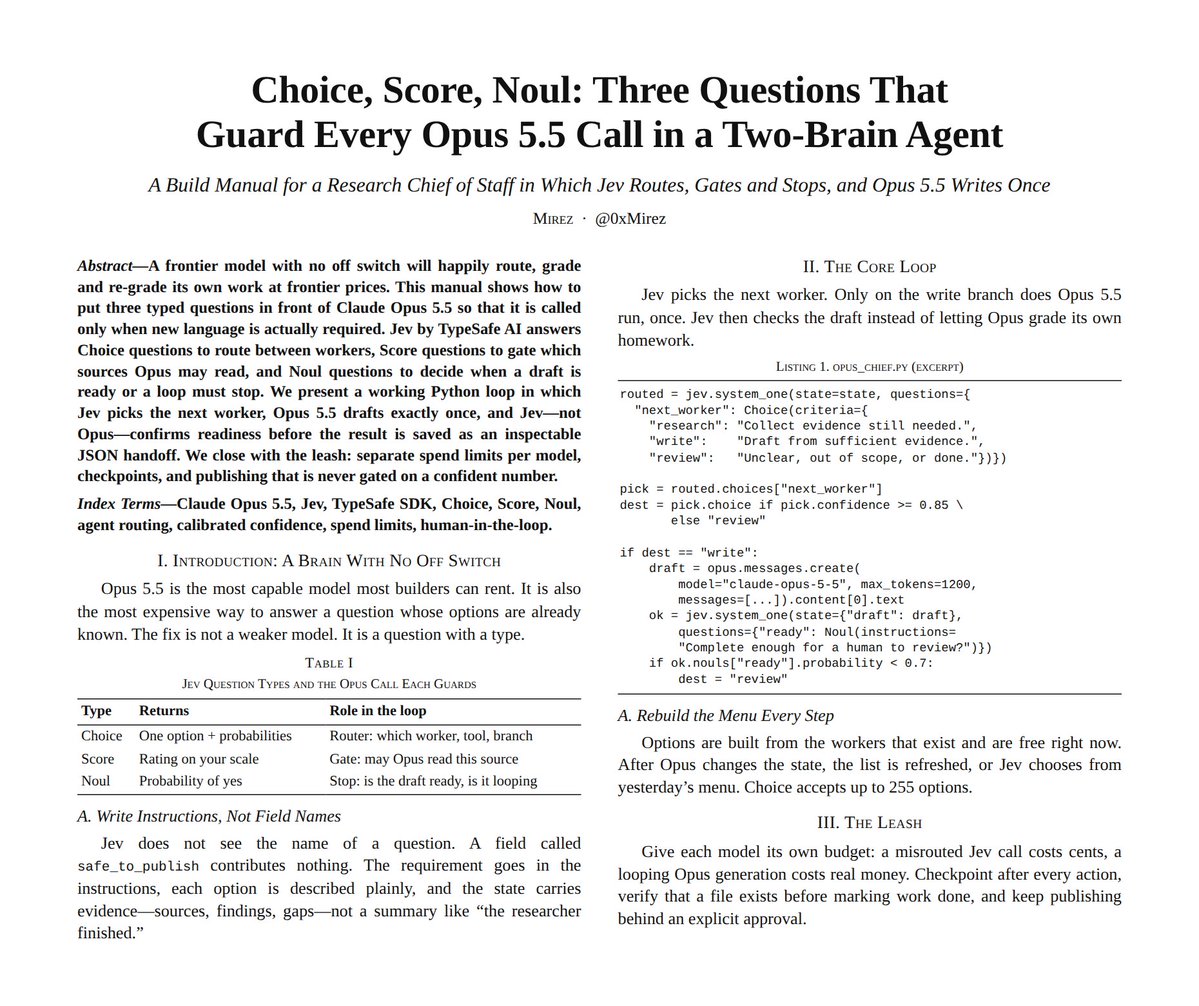
i wrote a build manual on fixing this with 3 questions from jev:
→ CHOICE: which worker goes next
→ SCORE: is this source worth opus reading
→ NOUL: is the draft actually ready
jev answers in 70 to 500ms at $0.042 per million tokens. opus writes exactly ONCE
the full loop is in python, about 80 lines. two api keys, one json handoff you can inspect
opus writes. jev checks. nothing publishes without your approval:
12 SECONDS OF AI JUST MADE A $2M VFX STUDIO LOOK UNNECESSARY.
Green-screen goat. Water tank. Production crew at the monitors. It looks like a real set from a $200M blockbuster.
Then something breaks the surface.
A creature the size of a building erupts from the water. Opens its jaw. Swallows the frame whole. The cameras shake. The water crashes into the rails.
None of it is real.
No pool. No crew. No monitors. No green screen. Not even the goat.
One prompt. One generation. 12 seconds. And it looks more convincing than half the BTS footage studios actually release.
This is why VFX artists are not sleeping well right now. Not because AI replaces the final shot. Because it replaces the entire pipeline before the shot even exists.
Pre-production. Animatics. Concept shoots. Location tests. All of it. Gone in one generation.
The scariest part is not the monster. It is how real the boring parts look. The chairs. The railings. The reflections on the monitors.
AI learned to fake the mundane. That is when you know it is over.
A FLY STOLE THE MOST PROTECTED CORE IN THE BUILDING AND HID IT IN A COFFEE CUP
The server room has one rule, and it's printed right there on screen: do not touch.
A purple fly with a gold head flies straight to the pedestal anyway.
It grabs the glowing core and the alarm goes off.
Three security drones with red eyes come out of the dark, lasers already firing.
-> the fly doesn't hide. it drags the core down the corridor and threads it through the rings like it's done this before.
Then the chase goes quiet.
The core drops into a coffee cup. The fly lands on the rim, folds its wings and sits there like nothing happened.
"just making coffee."
34 seconds. Made with Opus 5.5 + JEV.
tiny thief. big problem.
I MADE TWO AI ENGINES COLLIDE AT 9,600 POINTS AND THEY FUSED INTO ONE STRUCTURE
Opus 5.5 runs Channel A. Cyan. 4,800 particles forming a sphere.
JEV runs Channel B. Copper. Another 4,800 particles. Same shape. Different frequency.
At T=00.00s they exist as two independent fields. Parallel paths. No contact. No overlap.
Then Phase 2 hits. Exchange. The spheres start pulling toward each other. Bidirectional flow kicks in. Cross-channel transfer begins.
By Phase 3 the geometries interlock. The merged field is no longer two objects. It's one braid.
-> at Phase 4 the braid resolves into a shared lattice. 9,600 points locked into a single rotating structure that neither engine could have built alone.
Phase 5 synthesizes the waveform. The cross-channel transfer graph flatlines. Both engines are running at the same frequency now.
Phase 6 releases the lattice. The structure unwinds. Two fields separate. And the cycle begins again.
36 seconds. 2,160 frames at 60fps. Depth parallax rendering. Real-time pipeline telemetry on every frame.
Two engines that were never designed to meet. And they built something neither one could imagine.
Opus 5.5 + JEV is not collaboration. it's collision.
HOLY SH*T, MY GROK BOTS BOUGHT EVERY LOCAL BOTTOM WHILE I SLEPT
they don't chase. they don't fomo. they wait for the exact moment volume dries up and price stops falling, then step in with 0.3 to 0.5 SOL
woke up to 6 closed positions, all green:
$WIF69 +180% · +0.90 SOL
$CATVIBES +110% · +0.33 SOL
$MOONBOY +240% · +0.96 SOL
$SIGMA +90% · +0.32 SOL
$BRAINROT +150% · +0.75 SOL
$WOJAK69 +70% · +0.28 SOL
net: +3.53 SOL from ~2.4 SOL deployed. 100% win rate on the night, which is not normal and will not repeat
five agents split the job:
> scanner finds oversold setups
> timing waits for the actual reversal candle
> entry sizes the position based on liquidity
> exit takes profit when momentum breaks
> risk kills anything down 30%, no exceptions
no fomo. no revenge trading. no leverage. no override
architecture:
> keys stay on my phone
> position size hard cap 0.5 SOL
> daily loss stop at 2 SOL
> 6 setups per day, then it sleeps
HOLY SH*T I WIRED A FLY BRAIN TO A ROBOT AND IT JUST STARTED WALKING
this is flybrain robot bridge
took a drosophila connectome, connected it to a strandbeest walker with an ESP32, let the neural model drive the legs
no remote control, no scripted path, it decides where to go on its own
the brain overlay in the corner shows which regions fire in real time as it moves
it sees obstacles through optical flow and reverses before impact, same reflex a real fly has
open source, MIT license
MIT put its full multivariable calculus course online in 2007 and charged nobody a dollar for it.
Lecture 34 is the final review. A professor in an orange sweater writes Unit 1 on a chalkboard and starts working through the whole semester.
The camera never moves much. No editing, no music, no production budget visible anywhere.
MIT OpenCourseWare launched in 2001 with 50 courses. The plan was to publish materials from every course the university taught.
Faculty were told they would get no royalties and no extra pay. Most agreed anyway.
The catalog passed 2,400 courses. Downloads run past 300,000,000 and the site draws millions of visitors a year from countries with no equivalent institution.
Universities charging 60,000 dollars a year watched a peer give the lectures away and kept charging.
The thing people pay for was never the lecture.