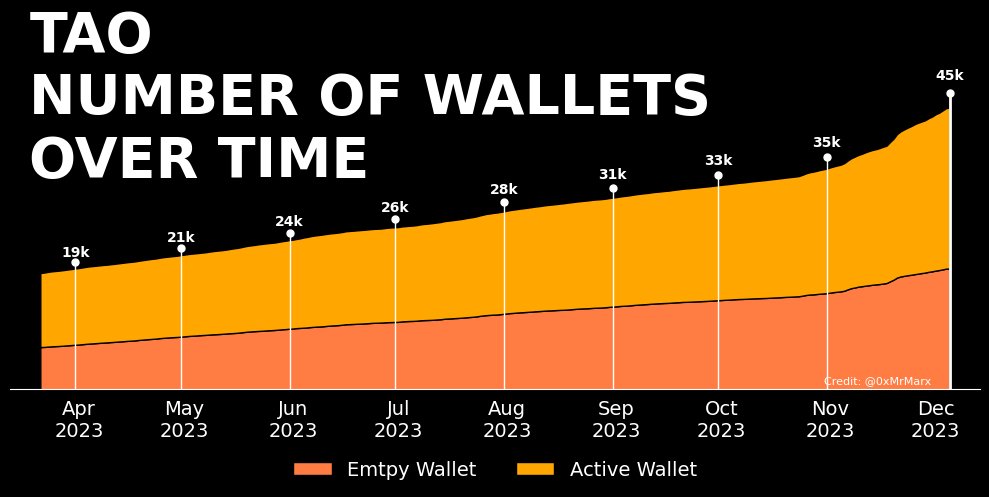
#Bittensor Wallets Analysis 📊
November saw a surge with 10K+ new wallets on #bittensor! 🚀
The account growth is on fire! 🔥
Still thinking you are late to the $TAO revolution?
#SN42 Thesis update
@YumaGroup subnet Hermes #SN82 was deregistered.
They still have one free slot for a subnet.
#SN42
Pretty sure it will be reveal soon.
@AlgodTrading 1. There is no incentives for holder to lock (Only incentives is for owner to keep it's subnet)
2. Locked Staked != ve(3,3) tokenomics, therefore you can not trade/sell your stake as they are not NFT.
3. Only for mature subnet, what is mature, it's unclear
This is Quasar Attention, the mechanism behind the upcoming Quasar models, designed to support context lengths of up to 5 million tokens.
Attention has long been a bottleneck for processing extended context. Standard attention mechanisms struggle to scale beyond ~200k tokens in training, creating a ceiling on how much information models can reliably use.
One approach to solving this has been linear attention methods, such as gated delta attention (used in Qwen 3.5) or Kimi delta attention. These improve efficiency and allow longer sequences, but introduce trade-offs: instability at extreme lengths, quality degradation, and in practice, they are not strictly linear.
Quasar Attention takes a different approach. It uses a continuous-time formulation, implemented as a fully matrix-based system rather than relying on vector-state approximations. In practice, this improves stability, reduces cost, and maintains performance as sequence length increases.
In internal stress tests at 50 million tokens, KDA-based approaches begin to lose stability, while Quasar Attention remains stable. This allows performance to hold as sequence length increases, rather than degrading beyond a fixed threshold.
On BABILong, a Quasar-based model pretrained on 20B tokens and fine-tuned on 16k sequences was evaluated on contexts ranging from 1 million to 10 million tokens, maintaining consistent performance across that range. By contrast, models using gated delta attention show significant degradation at longer lengths, in some cases dropping to ~10% performance at 10 million tokens. (Note: results are indicative; setups are not directly comparable)
On RULER benchmarks, a Quasar-10B model (built on Qwen 3.5 with frozen base weights and Quasar Attention added), pretrained on 200B tokens, achieved 87% at 1 million tokens, outperforming significantly larger baselines, including Qwen3 80B, under the same evaluation conditions.
Taken together, this points to a shift in where long-context performance is won or lost: not in model size alone, but in the attention mechanism itself.
Quasar Attention represents a step change in long-context modelling, setting a new standard for stability and performance at scale.
We thank @TargonCompute for the compute and for being our compute provider and long-term partner in training the upcoming Quasar models
Here is the link to our paper 👇
Things i am expecting this week on #bittensor
- #SN88 public vault launch
- #SN24 news and breakouts
- #SN85 news on Vidaio OS and revenue streams
Only big weeks on $TAO! 🚀
#SN88 launching public vault on @TrustedStake (EOM)
Currently:
2.5k $TAO AUM
$5.5M MCAP
Allocation will be 20% #SN88 / 80% $dTAO
Small cap + increasing demand pressure = asymmetric setup
#SN88 is the entry ticket for 300-500 compound APR strategy
"Please fasten your seatbelts
and ensure your seatback and tray tables
are in their full upright position."
From groundbreaking tools...
To a complete intelligent ecosystem...
"LADIES AND GENTLEMEN, PREPARE FOR TAKEOFF"
Introducing: VidaioOS
The next dimension in enterprise video management.
$TAO @vidaio_
Introducing the Open Gas Initiative by ETHGas — a path to a frictionless onchain experience.
@Uniswap, @pendle_fi, @aave it's your time to step up and sponsor gas for users.⚡
Get started here: https://t.co/9o3XheGRbn
https://t.co/HlBCjIRuu5
Introducing the Open Gas Initiative - a way for protocols to subsidize gas for users, zero-code, for a seamless, frictionless onchain experience.
With OG cohort: @eigencloud, @ether_fi, @pendle_fi, @Velvet_Capital.
👇
Leveled up in the Great Gas Reckoning with ETHGas! 💪
Baby Jack status: 0.0501 ETH gas spent, 12 Beans earned—supporting the Gasless Future!
Claim your Gas ID at https://t.co/yUc9Ma2wI6
So @SonicLabs farmed their own $S airdrop - then arbitrarily set a minimum claim threshold without any prior notice.
I thought transparency was supposed to be the essence of blockchain.
#Sonic
I am happy to explain this!
I had decided the minimum claim for airdrop would be 200 S. This was 100% my decision.
Just wanted to share some of my logic behind this.
Being that the initial claim was 25% liquid and the remainder 75% linearly vested over 9 months
We calculated S at current value of 40c, meaning that users would get $80 total minimum airdrop with $20 liquid initially and $60 vested over the 9 months
The logic behind this was not about the initial 25% but making it so that the 75% portion would be logical for the 9 month duration wait time being that the order book was not ready and we were not sure when it would pass final audit. We wanted to keep airdrop timeframe.
For example:
We could have went with a 10 S minimum airdrop, but that would have resulted in
2.5 S liquid, 7.5 S vested over 9 months
Meaning $1 claim and $3 linear vested the 9 months
Having $3 vested for 9 months was really low and would also be major fud.
The decision had to reflect the logic of “what $ amount value at time of airdrop was worth it for users to wait 9 months to claim that full value”
This is how I landed at 200 S minimum
There were 2 options.
Option 1:
Make those under 200 S claim ineligible.
Option 2:
Make those under 200 S claim eligible with long 9 month vesting for small amounts and unable to trade instantly because orderbook was not going to be live for those long vest small sized fNFTs for user exits.
I am working on a potential solution moving forward.
Thanks @SonicLabs for burning this airdrop while disqualifying thousands of wallets...
Not to mention that @SonicLabs was eligible for its own $S airdrop...
On Crypto Treasury TradFi Firms
I've been pretty busy at work, so haven't had much time to post, but this caught my eye.
=====
TradFi firms are announcing new altcoin crypto treasuries almost every couple of days—$TRX, $BNB, $HYPE, $TAO, $LTC, and more.
(@crypto_condom has an excellent list.)
Here are a few things to consider regarding these stocks:
1) Reflexivity
∘ Imagine two firms, A and B, that buy stock in each other: when price(A) rises, it triggers price(B) to rise, which in turn lifts price(A) again.
∘ It’s similar with these altcoin treasury stocks: when the price of the altcoins rises, it increases the value of the treasury, which then triggers more buying pressure on the altcoin as stock investors pile in.
∘ but always remember that reflexivity is a double-edge sword. When price action is not up-only, the selling pressure on such stocks will accelerate on the way down
2) Moral Hazard
∘ I am critical of $BTC and $MSTR (and copycats) for various reasons but at least that relationship is free of most moral hazard
∘ For many altcoins, the relationship between the project, foundation, or labs and the TradFi treasury partners is highly intertwined and complicated—often with the same beneficial owners (think: Tron).
∘ In a way, crypto treasury firms are simply a new variant of the insider/VC selling dynamic in native crypto—except this time, they’re selling to TradFi stock buyers instead of crypto degens.
∘ These firms act as an intermediate layer that obfuscates the nature of insider selling, dressing it up with cosmetic buying announcements that get splashed across the media.
3) Altcoin Stock Dividend is Bullshit (Mostly)
∘ Many of these firms will likely try to copy Saylor's "Bitcoin yield" concept from $MSTR.
∘ Personally, I find the idea of such a dividend pretty nonsensical.
∘ Structurally, this so-called "yield" originates from an inflated premium in the crypto treasury company's stock. That premium lets them buy more crypto from the native market, increasing the amount per share, which is then reported as "yield."
∘ Despite this, shareholders are effectively buying overpriced crypto compared to simply purchasing the underlying asset directly from the native market. And with self-custody, you actually own the coins instead of just an IOU from the treasury company.
🤔 The market is really bullish right now, especially with GENIUS and CLARITY sent to Trump’s desk, so maybe none of this matters for the moment. But the time will come when it will, and I don’t think that’s too far off.
#view #crypto #crypto_holding_companies