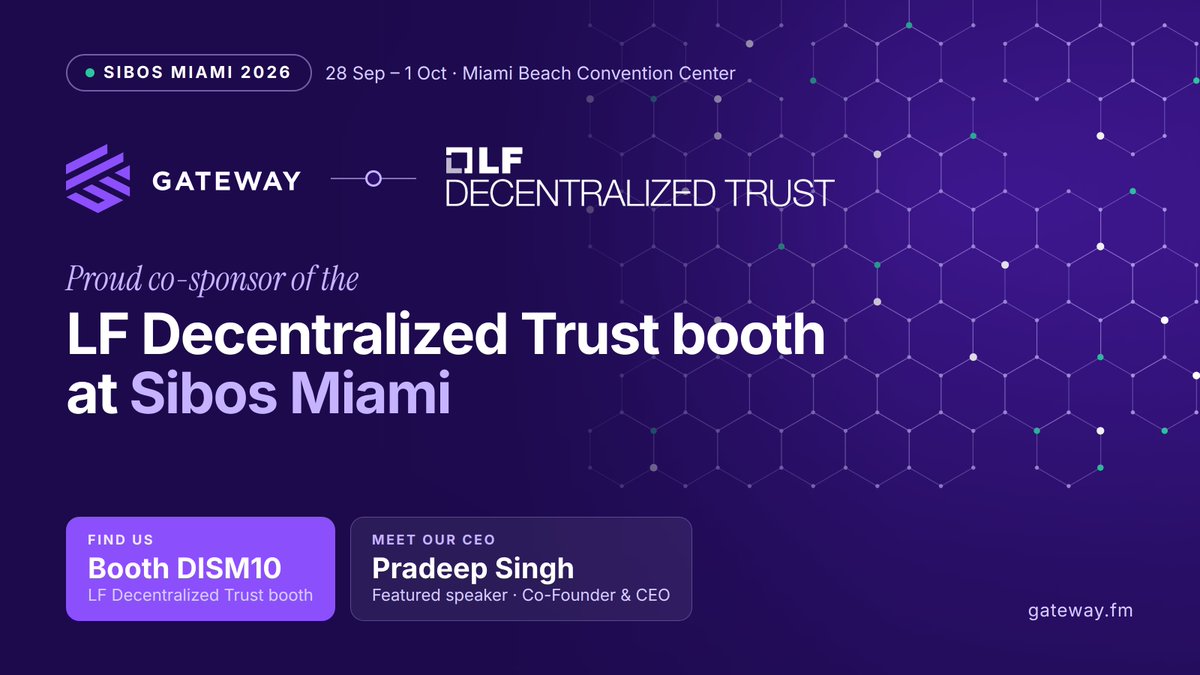
Gateway is co-sponsoring the @lfdecentralized booth at @Sibos 2026 in Miami 🤝
Sibos brings together the banks, market infrastructures and policymakers shaping how money moves. This year the conversation is squarely onchain - tokenized deposits, stablecoin settlement, sovereign networks and the controls institutions need to run them in production.
Our Co-Founder & CEO @pradeep_rvsingh is a featured speaker at the booth, presenting "From Tokenization to Sovereign Onchain Finance".
📍 Booth DISM10 · Miami Beach Convention Center
🗓 28 Sep – 1 Oct 2026
Find us at the booth throughout the week. 🙏
𝗧𝗵𝗲 𝗺𝗮𝗿𝗸𝗲𝘁 𝗶𝘀 𝗰𝗮𝘁𝗰𝗵𝗶𝗻𝗴 𝘂𝗽 𝘁𝗼 𝘄𝗵𝗮𝘁 𝗚𝗮𝘁𝗲𝘄𝗮𝘆 𝗵𝗮𝘀 𝗯𝗲𝗲𝗻 𝗯𝘂𝗶𝗹𝗱𝗶𝗻𝗴.
Regulated onchain finance is becoming one of the most important shifts in financial infrastructure. But Gateway did not arrive here because the category became popular.
𝗪𝗲 𝗮𝗿𝗿𝗶𝘃𝗲𝗱 𝗵𝗲𝗿𝗲 𝗯𝘆 𝗯𝘂𝗶𝗹𝗱𝗶𝗻𝗴 𝘁𝗵𝗿𝗼𝘂𝗴𝗵 𝗶𝘁.
For nearly six years, we have been deploying networks, operating production infrastructure, solving for privacy, interoperability and institutional control, and learning what it actually takes to move financial systems onchain.
Today, we are making that position explicit: 𝗚𝗮𝘁𝗲𝘄𝗮𝘆 𝗶𝘀 𝘁𝗵𝗲 𝗶𝗻𝘀𝘁𝗶𝘁𝘂𝘁𝗶𝗼𝗻𝗮𝗹 𝗶𝗻𝗳𝗿𝗮𝘀𝘁𝗿𝘂𝗰𝘁𝘂𝗿𝗲 𝗼𝗿𝗰𝗵𝗲𝘀𝘁𝗿𝗮𝘁𝗼𝗿 𝗳𝗼𝗿 𝘀𝗼𝘃𝗲𝗿𝗲𝗶𝗴𝗻 𝗼𝗻𝗰𝗵𝗮𝗶𝗻 𝗳𝗶𝗻𝗮𝗻𝗰𝗲.
Our latest article explains the market shift, the architecture behind it, and what we believe the next phase of institutional onchain finance will require.
Read the full thesis → https://t.co/jCRomIneBL
Lido Core 2026 Upgrade
The biggest evolution of Lido Core brings improvements across the staking modules to keep the protocol aligned with Ethereum’s roadmap and ensure long-term protocol sustainability.
No action is required from stakers - the upgrade is protocol-level.
↓
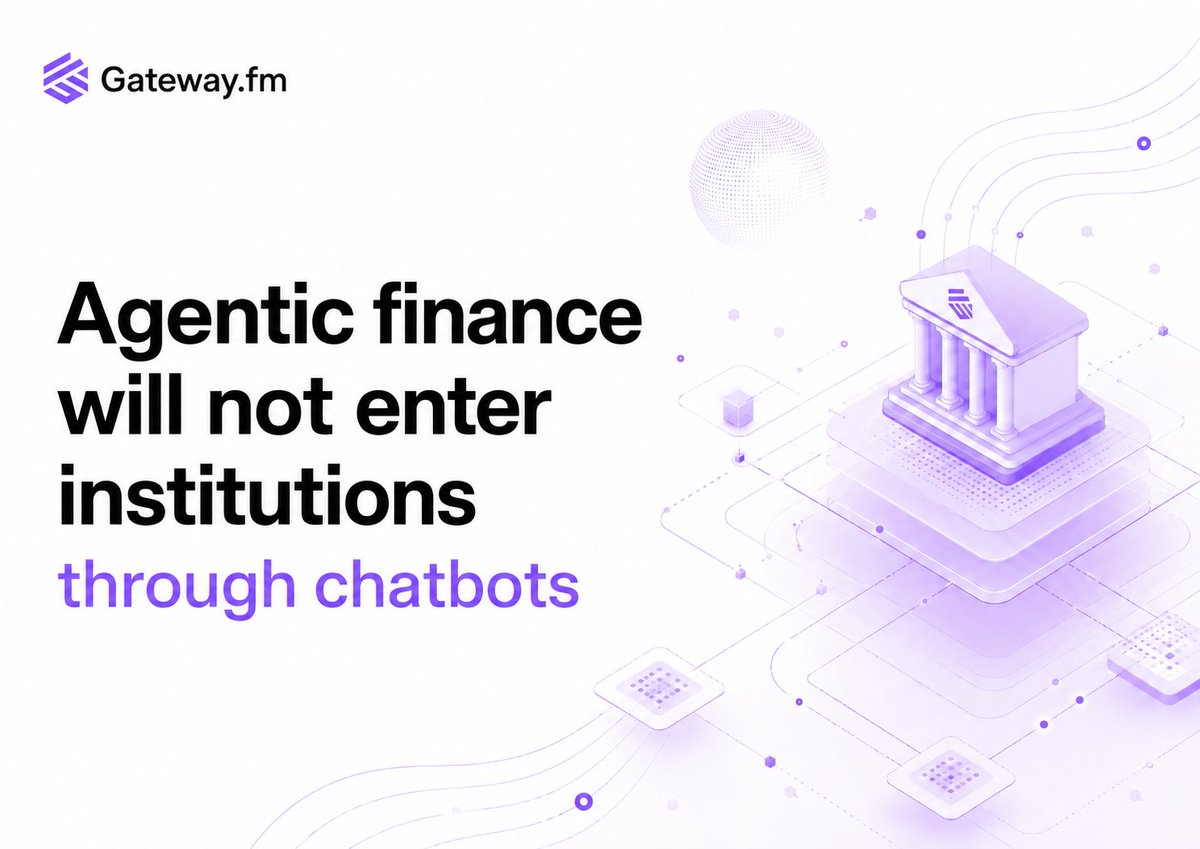
Agentic finance will not enter institutions through chatbots.
That is the retail imagination of AI.
The institutional path will be much less theatrical and much more important.
It will enter through payment operations, treasury workflows, API access, stablecoin settlement, tokenized asset servicing, reconciliation, compliance automation, and eventually machine-to-machine financial execution.
The interface may look boring.
The consequences will not be.
A bank will not care that an agent can “think.”
A payments company will not care that an agent can “recommend.”
A fintech will not care that an agent can “chat.”
They will care whether the agent can be permissioned.
Whether the mandate is explicit.
Whether spend is bounded.
Whether execution is policy-compliant.
Whether counterparties are approved.
Whether settlement is final.
Whether the whole thing is auditable.
That is the real gap between consumer AI and institutional AI.
Consumer AI optimizes for convenience.
Institutional AI has to optimize for control.
This is why the infrastructure question matters more than the interface question.
The market is already moving. Visa, Mastercard, Google, Coinbase, Stripe, AWS and others are all building around agentic commerce, machine payments, programmable settlement, and payment protocols. The direction is clear: software is becoming economically active.
But in finance, activity without governance is not progress. It is exposure.
The winning infrastructure layer will not simply let agents move money.
It will define what financial agency means in the first place.
Who can act, what they can do, how far they can go, how value settles, and how the institution proves it later.
That is where this market is going.
This is an important step for institutional Ethereum.
As financial activity moves onchain, institutions need infrastructure that preserves confidentiality, control, auditability, and compliance on public rails.
Great to see @eth_systems focused on one of the hardest problems in the market.
The next phase of onchain finance will surely be defined by the systems that make public rails usable under private, sovereign, institutional conditions.
A lot more to build here and more to say soon. 🙌
Today we're launching EthSystems.
We build confidential systems for institutional Ethereum.
Institutions want to use Ethereum, but one of the biggest problems is the lack of built-in, modular privacy tools.
We were the Ethereum Foundation's Institutional Privacy Task Force (IPTF) for the past year. We had hundreds of conversations with central banks, regulators, tier-one banks, and asset managers, shipping open source work the whole time.
Wall Street has found crypto as an asset class, but not yet as commercial infrastructure. Institutions want to run real flows on Ethereum: stablecoins, tokenized assets, settlement. These are businesses with billions of dollars on the line, and no bank will operate in full public view. On a public ledger, confidentiality is the hard part: each party to a transaction should see what it has a right to see, and nothing more.
We have a year of proof of work: private bonds, confidential stablecoin transfers, private settlement across chains, the Ethereum Privacy Map, and more. All with protocol specs and security properties, at our website.
We've spent a decade working on privacy in crypto. We know there's no silver bullet. Different use cases need different systems, each designed, specified, and hardened properly, and someone has to do that work. That's why EthSystems exists.
We're an independent, for-profit company, backed by long-term Ethereum-aligned investors. This is a decade-long transition, and we aren't going anywhere.
If you're an institution that wants to build on Ethereum, talk to us. We're hiring: BD in New York, protocol engineers, ops: [email protected]
Money is becoming autonomous faster than institutions can govern it.
I don’t think the market is overestimating AI in finance.
I think it is underestimating where the risk actually moves.
Most of the current conversation around agent payments is still framed like a UX problem: can an agent search, select, and pay on behalf of a user?
That is the consumer-commerce version of the story.
The institutional version is much more serious.
Once an agent can initiate a payment, call an API, access a wallet, trigger a treasury workflow, or interact with tokenized money, it stops being a “feature.” It becomes a financial actor inside an operating environment that was mostly designed around human intent.
And financial systems are not built only around movement.
They are built around responsibility.
Stablecoins already moved programmable money into the mainstream financial conversation. The market is now roughly hundreds of billions in size, with trillions in annual transaction volume. Tokenized assets are no longer a slide-deck category either; real assets are being represented, transferred, and financed through onchain infrastructure.
Now add agents.
The problem is no longer whether money can move.
The problem is whether money can move under mandate.
That is a very different architecture.
An institution does not only need to know that a transaction settled. It needs to know who or what initiated it, under whose authority, within which limits, against which policy, through which rail, and with what audit trail.
This is why I think the next important category is not “agent payments.”
Agent payments are a surface area.
The deeper category is autonomous money movement.
And autonomous money movement will not be accepted by institutions until control moves into the infrastructure layer itself.
Identity.
Authority.
Limits.
Settlement.
Audit.
That is the stack that turns autonomy from a risk event into a financial system.
@gateway_eth
We have successfully completed the ISO 27001:2022 security audit.
This certification formalizes how we manage information security across the entire organization: access controls, risk management, incident response, and continuous monitoring. For institutions building on our infrastructure, this translates into a predictable and auditable security posture.
With ISO 27001:2022, our security systems are built to identify risks early and adapt as the threat landscape evolves - the same standards you apply internally are now enforced across the systems you rely on.
We build infrastructure for regulated financial workflows. Security is part of our operating model.
We’re teaming up with @ziskvm.
As we scale rollups, proving latency and cost aren’t side concerns, they’re core constraints. Z
ZisK delivers low-latency, distributed proving with 128-bit quantum-resistant security, so performance can scale without proving becoming the bottleneck.
This only gets more critical with every rollup we launch.
Institutions don't struggle to decide on on-chain finance. They struggle to own it.
Vendor stacks split your economics. Long deployments kill momentum. And every new product means a new integration.
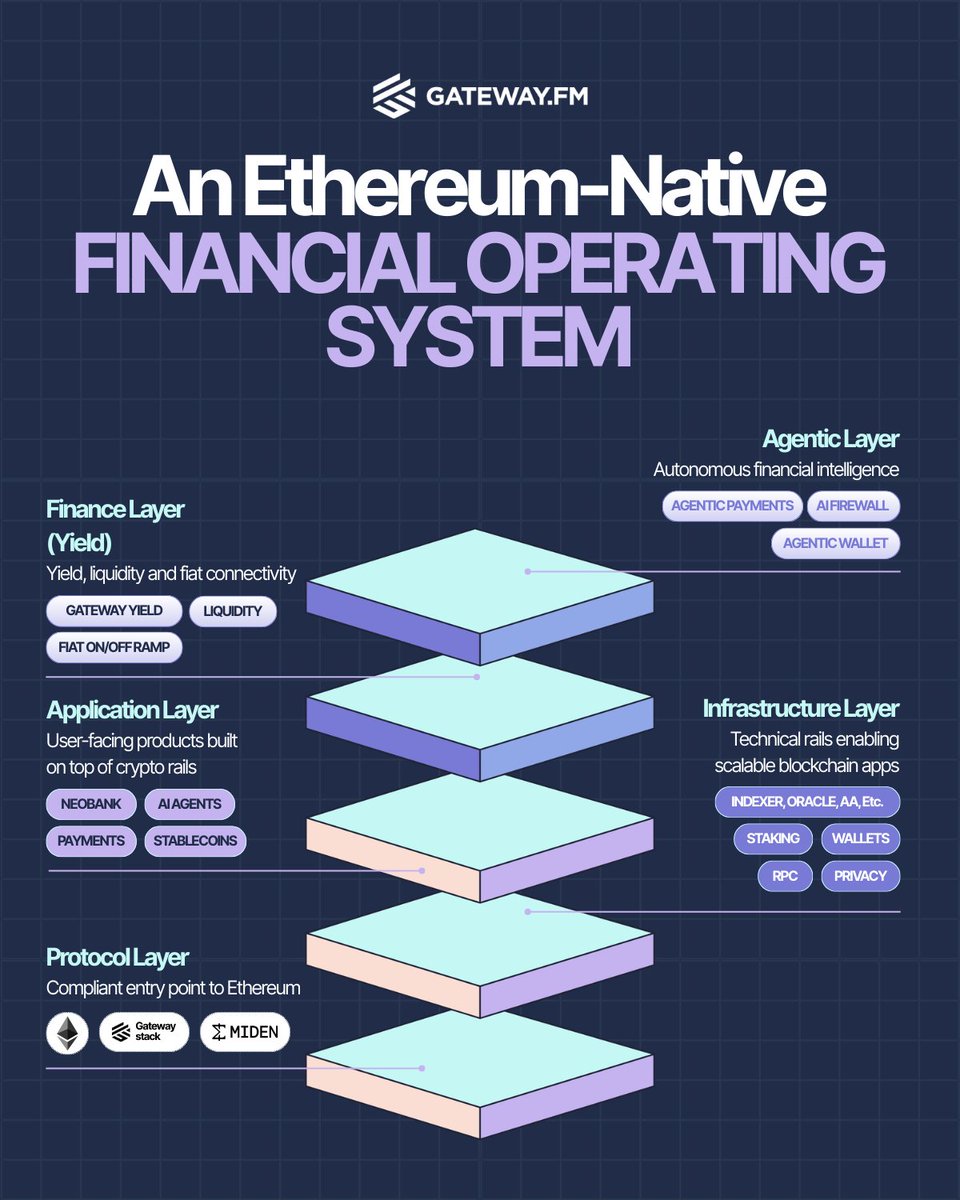
We built a single platform where institutions own their infrastructure, launch on-chain financial products in weeks, not months, and keep the yield they generate.
One platform. Five layers. Every product you need to run on-chain finance end to end.
Think of someone getting displaced right now. They have to relocate and leave their region suddenly.
They might have a million-dollar portfolio, real estate, bank balances and investments. On paper, they are wealthy, but the moment they have to move, those assets are locked. Think about it, if you put money in the bank, do you actually have custody of your account?
The core issue becomes liquidity. How do you access liquidity when everything you own is tied to a specific country's system? In some cases, countries can even lock assets. This is already happening, and it is the undercurrent that will shape what global finance looks and feels like for the next two decades.
This is exactly why self-custody is becoming an important topic. It completely changes how we hold our assets. Try doing a stress test on your portfolio today: ask yourself, which of your assets will actually serve you and remain accessible during a time of crisis?
Having spent more than a decade building traditional financial infrastructure and now contributing to the Ethereum ecosystem, this resonates deeply.
Ethereum is scaling, the roadmap is strong, and L2s moving beyond generic scaling into real value-add is the path for global financial markets to come onchain
Less than 24 hours to go ⏱
Tomorrow at 10am UTC $DN will be live on @Gate, @bitget, @MEXC_Listings and @kucoincom .
It’s time for a new era of AI.
Countdown activated.
.@DeepNodeAI is building the foundation for open intelligence.
A decentralized network where AI models, data, and compute can be contributed, validated, and governed openly, with contributors rewarded for meaningful impact.
https://t.co/9e25xNe8EV powers @DeepNodeAI across the protocol, infrastructure, and application layers, providing engineering support, architectural leadership, and long-term technical advisory.
Through our AppKits, we help accelerate development with modular, enterprise-grade components already proven at scale.
AI needs open systems, and we’re proud to support DeepNode’s vision.
AI systems need scalable compute.
Blockchain systems need verifiable execution.
This shows up clearly across both @DeepNodeAI and @gateway_eth : the architecture forces the two layers to work together.
#AI#web3#gatewayfm#deepnode
.@0xMiden is redefining blockchain: private, scalable, and compliant.
https://t.co/9e25xNe8EV is providing the core infrastructure, ensuring reliability, security, and performance that allows Miden to grow without compromise.
Together, we’re building the foundation of institutional adoption.
Proud to help teams unlock privacy-first, compliant blockchain capabilities with CDK Enterprise, without giving up scalability.
Enterprises can now upgrade their infra with zero downtime, full auditability, and future-ready connectivity to Agglayer.