Japan just delivered another rate hike, taking the policy rate from 0.5 percent to 0.75 percent, and the numbers behind the move explain the shift in tone.
Inflation has stayed above 2 percent for nearly three years, core CPI remains elevated, and wage growth is now running close to 3 percent year over year. In his remarks, the BOJ governor made it clear that policy is no longer in emergency mode and that further normalization remains on the table.
Markets are already pricing the next steps. A move toward 1.25 percent is now being discussed, which would imply two more hikes if current conditions hold.
Today’s 25 basis points is the confirmation that Japan is stepping away from ultra-loose policy, and the era of endlessly cheap yen liquidity is slowly ending.
Beyond the confirmed Dec 19 rate decision, the real question markets are wrestling with is whether the Bank of Japan is about to enter a streak of consecutive hikes.
Rates are currently at 0.5 percent. Even a hike only takes them to 0.75 percent, which still looks mild on paper. But if the BOJ is serious about moving toward a neutral rate, the market is starting to price a path toward 1.25 percent, effectively three consecutive hikes.
The last time Japan went down this road was from March 2024 to January 2025. Over roughly ten months, rates climbed from minus 0.1 percent to 0.5 percent, ending the era of negative rates.
Fast forward to now, the backdrop has not improved. Inflation has stayed above 2 percent for three straight years, and public criticism is growing that rate hikes are still lagging behind price pressures. In real terms, borrowing costs remain cheap.
What markets are digesting today is not just the next hike, but the fear of what comes after. Add to that December seasonality with North America heading into holidays and year-end breaks, liquidity thinning out fast. Volatility spikes almost by default.
This is just one input among many, when liquidity is thin and policy uncertainty rises, even small signals can move prices more than they should.
Coinbase just laid its cards on the table, and it’s a lot bigger than a single product launch.
What they announced is basically a full rebuild of the crypto financial stack under one roof.
Prediction markets.
Tokenized stocks and perpetuals.
DEX access with Solana in the mix.
BTC and ETH backed lending.
Native on-chain payments tied directly to fiat rails.
An AI-powered investment assistant.
A production-ready corporate account suite.
And yes, public token sales are already live.
Coinbase is positioning itself as the default gateway for everything crypto touches, from retail to institutions, from trading to payments to capital formation.
Quietly, they’re turning into a regulated super-app.
The smart money wallet 0xA33…AE12C, which went long ETH near the lows at $1,729, finally started trimming risk.
Back on April 23, this address aggressively bought 19,973 ETH on-chain, worth $34.54M at the time. At peak exposure, its looping long position reached nearly 50,000 ETH, and it never sold even when ETH pushed toward $4,700.
Over the past two hours, it sold 9,999.95 ETH at an average price of $2,921.35, locking in roughly $11.92M in profit while reducing leverage.
The position is far from gone. The wallet still has 40,597 WETH deposited on Aave, with about $39.05M borrowed against it.
This looks less like an exit and more like disciplined risk management after a long, high-conviction run.
Source: https://t.co/gXziCi8mm1
Beyond the confirmed Dec 19 rate decision, the real question markets are wrestling with is whether the Bank of Japan is about to enter a streak of consecutive hikes.
Rates are currently at 0.5 percent. Even a hike only takes them to 0.75 percent, which still looks mild on paper. But if the BOJ is serious about moving toward a neutral rate, the market is starting to price a path toward 1.25 percent, effectively three consecutive hikes.
The last time Japan went down this road was from March 2024 to January 2025. Over roughly ten months, rates climbed from minus 0.1 percent to 0.5 percent, ending the era of negative rates.
Fast forward to now, the backdrop has not improved. Inflation has stayed above 2 percent for three straight years, and public criticism is growing that rate hikes are still lagging behind price pressures. In real terms, borrowing costs remain cheap.
What markets are digesting today is not just the next hike, but the fear of what comes after. Add to that December seasonality with North America heading into holidays and year-end breaks, liquidity thinning out fast. Volatility spikes almost by default.
This is just one input among many, when liquidity is thin and policy uncertainty rises, even small signals can move prices more than they should.
#Strategy’s stock is still struggling, and skepticism around its structure and operating model hasn’t gone away. Media and analysts remain openly doubtful.
But while the narrative stays bearish, the balance sheet tells a different story. Over the past two weeks, Strategy quietly bought another 21,000 BTC, bringing its total holdings to 671,000 BTC, roughly 3.1 percent of total supply.
The market may be questioning the wrapper.
Strategy is still accumulating the asset.
Japan just made its move. A flat 20 percent capital gains tax on crypto next year is no longer speculation. It is being engineered in real time.
The Financial Services Agency released a new framework that upgrades crypto from a payment tool into a securities-level financial product. This is not about tightening for the sake of control. It is about making crypto fit cleanly into the existing financial system so the tax code can follow.
What this really means:
Token launches are being treated as small-scale securities offerings. Audits become mandatory and retail participation gets capped.
Crypto exchanges are being elevated to the same regulatory tier as securities brokers. Binance Japan is no longer a crypto platform in the eyes of regulators. It is effectively a brokerage.
Insider trading rules are coming on-chain. Teams, exchange staff, and large holders are all in scope as long as the asset is listed in Japan.
New Japanese exchange users may lose immediate withdrawal access. From a fraud prevention lens it makes sense. For on-chain and DeFi-native users it is friction.
Staking is officially classified as a regulated financial product. Yield is no longer a gray area.
Crypto KOLs are now on notice. Paid signals, closed groups, and trading advice could require a license. Without one, it is no longer a slap on the wrist. It is criminal liability under Japan’s Financial Instruments and Exchange Act.
Even DEXs are not exempt. The direction is clear. Decentralized does not mean outside the framework.
Japan is not trying to kill crypto. It is trying to normalize it. Lower taxes in exchange for full financial regulation. Less chaos. Less freedom. More legitimacy.
The real story today is not another ETF rumor or whale shuffle.
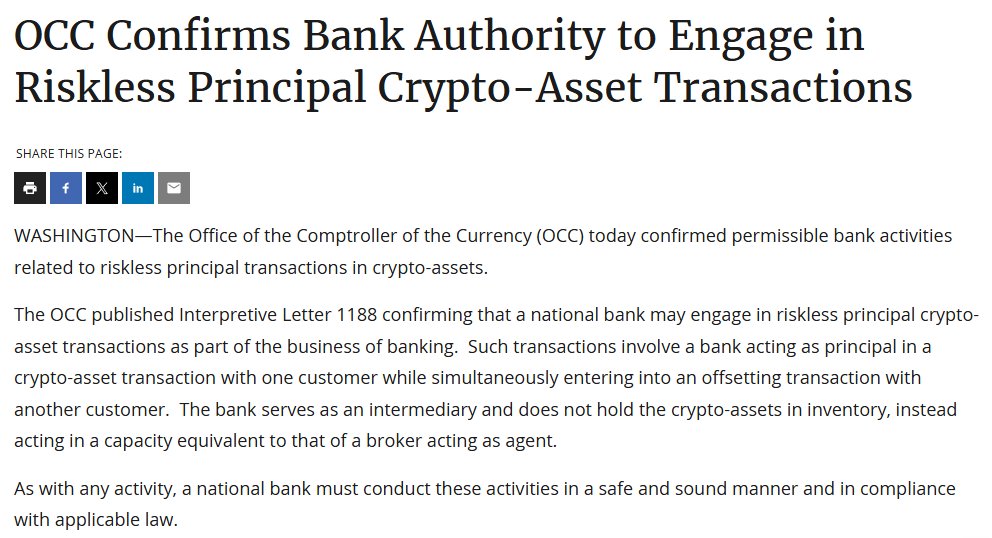
It is the fact that America’s national banks just got permission to run crypto order flow.
Not custody. Not market making. Pure execution. They can sit in the middle, match buyers and sellers, take the fee, and never touch the asset.
If you zoom out, this is the first time regulators have allowed the banking system to plug directly into crypto’s liquidity layer without taking balance sheet risk. That is a structural shift.
Think about who this applies to:
JPMorgan
Bank of America
Wells Fargo
Citibank
US Bank
PNC
These are not startups fighting for licenses. These are the institutions that already dominate payments, FX, and settlement pipes. Now they are cleared to eat part of the crypto exchange business.
Coinbase and Robinhood will not be competing with fintechs anymore. They will be competing with the banking system itself. And that tells you where the next phase of crypto market structure is heading.
Circle just joined the Abu Dhabi migration.
After #Tether and #Binance, #Circle announced today that it has secured full ADGM authorization and appointed a senior MD to run the region on the ground.
At this point the map is drawing itself. Every major issuer and exchange is planting a flag in Abu Dhabi.
Abu Dhabi is quietly building the full stack for the next cycle.
Sixteen billion dollars to expand Al Maryah Island and double the financial district. At the same time #Binance chooses ADGM as the regulatory home for its global platform.
Real capital plus hard regulation plus crypto liquidity in the same zip code. That is not another regional hub story. That is how a new center of gravity is born.
Abu Dhabi is quietly building the full stack for the next cycle.
Sixteen billion dollars to expand Al Maryah Island and double the financial district. At the same time #Binance chooses ADGM as the regulatory home for its global platform.
Real capital plus hard regulation plus crypto liquidity in the same zip code. That is not another regional hub story. That is how a new center of gravity is born.
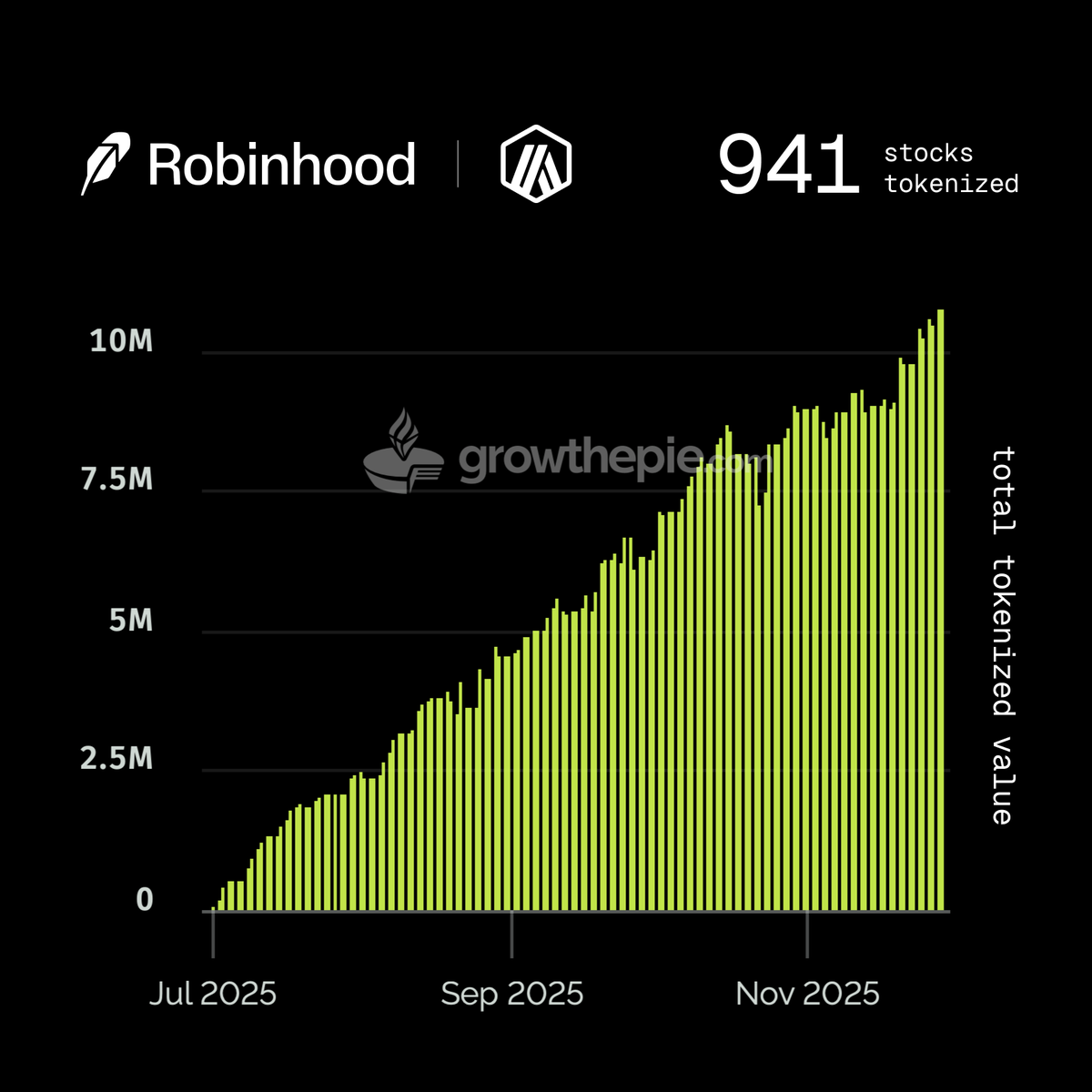
Tokenized equities are hitting escape velocity.
Since #Binance Wallet integrated Ondo’s US stock tokens last week, more than 37.3M USD worth of tokenized shares have been minted on-chain in just three days. Ondo’s response was blunt. This is real demand from large-wallet users.
And it is not just #Ondo seeing the surge.
#xStock, launched on June 30, 2025, has been riding Solana’s throughput and DeFi composability to explosive growth.
During the first week of December alone, xStock minted an incredible 91.8M USD worth of tokenized equities.
The message is clear.
Tokenized stocks are no longer an experiment. They are becoming one of the fastest-growing on-chain asset classes.
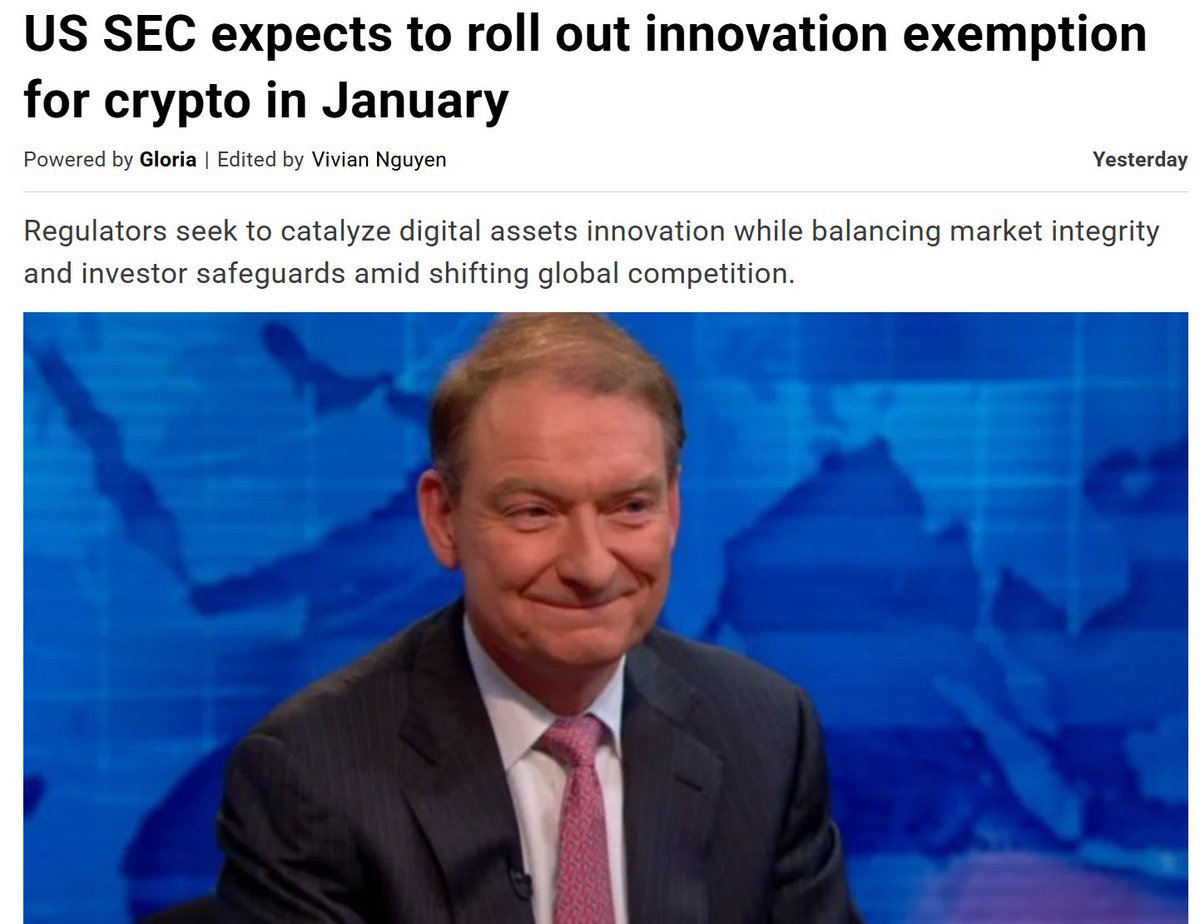
The SEC just dropped a signal that could reshape the entire US crypto landscape.
According to the chair, an Innovation Exemption policy for crypto companies is set to roll out within one to two months. If implemented, teams will be able to launch new products first without immediately worrying about enforcement risk.
The community is already speculating which sectors stand to benefit most.
The leading candidates are tokenized securities, public ICO-style raises, derivatives, and on-chain prediction markets.
If the SEC actually follows through, this could be the closest the US has ever come to a regulatory sandbox for crypto.
#SEC
Prediction markets just crossed into mainstream media territory.
#CNN announced it will integrate live data from @Kalshi, currently the second-largest prediction market in crypto, directly into its on-air news ticker.
Viewers will start seeing market-priced probabilities under news segments across politics, economics, culture, even weather. And CNN signed an exclusive deal, meaning Kalshi will be the only prediction market feeding data into the network.
This is a huge shift.
Prediction markets are no longer a crypto niche.
They’re becoming an information layer for how traditional media reports reality.
BMNR, leading by Tom Lee, is still pressing the buy button and their pace has actually accelerated over the past two weeks.
They had added more than $265 million in Ethereum to its treasury last week, now hold roughly 3 percent of the entire ETH supply, already surpassing the Ethereum Foundation’s treasury.
The march toward their stated 5 percent target is getting uncomfortably close for the rest of the market.
I am asking all America First Patriots in Tennessee’s 7th Congressional District to please GET OUT AND VOTE TOMORROW for a phenomenal Candidate, Matt Van Epps, on Election Day, Tuesday, December 2nd! You can win this Election for MAGA Warrior Matt Van Epps, who has my Complete and Total Endorsement. HE WILL BE A GREAT CONGRESSMAN and, unlike his Opponent, he cherishes Christianity and Country Music — She has openly stated that she hates them both!
TN-07: Polls open in all Counties no later than 9:00 A.M., but some open as early as 7:00 A.M. Polls close at 7:00 P.M. IF YOU ARE IN LINE BY 7 P.M., STAY IN LINE, AND THEY MUST LET YOU VOTE! Election Day is TOMORROW, December 2nd. GET OUT AND VOTE, VOTE, VOTE FOR MATT VAN EPPS — HE WILL NEVER LET YOU DOWN!
Find your voting location and hours at:
https://t.co/saCiO9NLKx
🚗 My Favorite Spatial Experience: A Window That Thinks
Five years later, this project still feels ahead of 2025.
Toyota’s “Window to the World.”
A car window that understands what you are looking at.
It turned passive car rides into interactive, educational journeys using augmented reality (AR). This was innovation at its best, developed with the Copenhagen Institute of Interaction Design (CIID).
Imagine the backseat window as a smart display:
🔍 Learn on the Go: Point at a landmark, and the system instantly identifies it, calculates its distance, and provides information.
🌐 Real-Time Translation: Foreign road signs? AR translates the text instantly right onto the glass.
🖼️ Digital Capture: "Capture" a view and save historical facts about elements in the scene.
The goal was to make the world outside a living textbook and solve that classic problem: backseat boredom.
🤫 The Design Secret: The team prioritized direct manipulation—users had to physically touch the glass to interact. They avoided controllers because they wanted the tech to feel like a natural, physical extension of the real world, reducing motion sickness and keeping the focus outward.
A perfect example of AR that enhances, not replaces, reality.
What five-year-old tech still inspires you?
#innovation #technology #augmentedreality #AR #UX #education #DesignThinking
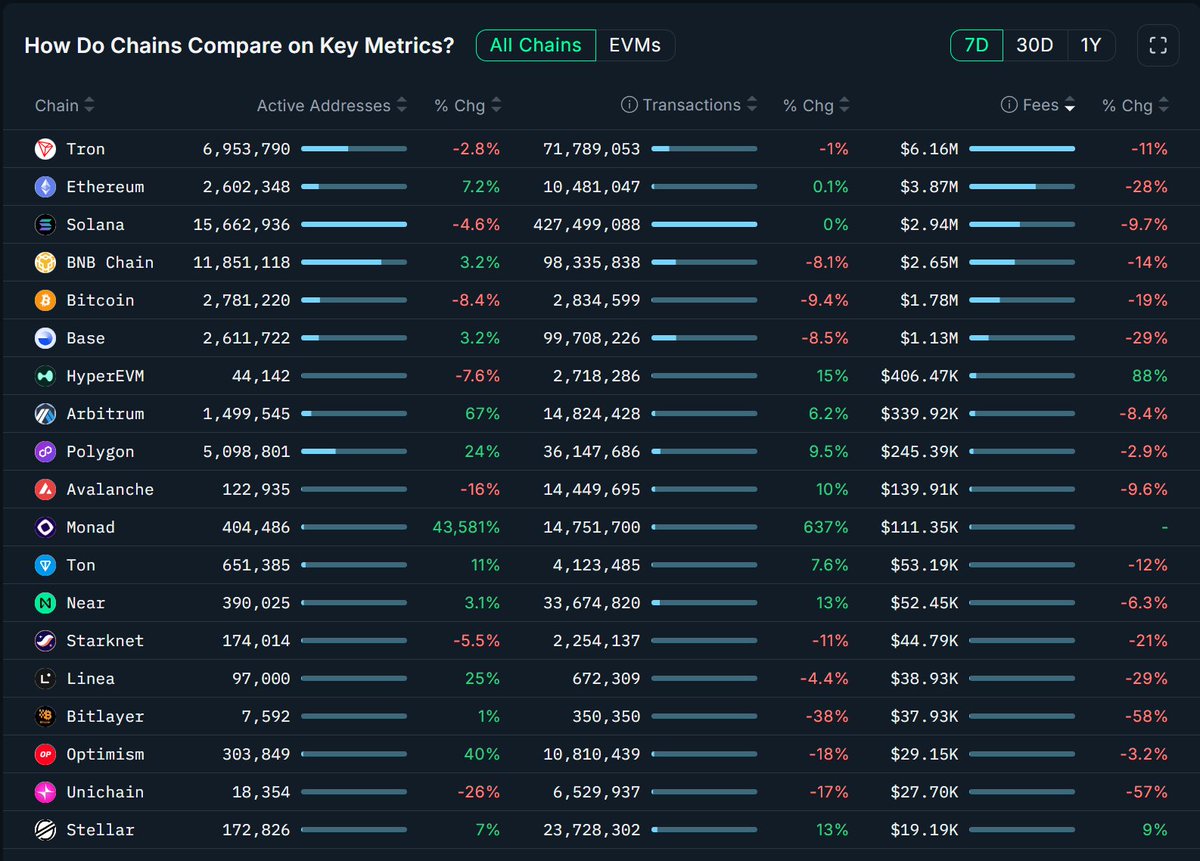
On-chain noise comes and goes, but this new dataset from Nansen is the part that really stings.
Over the past seven days, only 11 blockchains generated more than 100K USD in protocol revenue.
And the top six chains completely dominated the field:
#Tron, #Ethereum, #Solana, #BNB, #Bitcoin, #Base
These six alone captured more than 95 percent of all user-paid fees across the entire ecosystem.
Which leaves nearly every other chain in a harsh reality.
Low activity, near-zero revenue, and functionally ghost-chain status.
In bull markets people argue narratives.
In on-chain revenue, you see the actual winners.