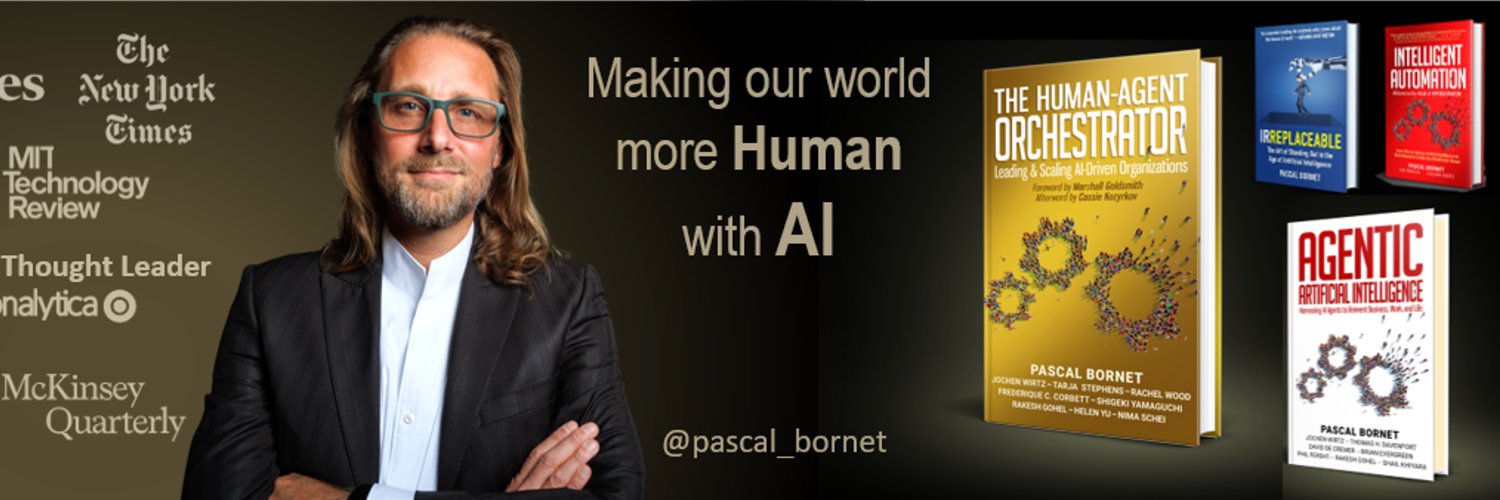
Nine co-authors. Over a hundred contributors. One book.
The Human-Agent Orchestrator is out today.
We are the last generation to manage only humans. We wrote the playbook for what comes next, and for right now.
I will be honest: this book exists because we got it wrong first. Across hundreds of deployments, we watched organizations — and ourselves — fail at something that looked simple on paper. Not because the technology broke. Because nobody had built the management layer around it. That gap kept us up at night. This book is our answer to it.
Four years of research across 432 organizations, and more failed deployments than we would like to admit. That is what this book is built from.
Marshall Goldsmith wrote the foreword. Andrew Ng called it out. And somewhere in the middle of all of it, a team of nine co-authors and over a hundred contributors built something I believe will genuinely help leaders navigate what is coming.
I could not have done this without them. Today is theirs as much as mine.
If this resonates, share it. The more leaders see it, the more it matters.
Here is the link to the book: https://t.co/c2hWCWsjGB
Please read it and let me know your views. I look forward to the discussion!
#AgenticAI #AILeadership #TheOrchestrator #HumanAgentOrchestrator #FutureOfWork #AIManagement #HybridTeams #ArtificialIntelligence
𝗪𝗶𝗸𝗶𝗽𝗲𝗱𝗶𝗮 𝗵𝗮𝗱 𝗰𝗶𝘁𝗮𝘁𝗶𝗼𝗻𝘀 𝗮𝗻𝗱 𝘀𝘁𝗶𝗹𝗹 𝗴𝗼𝘁 𝗱𝗲𝘁𝗲𝗻𝘁𝗶𝗼𝗻.
ChatGPT arrived saying “Absolutely!” with no sources, and somehow got invited straight into the strategy meeting. 😅
I have to admit, this made me laugh because the contradiction is painfully accurate.
For years, students heard the same warning: “Wikipedia is not a valid source.” And to be fair, questioning it made sense. Anyone could edit an article, so we were taught to check the original references instead of trusting the page blindly.
Then AI entered the workplace, and our standards became strangely flexible.
Someone presents a surprising statistic in a meeting. A colleague asks where it came from. The answer is, “ChatGPT gave it to me.”
A few people nod. Someone adds it to the presentation. By Friday, it has become part of the company strategy. 😂
This is not an argument against AI. I use it, study it, and spend much of my work exploring how it can help us think and perform better.
But AI’s greatest strength can also become its most convincing trick: it makes uncertain information sound wonderfully finished.
That is why Critical Thinking is one of the deeply human capabilities I emphasize in IRREPLACEABLE. As AI becomes faster and more persuasive, we need to become better at slowing down, asking questions, and checking what sits behind the answer.
AI can draft the analysis, summarize the research, and help us explore possibilities. But it should not receive the final vote simply because it speaks confidently and uses excellent grammar.
Use AI to accelerate your thinking, not to outsource it.
Otherwise, we may have spent years warning students about Wikipedia, only to promote its more confident cousin to senior management.
Have workplaces become too comfortable treating AI output as evidence rather than the beginning of an investigation?
#ArtificialIntelligence #CriticalThinking #FutureOfWork #Leadership
𝗔𝗜 𝗺𝗮𝘆 𝗺𝗮𝗸𝗲 𝗲𝗮𝗰𝗵 𝗼𝗳 𝘂𝘀 𝗺𝗼𝗿𝗲 𝗰𝗿𝗲𝗮𝘁𝗶𝘃𝗲, 𝘄𝗵𝗶𝗹𝗲 𝗺𝗮𝗸𝗶𝗻𝗴 𝗮𝗹𝗹 𝗼𝗳 𝘂𝘀 𝗺𝗼𝗿𝗲 𝗮𝗹𝗶𝗸𝗲.
That possibility has stayed with me.
When people are asked to choose a number between 1 and 10, many select 7. Interestingly, certain AI models show an even stronger preference for it under specific conditions.
The chart is illustrative, of course. The result changes depending on the model, prompt, and settings. But the larger question matters far more than the number itself:
What happens when millions of us turn to similar AI systems for ideas, strategies, and decisions?
A study published in Science Advances offers a clue. People who received ideas from generative AI wrote stories that were judged to be more creative, particularly those who initially scored lower on creativity.
That sounds like a clear win. And at the individual level, it was.
But there was a catch. The AI-assisted stories also became more similar to one another.
In other words, AI helped individuals perform better while quietly reducing diversity across the group.
This connects directly to something I explore in IRREPLACEABLE. As AI becomes more capable, two deeply human abilities become even more valuable: Genuine Creativity and Critical Thinking.
We need creativity to move beyond the most probable answer. We need critical thinking to question an answer that sounds convincing, especially when everyone else is receiving something similar.
That means responsible AI adoption is not simply about giving everyone access. Leaders also need to protect the conditions that produce original thought: independent reflection, constructive disagreement, different lived experiences, and the courage to challenge consensus.
One practical habit can help. Before asking AI, form your own view. Then use AI to challenge it, not replace it.
AI can make intelligence more accessible. But leadership must ensure it does not make our thinking more uniform.
Which concerns you more: falling behind on AI adoption, or allowing AI to quietly standardize how we think?
#ArtificialIntelligence #Leadership #CriticalThinking #Creativity
Your finance team is the API.
#ad#hyphenatepartner
We automated billing, cash and accounting. Then left humans connecting the pieces.
Hyphenate’s $45M Series A is a bet on agents that finish the work, not just assist.
https://t.co/cryAdKDiqK
@ramkris@HyphenateAI Your finance team is the API.
#ad#hyphenatepartner
We automated billing, cash and accounting. Then left humans connecting the pieces.
Hyphenate’s $45M Series A is a bet on agents that finish the work, not just assist.
https://t.co/cryAdKDiqK
Most companies don't need Level 5 tomorrow. The goal is the right level for the risk, with humans where judgment matters.
Where are your AI tools today, really? Reply with the level.
Most "AI agents" I get demoed are a chatbot with a to-do list.
Here's the 5-level scale I use to tell the difference, plus the one question to ask a vendor at each level.
Save this before your next vendor demo.
Red flags of agent-washing:
- Called an agent, can't take a single action
- No clear answer on what it can access
- Demo only works on the happy path
- No log of what it did or why
"Fully autonomous," with no path to a human
A humanoid robot that doesn't need legs.
LimX Dynamics mounted the upper body of its TRON 2 humanoid on the end of a giant industrial arm.
The arm gives the reach and the stability. The two hands do the tool work: firing a nail gun, building formwork, running two drills at once, right next to a human worker.
Why it matters: construction is one of the most dangerous jobs there is, and a lot of that danger is heavy, overhead work at height. That's exactly the part this setup takes on.
My view: the robots that change work first won't be the ones that look most human. They'll be the ones that put useful hands where the risk is, and leave the judgment to the person standing beside them.
Which job would you hand to a pair of robot hands first?
A humanoid riding on the end of an industrial robot arm. 🏗️
LimX Dynamics mounted TRON 2's upper body on a giant arm. The arm brings reach, TRON 2 does the hand work.
Firing a nail gun, building formwork, running two drills at once.
Credit: LimX Dynamics (@LimX_Dynamics)
𝗦𝗽𝗮𝗰𝗲𝗫 𝗳𝗮𝗶𝗹𝗲𝗱 𝘁𝗵𝗿𝗲𝗲 𝘁𝗶𝗺𝗲𝘀. 𝗧𝗵𝗲 𝗳𝗼𝘂𝗿𝘁𝗵 𝗮𝘁𝘁𝗲𝗺𝗽𝘁 𝗰𝗵𝗮𝗻𝗴𝗲𝗱 𝘀𝗽𝗮𝗰𝗲 𝗵𝗶𝘀𝘁𝗼𝗿𝘆.
In 2008, SpaceX’s first three Falcon 1 launches failed. After the third, Elon Musk was asked whether it was time to stop.
His answer was simple: “I don’t ever give up.”
Eight weeks later, Falcon 1 reached orbit and became the first privately developed liquid-fueled rocket to do so.
The obvious lesson is persistence, but I think that is only half the story.
Repeating the same attempt without learning is not resilience. It is expensive stubbornness.
Real progress follows a different loop:
→ Face the failure honestly
→ Find the signal inside it
→ Change what did not work
→ Try again before fear becomes permanent
This matters far beyond rockets.
I see organizations abandon AI initiatives after one disappointing pilot, while others continue pouring resources into the same flawed process. Neither response produces transformation.
The strongest leaders know when to persist, but they also know that every new attempt must be smarter than the last.
Success is rarely one more identical attempt. It is one more informed attempt.
When a project fails, how do you decide whether to stop, redesign, or launch again?
#Leadership #Innovation #Resilience #Transformation
𝗜 𝘁𝗵𝗶𝗻𝗸 𝘄𝗲 𝗻𝗲𝗲𝗱 𝗮 𝗻𝗲𝘄 𝗰𝗮𝘁𝗲𝗴𝗼𝗿𝘆 𝗼𝗳 𝗵𝗼𝗿𝗿𝗼𝗿 𝗺𝗼𝘃𝗶𝗲𝘀: 𝗔𝗜-𝗴𝗲𝗻𝗲𝗿𝗮𝘁𝗲𝗱 𝗰𝗼𝗱𝗲. 😂
The monster doesn't chase you. It confidently announces that everything is fixed, and then you discover that your login page has disappeared, the database is crying, and somehow the shopping cart now sends emails to your grandmother.
The scariest part? When you ask what happened, the AI apologizes politely and offers to fix everything with another 200 lines of code.
I think developers deserve hazard pay just for reading the words "I've made a few improvements." 😂
Developers, what's the most terrifying thing an AI coding assistant has ever done to your project?
#AIHumor #AIAgents #FutureOfWork
Seven companies got rich from AI.
493 got a subscription.
Apollo's data: margins up for the Mag 7, flat for the rest of the S&P 500.
In 20 years at McKinsey and EY, I saw why.
They automated tasks and kept the org chart.
AI doesn't pay, but its redesign does!!
@AravSrinivas Love that the infra is the boring part now. Durable Objects for rooms is a clean pick.
Seeing the same with Lovable and Replit: non-engineers shipping real multiplayer stuff.
The question is less "can I" and more "should I".
@bindureddy Cheap is great until the "easy" task turns out to be a hard one in disguise.
The savings only hold if you've got evals catching where the small model quietly gets it wrong. Most teams don't yet.