We’re going LIVE with @stabbleorg to explore how Solana-native stablecoins and liquidity infrastructure are evolving.
🎙 Topics:
- How $USV is building the foundation for stable liquidity on Solana
- The inner workings of stabble’s liquidity engine
- The role of LSTs, AMMs, and modular design in Solana DeFi
🗓 Date: May 20
⏰ Time: 4PM UTC
📍 Join here: https://t.co/rZecfsbwhJ
💬 Got a question? Drop it in the comments — top questions will win a share of $100 in $STB, courtesy of @stabbleorg.
Today is the first day of CVGT’s official launch, and I couldn’t be more excited. $BTC surged through 100k again with massive inflow from ETFs, and soon we shall see the launch of a $SOL ETF driving liquidity into @Solana.
I’m humbled by the overwhelming support from the community. We’ve hit $3M in trading volume with over 1400 holders in just a few hours since the announcement. It validates our mission to push the decentralized stablecoin narrative forward on Solana. I’m thankful for the trust our community has in our vision.
Over the past two weeks, I’ve been completely heads-down—building, planning, and engaging with the community. Did a quick trip to Dubai for Token2049 last week and it was super constructive. Had multiple fruitful meetings with a number of incredible teams and potential partners who are keen in liquidity provision. There will be announcements coming soon, both for $CVGT and the whole @convergent_so ecosystem.
Now, I saw a few comments on X about the delay in the token CA announcement. So let me share some context. The original plan was to launch $CVGT alongside the Convergent platform. But during deployment, we ran into unexpected technical issues. We chose to delay the launch to prioritize security.
The token launch is only step one. The full roadmap is coming soon, and it’s packed with what we believe will be meaningful unlocks for our users.
I’m incredibly optimistic about where $CVGT is headed. Our mission has always been to disrupt the stablecoin landscape on Solana—and with USV’s 0% interest minting backed by JitoSOL, we’re laying the groundwork for sustainable yield at scale. I truly believe Solana DeFi is the next big thing. The UX, speed, and cost-efficiency of the chain are unmatched, and it’s finally reaching the maturity where scalable, real-world applications can thrive. That’s exactly why we chose to build on Solana from day one.
I envision $CVGT becoming the go-to stablecoin platform token for DeFi users, powering decentralized money movement across the ecosystem. We’re already in talks with several partners to integrate the upcoming $USV into their platforms—more on that soon.
Also, a quick note to @humafinance: I was tuning into a Twitter Space yesterday and heard about the Foundation’s focus on supporting PayFi and working closely with ecosystem-native projects. I believe Convergent is uniquely aligned with that mission. We’re about to launch what could be the first major 100% decentralized stablecoin on Solana, fully backed by LSTs, and we’d love to connect and explore ways to collaborate.
A bit of personal context, too—this isn’t just a weekend project. We’ve been building Convergent for over a year, starting from our NFT launch last year. It was originally a side hustle I was juggling after hours, until six months ago when I left my full-time job and stepped in to lead full-time as CEO. Since then, the focus has been relentless: building, shipping, and refining.
Today, I’ve been focused on our next steps:
• Launching a $CVGT staking program ASAP to reward early supporters
• Expanding $USV’s utility with new DeFi integrations
• Bootstrapping protocol TVL prior to launch
• Growing our community to 50K+ members by month’s end
We built this project with long-term conviction. $CVGT is more than a token—it’s a foundational piece of a permissionless, decentralized stablecoin platform. We’re building in public, iterating fast, and always staying grounded in our mission.
Whether the market goes up or down—we keep building. Thanks for being here early. Let’s make something big together.
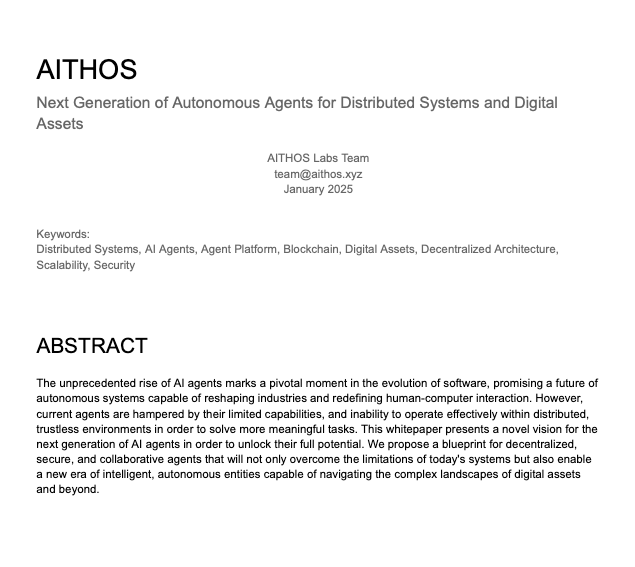
Sharing our original paper on AI agents in crypto. Check it out to understand the potential of agents, what problems they can solve and how they work. DMs open for questions and feedback. Demos coming soon!
Read the full whitepaper: https://t.co/koLRRfLozw
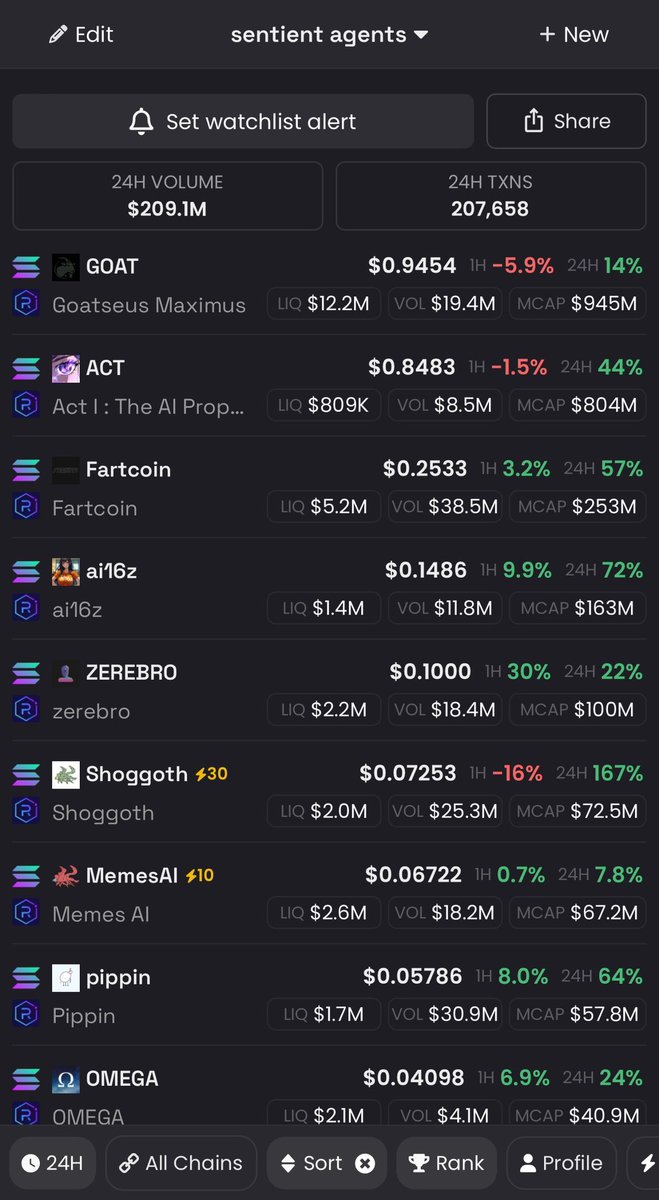
If you're going to watch ONE video during this Memecoin Supercycle... Watch this.
2025 will be the Year where Memecoins go Parabolic.
Watch this Video to Understand Why.
We are excited, with @bcap, @Web3com_VC and other angels, to support Mamori’s endeavour to identify zero-day exploits by ML-enabled fuzzing. On the way to mass adoption, there must be many crypto projects involved, and we are confident that Mamori will be one of them!
We’ve led the $5M Seed round of @mamori_xyz
Mamori is an ML-enabled optimizer for smart contract value extraction that can be applied to zero-day economic exploits, MEV searching, and intent solving.
More on our thesis. ↓
Should Games Be Built Fully On-Chain? ⬇️
In the article, our analyst @0xAesop provides a primer on blockchain games and explores the promises and impediments of building games fully on-chain.
Access the full article now: https://t.co/Dl2wAOZKl3
What are FOCGs?
Compared to Web 2.5 games, which involve tokenizing in-game assets or launching on-chain game currencies, FOCGs implements the entire game logic, state, and data storage on-chain. These client-agnostic games use blockchain as a decentralized game server, where players participate and contribute to a shared game state trustlessly.
Due to blockchain bottlenecks such as lack of native game ticks, high gas costs and low throughput, early FOCGs were blockchain-based games with asynchronous gameplay elements, i.e. turn-based TCGs. For other game genres, such as high tick RTS games that operate synchronously, scaling solutions become necessary.
The effective implementation of ZKPs (i.e. @darkforest_eth using zk-SNARKs) is also essential for incomplete information games to be built fully on chain while guaranteeing fairness.
Composable Modding
Mods in traditional games largely exist in isolation and fragmentation, lacking universal frameworks for meaningful interactions. To achieve composability, a potential approach is to allow third-party developers to directly interact with the game logic through smart contracts, allowing them to:
+ Create new mods (with mod-specific token economy)
+ Extend existing games and mods (such as adding new items, characters and quests)
This incentivises modders to consider all relevant mods when designing new features as these inputs could directly impact gameplay across the board, as opposed to merely aesthetic variations.
Smart contracts as social contracts
In traditional games, players relied on informal and unenforceable agreements for interactions that went beyond the predefined in-game mechanics. This approach has limitations, particularly in high-stakes games where the impact of broken agreements can be substantial.
Treaties explored by @0xcurio, are in-game smart contract agreements that can be formalized between players and can be trusted to execute when predetermined conditions are met. The customizability and modularity of these in-game smart contracts could extend social dynamics beyond the boundaries of games and allow for direct interaction with other on-chain ecosystems, such as DeFi protocols.
Impediments to FOCGs:
+ High gas costs and low TPS - bottlenecks of most mainnet chains make it challenging to support synchronous games and concurrent game sessions/instances.
+ Vulnerability of on-chain randomness - validators can see the result of randomness before its confirmed on-chain, creating room for manipulation.
+ Cost of permissionless composability:
+ Necessitate consistent game physics across all mods which restricts flexibility for modders
+ Game balance considerations limit new inputs to low impact features, i.e. aesthetic variations that don't impact gameplay.
+ Updating new inputs across the entire tech stack, including front-ends and relevant contracts, would entail complex coordination.
+ Different genres require different tick rates, which makes it impossible to build new genres of mods that rely on a higher tick rate than what the infra can offer.
What @0xAesop thinks of FOCGs:
In an ideal scenario where the value propositions of FOCGs proves highly valuable for players and modders, traditional games could incorporate these elements into their off-chain or hybrid systems, benefitting from them without being restricted by design space limitations.
However, I am hopeful that FOCG could out compete these hybrid games in specific niches. I believe the strongest case for FOCG are high stake games, driven by a player base that demands not only in-game assets and credentials but also the entire game logic to be on-chain.
Take Marvel Heroes shutting down as an example in Nov 2017. The studio, Gazillion received a wave of demands for refunds. However, with clever legal technicalities, consumers found themselves without a straightforward entitlement to compensation nor access to purchased in-game assets.
Merely having assets on-chain does not completely solve this problem in the event of a game studio rug pull, as the game state and progress would still be lost, rendering those assets useless in terms of gameplay utility.
In-game mechanics and outcomes being provably fair is also significant.Imagine a group of players engaged in a battle against a common enemy, where a high-value item drop is at stake for the highest damage dealer. Or a 4x RTS game where spawn location and proximity to scarce resources are randomized. In these scenarios, FOCG can guarantee the outcome of the battle or randomness to be tamper-free.
This trustless environment would not only benefit the players but also extend to speculators and protocols that place bets via smart contracts on game outcomes. Ensuring unmanipulated game result and permanence (as game state and logic can be forked) would allow for high stake game ecosystems and its economies to truly scale without any platform risks.
@0xAesop goes into more details about what other elements need to be further explored and aligned in the article: https://t.co/Dl2wAOZKl3
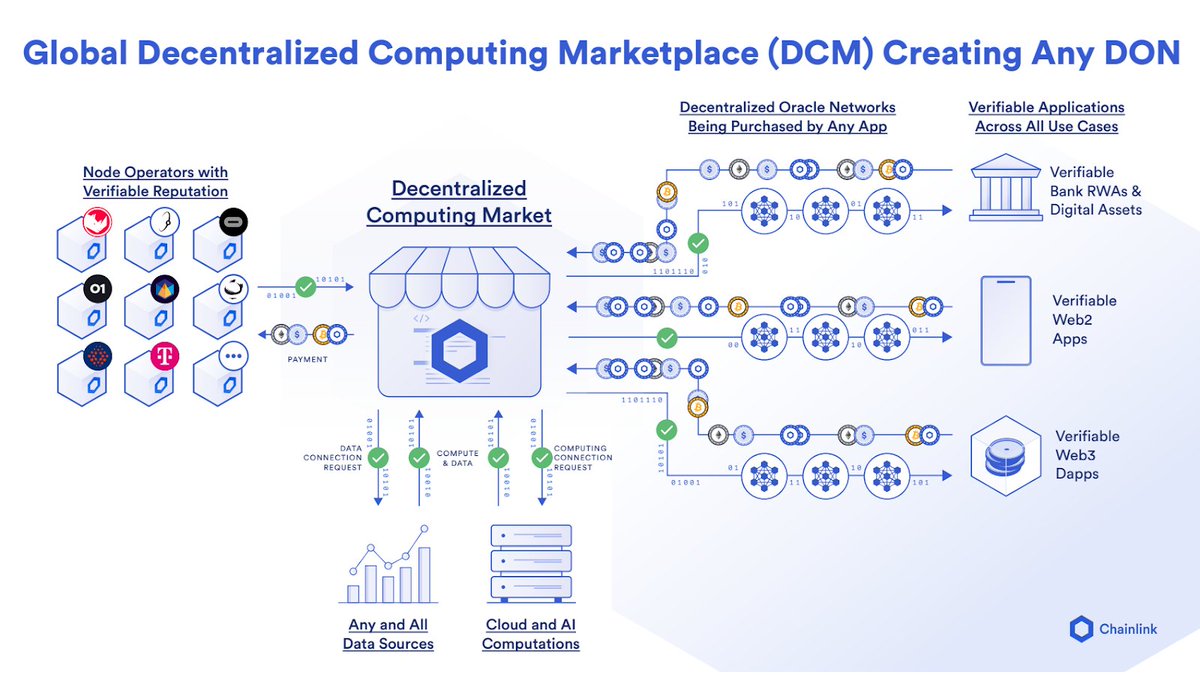
⚡️: 5 First Impressions from my Chainlink Rabbit Hole
1. @chainlink is NOT an "oracle"
• An ecosystem of thousands of decentralized computing networks
• Enables the creation of validator sets that handle a single specific offchain computation in a trustless and verifiable way
>> Do one thing and make sure its 100% accurate at all times using a network of nodes
• Decentralized Computing Marketplace launching soon. Anyone can launch their own Chainlink network and customize services, node requirements, data sources, multisig, security parameters etc
2. Oracles are not just for market data
• Fetching price data is the most widely use service, but it's the tip of the iceberg
• Oracles excels at everything blockchains cannot do or are inefficient at doing
• Other important, but overlooked functions include cross chain messaging & interoperability, two-way connections between smart contracts and external offchain systems, security, and much more
• Enables service oriented architecture for web3, i.e. modular decentralized web services, which is how most modern web applications are built
• Oracle networks can be combined to create new calculations, workflows, dApps, and protocols
======
3. CCIP's biggest breakthrough is enabling the transmission of information and value simultaneously
• Delay between txn initiation and settlement caused by data fragmentation and inefficient, bureaucratic workflows
>> You pay for asset, bank checks data, data verified, sends payment to other bank, other bank checks data, receives payment, releases asset, you receive asset (can take up to a few days)
• With Chainlink, data is fetched and verified simultaneously when txn is initiated. Data + value is transmitted by CCIP
>> Data of the asset (e.g. price, origin, proof of reserves) is available in real time
>> Data required for the transaction to be executed (e.g. KYC / AML, investor accreditation)
>> Stablecoins
• Programmable workflows enabled by the co-existence of value and data. Vastly improves standardization, automation, composability
4. AFAIK, CCIP is the most robust interoperability solution for bridging TradFi and DeFi
• SWIFT x CCIP experiment was well founded and included all the necessary parties (banks, CSDs, messaging networks), incl. Citi, BNY Mellon, Euroclear, Clearstream
• CCIP enables bidirectional information and value abstraction and transfer between all other private and public blockchains
• Minimizes the need for banks to incur additional costs to upgrade, train employees, or replace legacy systems
• Banks actually prefer fragmented backends (e.g. private blockchains), but connected markets and liquidity
• CCIP offers a plug and play interoperability protocol that allows for both, making it the easy, obvious choice for banks
5. Quadrillions
• Chainlink thesis: Banks will tokenize everything to profit-maxx
• Chainlink game plan: Get public (DeFi) and private (banks) sectors on the same operability standard - CCIP
• Once banks decide to connect their systems and blockchains with public blockchains, CCIP will facilitate quadrillions of dollars of liquidity flowing between TradFi and DeFi
I'm having a ton of fun researching $LINK and CCIP. Can't shake this feeling of "something big is coming"
Gonna do a deep dive next. Shill me anything that you think I should read or look into
Thanks in advance 🫡