1/ Multicoin published a full analysis & valuation of Hyperliquid (HYPE).
HYPE is now one of the largest positions in our liquid hedge fund. We've been accumulating aggressively since February.
Here's why we believe HYPE will be one of the best performers over the next cycle:
Daily priority fees have reached a new all-time high of $107.55K.
They now account for 6.1% of Hyperliquid’s 24-hour revenue, including trading fees, HyperEVM gas fees, and auction revenue.
"Memory is cyclical, everyone knows that, and the recent run up in memory names is an obvious bubble."
That's the easy, reflexive view. But I think the people who hold it are missing the simple scale of what AI is doing to memory demand.
The first clue that there might be more to the memory story came in January of this year when it came out that NVDA's next gen Rubin platform would require 16 TB of NAND per GPU, or 1152 TB per rack, and that required HBM bandwidth for the system would be 70% higher than what had been previously reported.
That was the first time it became obvious to outside observers that memory would need to scale exponentially to keep up with already-known GPU demand.
One under-appreciated fact is that while GPU compute has largely scaled with Moore's Law (doubling in compute ~every 2 years), memory density and speed hasn't. As GPU compute continues to scale, existing memory manufacturers must produce exponentially more chips.
These chips will also need to be faster than ever, which introduces an incredible technical challenge: how can memory manufacturers find the required speed improvements that have eluded them for decades?
When you combine this added technical complexity with an exponentially expanding demand for the product, memory starts to look less like the "commodity" everyone knows it to be, and much more like a high-margin proprietary chip.
This hasn't even touched on memory's role in inference (compute needed for inference is expanding exponentially as well, and is highly memory-dependent), long context, etc.
Agentic AI requires agents to pull massive amounts of data into their context, which increases the number of tokens per "turn" and also the amount of memory required to run them. True agentic systems will require both dramatically higher context, and also many more "turns" or iterations of each task (as they improve an output over and over until it reaches a target quality level). Longer context = more memory per workload, and more "turns" = more workload per output.
To put a specific number on that, Micron SVP Jeremy Werner said recently on The Circuit that agentic AI is causing context length to grow 30x a year.
Michael Dell recently framed the problem in extremely simple terms: H100 had 80GB of HBM; by 2028, accelerators could carry ~2TB. That is 25x more memory per accelerator. Over the same period, he expects roughly 25x more accelerators deployed.
That's 25 x 25 = 625x more accelerator memory demand by 2028.
Everyone knows memory stocks are cyclical, and they always look cheap right before the bubble bursts. But what if there are structural changes happening in the memory markets that could prove the consensus wrong?
Does anyone remember another traditionally cyclical company that has rerated to a growth story due to the demand from AI? Hint: It's now the most valuable company in the world.
Reminder: this is not a recommendation to buy or sell any securities. It's a framework for thinking about how the AI buildout may be changing the memory market.
Every US company of significant volume is going to use Intel Foundry
Intel obviously needs more capacity (fabs) to serve as major 2nd source
But as Lip-Bu Tan said on a podcast they have plans to be a major player and board has approved it
TSMC monopoly has been killed by USG
Edgewater is out with a very positive note on analogs today. Calling “bottlenecks emerging” on $TXN and $ADI. I assume $ON should be on this list too.
Also mentioned are $MPWR $VSH $MCHP $STM
Intel $INTC +9% premarket, after President Donald Trump announced the company landed a deal with Apple (AAPL) to design and build chips in the U.S. Intel stock sports a 228% year-to-date gain and could test its May 11 record high of $132.75 today.
Google and $NVDA are considering Intel $INTC as a backup chip manufacturer as TSMC capacity remains tight, per The Information.
Google has reportedly placed an order with Intel to manufacture more than 3M TPUs in 2028 after testing Intel’s advanced packaging technology.
Nvidia has not placed an order yet, but is testing Intel technology for a 2028 Feynman-series processor that combines four graphics chips into one unit.
Intel’s near-term opening appears to be advanced packaging, with SK Hynix also testing whether its HBM works reliably with Intel packaging.
Everything you need to know about SK Hynix and that fund called 7709 Capital Management that is massively long it...buyers please beware -->
SK is in a massive "spot up, vol up" episode, driven by a shortage of memory, extraordinary profits, rampant speculation and the circular demand that comes from both leveraged ETFs and options.
First chart below, the stock is up 900% over a year and the 1m implied vol has gone from 40 to 120. This is beyond rare. It is a sign of massive speculation.
Top right chart, the filings from 7709, the leveraged ETF that now has 13bln USD in AuM. Its prospectus limits it to have 25% of its exposure through options, but it can surpass that under "exceptional circumstances". Apparently, these are exceptional times, as the option exposure is now 36%.
The leveraged ETF is buying deep in the money calls that expire in July. The ratio of open interest in calls to puts is 100:1 (765k to 7.7k). I've never seen anything like it.
In order to rebalance each day, the leveraged ETF needs to buy when SK Hynix rises. In 2026, the underlying has already had 28 5% up days. That is one in 4 days! The leveraged ETF gets larger and larger. It will start tomorrow long 26bln USD exposure to a stock that is realizing more than 100 vol.
The hedging is two-way. When SK falls, 7709 will have to rebalance to get smaller, selling into a falling market. Its hedging amplifies moves in both directions.
Because 7709 has bought in the money calls from the market, the "Street" (vol community) is short gamma. From a risk standpoint, a deep in-the-money call is the same as a deep out-of-the-money put. The seller of the call to 7709 bought stock to hedge but will need to sell that hedge quickly to rebalance its delta should SK Hynix fall.
All in all, a toxic brew. The recent drawdown in SK of 17% from 6/1 to 6/8 could easily be an appetizer for a forthcoming vol event that is amplified by the overlay the lev ETF and options.
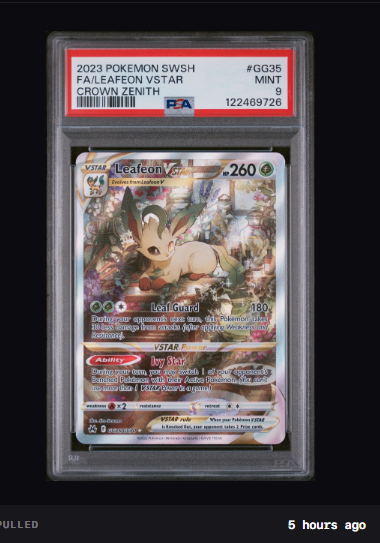
Terminal rewards are live for Monster users! To celebrate we will be giving away free packs randomly all day.
In order to be eligible, quote tweet this post with a pull you did today and make sure to include your username!
Good luck and happy ripping