Alpha Exchange is a podcast series by Dean Curnutt to explore topics in financial markets, risk management and capital allocation in the alternatives industry
“This makes me think that as the $NVDA board conducts a search for a new leader, that they need to go outside the company. That — just what was going on inside the company — they need a dramatic shakeup.” ~ Scott Bessent
Complicated situation.
@DannyDayan5 I will call it a one touch. It has a digital (fixed) payout on touch which distinguishes it from something like a one-touch up and in call.
This post shares some thinking out loud on product innovation in the Kalshi/Poly era and invites conversation. It's not meant to be truly rigorous on advanced option pricing models.
Prediction markets are "resolved" to yes or no, triggering a $1 payout in the process. Before we had Kalshi and Poly, we had credit default swaps (and still do).
In CDS, an industry Determinations Committee convenes to decide if a credit event has occurred. There are very specific rules on on how the DC works. An open question continues to be whether various kinds of "LME" (liquidity management exercises) constitute a credit event or not. In the lev loan market, LMEs exceeded defaults last year, according to PitchBook LCD.
While most prediction contracts resolve without incident, there are nuances on verbiage that can lead to different outcome determinations. Kalshi and Polymarket reached opposing decisions on whether Cardi B would perform at the Feb. 8 Superbowl halftime show. Polymarket resolved “Yes,” ruling that her live, in-person presence counted as a “performance” under its rules. Kalshi resolved the other way. Real money was at stake: Kalshi’s market traded more than $47.3 million and Polymarket’s more than $10 million.
In the CDS, a committee determines a payout. In a Kalshi/Poly "Yo-No" (yes or no) contract, it's the wording of the contract that determines payout. There are weaknesses in both.
There's another way to structure an outcome-based contract. Look directly to price as the resolving mechanism. "If X hits why Y, pay Z". This is also known as a digital one-touch. How much would you pay to receive a dollar if the asset touches a certain price?
These have traded in FX for years with a specific rulebook on what constitutes a "touch" that triggers a payout, typically a trade of a specific size. In liquid markets like USDJPY or EURUSD, this is easy.
What might a string of digital one touches look like on the VIX (future)? We can use a simple pricing model that takes in the vol surface and assigns a price to various one-touches with one month to expiration.
Here are two charts that overlay a set of prices that use the actual VIX vol surface versus simply using one vol for every price. We see how the well known bid to VIX call skew yields higher prices for upside contracts than a probability based simply on a flat vol assumption.
The two dates chosen are to highlight that even with the same 1m VIX future on 11/5/26 and 11/18/22, the vol surface was very different on the two dates and that produces very different prices on one-touch digitals.
The differences between the two make sense. There was great VIX call skew on 11/5/26 and that means the market was implicitly willing to pay an especially greater amount for a digital one touch call than a flat vol input would suggest on that day than versus the 11/18/22 comp when VIX implied vol was much lower.
Are digital one-touches a good idea on the VIX? I'm not so sure they are. Chris Cole once said on my podcast that with respect to strategies like "vol control" we have moved vol from a statistic we simply observe to becoming a "player on the field". One can imagine a market in which VIX one touch digitals become very popular. Trades in VIX futures near a concentration of one-touch barriers would have consequence, potentially yielding a payout. Competing interests would emerge trying to push the VIX to a barrier price or prevent it from getting there, as we see sometimes in the FX derivs market.
But the push towards creating outcome contracts isn't likely going away. In resolving to "yes or no", it could be that price (for a liquid instrument like a DM FX cross, the SPX or VIX futures) is the best "determination committee"...
TLDR: we should think about what a Central Bank of AI moving from easing to tightening mode could mean for the system at large.
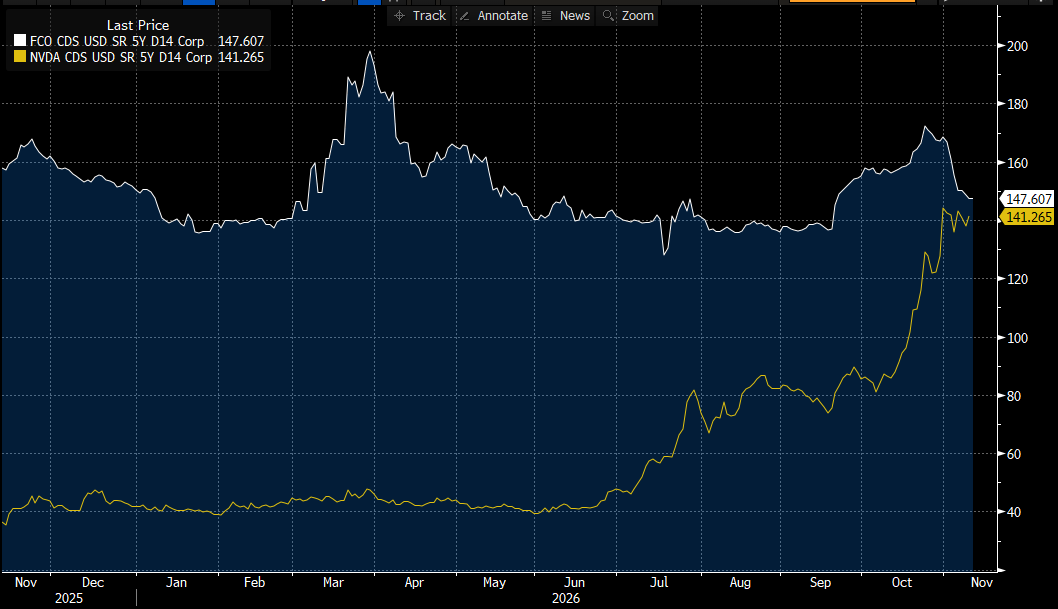
Given that $NVDA has been named the "Central Bank of AI", there's at least some analogue to LTCM, dubbed the "Central Bank of Volatility" back in 1998. No, Jensen Huang is not short $80mln of 5 year vega on global equity indices. He's short (personal) vol, for sure, and has sold options, just not on the SPX or SX5E. But both Central Bank monikers speak to the roles each firm played in their respective ecosystems.
LTCM sold vol (short equity vol; long swap spreads and other carry generating trades) in such size that it set the price of insurance. Nvidia has been doing something structurally similar. As recently as September, it revealed plans to mobilize more than 500bln of investment in AI infrastructure with six firms, by guaranteeing the value of the equipment it sells to such projects.
A residual-value guarantee is economically a written put on GPU collateral. LTCM wrote puts (and calls) on the SPX; Nvidia is writing puts on the asset its own revenue depends on. That's very wrong-way correlation. Its math models saying otherwise, LTCM was vastly concentrated and undiversified. NVDA may be the same.
More broadly, LTCM's capital and risk appetite kept the system of financial market insurance running. NVDA's capital has done the same with respect to the AI financing system.
Most tie LTCM's downfall to Russia's default in 1998. That's not incorrect, but events earlier in 1998 mattered as well. Salomon was acquired by Citi in late 1997. The bond arb effort that Meriwether left behind was largely dismantled in early 1998 as a result. The disappearance of this "copycat" capital that also absorbed risk put even greater onus on LTCM to keep vols and spreads in line.
It's hard to imagine a post-Jensen NVDA as having such a healthy appetite for reinvesting the firm's profits back into the ecosystem that bought chips from it. That cash has greased the wheels in many ways and as firms like $CRWV see ballooning costs of capital, we should think about what a Central Bank of AI moving from easing to tightening mode could mean for the system at large.
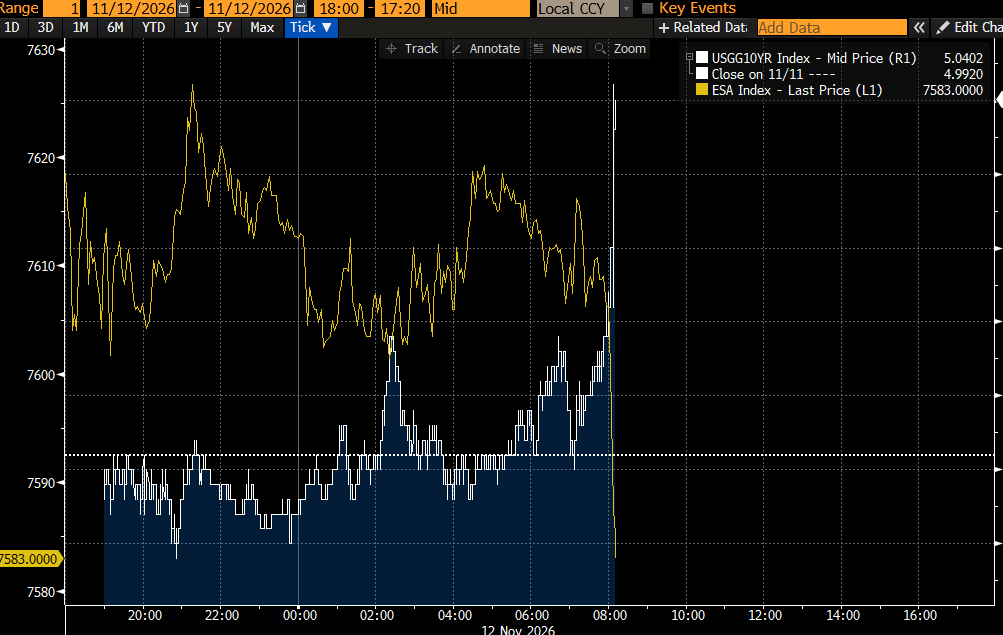
The swift down move in the $SPX on 11/5 pumped the front month $VIX futures up. It also caused a surge in the $VVIX, the implied vol measure on VIX options.
Here's an interesting comparison, showing the implied distribution of the front month VIX future on 11/5 and contrasting it with same on 11/18/22, when the future was at same level.
The big difference: VVIX of 135 on 11/5/26 and just 78 on 11/18/22. The tightening cycle in 2022 led to a consistently high VIX, but one that was not all that volatile, leading to a low VVIX. This had a lot of implications for hedging.
the down 4% days in the SPX since 2000, excluding the GFC and Covid. Includes the move of the largest 5 stock at the time. this last move was the lowest average of the top 5. speaks to just how large the move was in semis on 11/5 when the SMH was down 11.2%. excluding Covid crash, the largest single day plunge in the SMH since 2000 was 9.8% on 1/27/25, "Deep Seek Monday"
this was from almost exactly a year ago but I think the framing makes a fair amount of sense, especially in light of what could be a reduction in the risk bearing capacity of the "Central Bank of AI" $NVDA
https://t.co/lEeUhIGxKa
The question around a market (in this case AI) bubble is important but mostly not properly framed. Ask 5 intelligent folks and you won’t even find agreement on the word’s definition.
What can be agreed on, however, is that implicit in the question is the notion of vulnerability in prices. This matters because unless you are truly insensitive to mark to market risk (Bernanke, Buffet and Bessent?) drawdowns matter.
If you bought AMZN in early 2000, you experienced an 80% drawdown. It’s more than reasonable - in fact advisable - to have cut your losses along the way. It would have taken you until 2007 to break-even. The rest, as they say, is (very profitable) history.
So the bubble conversation is really better framed as whether prices for AI related equities, which certainly have pulled forward quite a bit of the expected productivity and profit gains, are vulnerable to a correction that is large enough to force a risk management decision.
While today’s economy bears little resemblance to that of 20 years ago, there’s too much riding on MAG7 market cap today in a way similar to the pre-GFC period when the lynchpin was rising home prices. In both cases, the economy is at the mercy of the market, rather than vice versa.
Here’s a graphic to describe this.
things you don't want: be on the cover of a magazine as a superhero and have your company nicknamed "The Central Bank of AI".
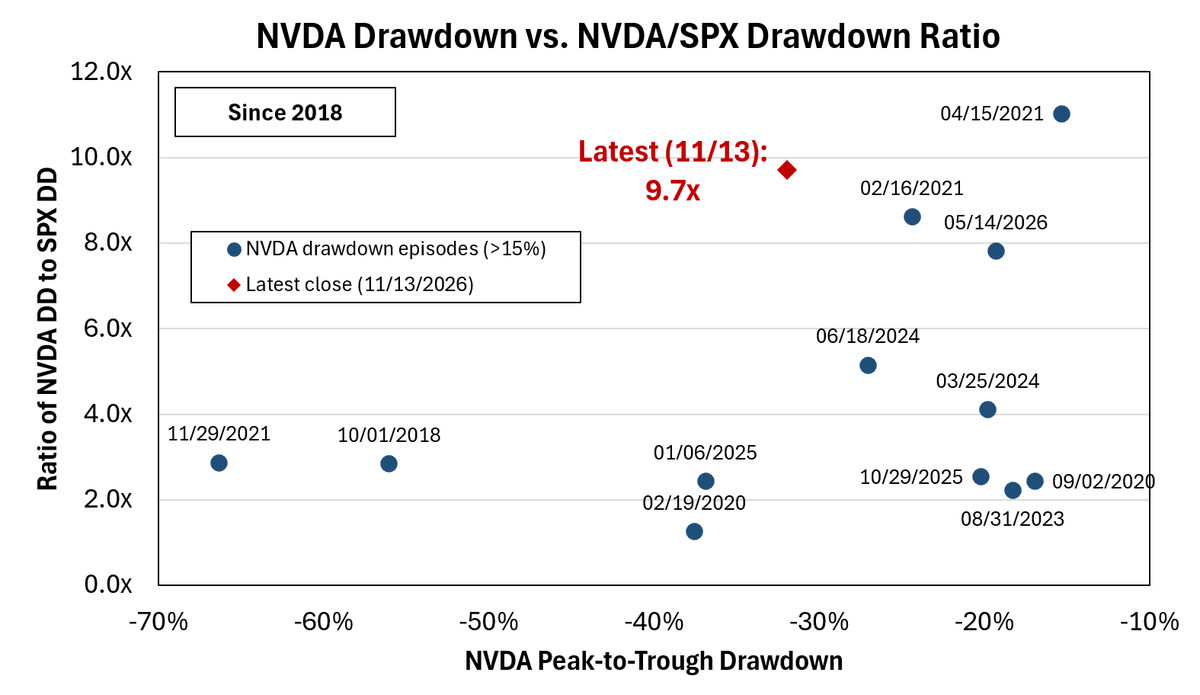
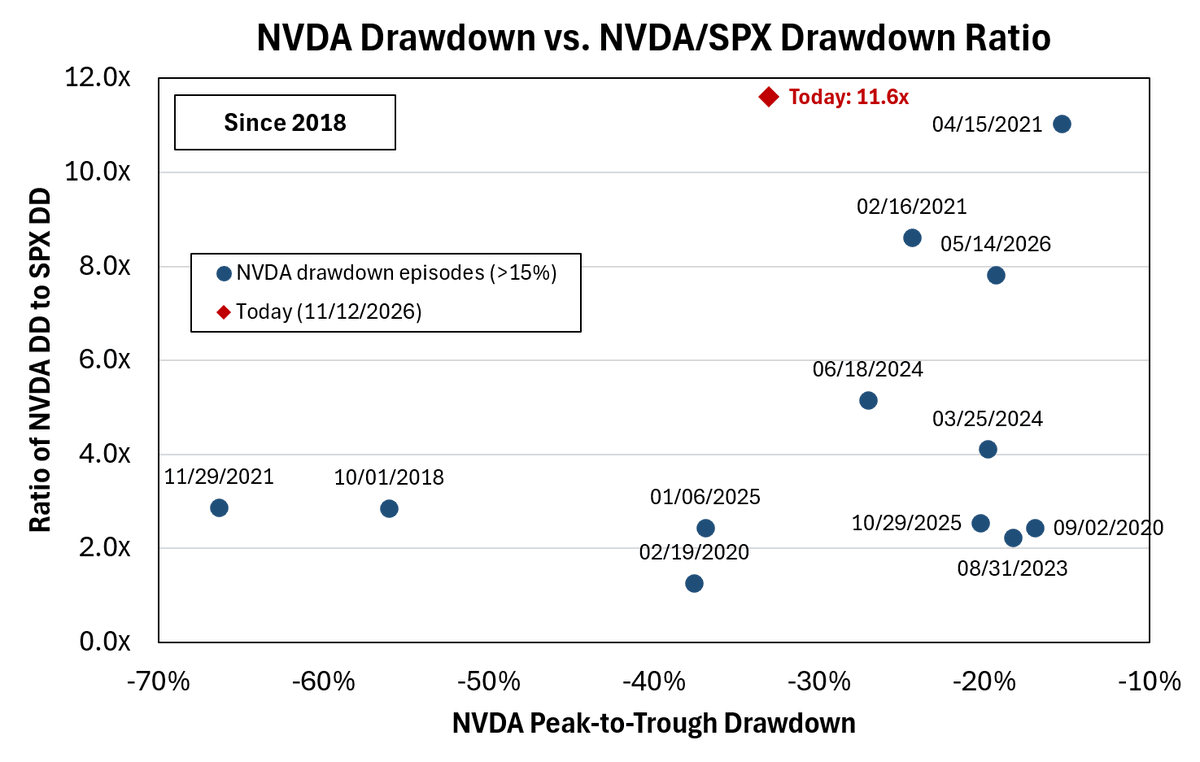
here are $NVDA drawdowns >15% since 2018 and the ratio of that DD to the SPX DD over same period. chart uses a price of 160 for today. ratio is 11.6 and DD is 33%.