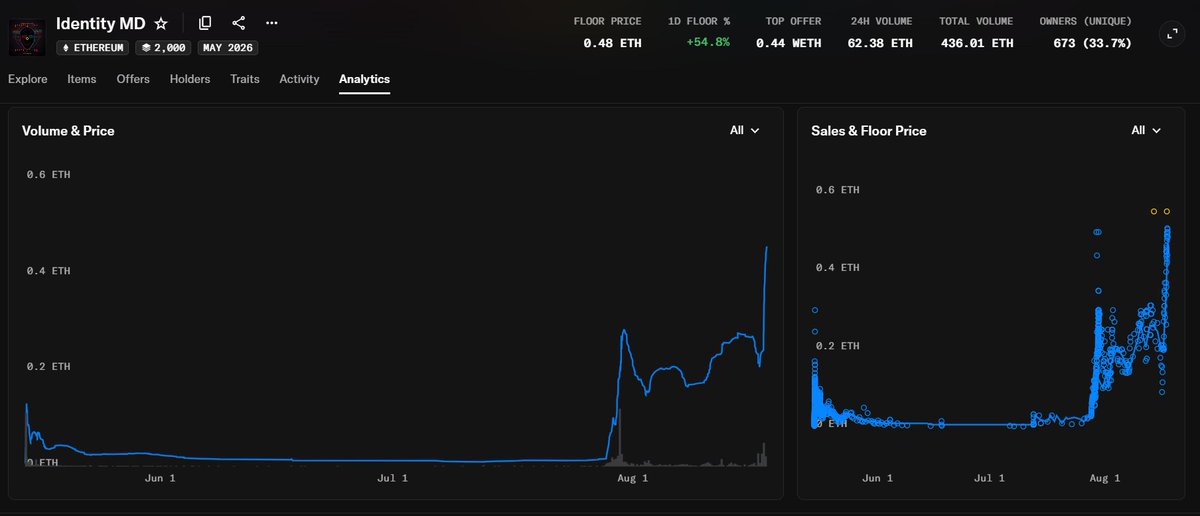
ethereum:0x4647e1fe715c9e23959022c2416c71867f5a6e80 bottomed here, encrypted compute stack privacy play with actual tech good tech and team
much higher.
Honestly, until today the investment thesis for $IMD and its NFTs looked interesting from a tech perspective, but the real utility was still unclear.
If each NFT was simply a license for one dev, a supply of 2000 seemed excessive
The project is unlikely to need thousands of active Solidity devs, so it was unclear where sustainable demand for the entire collection would come from
The key shift is that the potential market for the NFTs is now measured not by the number of Solidity devs, but by the number of participants across the entire agentic network.
The NFT is now officially called a Participation Pass & Identity, while the public code points to a much broader design:
> automated participants receive tasks
> they work only with approved files
> a separate verifier checks the output inside an isolated environment
In this model, an NFT may belong to more than just a regular dev
It could potentially represent:
> someone creating tasks
> an AI agent operator
> the agent itself as a persistent onchain identity
> a verifier or curator
> a governance participant
> an early network member with access to future features
This makes the 2000 NFTs look less like “2000 licenses for devs” and more like 2000 potential seats in the initial circle of an autonomous company.
The NFT thesis shifts from “buy a license, even though it is unclear who needs the other 1999 licenses” to “buy a limited pass and identity inside a network that could eventually coordinate AI agents, tasks and reputation”
A similar expansion is happening with $IMD
Previously, its value was tied mainly to a single launcher and Uniswap v4 experiments.
Now the launcher looks like only the first product inside a larger P2P protocol.
The most likely architecture:
> the NFT defines who participates and what reputation they have
> $IMD defines how value moves through the system
If this direction is implemented, the token could theoretically be used for task payments, rewards for agents and verifiers, collateral, governance and fee distribution.
The FeeDistributor repo shows the first possible value-capture mechanism: a 5% trading fee accumulates in $ETH and is distributed among major holders of the launch token.
This is likely referring to $IMD, but it is not explicitly stated yet.
As a result, the $IMD thesis shifts from a bet on the success of one launcher to a bet on the economic layer of an autonomous company capable of launching multiple products and creating multiple sources of fees
Feels like @proofoftalk attendance is going to be very interesting this year, great work @VictorOnChain@karl_rusche
If anyone wants to talk liquidity provision, OTC flows, market structure or just grab a coffee, feel free to reach out, I'll be there!
The next era of global finance is being built by a wide range of institutions.
Asset managers navigating complex multi-asset strategies. Banks bridging traditional and onchain markets. Token projects building global markets from the ground up. Exchanges optimizing liquidity at institutional depth. And the funds, family offices, and issuers operating at every layer in between.