Yesterday, we've announced Liquid Lane - a vault-based RFQ solution going to market with RWAs.
LL provides an alternative solution for issuers to idle buffers and DEX/AMM liquidity. This research piece goes deep into the structural benefits incl. analytics on capital efficiency
This is the exact problem @jito_sol’s MPP plugin is trying to solve.
If oracle updates can land more deterministically in a block (i.e. a flatter distribution below), prop AMMs can quote with more confidence, more depth, and across more pairs.
That is how better onchain execution starts compounding beyond majors on @solana.
Today, we're launching institutional OTC prediction markets trading through our Global Markets desk.
Hedge funds, family offices, and other institutional clients can now access prediction market liquidity at sizes and with a level of discretion suited to institutional scale.
"Galaxy is betting that thin liquidity and wide bid-ask spreads on political and economic event contracts will make doing business over the counter more enticing for hedge funds, family offices and other institutional investors."
We just closed our first onchain institutional block trade. The time is now for institutions using prediction markets to hedge real world exposure.
2 months in and couldn’t be more excited about what we continue to build at @Polymarket
https://t.co/ssCYyjm1ty
NEW: Polymarket booked the first on-chain prediction market block trade, a six-figure transaction tied to an index tracking the price of Nvidia compute rental.
The counterparties were @FalconXGlobal, a digital asset brokerage, and @intheanera, an AI inference exchange.
According to a press release, "FalconX intends to serve as a dedicated market maker on Polymarket for Future block trades. AneraLabs, whose products span physical and financial derivatives for AI compute markets, worked with Polymarket to bring this trade to execution. Ornn AI Inc. provided the index infrastructure underpinning the transaction."
@ceterispar1bus@0xQuintus@fede_intern Block times still get in the way of propAMMs and traders trading them unsurprisingly
Growing area of research has been where active flow originates geographically and their chain preferences
For EVM propAMM teams, Base, BSC and then Ethereum is the preferred deployment order
Most Solana teams optimize RPC.
We decided to remove it.
At @brewlabshq_ , our latency requirements pushed us beyond Yellowstone and toward consuming validator data directly from the source.
Today we're open-sourcing part of that work:
Qlaster — Shared-Memory Data Streaming for Colocated Solana Services.🧵
KyberSwap is the first DEX Aggregator to connect to PropAMMs via @titanbuilderxyz. This connection helps KyberSwap users access better rates and better execution onchain.
Titan improves execution at the builder layer by ensuring the latest PropAMM quote update is ranked before the taker’s swap in the block. This further supports taker protection from stale pricing before the final block state is known, reducing value leakage to makers.
As a first step, FermiSwap has been added via Titan as a new liquidity source alongside existing sources.
Better rates. Smarter execution. Together on KyberSwap.
1/2 We are now live with PropAMM Taker Boost inside Titan blocks! 🌴☀️
During block construction, takers accessing pAMM liquidity will have their orders valued at a 5% premium.
- Boost capped at 0.01 ETH per order
- Paid directly by Titan Builder
- Active until Tue 30th June
update: cracked the subscribe schema. it's: {"req":"sub","chs":["tickers::N","book::N"]}. only numeric instrument IDs, no symbols on the wire.
so I matched each index price to live spot and inferred each underlying asset:
> iid1 => S&P 500 (idx 7,581 = yesterday's close to the decimal)
> iid2 → Gold
> iid3 → WTI Crude
> iid4 → XYZ100 (https://t.co/i3FgFikfNS equity index, Pyth-fed off Nasdaq E-mini)
> iid5 → Silver
> iid6 → Bitcoin
full 20-level books, mark/index basis, hourly funding, OI all streaming ~10 msg/s. Pyth-powered (not 100% sure).
Σ open interest already $2.13M+, Silver leading at ~$623k. and there's still no public UI.
apparently polymarket is focusing mainly on tradfi-asset perps which means demand for this product could skyrocket. tokenization might happen through perpetual-contract speculation rather than directly custodying the underlying asset.
h/t @SeladorEth for the schema 🤝
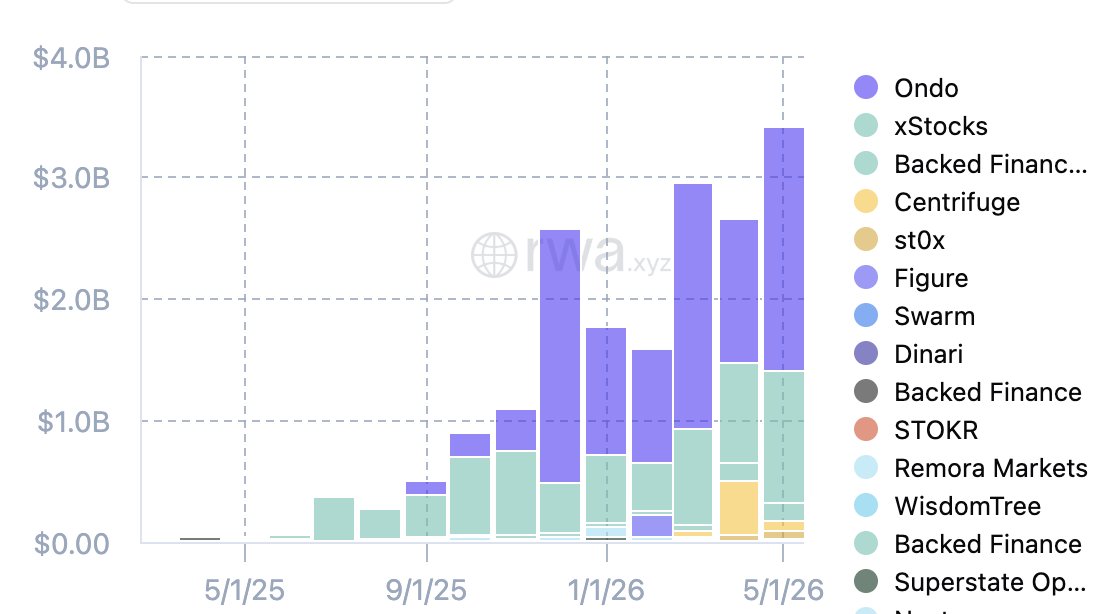
Tokenized stocks just hit a new record of monthly trading volume, seeing over $3.4B traded onchain in May. This represents 29% growth month-over-month and 93% YTD.
@OndoFinance led with $2B, followed by @xStocksFi at $1.1B.
This comes as the SEC develops a tokenized stock framework and the DTCC prepares to begin tokenized securities trades in July 2026.
data: @RWA_xyz
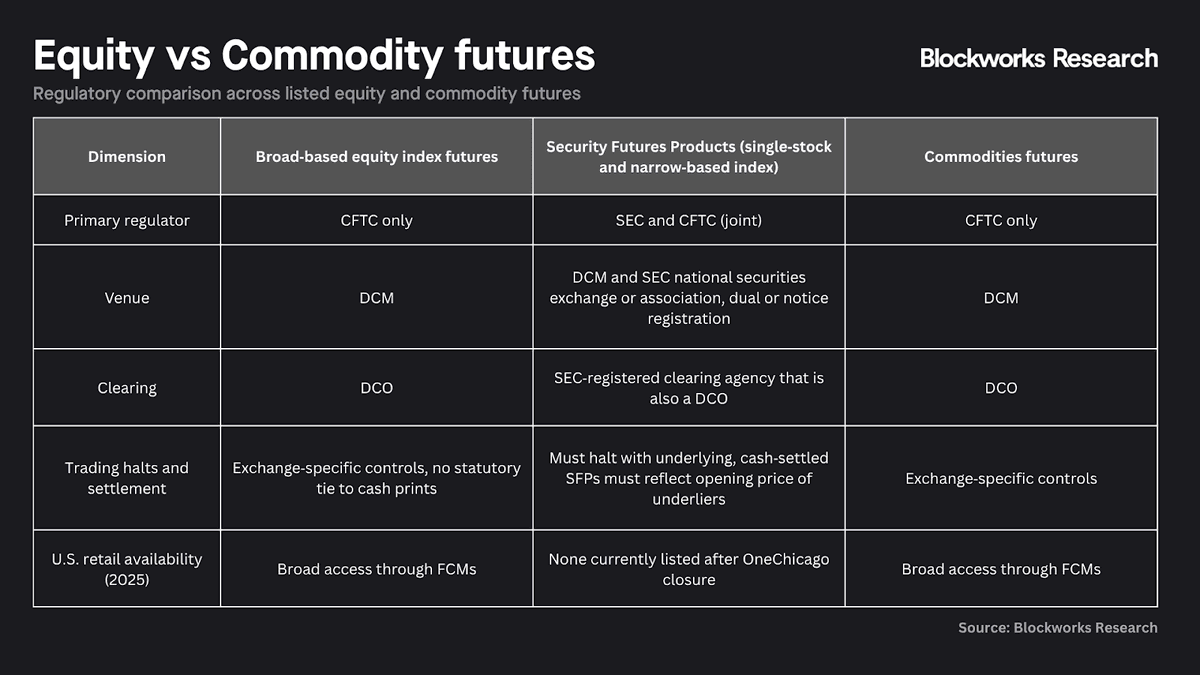
Perpetuals have no expiry and never physically deliver. In the U.S., that pushed them into the futures framework: DCM execution, DCO clearing, FCM intermediation, and CCP-style margining.
To be compliant, U.S. perps had to take two steps back to fit this legacy system. For example, instead of simply listing a crypto-native perp, Coinbase Derivatives acquired a DCM, worked through Nodal Clear, and structured its product as a five-year, cash-settled futures contract, with funding handled through clearinghouse cash adjustments.
This framework therefore created a lot of complexity:
-Exchanges can’t list any asset they want. They need to be a DCM, acquire a DCM, or list through one.
-Expiries, funding, and settlement mechanics need to be adjusted to fit legacy infrastructure.
Importantly, it structurally prevents brokers from using exchanges like Hyperliquid that do not meet the legacy criteria of a DCM.
While this new order does not remove those complexities, it does allow a true no-expiry BTC perp instead of the five-year expiry workaround.
Still, it points to the CFTC genuinely being willing to innovate and make perps fit into existing frameworks. Over time, hopefully that framework expands to also include crypto-native exchange layers like Hyperliquid as true market layers.


![probabilitygod's tweet photo. update: cracked the subscribe schema. it's: {"req":"sub","chs":["tickers::N","book::N"]}. only numeric instrument IDs, no symbols on the wire.
so I matched each index price to live spot and inferred each underlying asset:
> iid1 => S&P 500 (idx 7,581 = yesterday's close to the decimal)
> iid2 → Gold
> iid3 → WTI Crude
> iid4 → XYZ100 (https://t.co/i3FgFikfNS equity index, Pyth-fed off Nasdaq E-mini)
> iid5 → Silver
> iid6 → Bitcoin
full 20-level books, mark/index basis, hourly funding, OI all streaming ~10 msg/s. Pyth-powered (not 100% sure).
Σ open interest already $2.13M+, Silver leading at ~$623k. and there's still no public UI.
apparently polymarket is focusing mainly on tradfi-asset perps which means demand for this product could skyrocket. tokenization might happen through perpetual-contract speculation rather than directly custodying the underlying asset.
h/t @SeladorEth for the schema 🤝](https://pbs.twimg.com/media/HJkJTpCXcAYho1e.png)