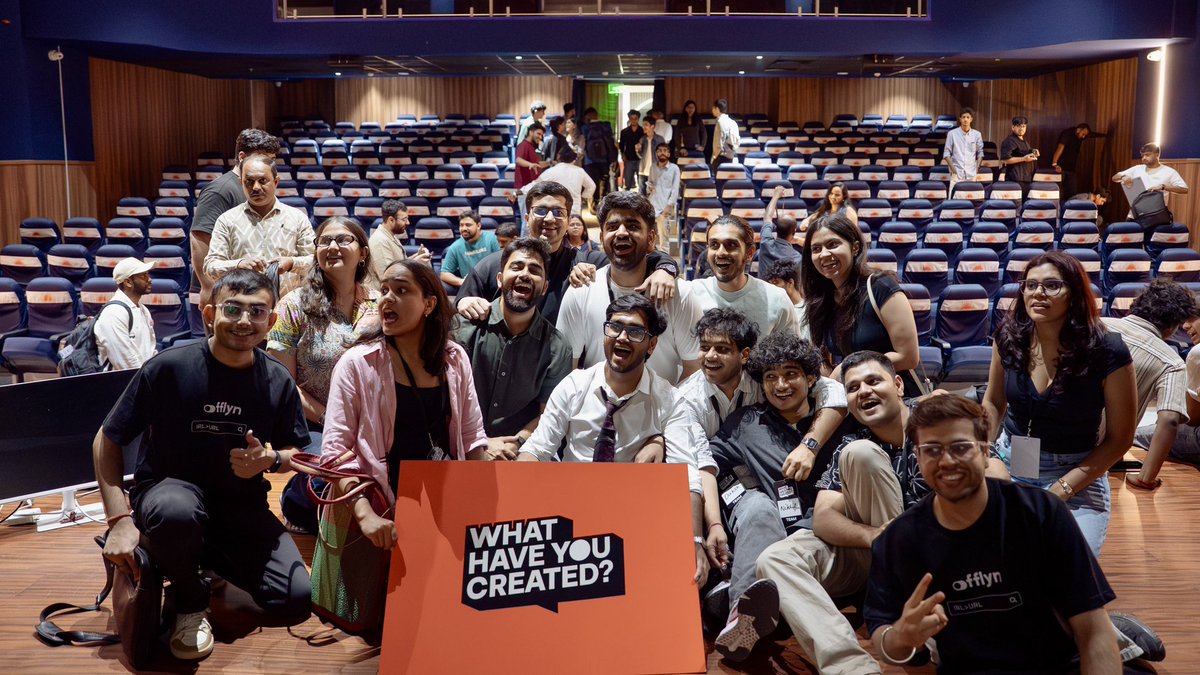
i was 13 when i first saw the WWDC event.
never thought i'll make one someday.
as the world preps for #WWDC26, here’s how we made an Apple-style keynote for Dreamspan’s brand launch on less than 0.1% of Apple’s budget. 🧵
some time back, i fell into a peptide rabbit hole. read everything. started experimenting. couldn't stop.
then India's semaglutide patent expired in march. 25+ generics launched overnight. suddenly one of the most powerful drugs in healthcare was accessible - but nobody had built proper infrastructure around it.
no GLP-1 specialists. no monitoring. no cold chain. 1 in 4 indian adults overweight or obese and the system just wasn't ready.
so we built @ZeltaHealth, doctor-prescribed GLP-1s with full medical oversight, delivery, follow-ups, nutrition, blood work - the whole stack.
5,000+ registered patients later, linking up with the head of BD at Novo Nordisk - the company that pioneered GLP-1s with Ozempic and Wegovy.
the peptide space in India is just getting interesting. a lot more to come.
took my first bpc-157 peptide shot 48 hours ago. 375 mcg, subcutaneous. observations so far.
positives:
• trained upper body hard the next day. zero soreness. the kind of session i'd normally feel for 2-3 days (bpc-157 accelerates tissue repair + anti-inflammatory)
• noticeably better endurance during table tennis session - lasted way longer than usual (increased blood flow + nitric oxide modulation)
• sleep is solid, green days on whoop, good recovery (baseline was already good, maintained)
• appetite is up. went from 2 meals to 3 and still hungry. hungry late at night too (bpc-157 is a gastric peptide - upregulates gut function, body demanding more fuel for repair)
negatives:
• mild irritability during the day. just low patience, slightly annoyed (likely interacting with clonazepam which i'm prescribed - both hit the same GABA pathway)
• sleep still good but the deep "knockout" feeling is slightly blunted. functional but different (same GABA overlap - peak sedation at night flattened, leaking into daytime)
one shot. still observing
Lab0 (@lab0_ai) is the AI FDE to make Enterprise Software self-serve.
They automate the entire post-sales delivery process for software companies, from client process discovery, configuration, & testing to go-live.
Six months of deployment, done in ten days.
Congrats on the launch, @onkar_borade_10, @tokenaware, and @SujaySriv!
https://t.co/ghMCFe0la7
Last week I posted a rant about Indian VCs. Specifically, a red-orange logo firm that passed on multiple research labs and then confidently told me the Chinese are winning in AI.
I felt it, a lot of you felt it. So here's what I'm doing about it - I am getting into the system.
Over the weekend I leased out a 3000+ sq ft space to convert into a deep AI research incubator in Indiranagar, Bangalore.
If you're a pre-seed founder with a deep tech or AI research idea - and you've been burnt by VCs who want traction before they'll give you the time of day - this is for you.
Here's what I'm putting on the table:
- A place to work, think, and build without distraction
- Introductions to investors who actually understand early stage
- The best research minds in the same room as you
- 3 months to prove your thesis (Important)
- And to promising projects - a stipend; so survival isn't the thing eating your focus
No pedigree filter. No "come back when you have PMF." No sitting across the table asking why you're doing too many things while doing nothing yourself.
My Creds?
- Raised $5M + from a16z and others for my first startup as a solo founder - before I turned 24
- Exited to build something meaningful in AI - now running Conscious Engines (@c_engines), focused on small models doing big things
- Helped 10+ teams with fundraising and operational mettle in their 0 to 1 journey
- I know what 'early' looks like, and I know what it needs.
What do I get in return? (candid)
- New Friends and mutual contacts
- Peer group to review our own work at Conscious Engines
- Maybe the ability to put some $ early in on promising projects
- Provenance
---
To beat the system, sometimes you have to become the system. This will probably be hard. It might not work. But I have more risk appetite than the red-orange logo VCs who inspired this - so that's something.
Founders: Join the WhatsApp Community.
VCs: DM me.
I have privilege. I would like to share it.
we're launching @AskSoca in private beta.
Soca is an AI, who curates professional intros driven by shared context, intent and timing.
Our mission is to eradicate middle men who delay process, are not trustworthy and block humanity from evolving.
ambition should not be gatekept.
in 1954, people thought walt
was crazy for spending $17 million to build a theme park on empty land far away from the city.
today that place is called disneyland.
Every great idea looks delusional in the beginning.
Hiring!
Looking for the most cracked AI research folks to join the @c_engines team:
Research:
1. Model Optimisation, Efficiency & Inference
2. Model Evaluation & Benchmarking
3. Model Fine-Tuning & Specialization
Engineering:
4. Hardware & Electronics Engineer
In office - BLR
DM/comment your PoW 🫡
Meet Kimi K2.6: Advancing Open-Source Coding
🔹Open-source SOTA on HLE w/ tools (54.0), SWE-Bench Pro (58.6), SWE-bench Multilingual (76.7), BrowseComp (83.2), Toolathlon (50.0), Charxiv w/ python(86.7), Math Vision w/ python (93.2)
What's new:
🔹Long-horizon coding - 4,000+ tool calls, over 12 hours of continuous execution, with generalization across languages (Rust, Go, Python) and tasks (frontend, devops, perf optimization).
🔹Motion-rich frontend - Videos in hero sections, WebGL shaders, GSAP + Framer Motion, Three.js 3D.
🔹Agent Swarms, elevated - 300 parallel sub-agents × 4,000 steps per run (up from K2.5's 100 / 1,500). One prompt, 100+ files.
🔹Proactive Agents - K2.6 model powers OpenClaw, Hermes Agent, etc for 24/7 autonomous ops.
🔹Claw Groups (research preview) - bring your own agents, command your friends', bots & humans in the loop.
-
K2.6 is now live on https://t.co/YutVbwktG0 in chat mode and agent mode.
For production-grade coding, pair K2.6 with Kimi Code: https://t.co/uvoSJKyGCY
-
🔗 API: https://t.co/EOZkbOwCN4
🔗 Tech blog: https://t.co/9wWvgIQSS3
🔗 Weights & code: https://t.co/Be0hjs2RTP
very emotional while tweeting this. tears in eyes.
paise bhale naa kamaye ho, log laakh kamaye hai
thanks for pulling up all of you end moment.
this is for you, you know it. all of you. who have been with me in last 10 days figuring things out all day and night
without you this wouldn’t have been possible
love you.
to think that @0xratnakar thought of this as a gag 10 days ago, to supporting them, and then today finally pulling it all together, it was an incredible ride.
priyanshu and @tushaarmehtaa from @aiweekendsxyz have that dawg in them. two events over three days, planned and executed with impeccable finesse.
i've collected a lot of event badges over the years but i'll cherish this one the most.
Today, we're launching Nue Health, India's most affordable preventative healthcare membership.
This all first started when I heard Nithin Kamath had suffered a heart attack - someone who cared so much about health and fitness. How was this possible?
We're constantly told that we hit our "quarter life crisis" at 25 - which means we're all supposed to live till a 100 right?
Then why was I seeing so many people succumb to cancer and cardiac arrests in their 30's and 40's?
Something didn't add up.
I dug deep - there had to be a way to see this coming.
Why was everyone in the dark about what was happening inside their body?
This is when I realised that health is an extremely fragmented and uncertain experience in India.
People don't know what biomarkers to test, what to do with an 18 page blood test report, how to connect these results over time and exactly what they needed to do to improve their health.
They had the data, but they didn't know what to do with it.
We put our heads down and started building. We learnt every single thing there is to know about the space. Got engineers and researchers from Princeton onto the team - people who've been into biology since they were 14.
We're building a digital twin of the human body for every Indian - one single blood panel tested every 6 months, combined with your wearable and nutrition data, and a doctor verified action protocol so you know exactly what's happening inside your body at all times and what you need to do to improve it.
We're building a new kind of healthcare :
one that that doesn't wait for you to get sick before taking action.
one that helps you understand your unique biology.
one that India truly deserves.
Link in pinned tweet.
hiring 2 full-stack interns (3 mo) @medsee_ai · ₹50k/mo · bangalore, in-person
if you lean backend: you like architecting around text+visual data at scale & building and orchestrating ai/ml pipelines
if creativity drives you: you thrive around 2d/3d visual engines & workspaces, have an eye for clean notion/figma like ux
dm with your favorite work - github / resume / coding agent session 🧵
Asked someone from the industry whether foreign investors are still interested in allocating to India. The TLDR:
Interest has pretty much died out. India is seen as geopolitically exposed, especially to an oil shock. There are no real AI plays. Valuations are rich. And the rupee situation doesn't help.
On top of that, investors who were sitting on gains have taken money off the table and are now looking at markets like Japan, Taiwan, Korea, Europe etc instead.
He also pointed out that our LTCG/STCG structure and the increase in STT have made India less attractive compared to other markets that are seeing inflows.
If we need to attract FPIs back, and we do, fixing this feels like pretty low-hanging fruit.
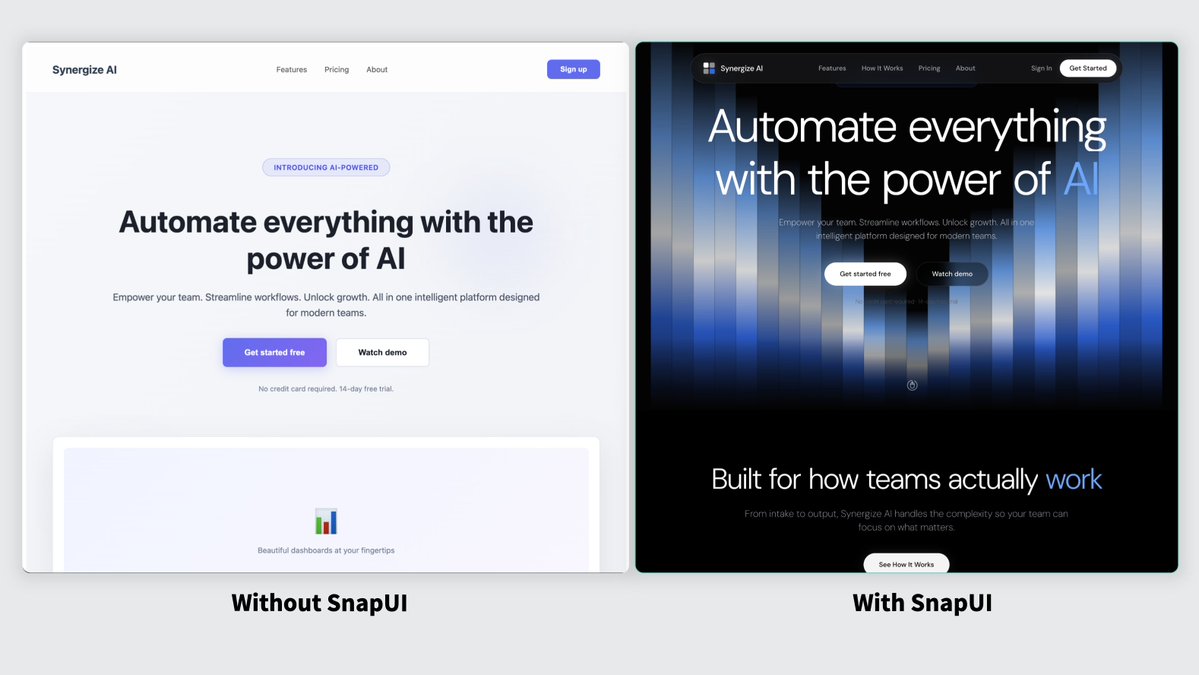
AI has no taste.
Every vibe-coded UI looks the same - generic sans-serif, off-white bg, gradient buttons. You can always tell.
So I built SnapUI - an MCP server that gives your AI agent a full design spec to follow. Colors, typography, spacing, components. A beautifully formulated UI kit.
The output actually looks designed.
Free at https://t.co/PERBFDV8qj - brutal feedback welcome
The West poured $50 billion into fast breeder nuclear reactors and abandoned every single one. India poured $900 million and just achieved criticality on the first commercially viable one outside Russia.
The US spent $15 billion. Gave up. Japan spent $12 billion. Their Monju prototype had one sodium fire in 1995 and never recovered. The UK spent $8 billion. Germany spent $6 billion. France, Italy, all walked away. Six of the richest nations on Earth concluded this technology was too hard and too expensive to pursue.
India started building in 2004 with an initial budget of $420 million. Twenty-two years, a dozen missed deadlines, and a cost doubling later, the Prototype Fast Breeder Reactor at Kalpakkam just sustained a controlled fission chain reaction. The reactor is now alive.
The reason India never quit is a constraint most people have never thought about. India has only 1-2% of the world's uranium reserves. For a country of 1.4 billion people trying to build energy independence, that's a death sentence if you're running conventional nuclear.
But India has 25% of the world's thorium. The single largest national reserve on Earth.
The problem: you can't just burn thorium the way you burn uranium. A physicist named Homi Bhabha designed a three-stage nuclear program in the 1950s specifically to solve this. Stage 1: burn natural uranium in heavy water reactors, collect plutonium as a byproduct. Stage 2: feed that plutonium into fast breeder reactors, where it breeds MORE plutonium AND converts thorium into fissile uranium-233. Stage 3: burn thorium directly at scale.
India just entered Stage 2. Seventy years after Bhabha drew it up on paper.
The math on the thorium endgame is wild. At current energy consumption rates, India's thorium reserves could power the country for over 700 years. Most nuclear nations are playing a uranium game with maybe 80-100 years of runway. India is playing a completely different game with a 7x longer fuel supply.
The West quit because uranium stayed cheap and sodium coolant is terrifying. It catches fire on contact with air. It explodes on contact with water. Russia's BN-600 had 27 sodium leaks and 14 sodium fires between 1980 and 1997. And Russia kept going anyway because Russia doesn't quit nuclear projects. India watched all of that and kept going too.
When you have 1% of the uranium but 25% of the thorium, the engineering difficulty stops being a reason to quit. It becomes the price of admission to a 700-year energy supply that nobody else can access.