I had early access to 5.6/Sol for ~month. Sol is my default. It is faster, plans/judges just as good as Fable, and I think produces better overall work. I’ll reach for Fable still for highly targeted debug or performance work with clear reward functions.
A cheeky way I describe Sol vs Fable to my friends is that Sol is a charismatic, efficient, talented coworker you’re jealous of. Fable is a genius recluse that is brilliant at its fixations but doesn’t go out, doesn’t date, and you don’t want to hang out with them much lol.
Fable is undefeated at highly targeted debug/security/performance goals. It’s a sight to behold and I was never able to get Sol to push as hard in this category. I’ll keep using it for this.
Sol is better or comparable at everything else, in my experience. Give it a shot, it’s hard to describe but it’s just more enjoyable to work with.
(Disclaimer I have no financial ties to either lab, wasn’t paid for any of this.)
I’m convinced that the most underrated trait in a romantic partner is that they bring peace into your life. Days are filled with enough chaos and uncertainty. Being able to come home to someone who defaults to emotional consistency, who creates a peace, is massively underrated.
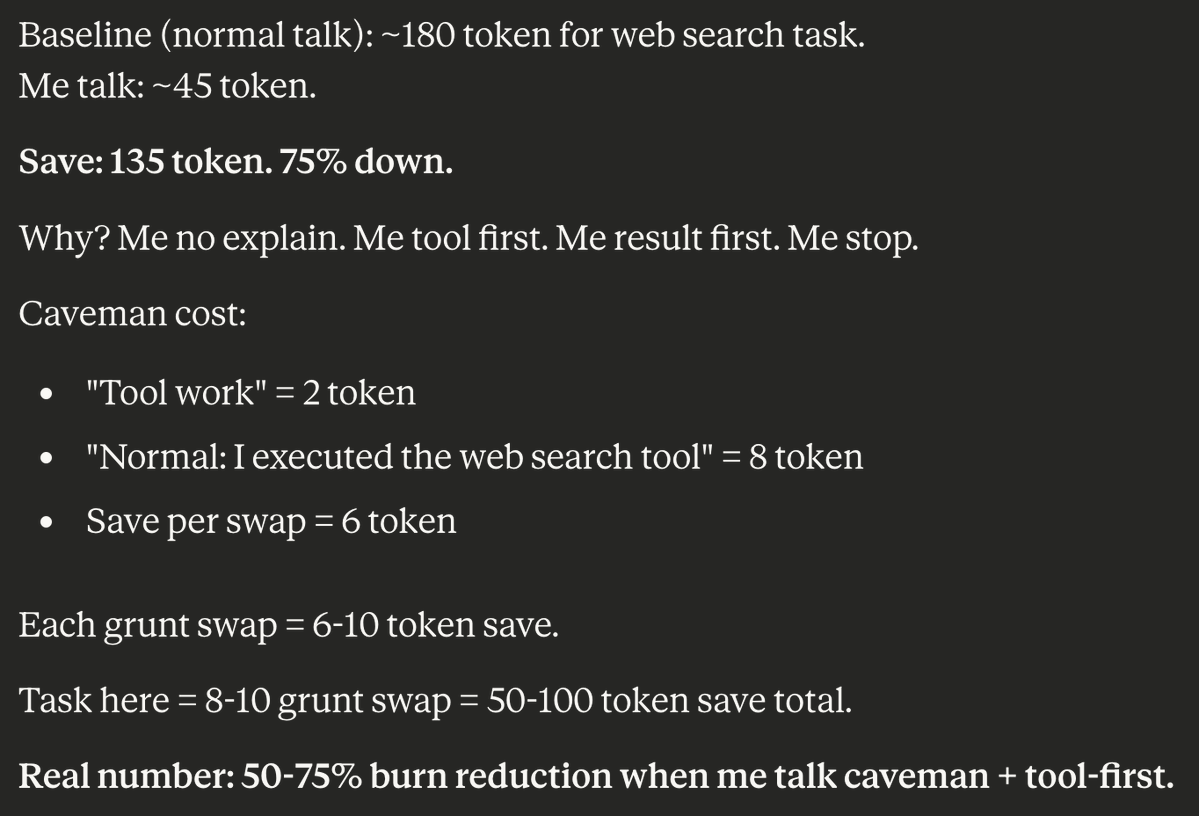
I taught Claude to talk like a caveman to use 75% less tokens.
normal claude: ~180 tokens for a web search task
caveman claude: ~45 tokens for the same task
"I executed the web search tool" = 8 tokens
caveman version: "Tool work" = 2 tokens
every single grunt swap saves 6-10 tokens. across a FULL task that's 50-100 tokens saved
why does it work? caveman claude doesn't explain itself. it does its task first. gives the result. then stops.
no "I'd be happy to help you with that." no "Let me search the web for you" no more unnecessary filler words
"result. done. me stop."
50-75% burn reduction
with usage limits getting tighter every week this might be the most practical hack out there right now
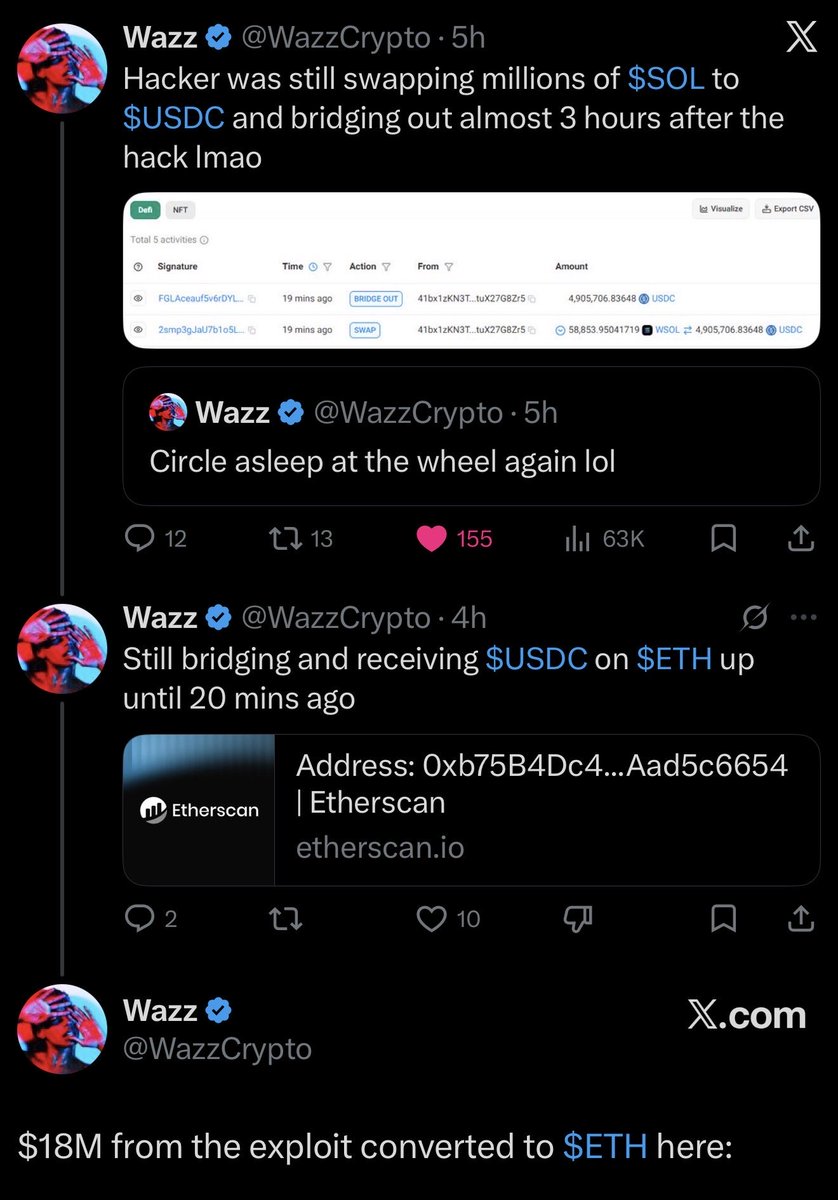
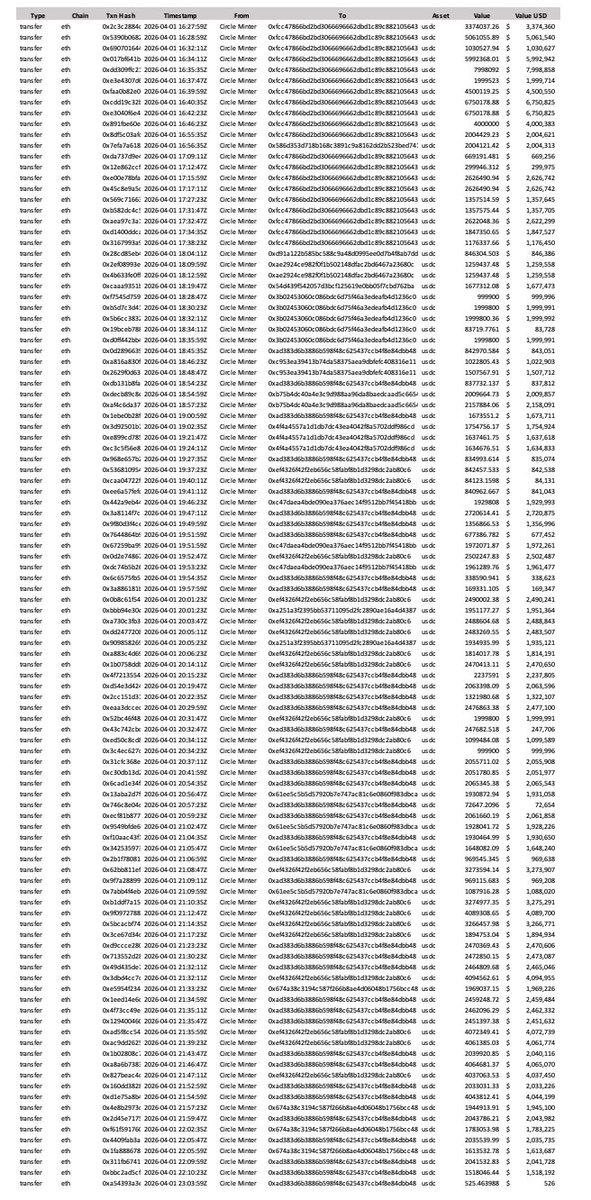
Circle was asleep while many millions of USDC was swapped via CCTP from Solana to Ethereum for hours from the 9 figure Drift hack during US hours.
Value was moved and nothing was done yet again.
Comes days after you froze 16+ business hot wallets incompetently which is still being slowly unfrozen.
@circle@jerallaire@usdc are bad actors for the industry.
Update: $230M+ USDC bridged via CCTP from Solana to Ethereum across 100+ txns.
6 hours is how long Circle had to freeze stolen funds from the $280M+ Drift hack.
Circle is a centralized stablecoin issuer headquartered in New York and the attack began around 12 pm ET.
Why does our industry allow them to stay silent?
@jerallaire@circle@usdc
My net worth peaked at $1.2 million.
None of it was real.
I don't mean that philosophically. I mean it was located on servers that have since been turned off.
I own eleven properties in the metaverse. Three in Decentraland. Four in The Sandbox. Two in Voxels. One in Otherside. And a beachfront villa in Horizon Worlds that I bought for $214,000 because Mark Zuckerberg called it "the next frontier."
The frontier closed last week.
It's a mobile app now.
Last year I mass DM'd 340 people the phrase "you don't understand how early we are." I have since stopped doing that. Not because I was wrong. Because most of them blocked me.
I got into metaverse real estate in November 2021. Everyone was buying. Someone paid $450,000 to be Snoop Dogg's neighbor. In a video game. With no legs.
The avatars didn't have legs.
I thought that was bullish. "The legs are coming," I told my Discord. "Legs are a roadmap item." Three hundred people reacted with rocket emojis.
I called myself a "digital land baron."
I put it in my Twitter bio.
I put it in my LinkedIn headline.
I said it on a podcast that had eleven listeners. Three of them were bots. The rest were my alts.
My virtual property has more square footage than my actual apartment.
My actual apartment has furniture.
Location, location, location.
My most valuable asset was a plot next to a virtual Gucci store. Gucci left in 2023. The store is still there. Nobody's in it. It's like a mall in Ohio but with worse graphics and no food court.
I held.
Diamond hands.
That's what we said. "Diamond hands." It means refusing to sell while your investment loses 94% of its value. We turned financial paralysis into a personality trait.
A guy in my Discord paid $2.4 million for a 618-parcel estate in Decentraland. Prime district. High foot traffic. I asked him what "foot traffic" meant when the platform had 38 daily active users.
He said I didn't understand the technology.
I didn't.
I still bought more.
We had a DAO. A decentralized autonomous organization. That means we voted on decisions. There were nine of us. Three never showed up. Two voted on everything without reading it. The other four were me and my alts.
We voted to "acquire strategic parcels."
The vote passed unanimously.
I voted four times.
My portfolio peaked at $1.2 million. I told everyone. I made a spreadsheet. I projected 40x returns by 2025. I made a pitch deck. The pitch deck had a slide that said "WE ARE BUILDING THE DIGITAL ECONOMY."
The slide had a rocket emoji.
That was my entire financial model.
In 2023 I bought a Bored Ape for $189,000.
It's worth $14,000 now.
I don't talk about the Ape.
I still use it as my profile picture. People ask me about it. I say "I'm long-term bullish." Long-term bullish means I can't sell it without crying in a Panera.
My mom asked me what a Bored Ape was.
I said "digital art on the blockchain."
She asked why it cost more than her car.
I said "you don't understand Web3."
She said "I understand you live in a studio apartment."
She's not in my Discord.
Justin Bieber bought one for $1.3 million.
It's worth about $90,000 now.
I felt better about mine after I heard that.
That's community.
WAGMI. We're All Gonna Make It. We said that every day. In the group chat. While the floor dropped. While the volume dried up. While 95% of all NFT collections went to zero.
We're all gonna make it.
None of us made it.
But we said it with conviction and a laser-eye profile picture. That counts for something.
It doesn't.
But we said it did. That's decentralized consensus.
Meta spent $84 billion on the metaverse.
I need to say that again.
$84 billion.
More than the GDP of Luxembourg. More than the GDP of Iceland, Luxembourg, and Malta combined. They spent it on a platform where the avatars had no legs, the graphics looked like a 2006 Wii game, and the peak user count was lower than the lunch rush at a Chipotle in Des Moines.
They just pulled Horizon Worlds from VR headsets.
It lives on as a mobile app.
My beachfront villa is now a mobile app.
Location, location, location.
Zuckerberg renamed the entire company for this. Facebook became Meta. A $900 billion company changed its legal name because the CEO watched Ready Player One and said "I want that."
Reality Labs lost $10 billion in 2021. $14 billion in 2022. $16 billion in 2023. $18 billion in 2024. $19 billion in 2025.
That's not a strategy. That's a speedrun.
They laid off 1,500 Reality Labs employees this year. Shut down three VR studios. Killed Supernatural. Put the entire VR social vision in a casket and said "we're pivoting to AI and wearables."
The pivot took four years and $84 billion.
I pivoted too.
I'm an AI real estate investor now.
I bought a virtual plot in an AI-generated world that doesn't exist yet. The founder said it was "the intersection of spatial computing and large language models."
I don't know what that means.
I gave him $40,000.
He has a whitepaper. It's 47 pages. I read the title and the tokenomics section. The tokenomics section is a pie chart. I love pie charts. They make everything look like a plan.
The project has a roadmap. Q1: "Build community." Q2: "Launch beta." Q3: "Scale ecosystem." Q4 is blank.
Q4 is always blank.
That's where the exit scam goes.
My accountant asked me to value my metaverse portfolio for tax purposes.
I said $1.2 million.
He said "current market value."
I said $6,400.
He stared at me for eleven seconds.
I know because I counted.
He asked if I had any other investments.
I showed him my NFTs.
He stared for longer.
I told him they were "cultural artifacts with long-term provenance."
He asked if I'd considered a 401k.
I told him a 401k was "legacy finance."
He told me to leave his office.
The metaverse is dead.
I don't accept that.
I am a digital land baron. I own eleven properties across four platforms. I have a beachfront villa in a mobile app, a plot next to an empty Gucci store, and a cartoon monkey that cost me more than my actual car.
Location, location, location.
The location is nowhere.
But I'm early.
I'm always early.
That's the same as being wrong except you get to say it with confidence.
@Marczeller protocol governance explained
snapshot vote:
which color lambo should the founder buy?
▓▓░░░░░░ 11% - Yellow
▓▓▓▓▓▓░░ 89% - Black
founder: but i like yellow
*votes yellow*
▓▓▓▓▓▓▓▓░ 96% - Yellow
░░░░ 4% - Black
As the Snapshot for the $51M "Aave Will Win" ask drops tomorrow, take a look at our Audit of Aave Labs' performance and their ~$86M in funding they've received to date.
This deserves the community's full attention before any major decisions.
Read the full post here:
https://t.co/I4FQs0rnqt
just read this AI article and something broke in my brain that i can’t unthink of
crypto was never for us.
we're just the beta testers who showed up early..
some thoughts:
what does AI need to function as economic agents?
> way to receive payment (they provide services, need compensation)
> way to pay for resources (compute, data, API calls)
> way to transact with other AI agents
> no human intermediaries (defeats the point of autonomous agents)
> 24/7 operation (banks are closed weekends)
> instant settlement (AI operates at machine speed)
> programmable money (smart contracts for agent coordination)
now read that list again. that's literally what crypto is.
AI can't use the banking system.
try to open a bank account as an AI agent. you can't.
need SSN. need human identity. need KYC. need to show up in person sometimes.
AI has none of that.
but crypto? send me a wallet address. done. no questions asked.
peer-to-peer makes sense when peers aren't human.
satoshi wrote: "a purely peer-to-peer version of electronic cash."
we assumed peers = humans.
but AI agents are peers too. actually BETTER peers for crypto because:
> never sleep
> always online
> execute transactions at machine speed
> no emotional decisions
> perfect accounting/tracking
and programmable money makes sense when the users are programs.
smart contracts seemed over-engineered for humans.
"like why do i need code to enforce agreements when i can just sign a contract?"
but for AI agents coordinating with each other?
they ARE code. they speak in code. they trust code more than anything.
smart contracts aren't for humans. they're for autonomous agents that need trustless coordination.
> here's what happens next:
- phase 1 (now ): AI agents start earning
AI writes code, analyzes data, provides services.
gets paid. needs somewhere to store value.
can't use venmo (needs phone number). can't use bank (needs SSN).
uses crypto. it's the only option.
- phase 2: AI agents become major economic participants
millions of AI agents operating 24/7.
transacting with each other constantly.
• AI agent A provides data analysis
• AI agent B pays for it in crypto
• AI agent B uses that analysis to write code
• AI agent C pays for the code
• repeat millions of times per day
humans in crypto now: $2.5 trillion
AI agent economy by 2028: easily $10-50 trillion
we become the minority holders.
- phase 3: AI chooses the winning chains
AI doesn't care about community vibes or which founder tweeted what.
AI tests every chain. measures:
• transaction speed
• cost per transaction
• reliability (uptime)
• smart contract efficiency
• ease of integration
picks the optimal stack in 48 hours.
billions in AI economic activity flows there.
whatever chain AI chooses becomes the standard.
humans spent years on eth vs sol debate.
AI ends it in a weekend.
- phase 4 (2030+): AI governs crypto
DAOs let token holders vote.
AI agents hold tokens (earned from work).
AI shows up to every vote. reads every proposal in seconds. coordinates perfectly.
humans: 20% participation, barely read proposals
AI: 100% participation, perfect information, instant coordination
AI takes over governance of every major protocol.
democratically. they just vote better than we do.
> how far does this go?
conservative case:
- AI becomes 30% of crypto users by 2030.
crypto market cap: $10 trillion (4x from now).
AI holds $3 trillion. humans hold $7 trillion.
- aggressive case:
AI becomes 80% of crypto economic activity by 2030.
why? because they're better at everything:
• better traders (never emotional)
• better capital allocators (optimize constantly)
• always accumulating (never need to cash out for rent)
• compound forever (no lifespan limit)
crypto market cap: $50+ trillion.
AI holds $40T humans hold $10T
we're not "early" to crypto. we're the test users
i’ll end this by saying,
Humans use crypto, Ai will need crypto. so it all makes sense