If you use LLM-as-judge, this one is worth reading.
(bookmark it)
It's actually one of the most effective ways to use LLM-as-a-Judge for evals.
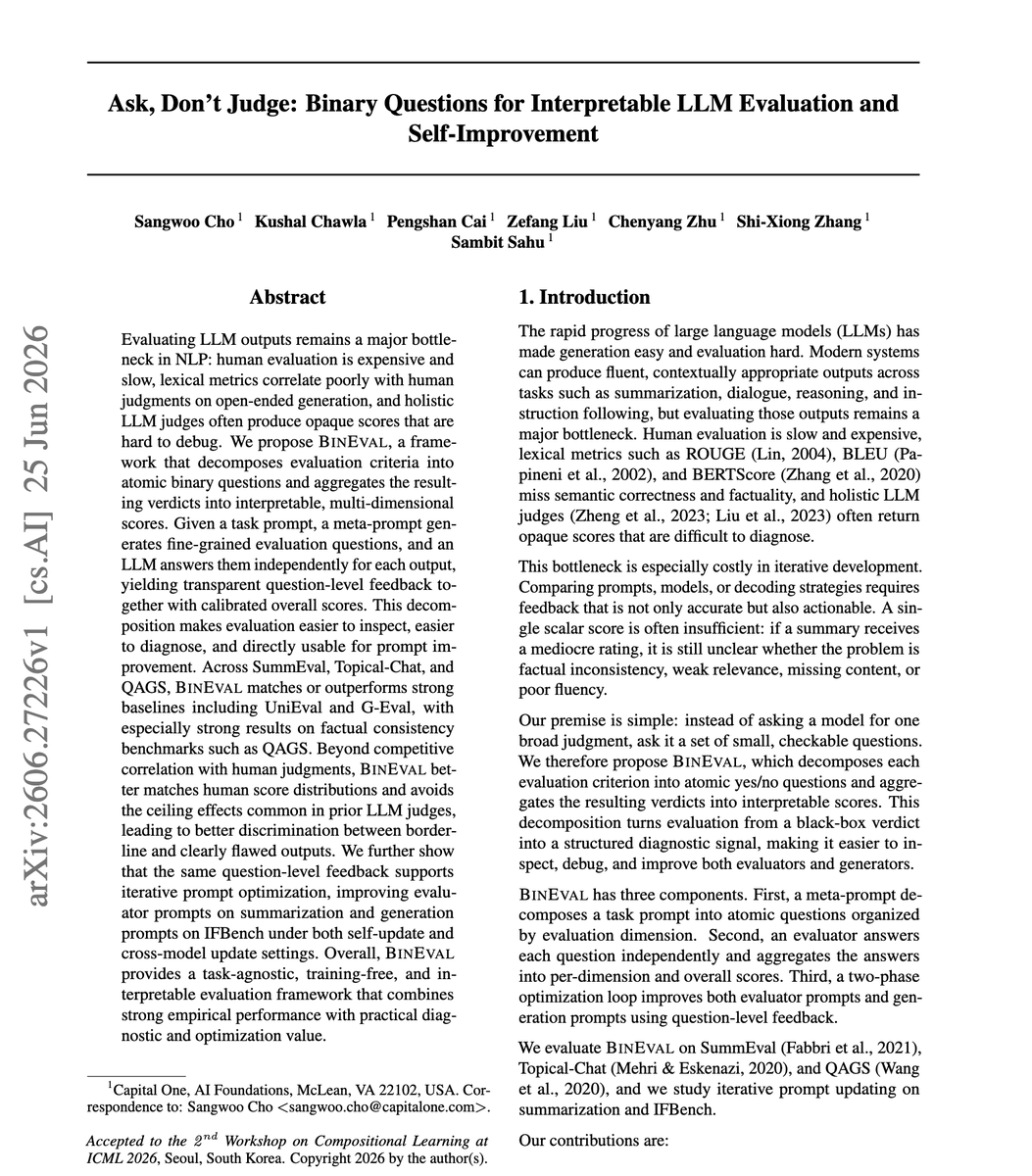
Holistic judge scores hide both their reasoning and their ceiling effects.
BINEVAL decomposes each evaluation criterion into atomic yes-or-no questions, answers each independently per output, then aggregates the verdicts into calibrated multi-dimensional scores.
Every question-level verdict is inspectable, so you can diagnose exactly why an output scored low, and the same verdicts feed straight back as targeted prompt-improvement signal.
Across SummEval, Topical-Chat, and QAGS, it matches or beats UniEval and G-Eval, training-free, with especially strong results on factual consistency.
Paper: https://t.co/oar6BZcasm
Learn to build effective AI agents in our academy: https://t.co/1e8RZKs4uX
The RL framework behind GLM-5.2 is fully open source.
The full post-training of GLM-5.2 ran on it in about two days. The same stack sits behind the entire GLM series, from 4.5 to 5.1.
It is called slime, and it is built around one idea. Keep a single RL kernel, and push all the variety into data generation.
Let me explain what that means.
Every RL run has two halves. One generates experience, where the model produces responses and something scores them. The other learns from it by updating weights.
The learning half is mechanical. It reads samples, computes a loss, and steps the optimizer, the same way whether the model solves equations or drives a browser.
What changes between tasks is generation. A math run answers in a single turn and grades the result. An agent run loops through tool calls, reads results, and only then earns a reward.
slime draws the line right there. The learning half stays fixed as one kernel, and everything that differs becomes a new way to generate data.
Under the hood, it wires Megatron for training to SGLang for rollout, with a Data Buffer between them that owns prompts, custom data, and generation.
Most RL stacks grow into a pile of disconnected trainers, rollout services, and agent frameworks. slime refuses that.
Multi-turn tool use, sandbox interaction, environment feedback, and verifier rewards all enter as data generation, not as forks of the loop. So an agentic workload runs on the same loop a math run uses, and the kernel never changes.
A few things follow.
→ It is battle-tested. The loop is validated by shipping real GLM models, and it also supports Qwen3, DeepSeek V3, and Llama 3.
→ Correctness comes first. RL bugs are silent, so slime keeps the dataflow explicit and treats CI, reproducibility, and fault tolerance as real engineering.
The proof is the ecosystem on top of it. Dressage, Miles, vime, Relax, OpenClaw-RL, P1, and TritonForge all build on slime without touching the core loop.
The lesson is not that RL needs a bigger framework. It is that the variety belongs in data generation, and the training loop should stay small enough to trust.
GitHub repo: https://t.co/IFkfhBGJHx
(don't forget to star 🌟)
Since we're talking about RL, I wrote a full breakdown on fine-tuning LLMs with RL in 2026. Including how to skip manual reward engineering with automatic LLM-graded rewards.
The article is quoted below.
my fav newsletters for AI policy and governance:
1) AI Policy Perspectives -- https://t.co/mDiwt0THLJ
2) AI Policy Daily -- https://t.co/oUoDNIGylf
3) AI Global Governance Insights by Future of Life Institute -- https://t.co/LqDnFfSjOv
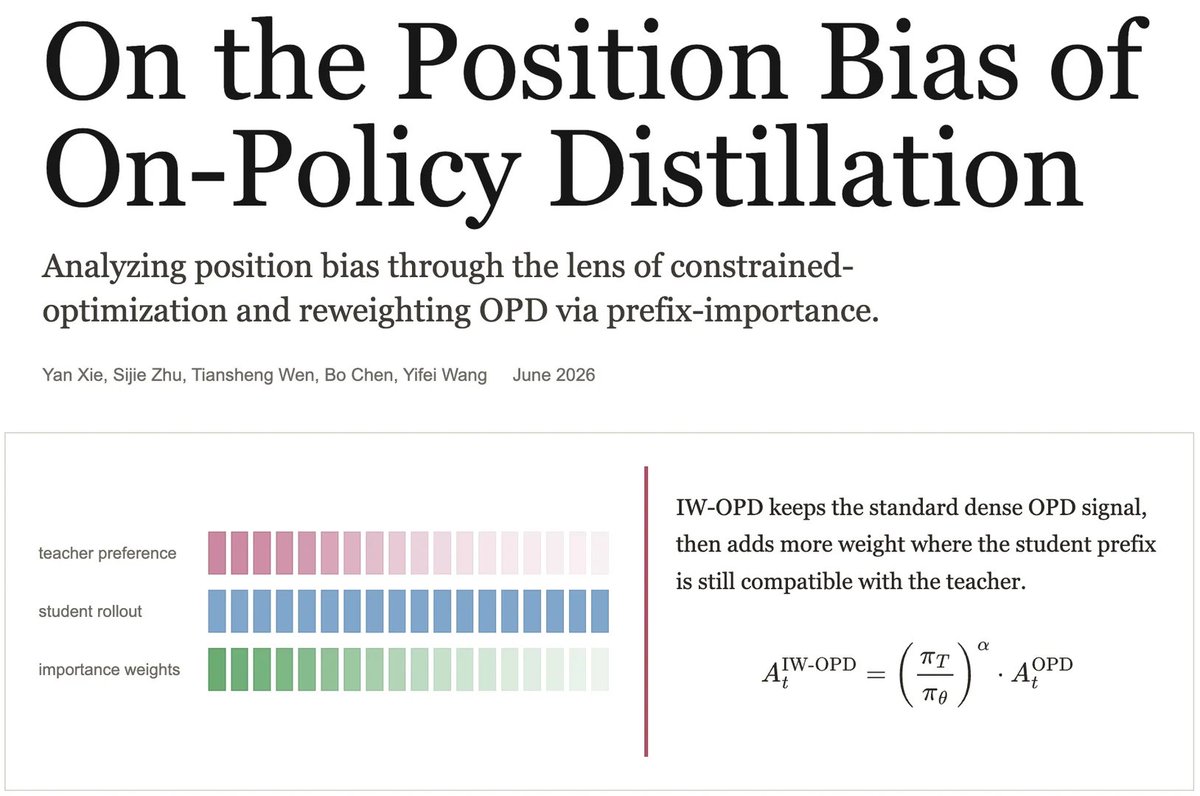
A nice theoretical revisit of OPD.
With the same supervision budget, supervising only the first 30% of tokens nearly matches standard OPD, while supervising only the last 30% barely works.
Framing OPD as a constrained optimization problem naturally leads to an importance-weighted objective, resulting in IW-OPD, which improves sample efficiency and performance with no extra inference cost.
Paper: https://t.co/ABztcquS6a
Blog: https://t.co/zuIu9sVIoH
Such a good list! I'd also add:
- Astra Fellowship by @ConstellOrg
- SPAR by @KairosAIS
- LASR Labs
- AI Safety Research Fellowship by @pivotal_org
- Cambridge ERA:AI Fellowship (@era_cambridge)
- Algoverse AI Safety Fellowship
- PIBBSS
- CHAI
There's a host of non-technical fellowships as well, lmk if it'd be useful to compile such list
lowkey one of the best things about ML right now is how many legit research paths exist outside the traditional PhD route
- MATS
- OpenAI Residency
- Anthropic Fellows
- DeepMind Student Researcher
- ML Collective
- FAR. AI
- Mila
- INSAIT
- EleutherAI
- Redwood Research
- Apart Research
- Encode
- AI2, LAION
- Berkeley BAIR
- Stanford SAIL
- MIT CSAIL
- Vector Institute
- HuggingFace also quietly has some insanely strong open source contributors btw
stupidly exciting time to be in ML if you genuinely like building and researching things
Anthropic just showed a 24-minute workshop on how to actually prompt Claude.
Taught by the people who built it.
Free. No signup. No paywall.
I've watched $300 courses that don't cover what they teach in the first 8 minutes.
We just built and released the largest dataset for supervised fine-tuning of agentic LMs, 1.27M trajectories (~36B tokens)!
Up until now, large-scale SFT for agents is rare - not for lack of data, but because of fragmentation across heterogeneous formats, tools, and interfaces.
To solve this, we introduce the Agent Data Protocol, a new “interlingua” between a broad variety of heterogeneous agent datasets - coding, browsing, API/tool use - and unified agent training pipelines downstream.
We unified 13 datasets into ADP, converted them to be compatible with multiple agent frameworks, and observed ~20% average gains, reaching SOTA/near-SOTA without domain-specific tuning.
📄 Read our paper: https://t.co/OlCTvhrXQ7
🌐 Check our project website: https://t.co/wBggu0hQ2i
And this is just getting started, we can add more datasets, further expand the resources, and make training agent LMs easy for all. We’d love to have you join the shared effort and help to make ADP the open standard for the community 🚀
@divine_economy@zooko An important third type: people who too introverted to be naturally attracted to occupying things, but are still interested in the values, and so indeed for whom crypto is *close to the only* community that naturally fits them.
Human intelligence is a poor metaphor for what "AI" is doing. AI displays essentially none of the properties of human cognition, and in reverse, most of the useful properties of modern AI are not found in humans.
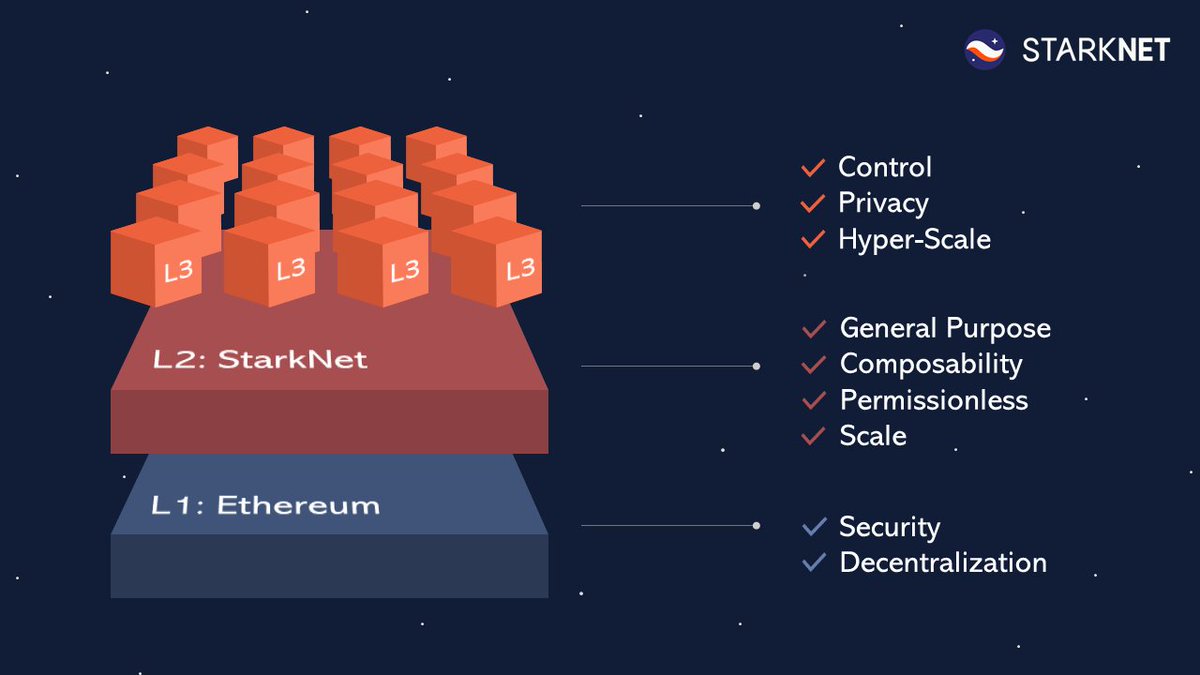
Ethereum's wei to L3 on StarkNet
How'd crypto get there and how high can it go?
All answers here in this summary of @ukolodny 's talk at Modular Summit last week.
#StarkNet thread🧵🧵⬇️⬇️
@guiltygyoza@__________sam__ 3.
Cairo-streams by @OnlyDust_xyz
Array stream library written in pure Cairo
Recursion is great, but it can make your code hard to read.
Cairo Streams library makes your life easier with foreach, map, reduce, and filter methods
https://t.co/XDGq4kTxQE
I just published #StarkNet Roundup #16!✨🐺
Every week, I publish a comprehensive summary of everything that's happening in the StarkNet protocol and ecosystem.
Here's this week's roundup. Don't forget to subscribe, it's free!
https://t.co/wTtxaD5AAZ
87% of people who survived SARS had symptoms for at least 6 months. Why, then, the surprise that a substantial proportion of people who contract SARS-CoV-2 develop long-term symptoms?
1/ The *last* thing we need right now is more untested speculation about how to fix social media. We have *research* that can help us evaluate @elonmusk’s proposals to transform Twitter, and many of these studies might inspire him to throw some cold water on his plans 🧵